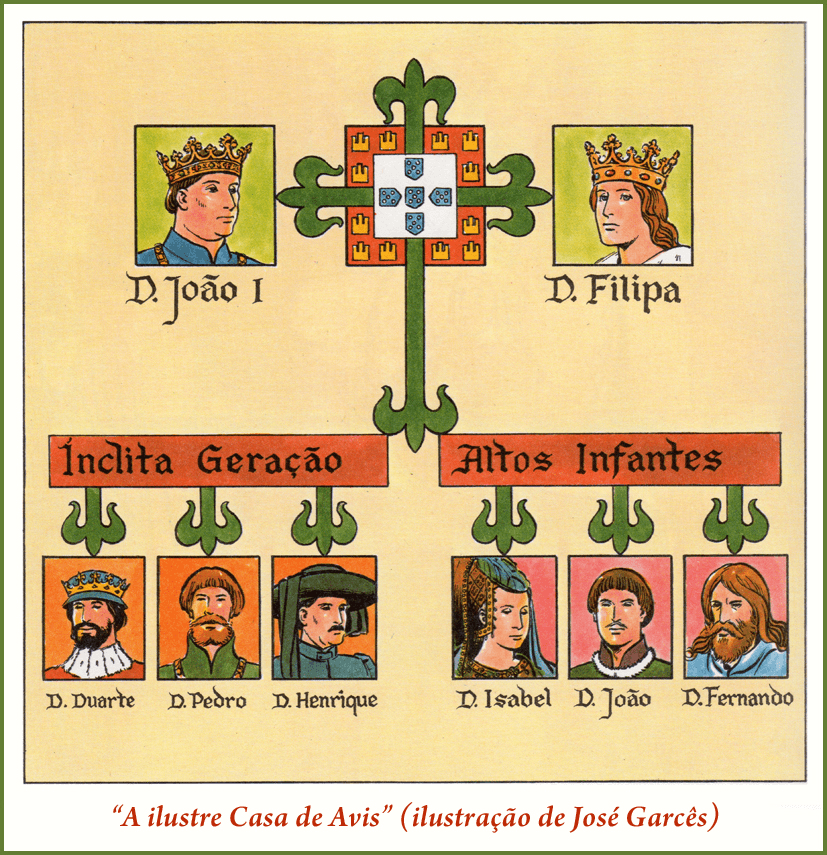
Ínclita Geração, the "Illustrious Generation."
Preface: Welcome to this quick recap of the history of immigration of US. Celebrating 250 years of USA.
Between 1415 and the 1480s, Portugal worked its way down the western coast of Africa, from the Strait of Gibraltar toward the southern tip of the continent, one voyage at a time. The effort is usually called the Age of Discovery. The man who set it going was Prince Henry, born in 1394, the third of King João I’s five sons — the generation later Portuguese writers would call the Ínclita Geração, the “Illustrious Generation.”
1394/ Prince Henry
Prince Henry was born on 4 March 1394 in Porto, the third of the surviving sons of King João I — founder of the House of Aviz — and Philippa of Lancaster, daughter of John of Gaunt and sister of Henry IV of England. His mother’s marriage was a political one, sealing the Anglo-Portuguese alliance against Castile, and it mattered to who Henry became: the English, devout, chivalric strain in his upbringing came largely from her. He and his elder brothers Duarte and Pedro — the trio at the center of what Portuguese writers later called the Ínclita Geração, the “Illustrious Generation” — were educated under their parents in the standard noble curriculum of the age: military arts, administration, and the chivalric codes, steeped in crusading ideals. Philippa bore nine; three died young. The six who survived turned out to be an unusually capable, cultivated cluster of siblings, and their devout, rigorous, English-inflected upbringing under Philippa got much of the credit — she died of plague in July 1415, days before the sons she’d raised sailed for Ceuta. The reputation is real, but so is the darkness underneath it, which the flattering label tends to hide.
The six, in birth order. Duarte (b. 1391), the eldest, became King Duarte I in 1433 — “the Philosopher King,” who actually wrote books (a treatise on ethics and counsel, O Leal Conselheiro, and one on horsemanship); his short reign was wrecked by the Tangier disaster and he died of plague in 1438, worn down, some said, by guilt over his captive brother. England, Flanders, the Empire, Hungary, Italy, and the Holy Land — and the most learned of them; he served as an able regent for his boy-nephew Afonso V through the 1440s. Pedro (b. 1392), Duke of Coimbra, was the great traveler of the age — nicknamed “das Sete Partidas,” of the seven parts of the world, for his journeys across Philip the Good in 1430; the Order of the Golden Fleece was founded around their wedding, and she grew into a formidable political operator and mother of Manuel I of Portugal and of Isabella the Catholic of Fez prison in 1443. Pedro, the traveled and learned regent, fell out with the nephew he had governed for and was killed in 1449 at the Battle of Alfarrobeira, cut down by a royal army in what was effectively a family civil war. So the glittering set of siblings produced a martyr left to rot and a regent killed by the crown, within a decade of each other.Castile. Charles the Bold. Henrique (b. 1394) you know, this is the Prince Henry we’ve been discussing. Isabel (b. 1397), the only surviving daughter, was raised in the same curriculum as her brothers — Latin, languages, science, statecraft — and became Duchess of Burgundy by marrying João (b. 1400), Constable of Portugal, was the quietest — a man who by one account disliked fighting — but dynastically enormous in hindsight: through his children he became grandfather both of Fernando (b. 1402), the youngest, is remembered as the Infante Santo, the Saint Prince. Left behind as a hostage after Henry’s botched 1437 assault on Tangier, to be redeemed only if Portugal returned Ceuta, he was abandoned when the crown — Henry among the voices — refused to give the city up, and he died after six years in a
Camões, who coined the celebratory phrase and wrote the national epic of the discoveries, did not actually make Henry its hero — he praised the generation as a whole and gave the sea-story to others. The centering of Henry as theSalazar-era afterlife. There’s even a decent revisionist case that his father João I and his brother Pedro were more genuinely curious about southward exploration than Henry was, whose own energies bent toward North African crusade, the Canaries, and the gold-and-slave profit. Britannica’s summary of what he grew into is telling: he emerged with pronounced tastes for chivalric romance and astrological literature, and with ambitions to fight campaigns and, if he could, win a kingdom of his own. His chroniclers made much of a birth horoscope that supposedly foretold he would be a crusader and a discoverer of hidden things. Beyond that the documented childhood is thin; he steps into real history at twenty-one, at Ceuta. figure of the discoveries came later, with the nineteenth-century “Navigator” myth and its
1415/ Ceuta
Ceuta was Portugal’s first overseas conquest, and for Henry it was the making of him. The campaign fit the young man exactly: a third son with no crown coming to him, a hunger to prove himself in arms, and the crusading cast of mind he’d taken from his English mother. When a recent peace with Castile left the king’s grown sons no war in which to earn their knighthoods, the three princes persuaded their still-vigorous father to undertake a campaign that would let them win their spurs in real combat instead of in the mock warfare of a tournament — and the target they chose, a Muslim port on the Moroccan side of the strait, made the venture a crusade as well as a proving ground. An army of some 240 ships and forty-five thousand men sailed in the summer of 1415 — days after Henry’s mother, Queen Philippa, died of the plague — and took the unprepared city in a single day’s fighting.
The target had been hidden behind rumors of other destinations, but weather scattered the fleet off the Moroccan coast and forced it to regroup, and the delay helped Portugal: Ceuta’s governor, Salah ben Salah, had gathered tribesmen and volunteers to hold the city — the Portuguese would later boast, absurdly, that a hundred thousand men had reinforced it — but when the ships seemed to falter and drift off, the defenders relaxed. No relief came from the Marinid sultan at Fez, whose dynasty was too tangled in its own quarrels to send any. By the time the Portuguese struck, the city was far less ready than it had been days earlier.
The assault opened on the morning of 21 August 1415. As King João boarded a longboat to go ashore he took a wound in the leg, and the landing fell to his sons, who drove the defenders back through the Almedina gate before it could be barred and carried the fight into the narrow streets — where, in the episode the chroniclers loved, a single giant Nubian fighter held off the attackers with hurled stones until he was cut down and the resistance behind him folded. Salah ben Salah held the citadel until dusk, then slipped out of the city in the dark with his men and their families; by the next morning the Portuguese found the fortress empty and Ceuta wholly in their hands. The chroniclers put their own dead at eight — a number meant to announce a miracle rather than to count the fallen — against thousands of the city’s defenders killed or captured. In substance it had been the work of a day.
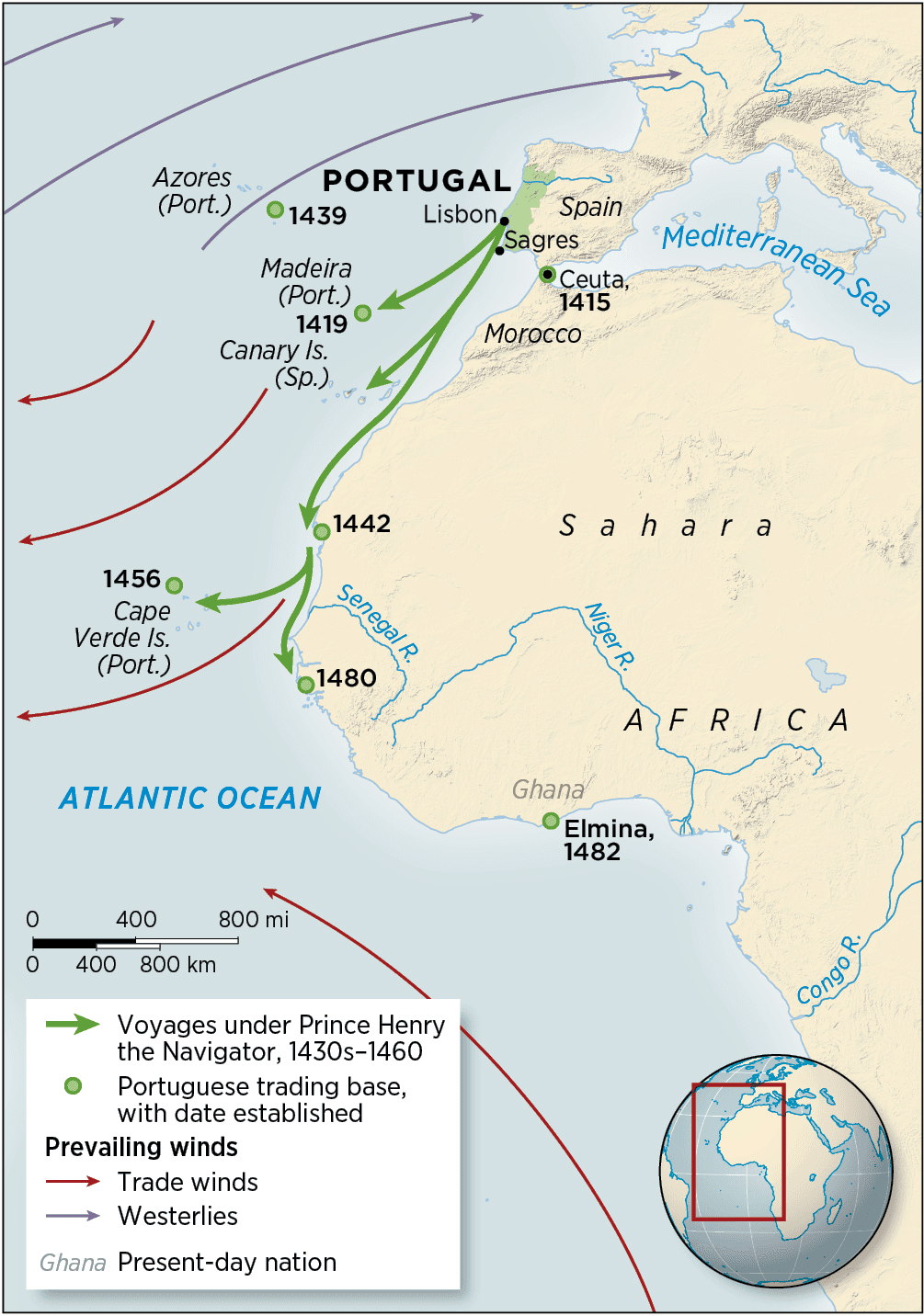
Ceuta was a rich entrepôt, its warehouses packed with the goods of the Saharan and Mediterranean trades, and the soldiers tore through them with little sense of what they were ruining — slashing open sacks of pepper and cinnamon and grinding a fortune in spice into the street underfoot. The plunder disappointed in the end; there was less ready wealth in it than the crown had hoped. The main mosque was consecrated as a church, a Te Deum sung inside it, and there the three princes were knighted. What Portugal had seized was less a treasure than a position — and, in those ransacked warehouses, a glimpse of how much wealth moved along this coast, and of where it came from.
1419/ Madeira
In 1418, two squires of Henry’s household, João Gonçalves Zarco and Tristão Vaz Teixeira, were sailing the Moroccan coast when a storm blew them out into the open Atlantic and onto a small island they named Porto Santo, “holy port,” in thanks for the shelter. The larger island beyond it, wrapped in cloud, they reached the following year: Madeira, “the wooded isle,” uninhabited and thick with timber. It was the first territorial gain of the whole enterprise, and it set the pattern for how Henry would handle everything he found. He did not govern it himself. As lord of the islands — a lordship he vested in his Order of Christ — he parceled Madeira out to hereditary captains drawn from his own household, Zarco and Vaz Teixeira among them, each granted a stretch of the island, the right to distribute land to settlers who had to clear and plant it, and a share of what it produced, in exchange for populating and defending it at his own cost.
What the settlers produced turned the accident into something consequential. They burned off the forest to open the ground — later accounts claimed the fires on Madeira smouldered for years — and planted first wheat and then the crop that would matter, sugar cane, which took to the volcanic soil so well that within a few decades Madeira was one of Europe’s leading producers of what had been a rare luxury.
Sugar at scale needed labor no free workforce would supply, and the island filled it with enslaved people — Guanches seized from the Canaries, Berbers from the Barbary coast, and, before long, Africans bought down the coast the caravels were opening. The whole arrangement — a hereditary captain developing colonial land at his own risk, a cash crop worked by slaves, the profits split with the crown — was worked out here, on a small Atlantic island, a generation before it crossed the ocean. Madeira was the model. Everything Portugal did later in Cape Verde, in São Tomé, and finally in Brazil was a version of it.
Several major traditions locate capitalism’s origin right about here. Immanuel Wallerstein’s world-systems theory dates the “modern world-system” to the long sixteenth century and puts the Iberian Atlantic — cash-crop islands and colonies producing for a European core — at its founding edge; on that map Madeira is nearly the first pixel. Sidney Mintz, in Sweetness and Power, argued the sugar plantation was essentially proto-industrial: a factory in the field, combining agriculture with the milling process, disciplining labor to something like a clock, producing a single commodity not for use but for sale to a distant mass market. Marx, in the section of Capital on “primitive accumulation,” treated colonization, the slave trade, and the plunder of the Atlantic and the Indies as the violent prehistory that made industrial capital possible — the “rosy dawn,” in his phrase. And the current New History of Capitalism (Sven Beckert’s “war capitalism,” building on Eric Williams’s older thesis that slave profits financed British industrialization) insists slavery wasn’t a pre-capitalist leftover but the engine room of capitalism’s first phase. On all of these readings, what they described on Madeira — land and labor reorganized purely to produce a commodity for profit, financed by merchant capital (Genoese money and Genoese sugar expertise flowed into Madeira, carrying the trade straight out of the medieval Mediterranean) — is capitalism being born.
However, for a large body of thought, capitalism means free wage labor — workers who own nothing but sell their labor-power on a market — and a slave plantation is precisely not that. It runs on coercion, not a labor market. The “political Marxists” (Robert Brenner, Ellen Meiksins Wood) go further and argue capitalism proper wasn’t born of trade or plantations at all but of specific social-property relations in the English countryside (I disagree), where landholders and tenants became market-dependent and competition compelled improvement; on that account, merchant wealth and slave sugar, however vast and profitable, are a different system — commercial, extractive, but not capitalist. Madeira — and then, at larger scale and with fully African enslaved labor, São Tomé — is where the Atlantic plantation complex was assembled, the direct ancestor of Brazil and the Caribbean, and the hinge between medieval Mediterranean sugar-slavery (Cyprus, Sicily, the Crusader Levant) and the American system. Historians like Charles Verlinden and Philip Curtin built careers on that lineage. Whether you then call that the “beginning of capitalism,” or “merchant capitalism,” or “primitive accumulation,” or just “the plantation complex,” tells you which theory of capitalism you hold more than it tells you a new fact about Madeira.
1427/ Azores
The Azores followed the same logic, further out and to a different end. They lie roughly 1,400 kilometers into the open Atlantic — a third of the way to America — and Portuguese knowledge of them emerged in the late 1420s and early 1430s. A pilot named Diogo de Silves, of whom almost nothing is known, may have reached part of the archipelago around 1427; his name survives as a note on a chart. Better-documented Portuguese voyages followed in the early 1430s. Ships reached the islands by riding the great westward arc of open ocean that the volta do mar traced — the Azores sit close to the point a homebound ship swings through on its long loop back to Portugal, which is to say they were less discovered than passed through. Like Madeira, they were uninhabited when the Portuguese arrived, and Henry settled them the same way: vested in the Order of Christ, parceled to hereditary captains, the first of them Gonçalo Velho Cabral, and seeded from the mainland with colonists, livestock, wheat, and woad from about 1439.
Sitting in the mid-Atlantic astride the return route, they became the indispensable waystation of the ocean — the place ships stopped to take on water and repairs on the way home, and later the hinge of a much larger traffic than Henry’s. Columbus put in there on his way back from the first American voyage; the treasure fleets from the Indies and Brazil would call there for generations. Two small clusters of empty islands, found by accident and settled almost as an afterthought, turned out to be the fixed points that made the whole Atlantic navigable. And the technique that reached them — sailing away from land into open water to come home — was the same one that, in 1434, would finally carry a ship past the barrier to the south.
1434/ Cape Bojador
By the mid-1420s, settled on the Algarve with the Order’s money behind him, Henry began sending ships south — and for the better part of a decade they accomplished almost nothing. The obstacle was a low, sandy headland on the Saharan coast, Cape Bojador, about a hundred miles below the Canaries, that fifteenth-century sailors treated as the end of the navigable world — the “Cape of Fear.” Arab geographers had warned of it; European crews called the water beyond it the Green Sea of Darkness and told one another that past the cape the sun boiled the sea and scorched men black. The dread was not pure invention. The cape threw up real hazards — shallows that ran a league out from shore, heavy surf and currents along its northern side, frequent fog — and, worse, a genuine trap in the wind: the prevailing northeasterlies and the southward current made it easy to run past the cape and very hard to beat back north again. A ship that rounded Bojador might not get home. So Henry’s captains kept reaching it and turning around. By one reckoning, some fifteen voyages failed at the cape across a dozen years.
The man who finally passed it was Gil Eanes, a squire from Lagos in Henry’s household — and he failed first. Sent out in 1433, he got no farther than the Canaries and came home with excuses about the dangers, to a cold reception. Henry sent him straight back the next year with orders to ignore the sailors’ legends and not to return without rounding the cape, promising him the “honour and profit” that would come of it. This time Eanes did the thing that actually worked, and that would define Portuguese sailing for the rest of the century: rather than hugging the dreaded shore, he stood well out into the open Atlantic, swung south, and came back to land below the cape. Beyond it he found no boiling sea and no monsters — only a calm ocean and an empty desert coast. There were no people to be seen, so for proof that he had been there he gathered a few hardy wildflowers the Portuguese came to call St. Mary’s roses, and carried them home.
Measured as geography, it was almost nothing — a competent piece of seamanship that added a short stretch of barren coastline to the map. Measured as a barrier broken in the mind, it was the whole beginning. Once a single ship had gone past Bojador and come back, the terror drained out of the place and the turning-back stopped.
1435–36/ beyond Bojador to the Rio de Ouro
Passing Bojador only opened the next stretch of nothing. The coast below Bojador was barren in a way that unsettled sailors on its own. The Sahara simply runs into the Atlantic there — a low, flat, dun-colored shore with no hills to steer by, no trees, no green, the same bare line of sand and rock unspooling mile after mile under a hazed sky, the sea shallow and breaking white a long way out. Two small ships worked south along it, Eanes’s and Baldaia’s, days of that sameness sliding past the rail. When they put in at a bay and waded ashore, what they found in the sand were footprints — men’s, and the splayed pads of camels — fresh enough to say that people were near, though the people themselves had gone into the desert and were nowhere in sight. They stood on a shore that was inhabited and blank at once, named the inlet, and sailed on.
In 1435 Henry sent Eanes out again, now with a second ship — a barinel under Afonso Gonçalves Baldaia, the prince’s own cupbearer — and orders to see what lay beyond. They pushed about 150 miles past the cape and named the inlet Angra dos Ruivos.
The next year Baldaia came back carrying two horses in the hold for the single purpose of running a man down, and put them ashore on that sand; his people sighted figures in the distance, gave chase, closed to a brief clumsy scuffle, and caught no one. Farther south the coast opened into a long tongue of seawater reaching back among the dunes, and because Saharan traders had spoken of a great river of gold somewhere below the desert, they decided this must be it and wrote Rio do Ouro onto the chart — the River of Gold — over what was in fact a dead-end arm of the sea, no river running into it and no gold within reach of it. What the shore did hold was seals: monk seals hauled out to bask on the rocks, slow and unafraid, and the men clubbed and skinned them until the hold was full. That was what the first opened stretch of Africa gave up — not gold, not spices, a stack of oily hides — and the ships turned and rode the long ocean loop home with it. The map now reached south into a blank they had barely entered. What waited down there, when they came back for it, was not gold and not empty sand. It was people.
1441 / Cape Blanc, and the first captives
Henry sent two ships south. One, an armed caravel under Nuno Tristão, a seasoned knight of his household, was to explore past Baldaia’s furthest mark toward the white-sanded cape the Portuguese would call Cabo Branco. The other, a small vessel under a young household squire named Antão Gonçalves, had a menial errand — to hunt the monk seals that basked at Rio de Ouro and fill the hold with their skins. Gonçalves did that, and then, on his own initiative, to bring the prince something better than seal hide, he took nine of his men ashore in the night and seized two of the local Sanhaja Berbers, a man and a woman. When Tristão’s caravel reached the same coast, he had aboard an Arabic-speaking servant of Henry’s who could question the captives; what they gave up led the two crews to a nearby fishing camp, which they raided together and carried off about ten more, among them a man of rank named Adahu — roughly a dozen people in all. Gonçalves turned for home with them at once while Tristão sailed on to the cape. These captives were among the first West Africans taken to Portugal in the developing Portuguese maritime trade in enslaved people.
What Henry did with the news his own chronicler records, unusually plainly. Zurara wrote that the prince’s satisfaction lay not in the dozen captives already taken but in the prospect of the countless captives still to come — the commercial arithmetic set down without embarrassment. Over it went the justification that would cover the enterprise for a century: these were souls being brought to Christianity, and whatever a captive suffered here weighed as nothing against salvation. The men who took them reasoned the same way. Gonçalves proposed, and Henry approved, that the captives be carried back and exchanged — partly to learn more about the country from whoever was traded for them, partly, Zurara insists, to save their souls by conversion.
That exchange, in 1442, is the quiet hinge of the whole trade. Gonçalves sailed back with Adahu and another and returned them to their people — and took in return about ten Black Africans, along with a little gold dust, some salt, and a few ostrich eggs. The gold was the first brought back from that coast, proof the Saharan trade was at last within reach, and it fired Henry’s interest as nothing yet had. But the deeper change was in the ten enslaved people. They were not seized; they were handed over — sub-Saharan captives the Berbers already held and were willing to sell.
The European maritime trade in Black Africans that became the transatlantic slave trade — but not the beginning of Black slavery, or even of the large-scale trade in Black Africans, both of which were centuries old by 1442. The word “beginning” is doing a lot of work, and it’s worth separating the layers, because conflating them produces two opposite errors: the myth that Europeans invented Black slavery, and the apologetic move that says Africans were “already doing it” so the Atlantic trade was nothing new.
What was already old by 1441–42. Slavery itself is ancient and nearly universal — it existed across Africa, Europe, the Islamic world, and the Americas long before Portugal. More specifically, the large-scale trade in Black African slaves was already seven-plus centuries old: from the 700s, Arab and Berber caravans had moved enslaved sub-Saharan Africans north across the Sahara, and other routes ran up the Nile and out along the East African coast into the Indian Ocean world. By one common estimate, on the order of six million people had already been trafficked across the desert before a Portuguese ship reached the coast. So the trafficking of Black Africans as a commodity, across long distances, to foreign markets, was not new. What Gonçalves bought in 1442 were people already enslaved inside that existing system.
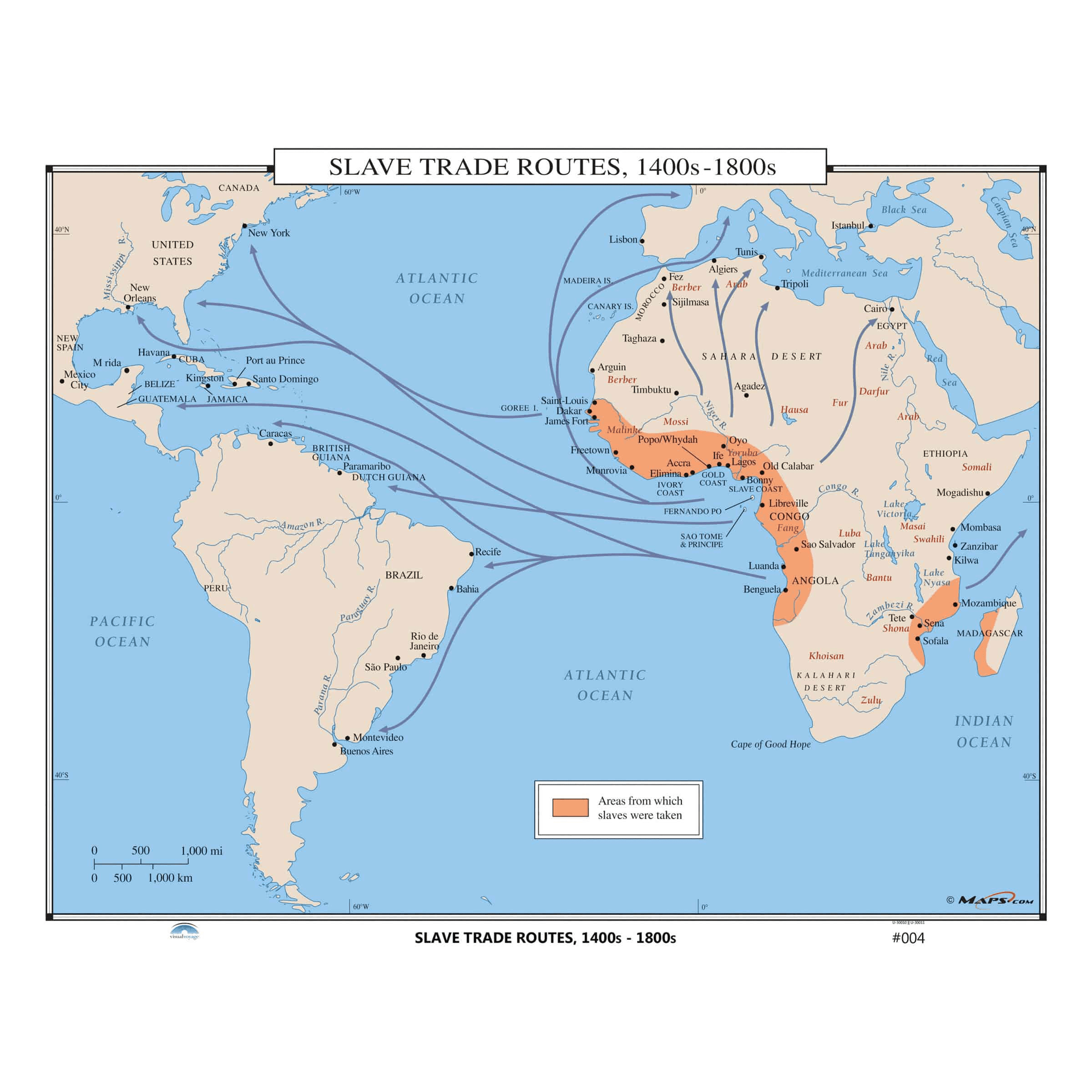
What actually began here. Three things were genuinely new, and they’re what make 1441–42 a real hinge rather than just another transaction: First, it was the start of Europeans buying and shipping Black Africans directly, by sea, out of West Africa — cutting out the trans-Saharan middlemen the Ceuta expedition had first revealed. That maritime, European-run branch is the one that grows into the Atlantic trade. Second, and most consequential, it pointed toward a different kind of slavery. Earlier African and Islamic systems of slavery were diverse and changed across place and time; forms of household incorporation and manumission existed in some settings, but coercion and violence remained central. the enslaved could be absorbed into households, could sometimes marry in or gain freedom within a lifetime, and weren’t defined primarily by race. What the Atlantic trade built instead, first on Madeira and São Tomé and then across the ocean, was chattel slavery: hereditary, permanent, increasingly racialized, and welded to plantation production. That system developed over time rather than appearing fully formed in one place. Third, the scale and direction eventually dwarfed and reorganized everything before it — roughly twelve and a half million people were embarked across the Atlantic between the sixteenth and nineteenth centuries, and European demand did not merely tap existing systems but reshaped and intensified them, driving more war and raiding inside Africa to feed the ships.
So the precise way to say it is that 1441 is usually marked as the beginning of the transatlantic (or European maritime) slave trade in Black Africans, not the beginning of Black slavery, which was far older. Historians who study this are careful about exactly that distinction, because both errors are politically loaded: saying “Europeans started Black slavery” is false, and saying “Africans and Arabs were already doing it” is often deployed to shrink European responsibility for what was, in scale and cruelty and racial logic, a new thing.
1443/ Arguin
In 1443 Nuno Tristão pushed past Cape Blanco into the Bay of Arguin, a shallow gulf strung with low islands off present-day Mauritania, and raided it, falling on people in their canoes and carrying off some fourteen of them. But Arguin was more than another place to seize captives. It lay close to the caravan routes of the western Sahara, within reach of the salt pans and of Ouadane, a trading town of the interior a few hundred kilometers inland; the gold and the slaves that had always moved north across the desert passed near this stretch of coast. What Tristão had found was not just a raiding ground but a door into the trans-Saharan trade — the thing the whole enterprise had been reaching for since Ceuta.
That same year the enterprise became, formally, Henry’s own. In October 1443 his brother Pedro — by then regent for the boy-king Afonso V — granted him a monopoly over all navigation, war, and trade south of Cape Bojador: no ship could pass the cape without Henry’s license, and Henry took a fifth of whatever came back. It was the legal capstone on everything he had been assembling. Exploration was now a chartered business that he owned outright, and the gold dust and captives already trickling home had made it one that others wanted into — merchants began besieging him at Sagres for licenses to sail the Guinea coast. He could sit at the center of the trade, sending his own ships or selling the right to send others, and take his cut of all of it.
Arguin was where that trade first put down a permanent root. Within a couple of years — around 1445 — the Portuguese planted a trading post on the island, the first feitoria they built on the West African coast, and later walled it into a fort. The island itself was small and arid — a league or so across, off the Mauritanian shore, ringed by shoals so treacherous that a ship could approach only in daylight and on a high tide — but it had freshwater seeping up through its sands, rich fishing in the surrounding waters, and, above all, position: it lay within reach of the western Sahara’s caravan routes and a few hundred kilometers from Ouadane, an inland town on the desert trading circuit. In 1445 Henry’s men put up a feitoria there — a trading factory, part warehouse and part lodging for the agents who staffed it — one of the earliest Portuguese trading posts on the West African coast.
The purpose was to pull the Saharan caravan merchants — the Berbers and Arabs who had always carried gold and slaves north across the desert — down to the coast to deal at Arguin instead, exchanging by sea what had always gone overland. Portuguese and North African goods went one way: woolen cloth, linen, silver, horses, wheat, worked brass, trinkets. African commodities came back the other: gold, gum arabic, and enslaved people, along with camels, ostrich eggs, and the island’s own dried fish. It was a standing, bureaucratic operation rather than a raid — a royal monopoly with a resident feitor keeping the books, a crown-appointed captain rotated every few years, each entitled to a fixed cut of every transaction, and a collection depot set up back at Lagos to receive what the ships carried home.
Later estimates suggest that by the mid-1450s Arguin was sending hundreds of enslaved people annually to Portugal, alongside the gold that had drawn Henry to the coast in the first place. Arguin was an early proof of concept: a fortified island post that let a small European kingdom tap directly into an African trade network it could never have reached across the desert, buying at the shore what the caravans had always carried to Morocco. It helped establish a model later expanded at other Portuguese posts along the African coast, including Elmina.
1444/ the Senegal and Cabo Verde, and the Lagos Slave Market
Dinis Dias — an aging captain who, Zurara says, took up exploring rather than let himself grow soft in the comfort of rest — sailed past the desert without stopping and reached the mouth of the Senegal, the first great tropical river Europeans had found, and the line the Portuguese took as the boundary between the Berber and Arab world to the north and Black Africa to the south.
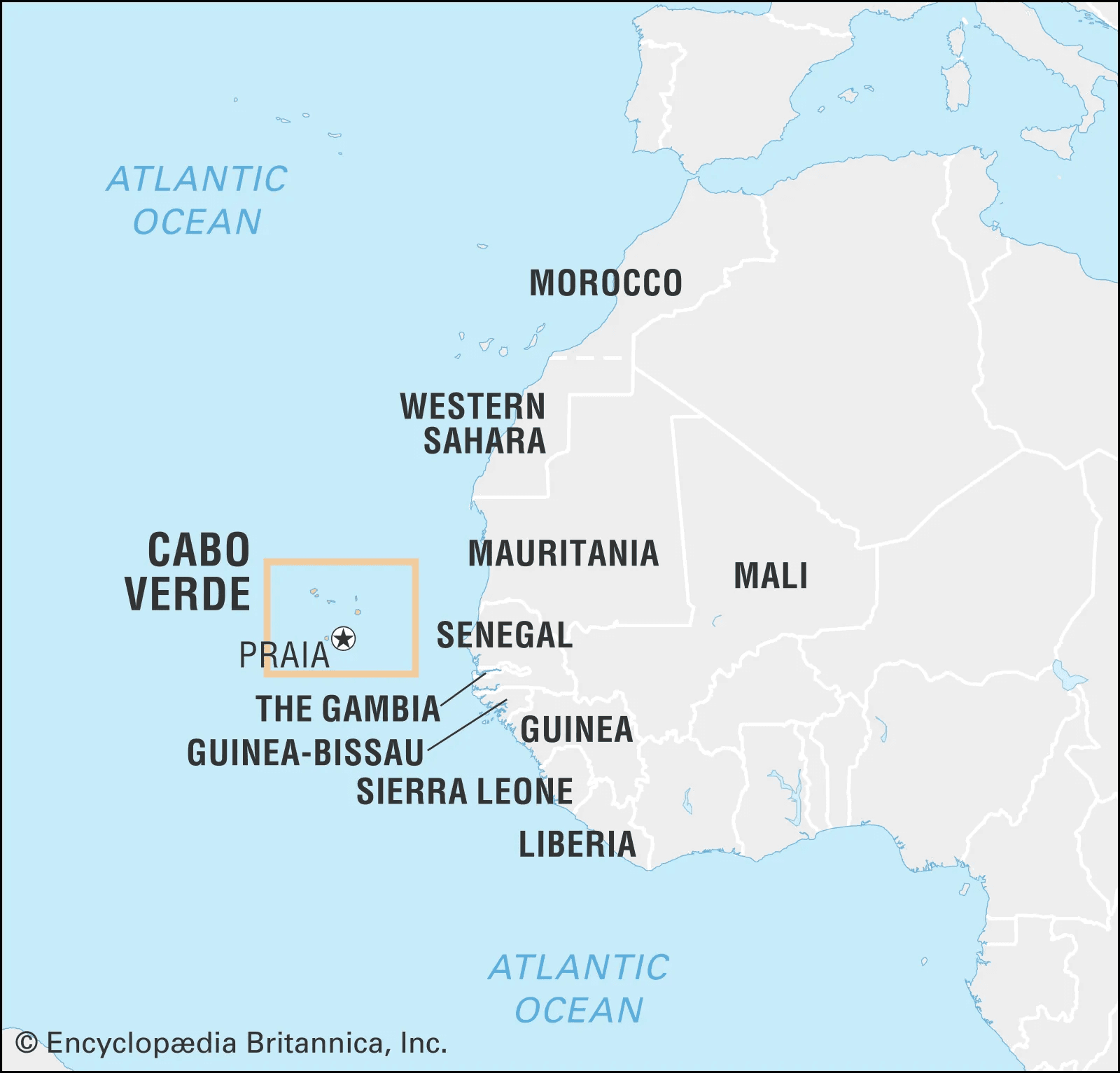
Beyond it the shore turned green. Dias rounded the westernmost point of the continent, thick with vegetation after two thousand miles of sand, and named it Cabo Verde, the Green Cape. He was after discovery more than plunder, brought back little, and was well received by Henry, who — his chronicler insists — valued the finding over the profit. And the Senegal flowed down from the direction of the West African goldfields, the source of the silent trade whose gold had always crossed the desert to Ceuta. The green coast, and the gold behind it, were at last within reach.
That same season a Lagos tax-collector named Lançarote de Freitas assembled the first slaving venture funded not by Henry but by a company of merchants — licensed by the prince, who took his cut — and sailed six caravels to the Arguin coast for the sole purpose of taking people. In a few days of raids on the Berber settlements there his men seized 235, and by early August the fleet was back at Lagos with them. On the 8th of August 1444, in a field outside the town, the captives were unloaded and divided. It was one of the earliest and most vividly documented large public distributions of West African captives in Portugal.
Henry’s own chronicler was present and set the scene down plainly, and it is the most harrowing passage in his book. The 235 were sorted into five lots for the division, and the sorting tore apart whatever bonds held them — parents separated from children, husbands from wives, brothers from one another, as each was assigned to a different share. Zurara describes the weeping, the people who threw themselves to the ground, those who lifted their faces to heaven; and then, in nearly the same breath, he consoles himself that their souls would be saved by baptism, and that they were better off as Christian slaves than as free heathens.
The 235 sold at Lagos did not come from Cape Verde Dias had just opened; they were Berbers taken off the desert shore near Arguin, the same raiding grounds as before. When the Portuguese did try the green, watered, densely peopled coast beyond Cape Verde — the Wolof lands of Senegambia — they were driven off the beaches by people well able to fight back, and took no captives at all; within a couple of years Henry suspended expeditions past Cape Verdefor the better part of a decade. What 1444 actually established, then, was narrower and more lasting than a conquered coastline. It was the business: merchant-funded and crown-licensed, captives arriving by the shipload, gold and slaves at last reaching Portugal by sea — around the desert and its Muslim middlemen, exactly the route Ceuta had pointed to thirty years earlier.
1452, 1455/ Rome Signs Off
By the early 1450s the enterprise had a monopoly, a fort, a slave market, and a chronicler’s justification. What it gained next was the sanction of the Church, in advance and in writing. In 1452 King Afonso V — Henry’s nephew, by now grown and ruling — appealed to Rome for the moral authority of the papacy behind the whole undertaking, and on 18 June 1452 Pope Nicholas V answered with the bull (which is the name for a formal written decree issued by the pope) Dum Diversas. It granted the Portuguese crown blanket permission to attack, conquer, and subjugate “Saracens and pagans and any other unbelievers and enemies of Christ” wherever they were found, to seize their lands and goods, and — the phrase that mattered most — to reduce their persons to perpetual servitude. The enslavement of non-Christians was now not merely tolerated but sacralized, folded into the crusade and rewarded, for those who took part, with the spiritual credit of holy war.
Three years later the grant was widened and made specific. On 8 January 1455 the same pope issued Romanus Pontifex, which confirmed Dum Diversas and added everything the trade required: a monopoly over navigation, commerce, and conquest along the entire coast south of Cape Bojador, and a prohibition — on pain of excommunication — against any other Christian power sailing or trading there without Portugal’s leave. It gave Portugal a papal claim to exclusive navigation and trade in the designated African regions, directed particularly against rival Christian powers, including Castile. The bull named and praised Prince Henry directly, for his zeal in opening the route and carrying the faith to the heathen, and it restated as settled doctrine that reducing pagans to slavery served their own good — a Christianizing correction to their barbarism. Afonso V had it read aloud in Lisbon Cathedral that October, before the foreign merchants, so there could be no doubt whose coast it now was.
The rationalization Zurara had improvised over the weeping captives at Lagos had become canon law: the salvation of souls laid over the seizure of bodies, blessed at the highest desk in Christendom. The predation no longer needed to excuse itself after the fact; it had been authorized before the ships sailed. These bulls would outlast their occasion by centuries and were later invoked in arguments associated with the Doctrine of Discovery — a legal and theological framework Europeans would carry into the conquest of non-Christian worlds.
The gold arrived with its own irony. The trade Henry had chased since Ceuta was at last yielding West African gold in quantity, and in 1457 Afonso V struck from it Portugal’s first gold coin — the cruzado, the “crusade-piece,” named and stamped with a cross because it was meant to help fund a crusade against the Turks who had just taken Constantinople. It was crusade money minted from gold bought, and captives sold, along a coast the same Church had just deeded to Portugal.
1455–56/ Cadamosto’s Book
By the mid-1450s the coast was no longer a frontier but a business, and Henry ran it increasingly by hiring outsiders. In 1454 a young Venetian merchant named Alvise Cadamosto put in at Cape St. Vincent on his way to Flanders; Henry’s agents came aboard, showed him sugar from Madeira and goods off the Guinea coast, and made an offer. Cadamosto took it. The license gave him half the profits of whatever he brought home — Henry supplying the caravel and taking the other half — and on 22 March 1455 he sailed from Lagos in a caravel of about forty-three tons. What Portugal was exporting to Africa by now was not conquest but capital and licenses; what it was importing was Italian commercial expertise, and gold and slaves.
Cadamosto’s account of that voyage is one of the most detailed surviving European records of fifteenth-century West Africa, and it is also a purchasing ledger. Past the Senegal — which he noted divided the arid Saharan country from the fertile, wooded lands to the south — he went ashore in the Wolof kingdom of Cayor and spent nearly a month inland as the guest of a lord he called Budomel, observing the court, the customs, the religion, the manner of dress. He dates the opening of Portuguese-Wolof trade to about 1450, five years before he arrived. He explains that trade on that coast was controlled by rulers, so the procedure was to send word inland and wait. He gives the exchange rates: horses were the prize commodity, and he sold seven of them plus some woolen goods for roughly a hundred human beings. He notes the price of young captives at coastal markets, and observes how readily African intermediaries supplied people taken in interior wars. The same passage that describes the Damel’s hospitality records that Cadamosto was given a girl of about thirteen “for the service of his chamber,” which he accepted and sent to his ship.
Cadamosto was a Venetian, and his account was published in Italy, posthumously, in 1507 — at the head of the Vicenza collection Paesi novamente retrovati, the same volume that carried Vespucci’s New World letters. It was translated into Latin and German within a year, French by 1515, and reprinted in Ramusio’s great collection in 1550. That is how literate Europe learned what was on the West African coast: from a hired Venetian’s book, not from Portuguese records. A Portuguese translation didn’t appear until 1812 — three and a half centuries later. The standard English edition is G. R. Crone’s Hakluyt Society volume of 1937, still the one scholars cite.
1456–60/ The Gold and Salt Trade
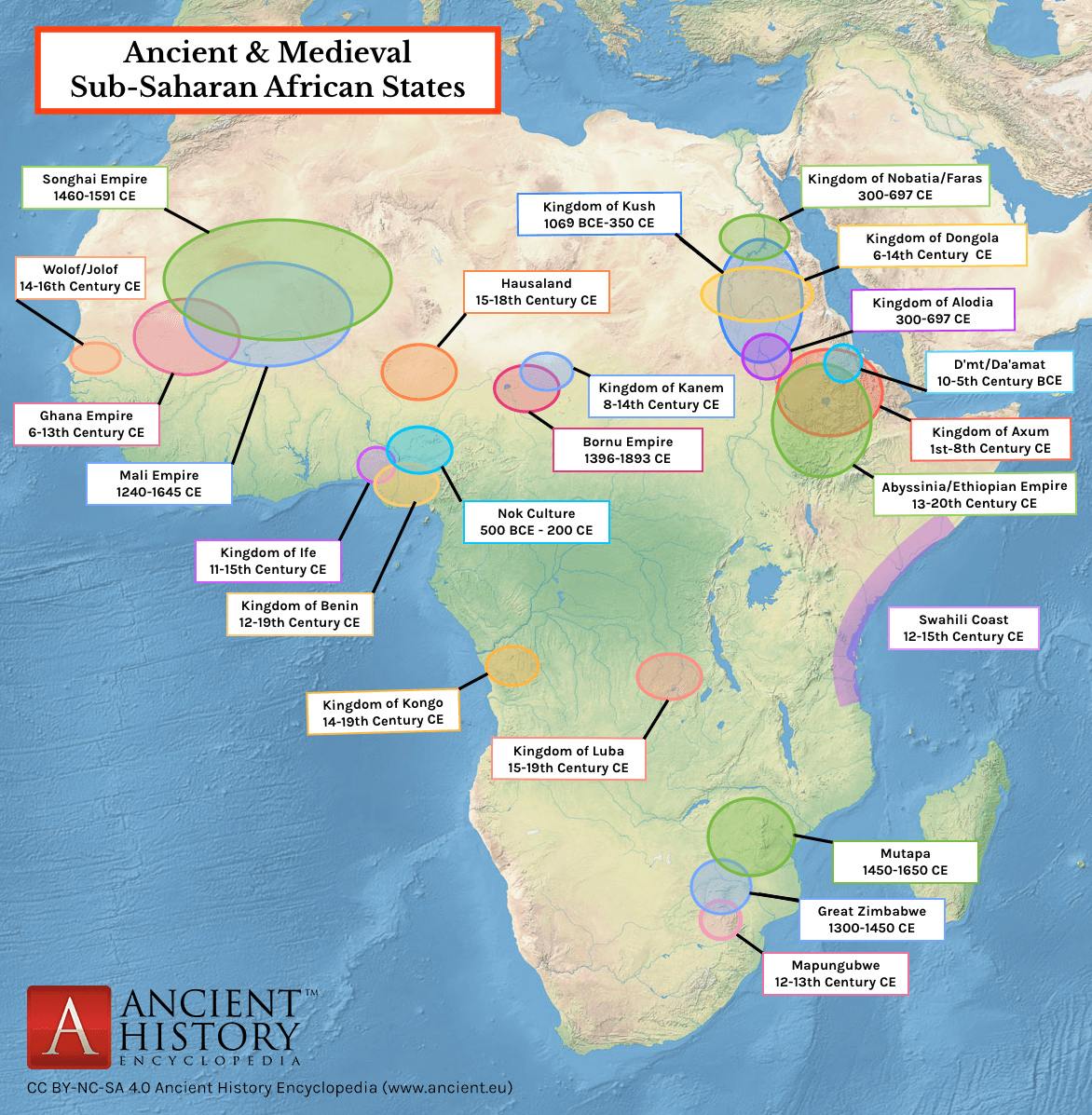
The final voyages of Henry’s lifetime reached the edge of what he had been chasing since Ceuta, and stopped there. Diogo Gomes, a squire of his household, sailed past the Geba around 1456 and on the return ascended the Gambia to the inland town of Cantor, where he found a market: traders had come there from Timbuktu, and the gold moved through a network of caravan towns feeding Tunis, Fez, Cairo, and the whole Muslim north. What Gomes had reached at Cantor was a market at the far western edge of a commercial system older and larger than Portugal.
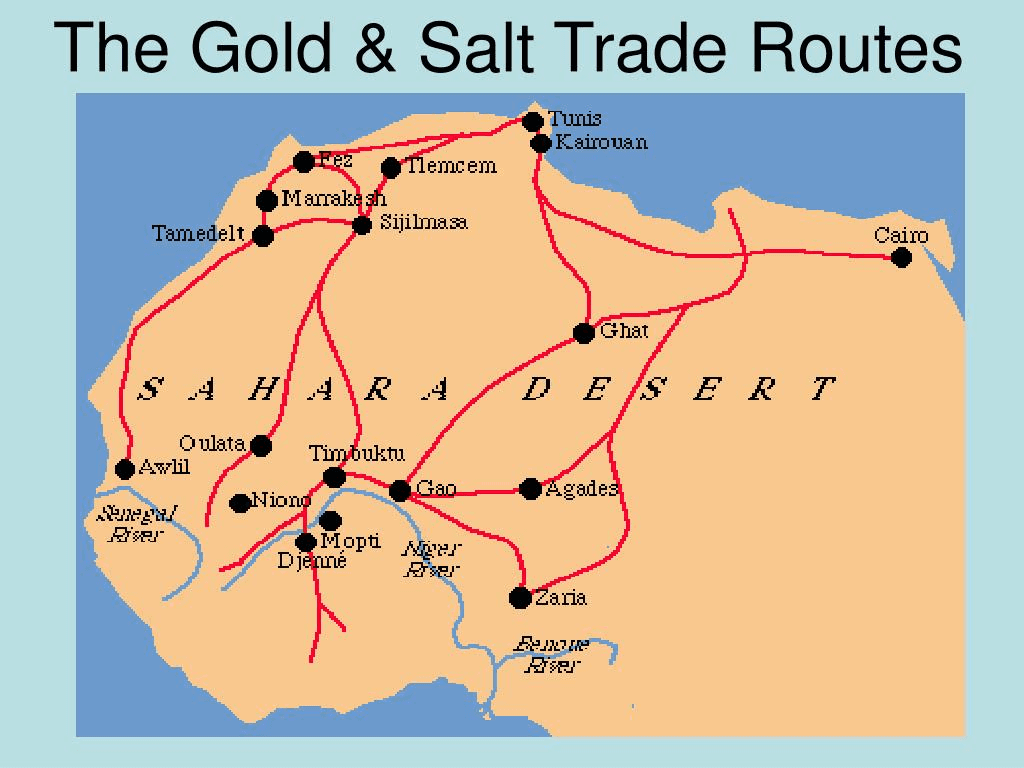
The gold itself came from three regions, none of them anywhere near the coast: Bambuk, at the meeting of the Falémé and the Senegal; Bure, on the upper Niger in what is now Guinea; and, increasingly by the fifteenth century, the Akan forest in modern Ghana, hundreds of miles to the southeast. It was alluvial gold — panned as dust and grains out of riverbeds and shallow workings, by farming communities who mined seasonally — and it was carried out by a Mande-speaking merchant diaspora, the Wangara or Dyula, who had been running these routes since at least the eighth century and whose network eventually stretched from the Akan forests all the way to Libya. Think of them as the long-haul freight network of West Africa — they bought gold at the fields and carried it north to three big river-port cities on the Niger: Djenné, Timbuktu, and Gao. At those cities the gold changed hands again, loaded onto camel caravans that crossed the Sahara to North African cities — Fez, Marrakesh, Tunis, Tripoli, Cairo — and from there it entered the Mediterranean and, eventually, European coins.
Coming the other way was salt, cut in slabs at desert mines like Taghaza. This is the part that surprises people. In the desert there was salt but no gold; in the savanna and forest there was gold but almost no salt — and salt is not a luxury, it’s a necessity for preserving food and for health in a hot climate. So caravans came south carrying slabs of rock salt cut at desert mines like Taghaza, and went back north with gold. Salt was so valuable that a block roughly doubled in price just travelling from Timbuktu down to Djenné, and by the time it reached the southern forests it could be worth close to its own weight in gold.
Islam had reached West Africa some four and a half centuries before Diogo Gomes did. Islam was established among some Sahelian courts and trading communities by the eleventh century, though the evidence for the earliest rulers and the depth of conversion varies by source and region. It came the way everything came, along the caravan roads: Berber and Arab merchants carried the faith south with the salt, and it took root first among the trading classes and the courts, then spread outward. The kings of Mali converted from the 1260s; Mansa Musa made his pilgrimage to Mecca in 1324 and returned with scholars, architects, and books, building mosques at Timbuktu and Gao and turning the school at Sankore into a university with a library. By the fifteenth century Timbuktu and Djenné were internationally known centers of Islamic learning, with a clerical class of West African scholars who themselves worked as missionaries carrying the religion further south. When Gomes reached the Gambia estuary in 1456 and found Islam dominant there, he was not encountering a frontier of the faith. He was encountering its long-settled western reach.
Cadamosto, in the Wolof kingdoms just a year earlier, found rulers advised by Muslim clerics. Gomes at Cantor met traders who had come down from Timbuktu. And the empire that controlled the whole system in those years — Songhai, under Sonni Ali, whose reign from 1464 almost exactly followed Henry’s death — was a Muslim state that would shortly take Timbuktu and Djenné and extend further than any West African power before it. The picture needs one qualification: Islamization was uneven and layered rather than total. It was strongest at courts and in commercial towns, thinner in the countryside, frequently mixed with older practice, and contested — Sonni Ali himself persecuted scholars who objected to his retention of local ritual. But the qualification does not change the essential fact. The Portuguese did not arrive among peoples waiting to be told about God. They arrived among Muslim kingdoms with mosques, jurists, written Arabic, and libraries, connected by trade and pilgrimage to Cairo, Fez, and Mecca.
Henry’s whole framework was the crusade — the war against Islam extended by sea, with the hope of finding Prester John, a Christian king somewhere beyond the Muslim lands who might be enlisted to take them in the rear. The bulls that licensed the slaving spoke of “Saracens and pagans,” and the justification for every captive taken was that heathens were being brought to salvation. What the voyages actually found was that there was no beyond. Sail past the desert and you reach Muslim courts; go up the rivers and you meet Muslim merchants from Timbuktu; the network Portugal had been trying to circumvent since Ceuta simply continued, in a different form, wherever they landed. And the trade they built ran on it anyway — at Arguin they set up a factory specifically to buy from the Muslim caravan merchants they were crusading against, and much of the gold and many of the captives that reached Lagos passed through Muslim hands first. The crusade and the commerce were, in Henry’s own account of himself, the same project. On the coast they turned out to require doing business with the enemy.
In 1458, aged sixty-four, he sailed with his nephew Afonso V against Alcácer-Ceguer, a Moroccan town on the strait, and took it. It was his last campaign, forty-three years after Ceuta and two before his death, and it changed nothing: Morocco stayed Muslim, and the Portuguese held a few more coastal towns at ruinous expense. Whatever the voyages had become by then — a licensed trade in gold and human beings, a chain of island plantations — the man running them died still fighting the war he had started in 1415, and understood the rest as an extension of it.
1460/ Death
In 1460, Henry knew he was dying and returned to Sagres, where he made his will. He died on 13 November 1460, unmarried and without children. What he left behind was an enterprise built on sustained royal and institutional resources: after four decades of financing voyages, the largest returns from the West African trade were still developing, and the gold and enslaved people that would eventually make the coast enormously profitable were, at his death, a trickle. His monopoly over everything south of Cape Bojador — the license, the fifth, the whole apparatus — reverted to the crown. Portuguese exploration had reached well beyond the Gambia; Madeira was making sugar with slave labor; the Azores were settled; Arguin was shipping people north by the hundreds each year; and Cape Verde had been sighted and would be settled two years later on the Madeira model. The machine was built and running, and its greatest returns expanded after his death.
Nine years after his death the crown leased the whole southward push to a Lisbon merchant, Fernão Gomes, on a contract obliging him to open a hundred leagues of new coast a year; his ships reached the Gold Coast in 1471, and in 1482 João II planted the fortress at Elmina on a model partly anticipated at Arguin — a walled trading post, permission extracted from a local ruler, and gold moving out by sea instead of by caravan. Elmina remained primarily a gold-trading post in its early Portuguese centuries; its central role in the transatlantic slave trade came much later.
What Henry actually did is clear enough without the school and without the epithet. He took the revenues of a crusading order, a stack of royal monopolies, and the licensing rights to an entire ocean frontier, and used them to run a private venture that felt its way down a coastline for four decades — outsourcing the risk to household squires and Italian merchants on profit-shares, planting hereditary captaincies on empty islands, working out on Madeira the pairing of cash crop and enslaved labor that would cross the Atlantic a century later, and helping establish a Portuguese maritime trade in enslaved West Africans that expanded sharply after 1441. He did it inside a framework he believed: that the war against Islam was the central fact of the world, that souls were being saved, that the Church had said so in writing. Both things are in the record and neither cancels the other. The chronicler who described people being torn from their families in a field outside Lagos, and then consoled himself that they were better off baptized, was not being cynical — he was showing how the accounting worked, and the accounting is the thing that lasted. It was not simply a road of discovery. It was the slow, licensed, profitable work of finding out what a coastline was worth, and taking it. 🇺🇸