被印象派影响的四位
Preface: welcome to this very brief intro to modern art. Please feel free to use this as a guide for museum visits.
TLDR:
“Post-Impressionism” is a term invented in 1910 by art historian Roger Fry to describe four artists who had almost nothing to do with each other — their only common ground being that each started from Impressionism and then moved in a completely different direction. Impressionism answered one question: how do you capture light and the instant? Post-Impressionism asked the next question: then what? Beyond light and the instant, what else can painting do? Cézanne, Van Gogh, Gauguin, Seurat — four people, four completely different answers.
Cézanne: reduced nature to geometric form. The spiritual father of Picasso.
Van Gogh (Dutch): the brushstroke became emotion itself. The starting point of Expressionism.
Gauguin: fled to Tahiti, painted Polynesian women — saturated with colonial gaze, but also the first time non-Western bodies entered Western high art.
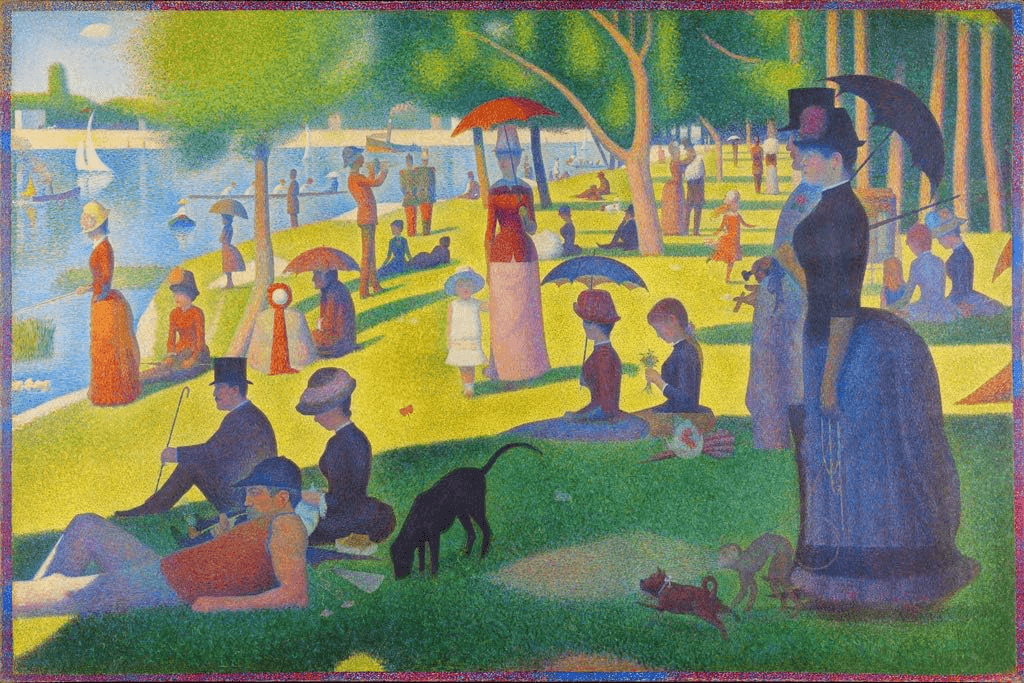
Seurat: Pointillism — making painting into a science.
Themes: subjective feeling, the romanticization of “primitiveness,” escape from modern civilization.
Paul Cézanne (1839–1906)
Keywords: structure, geometry, permanence
Cézanne was a contemporary of the Impressionists, but he had one fundamental complaint against them: Impressionism was too fleeting. Monet captured a moment of light, but that moment vanished and left nothing behind.
What he wanted: the Impressionists’ direct observation of nature combined with the solid permanence of classical art.
His solution: reduce nature to basic geometric forms.
He painted the same mountain in his home province of Provence over and over — Mont Sainte-Victoire — not to paint the mountain, but to investigate a question: how can three-dimensional space be honestly rendered on a two-dimensional surface? The Western answer since the Renaissance was single-point perspective — simulate the human eye, create the illusion of depth. Cézanne thought this was a lie. Your two eyes see slightly different angles, your head moves, your perception is multiple, not a single fixed viewpoint. So he began painting multiple viewpoints simultaneously — a table’s edge rendered from two angles at once, an apple’s outline left deliberately unclosed. The picture begins to loosen, to tremble. Reality begins to come apart.
Mont Sainte-Victoire series: The later versions grow increasingly abstract — the mountain becomes an arrangement of color planes, the boundary between sky and mountain disappears, the entire picture becomes a structural system of color and form.
The Large Bathers (1906): He painted the bather subject for twenty years. In the final version the figures have nearly become geometric shapes, merging with the trees behind them. Form overtakes narrative.
Character and life: Cézanne was a person of extreme anxiety and social difficulty. He was a marginal figure in the Paris art world, unrecognized for years, and in his later life he was almost a recluse in Provence. He and Zola — the celebrated novelist — were childhood friends, but Zola wrote a novel featuring a failed painter, and Cézanne believed it was based on him. They broke off contact and never spoke again. He was deeply uncomfortable with models: he said he couldn’t stand being looked at. His still lifes — apples, tablecloths, bottles — were freer than his figure paintings because apples don’t look back.
The spiritual father of Picasso: Picasso took Cézanne’s multiple viewpoints to their extreme: if two viewpoints can be shown simultaneously, why not five? Why not paint a face’s front and profile at the same time? That is the logical starting point of Cubism. After Cézanne’s death, his 1907 retrospective stunned the entire Paris art world. Picasso and Braque immediately began their Cubist experiments in its wake.
Vincent van Gogh (1853–1890)
Keywords: emotion, brushstroke, between madness and lucidity
Van Gogh was Dutch, didn’t start painting until he was 27, and died at 37. In his ten-year creative life he produced over two thousand works and sold exactly one. He learned color from the Impressionists — before coming to Paris, his paintings were in the dark, heavy Dutch manner (The Potato Eaters, 1885: brown, somber, the roughness of laboring people). After contact with Impressionism, his canvases exploded into light. But his fundamental difference from the Impressionists: their brushstrokes recorded light. Van Gogh’s brushstrokes recorded emotional states. Look at The Starry Night (1889): the sky is not a sky — it is a vortex, a movement, some cosmic force surging. This is not the sky he saw. It is the sky he felt. The brushstroke itself becomes the direct material expression of emotion. This is the starting point of Expressionism.
Key works:
Sunflowers (1888): different depths of yellow, warmth and anxiety coexisting. Painted to welcome Gauguin to Arles, to decorate the room.
The Bedroom (1888): his own room, intense color, perspective deliberately distorted. He said he wanted to express “absolute calm” — but the picture contains a suffocating tension.
Wheatfield with Crows (1890): completed weeks before his death, crows rising from a wheat field, roads leading nowhere in particular. People always read it as a premonition of suicide — but this may be retrospective over-interpretation.
The Arles period and Gauguin: In 1888 Van Gogh persuaded Gauguin to come live with him in Arles in the south of France, to build a “Studio of the South” together. Two months later they had a violent argument (the cause remains unknown), Gauguin left, and that night Van Gogh cut off his own left ear and gave it to a local prostitute. This event has been mythologized endlessly — the madness of genius. But psychiatric research suggests he may have suffered from temporal lobe epilepsy rather than madness in any romantic sense. During his hospitalizations he continued working steadily, his thinking clear, writing his brother Theo letters of remarkable lucidity and perceptiveness. The relationship between his mental state and his art is far more complex than the “mad genius” narrative allows.
His brother Theo: Theo was an art dealer in Paris who spent his entire career supporting Van Gogh with his own salary — buying his paints and canvases, receiving his letters. Six months after Van Gogh died, Theo also died: a mental collapse. They are buried in the same cemetery, in Auvers-sur-Oise.
Paul Gauguin (1848–1903)
Keywords: escape, colonial gaze, primitivism, contradiction
Gauguin is the most controversial figure in Post-Impressionism, and the one who most requires a critical eye.
His narrative: Gauguin had been a stockbroker at the Paris exchange, painting on the side. The financial crisis of 1882 left him unemployed, and he decided to become a full-time artist — abandoning his wife (Danish, with five children) and his middle-class life. He believed European civilization was corrupt and excessively rational; he wanted to find a “primitive,” uncorrupted vitality. He went first to Brittany in rural France — not “primitive” enough. In 1891 he went to Tahiti.
In Tahiti: He painted Polynesian women: earth tones, thick, full of life force. Where Do We Come From? What Are We? Where Are We Going? (1897–98) is his masterwork — enormous, like a mythological narrative, but rendered through Polynesian bodies and landscape.

The problem: Gauguin lived with multiple local women in Tahiti, including underage girls — Teha’amana, who was 13 when he arrived, and later Pau’ura. In his memoirs he romanticized these relationships as “primitive love.” His gaze toward Polynesian culture was colonial: treating local people as “natural beings uncorrupted by civilization” — itself a projection of European centrism. The Tahitian women in his paintings are beautiful, but they are objects of the gaze, not people with subjectivity.
But art history cannot ignore his contribution: He was the first artist to systematically bring non-Western visual language into Western painting — not decoratively “borrowing” it, but fundamentally reconstructing the logic of the picture plane. His color — non-naturalistic, bold, symbolic — directly influenced the Fauves (Matisse) and Expressionism. He opened a question: does the visual language of painting have to come from Europe? The answer is no. But the way he gave that answer was saturated with the power structures of the very civilization he wanted to escape. This contradiction cannot be resolved — only confronted.
Georges Seurat (1859–1891)
Keywords: science, system, dots, distance
Seurat was the most rational figure in Post-Impressionism.
His question: the Impressionists placed colors side by side intuitively and let the eye blend them. Could this process be made scientific? He studied the physicist Helmholtz and color theorist Chevreul, and developed Divisionism — later called Pointillism:
Only pure color dots, never mixed
Color placement calculated precisely according to color theory to produce the strongest optical mixing effect
Complementary colors adjacent (red next to green, blue next to orange) to create maximum contrast and visual vibration
This was technically grueling — his large works took years to complete.
A Sunday on La Grande Jatte (1884–86):His most famous work. Middle-class Parisians at leisure on the banks of the Seine near the island of La Grande Jatte — the same subject matter as Impressionism, but treated in an entirely different way. The figures are like sculptures: still, expressionless, maintaining a strange distance from each other. None of Impressionism’s vitality or warmth. The picture has an uncanny quality of alienation and solemnity. Three million dots. Two years.
The Circus (1891): His last painting, unfinished at his death. Brighter color, more dynamic line. He had been researching the relationship between line and emotion — ascending lines express joy, horizontal lines express calm, descending lines express sadness. A grammar of emotion in paint.
Death: Seurat died at 31 of diphtheria, or possibly meningitis — the diagnosis was unclear. He was at the height of his powers. His infant son died of the same illness three weeks later. He lived only 31 years, but the system he invented profoundly influenced later abstract art: liberating color from the figure, turning it into an independent unit — one of the logical preconditions of abstraction.
The Relationships Between the Four
They knew each other but were not a group. Pissarro (the Impressionist) was the teacher of both Cézanne and Gauguin, and the earliest champion of Seurat — he tried Pointillism for a period and eventually abandoned it. Van Gogh and Gauguin had their famous Arles cohabitation, which ended with the severed ear. Cézanne and Gauguin worked together in Brittany, but Cézanne had reservations about Gauguin — he said: “Gauguin stole my sensation.” Seurat had almost no personal contact with the other three. He was more like a solitary scientist.
The Historical Significance of Post-Impressionism
Together these four pushed open the Pandora’s box that Impressionism had cracked:
Cézanne → Cubism → Abstract Art
Van Gogh → Expressionism → German Expressionism → Abstract Expressionism
Gauguin → Fauvism → Primitivism → the (contested) reappraisal of non-Western art
Seurat → Abstraction → Op Art → color theory in design
Nearly every major art movement of the twentieth century can be traced back to at least one of these four people.🖼️