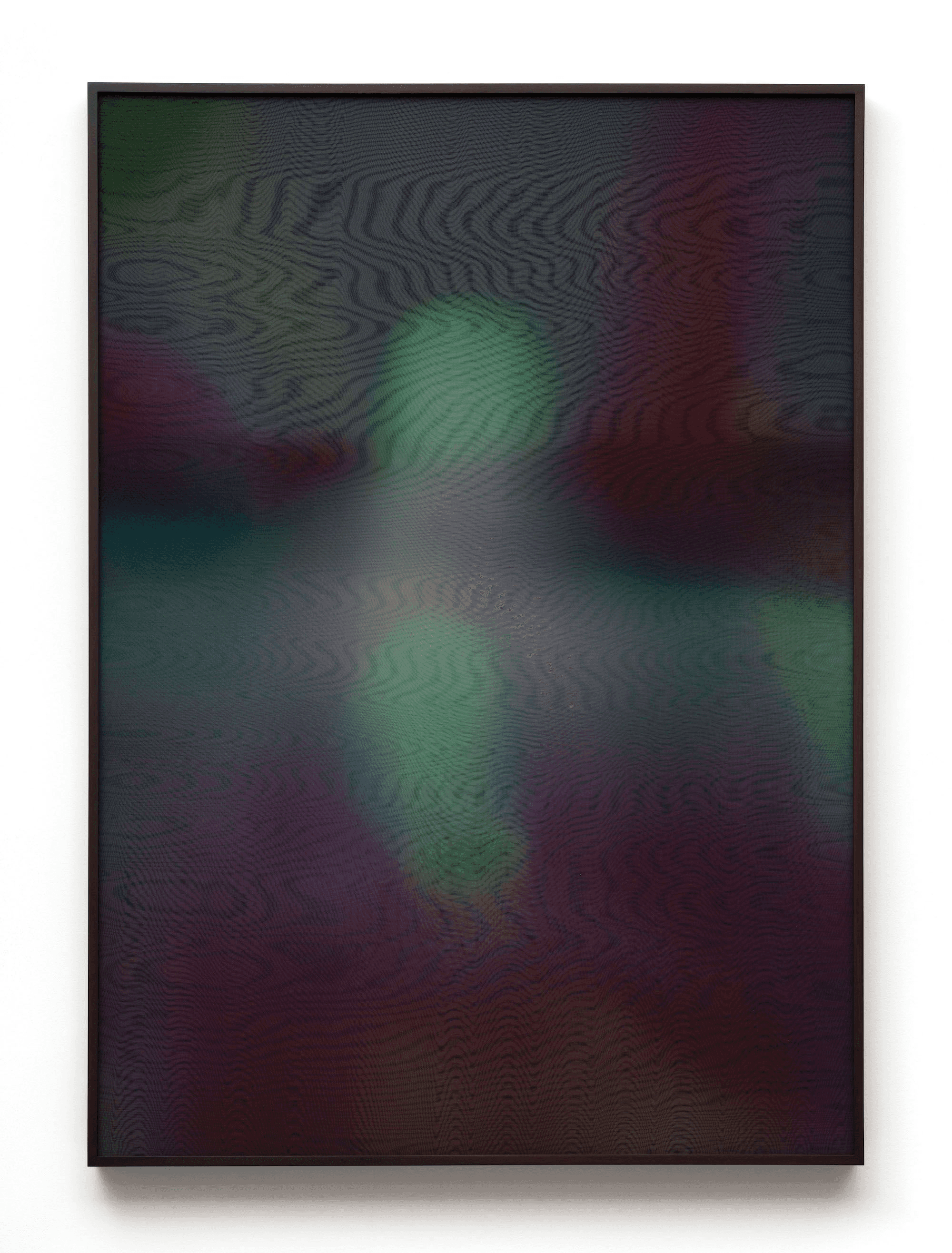
SFMOMA, Part 17: Floor 2, 1900 to Now. Afterimage, Pool Shift (Rosha Yaghmai, 2023).
Walk past it, then walk past it again. That's the instruction the painting gives you, and it's the only way to see it. Afterimage, Pool Shift is acrylic and ink on layered organza over cotton — sheer fabric, painted, stacked — and the layers interfere with each other the way two window screens do, throwing off moiré patterns that shift as you move. Stand still and it's one painting. Shift your weight and it's another. The image won't settle, which is the point: it's an afterimage, the ghost that stays on your retina after you look at something bright. Rosha Yaghmai paints the ghost, not the thing.

The work belongs to the Afterimage series, begun in 2021, in which Yaghmai takes imagery from Persian miniatures — the Shahnameh illustrations that hung in her childhood home — removes the historical figures, and zooms in on the landscapes until they dissolve into abstraction. Painted organza layered over cotton, set in the artist's deep box frame, roughly five feet tall. The 2023 group — Past Skies, Beam, Dip, Pool, Pool Shift, Trails — debuted at FOG Design+Art in San Francisco, in Commonwealth and Council's solo booth, January 2023. SFMOMA acquired Pool Shift through the Accessions Committee, by exchange, through a gift of Michael D. Abrams. The title's second half is hers to keep mysterious — no source decodes it — but Pool and Pool Shift are siblings in the group, and the reading suggests itself: a swimming pool's surface, another shimmering interference pattern, refracted through the series' optical language. Los Angeles, dusk, water, light. Use it as a hypothesis, not a fact.
Yaghmai was born in 1978 in Santa Monica, first-generation Iranian-American, and she has never been to Iran. Her father came from Tehran to study architecture; her relationship to the country, in her dealer's phrase, is "like living with a phantom limb" — a place she has never visited but considers her homeland. The Afterimage series is what you make from a phantom limb: you don't paint Iran, because you don't know it. You paint the distortion of knowing it secondhand — through miniatures on a wall, through stories, through the gap between the image and the place. The gallery's 2021 press release: the works "obscure and abstract the miniature in order to investigate the processes of distortion, estrangement, and assimilation of inheritance." Distortion over representation. The misunderstanding is the medium.
Misunderstanding as method
"I think misunderstanding is a very generative thing." That's Yaghmai, talking about her father's background and her own work, and it's the key to the whole series. She refuses the research trip. She refuses the authoritative account of "Iranian culture." She works from productive estrangement — from the fact that the miniatures are familiar and foreign at once, that the figures are gone but their absence has a shape, that the landscape remembers something she doesn't.

This is what makes the Afterimage paintings smarter than the average diaspora-art gesture. The easy move would be to reproduce the miniatures, or to collage them, or to paint over them — to claim the inheritance. Yaghmai does the opposite: she removes the figures, keeps the ground, and lets the ground shimmer. The blurred swaths of color, as the Jewish Museum's 2024 press release put it, "connect to images that emerge when we stare directly into a bright light and overstimulate our retinas. An inverted, residual copy imprints on our field of vision, unmoored from the physical world." The afterimage is the direct apparition of what's happening inside the body. The painting is not about Iran. It's about what Iran does to the eye that looks for it.
A sculptor's paintings
Yaghmai started as a photographer and quit over flatness. "The flatness of photography prohibited me from exploring the one-to-one relationship a viewer can have with the three-dimensional object," she said in 2018. Everything since has been a long argument with the flat: translucent silicone, clear resin, fiberglass veil, two-way mirror, organza, tulle — materials that are there and not there, that alter what you see behind them. "If you have one thing that's transparent, you're altering what you see behind it, and for me that altering and blending of sight is really important."
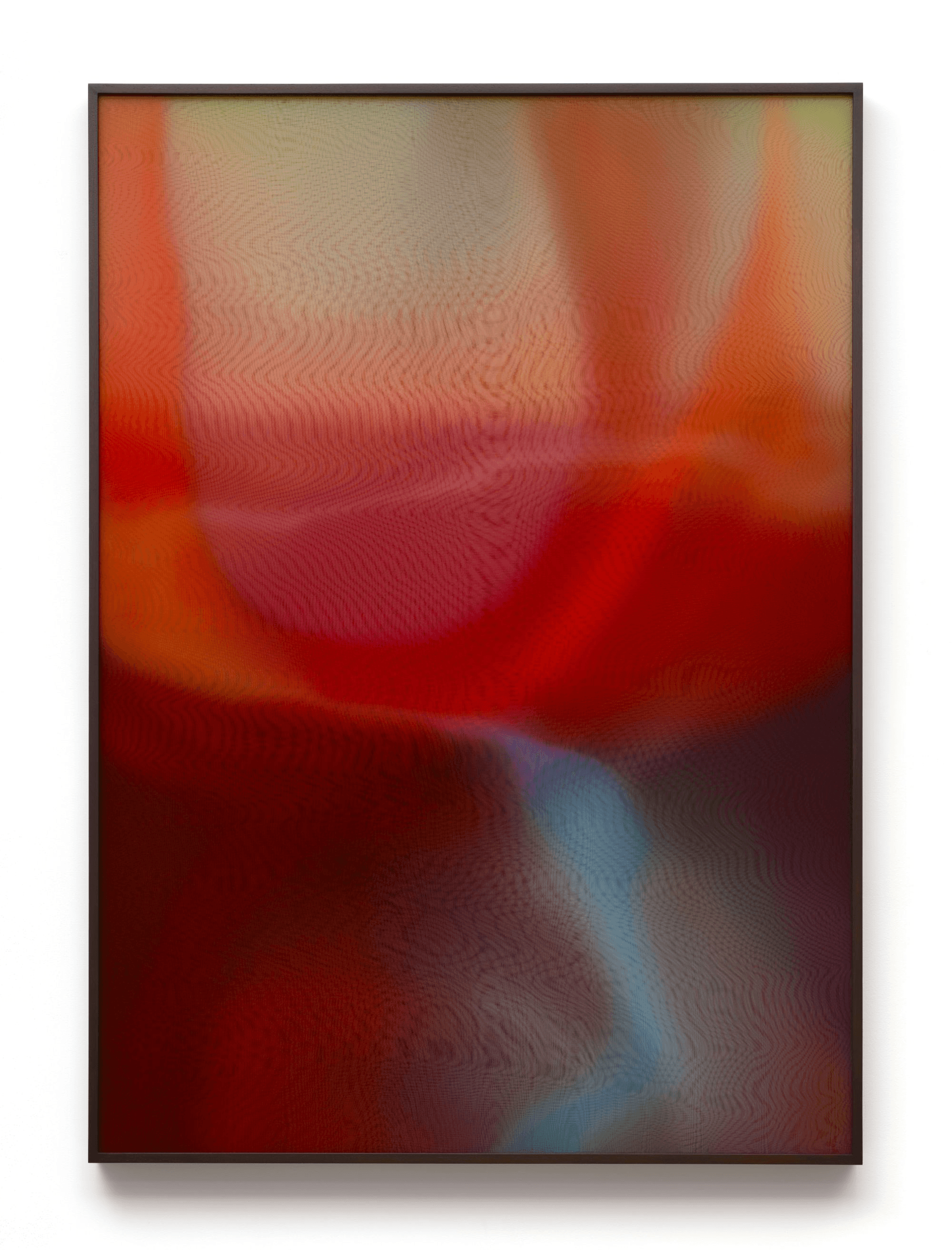
The Afterimage paintings are the argument continuing by other means. They're paintings, technically — acrylic and ink — but they behave like screens, like veils, like the mashrabiya lattices of Islamic architecture that both reveal and conceal. The organza is painted, not printed; the image happens in the gaps between layers, in the moiré, in the interference. A critic at the 2021 Kayne Griffin show wrote that the patterns "shimmer like mirages, confounding the eyes." Another called them "aura photographs missing their figures." Both are right. The figure is missing. The aura is the painting.
And then there's the palette. "I am realizing how much, basically, 'dusk' is my color palette," she said in 2019. "That is where the light and space of California comes into my work. It is 'dusk' but it is city dusk; that moment when the sky has that color and there is the neon turning on. That in-between time." City dusk, neon coming on, the in-between time — that's the Afterimage series in a sentence. Not day, not night. Not Iran, not California. The shimmer between.
Light and Space, complicated
The Art in America headline on her 2021 show was "Complicating Light and Space," and it's the right frame. Yaghmai inherits the LA perceptual tradition — MOCA literally paired her with Larry Bell for an "Artists on Artists" program in 2020 — and complicates it with everything Light and Space excluded: autobiography, miniatures, junk, the body, diaspora. Robert Irwin wanted the viewer to perceive perception. Yaghmai wants the viewer to perceive misperception — the afterimage, the distortion, the phantom limb. Same optical rigor, different ghost.
The lineage behind her: Helen Frankenthaler's stain-on-fabric, except Yaghmai's fabric is sheer and the paint sits on a membrane instead of soaking in — Frankenthaler made fabric hold color; Yaghmai makes fabric hold interference. Sam Gilliam's draped canvases, except Gilliam's drape is gravitational and baroque where hers is optical and veiling. Eva Hesse's translucent bodily materials — Yaghmai's early silicone works were, in her words, "the type of silicone you make prosthetics out of… an approximation or stand in for the body." The throughline is a sculptor who never stopped thinking in three dimensions, even when she picked up a brush.
So here's the thesis: Afterimage, Pool Shift is a painting about the impossibility of looking directly at what you love. You can't stare at the sun — you get the afterimage. You can't stare at the homeland you've never visited — you get the distortion. Yaghmai's move is to paint the distortion honestly, to make the shimmer the subject instead of apologizing for it. The moiré won't settle. The figures won't come back. The pool keeps shifting. And that's the most truthful thing a diaspora painting can do: admit that the image is unmoored from the physical world, and find the beauty in the unmooring. Walk past it again. It's different now. 🌁
Timeline — Rosha Yaghmai
1978 — born in Santa Monica, California; first-generation Iranian-American
2007 — MFA, California Institute of the Arts
2018 — Made in L.A., Hammer Museum; the father's 35mm slides become source material
2019 — Miraclegrow, CCA Wattis Institute, San Francisco
2021 — Afterimages, Kayne Griffin, Los Angeles; the series begins
2023 — Afterimage, Pool Shift debuts at FOG Design+Art, San Francisco; SFMOMA acquires it
2024 — Overflow, Afterglow, Jewish Museum, New York