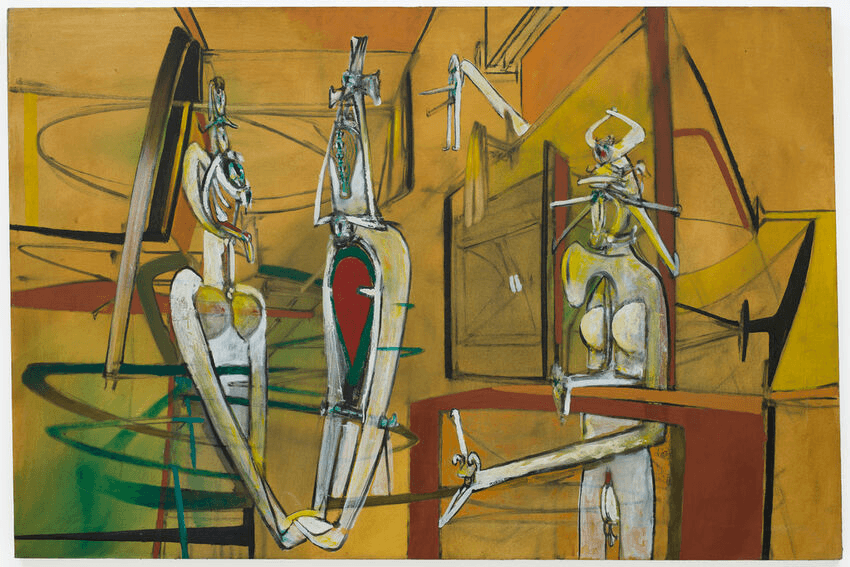
SFMOMA, Part 36: Floor 2, 1900 to Now. Chamboles les amoureuses (Roberto Matta, 1946).
Forty by sixty inches of cosmic erotic machinery. Chamboles les amoureuses, 1946 — a fractional gift of the Shrem family in 1992 — is Matta at full power: biomorphic figures, half-machine half-flesh, suspended in a horizonless cosmic space, grotesque and seductive at once. The title is a pun — roughly, "the lovers in shambles," les amoureuses tangled with disorder — and the painting earns it. Bodies unfold, fuse, penetrate; space has no up or down; desire operates like physics.
The inscape
Matta called these inscapes: interior landscapes, "the places of the mind." The word is a deliberate fusion — inside + landscape — and the painting is its demonstration. What looks like outer space is also anatomy: tubes, membranes, orifices, armatures. Matta trained as an architect and worked in Le Corbusier's Paris studio before Breton pulled him into Surrealism, and you can feel it — the compositions have structure under the delirium. His line: "Painting has one foot in architecture, one foot in the dream."
Roberto Sebastián Matta Echaurren, 1911–2002 — Chilean, the last of the first-generation Surrealists. Arrived in New York in the fall of 1939 with a letter from Breton and a head full of automatism. What happened next is one of the great transmission stories in modern art: Matta, barely thirty, became the conduit through which Surrealist automatism flowed into the young Americans — Motherwell, Baziotes, Pollock, Gorky. He held sessions. He demonstrated. He argued that painting could begin without intention and arrive at meaning. The New York School's breakthrough technique passed through a Chilean architect's hands.
1946
The date matters. In 1946 Matta painted this canvas of lovers in shambles — and in 1946 his affair with Gorky's wife Mougouch began, the affair that ended Gorky's marriage and, two years later, got Matta expelled from the Surrealist group. The painting predates the expulsion, the suicide, the whole catastrophe; it also anticipates it. Erotic disorder as subject, erotic disorder as life. The lore says the affair drove Gorky to despair; the lore is messier than that — Gorky's last eighteen months held a studio fire, cancer, a car crash, a custody loss. But Matta painted lovers in shambles the year his own love affair began its shambles, and the canvas knows something.
So here's the thesis: Chamboles les amoureuses is Matta's inscape at its most loaded — 1946, the cosmic erotic machine, the architect's structure under the dream's delirium, painted the same year the affair began that would detonate two lives and get him expelled from Surrealism. He was the transmitter: the Chilean who taught Pollock and Gorky automatism, who said painting has one foot in architecture and one in the dream, who made the unconscious look like engineering. "Les amoureuses" in shambles — the lovers, the painting, the year. All of them. 🌁
Timeline — Roberto Matta
1911 — born November 11, Santiago, Chile
1930s — architecture; Le Corbusier's studio; joins Breton's Surrealists
1939 — arrives in New York; becomes automatism's transmitter to the Americans
1946 — paints Chamboles les amoureuses; affair with Gorky's wife begins
1948 — expelled from the Surrealist group; Gorky dies
1992 — fractional Shrem gift brings the painting to SFMOMA
2002 — dies November 23, Civitavecchia, Italy, age 91