Faces of Friends, Square by Square

SFMOMA, Floor 4 · Ways of Seeing: Fourteen Artists.
Every face in Chuck Close's room belongs to another artist. Roy Lichtenstein, Agnes Martin, John Chamberlain, Lorna Simpson: four people who spent their lives making images, now made into images by a painter who could not reliably recognize a face in person. Close had prosopagnosia, or face blindness. He said it was part of why he painted portraits. A photograph holds a face still and flat, and a grid breaks it into pieces small enough to learn.
A Boy Who Drew to Keep Up (1940–1962)
Charles Thomas Close was born on July 5, 1940, in Monroe, Washington, an only child. His mother taught piano; his father was a plumber and part-time inventor. The family moved to Tacoma in 1945. He had oil paints at five and private art lessons at eight.
School went badly. Close had dyslexia, undiagnosed at the time, and a neuromuscular condition that made it hard to lift his feet. Nephritis kept him out of most of sixth grade. His father died when he was eleven. Drawing was the thing he could do, and he used it to make up for the things he couldn't.
He went to Everett Junior College from 1958 to 1960, won a scholarship to the Yale Summer School of Music and Art in 1961, and finished a BA at the University of Washington in 1962.
Yale and the Decision to Throw Away His Tools (1962–1967)
At Yale he earned an MFA in 1964. His classmates included Brice Marden, Richard Serra, Vija Celmins, Nancy Graves, Janet Fish, and Jennifer Bartlett. Two of those names have their own rooms on this floor. A Fulbright took him to the Academy of Fine Arts Vienna, and he came back to teach at the University of Massachusetts.
He had been painting in the gestural manner of the day, and painting it well, which was the problem. In 1967 he decided to "throw away" his tools: to give up the brushwork he was good at and force himself somewhere new. His first solo show that year, at the University of Massachusetts gallery, was closed by the university over male nudity. The case went to court. Close won at the state level, and the decision was overturned on appeal.
The same year he moved to New York and settled in SoHo.
The Grid and the Photograph (1967–1988)
The new method was severe. Close photographed a face, laid a grid over the photograph and a matching grid over a huge canvas, and copied the image one cell at a time. Big Self-Portrait (1967–68) is about nine feet tall: Close unshaven, a cigarette in his mouth, in black and white. It took more than four months, and the Walker Art Center bought it in 1969. It was the first painting he sold.
His tools in those years were an airbrush, rags, a razor blade, and an eraser fitted to a power drill. He had his first New York solo show at Bykert Gallery in 1970 and joined Pace Gallery in 1977. He was grouped with the Photorealists, but the photograph was never his subject. It was the thing that let him stand at a distance from the face and treat it as information.
He was also, from early on, a printmaker. A 1972 mezzotint residency at Crown Point Press in San Francisco started it, and in 1986 he worked with the woodblock printer Tadashi Toda in Kyoto. Printmaking, with its plates and blocks and stages, suited a mind that already thought in units.
December 7, 1988
On December 7, 1988, Close was at a ceremony in New York to present an art award. He felt pain in his chest, gave his speech, and went to Beth Israel Medical Center. There he had a seizure that left him paralyzed from the neck down. The cause was a collapsed spinal artery. He called it "the Event."
Months of rehabilitation gave him back some movement in his arms. He could walk a few steps but used a wheelchair for the rest of his life. He went back to painting with a brush strapped to his wrist. Assistants helped lay out the grids.
The paintings changed. The tight, invisible surface of the early work was gone. In its place came the grid made visible: each cell filled with loops, rings, and small lozenges of color or tone, abstract up close, a face from across the room. It is often called his late style, but it is better described as a second career, begun at forty-eight.
The Room
Every work here dates from after 1988, and most of them show the steps.

Lorna (1993) — Polaroid, and the painting. The Polaroid is black and white, about poster-sized, signed and dated 1993. It shows Lorna Simpson, then in her early thirties and already known for photographs paired with text that question how Black women are looked at. The painting made from it is grayscale oil on canvas, the size of a garage door. Simpson's own work is about the power of the person holding the camera. Close's portrait of her is a photograph turned into hundreds of hand-made marks, so the camera's view is handed back to the hand.


Roy/maquette (1994) and Roy I. The maquette is a Polaroid of Roy Lichtenstein, signed, dated 1994, inscribed "Roy, I" in graphite, and marked up with the grid Close would paint from. Lichtenstein, who appears on this floor in the room he shares with Sigmar Polke, made a career of enlarging printed dots by hand. Close made one of breaking a photograph into cells by hand. One painter of systems painted another. Lichtenstein died in 1997.
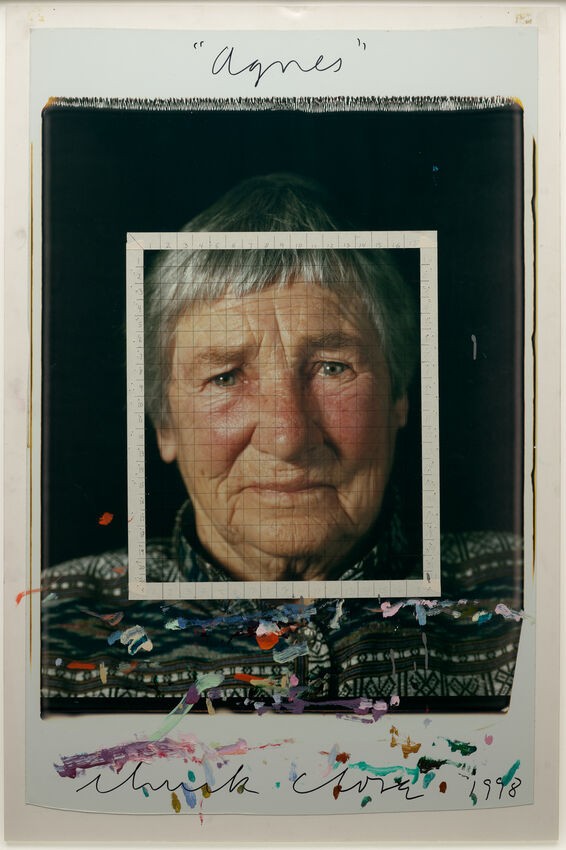

Agnes Maquette (1998) and Agnes. The maquette is dated 1998. Agnes Martin, whose room is next to Marden's on this floor, was eighty-six. Her own paintings are grids, drawn in pencil across pale fields. Close's portrait of her is a grid too: large, oil on canvas, built from cells, her short gray hair and lined face held in the same structure she used for her abstract work.
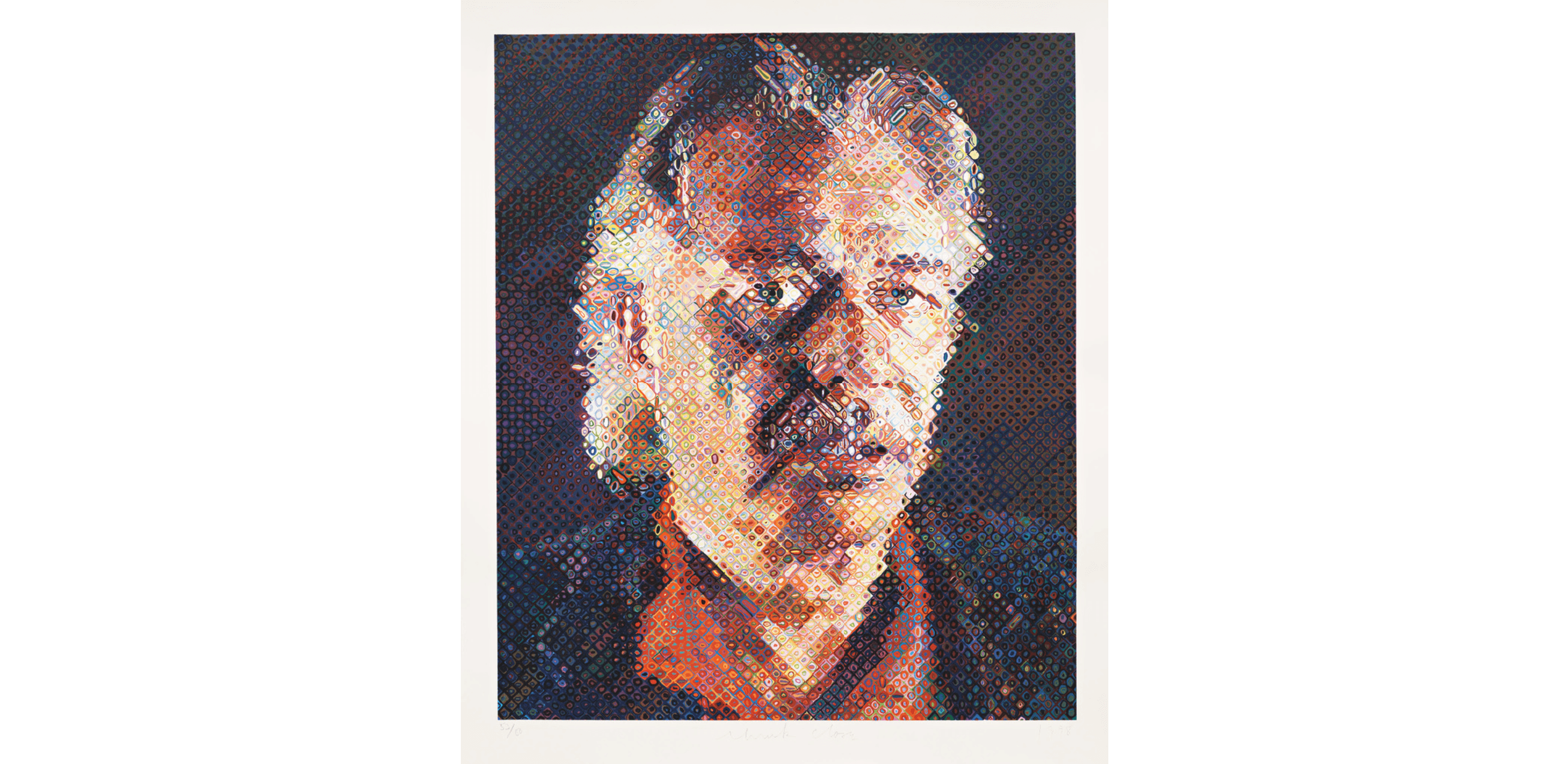
John (1998). A screenprint in 126 colors of John Chamberlain, edition 2/80, dated 1998. Chamberlain's crushed-steel sculptures stand in the City Gallery on this floor. This impression carries a handwritten dedication: "For Don & Doris," the Fishers whose collection fills this floor. Pulling 126 separate colors through a screen to build one face is the grid method moved into print.
Taken together, the room is a group portrait of Close's world: friends and peers he asked to sit for him, three of whom also hang a short walk away.
The Later Record
In December 2017 the New York Times and HuffPost published accounts by women who said Close had invited them to his studio, asked them to pose nude, and spoken to them crudely. More accounts followed in early 2018. Close apologized. The National Gallery of Art canceled an exhibition planned for 2018. He had been diagnosed with frontotemporal dementia in 2015, and his neurologist later said the behavior could be linked to it. Close died on August 19, 2021, in Oceanside, New York, at eighty-one.
The portraits here were made by a man who could not recognize faces, painted after his body had nearly stopped, of fellow artists who sat for his camera. Both the work and the record stand, and visitors can weigh them as they choose. 🌁
Timeline — Chuck Close
July 5, 1940 — Born in Monroe, Washington.
1945 — Family moves to Tacoma.
c. 1951 — His father dies when Close is eleven.
1958–1960 — Everett Junior College.
1961 — Scholarship to the Yale Summer School of Music and Art.
1962 — BA, University of Washington.
1964 — MFA, Yale; then Fulbright to the Academy of Fine Arts Vienna.
1967 — First solo show, at the University of Massachusetts, closed over nudity; moves to New York; begins working from photographs with a grid.
1967–1968 — Paints Big Self-Portrait.
1969 — The Walker Art Center buys Big Self-Portrait.
1970 — First New York solo show, Bykert Gallery.
1972 — Mezzotint residency at Crown Point Press, San Francisco.
1977 — Joins Pace Gallery.
1986 — Works with the woodblock printer Tadashi Toda in Kyoto.
December 7, 1988 — Spinal artery collapse leaves him paralyzed from the neck down.
1993 — Polaroid of Lorna Simpson.
1994 — Roy/maquette, for Roy I.
1997 — Roy Lichtenstein dies.
1998 — Agnes Maquette; John screenprint.
2015 — Diagnosed with frontotemporal dementia.
December 2017 — Harassment allegations published.
2018 — The National Gallery of Art cancels his exhibition.
August 19, 2021 — Dies in Oceanside, New York.