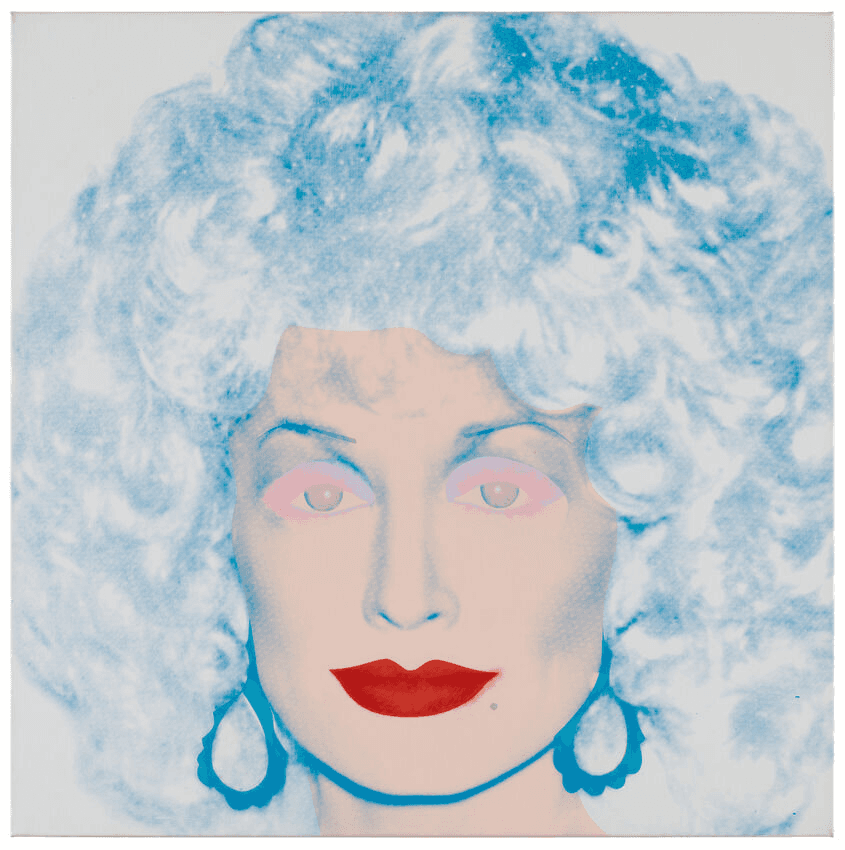
SFMOMA, Part 23: Floor 2, section 1900 to Now.
She is forty-two inches square and she is the most famous person in the room.
That is not a small claim on Floor 2 of SFMOMA, where the neighbors include Pollock and Rothko and the rest of the twentieth century's heavyweight division. But fame is a different currency from importance, and Andy Warhol — who spent his life arbitraging the two — understood the exchange rate better than anyone. Dolly Parton is not the most important painting in the 1900 to Now galleries. It might be the most honest about what it is.
The portrait is classic late Warhol: a silkscreened photograph, blown up, laid over flat acrylic color, the features sharpened into icon and the icon sharpened into product. Dolly's hair is a golden nimbus. Her smile is enormous and precise. The background is a flat, hot color that makes the whole thing hum like a neon sign. It looks like a record sleeve and a religious icon and an advertisement, which is to say it looks like America.
Andy Warhol made Dolly Parton in 1985, in acrylic paint and silkscreen ink on linen, and it measures 42 × 42 inches — 106.7 × 106.7 cm. It belongs to the Doris and Donald Fisher Collection, one of the 1,100 works the Gap Inc. founders placed at SFMOMA. It is currently on view on Floor 2 as part of 1900 to Now: SFMOMA's Collection.
The easy reading is that this is Warhol on autopilot — the portrait factory, the society commissions, the late-career cash register ringing. And it is true that by 1985 the commissioned portrait was Warhol's business model: celebrities, socialites, and businessmen paid handsomely to be Warholized, and the studio ran the silkscreens like a mint. But the subject is sharper than that. Dolly Parton is not just another commission. It is Warhol painting the one celebrity who understood his project better than he did — the woman who had already turned herself into a silkscreen before he ever picked up the squeegee.
1928–1968: The machine
Andy Warhol was born Andrew Warhola in 1928 in Pittsburgh, the son of Slovak immigrants, and he spent his life converting that unglamorous origin into the most glamorous surface in American art. The early 1960s made him: the Campbell's soup cans (1962), the Marilyns (1962), the car crashes and electric chairs, the Factory, the whole beautiful apparatus. Then 1968 — Valerie Solanas shot him, nearly killed him, and the art world assumed the story was over.
It wasn't. The 1970s and 1980s were Warhol's second act, and it was built on portraits. The museum's own 2019 retrospective put it plainly: the late galleries were a "facebook" — wall-to-wall grids of large-scale silkscreened portraits, "a who's who of celebrities, cultural icons, gallerists, athletes and business leaders from the late 1960s to the mid-1980s." Halston. Liza Minnelli. Pelé. Gianni Versace. Robert Mapplethorpe. His mother, Julia Warhola. And Dolly Parton, 1985.
For the sitters, a Warhol portrait was social validation and a status symbol. For Warhol, the commissions were "a consistent revenue stream that supported his studio and desire to explore other more personal ventures." That is the museum's language, and it is admirably frank. The portraits paid for everything else. But the frankness misses something: Warhol was genuinely interested in these faces. Not in their souls — he was never in the soul business — but in the machinery of their fame, the way a person becomes an image and the image becomes a fact. Nobody embodied that machinery more completely than Dolly Parton.
Dolly, the original
Consider the sitter. Dolly Parton, born 1946 in Sevier County, Tennessee, the fourth of twelve children, grew up in a one-room cabin with no electricity. By 1985 she was one of the most famous women on earth — country music's biggest star, a movie star (9 to 5 was 1980), a songwriter of genius ("Jolene," "I Will Always Love You"), and the architect of the most deliberate persona in American entertainment.
The persona is the point. Dolly has spent sixty years explaining, cheerfully and repeatedly, that the hair is a wig, the figure is engineered, the whole thing is a construction — and that the construction is the art. "It costs a lot of money to look this cheap," she says, and the line is funny because it is true and true because it is a business plan. She owns her masters. She built Dollywood. She turned down Elvis's people when they wanted half the publishing on "I Will Always Love You." She is the rare celebrity who is also the CEO of the celebrity.
Warhol must have recognized a colleague. His whole project was the observation that in modern America, the image is the person and the person is the image, and the smart move is to own the means of reproduction. Dolly had been running that play since before Warhol's soup cans. She didn't need him to make her an icon. She needed him the way he needed her: as confirmation that the game was real, and that they were both winning it.
Look at the portrait with that in mind and it stops looking like a commission and starts looking like a collaboration. The silkscreen treatment — the flattening, the color, the repetition-ready image — doesn't impose Warhol's style on Dolly. It reveals that Dolly was already working in Warhol's medium. She is the rare sitter who meets the silkscreen halfway.
The process
The way these portraits were made is part of the meaning. Warhol's method, by 1985, was industrial and intimate at once: he photographed the sitter himself, usually with a Polaroid Big Shot — the fixed-focus portrait camera that became his signature tool — shooting roll after roll in a session that was part sitting, part performance. He selected the frame, had it blown up, transferred it to silkscreen, and then painted the canvas underneath before pulling the screen across it. The sitter got the photograph's likeness. Warhol got everything else: the color, the cropping, the flattening, the final decision about what the face would mean.
The Polaroids are artworks in their own right — Vanderbilt's 2018 exhibition Famous! (and Not-So-Famous) showed the outtakes and contact sheets, and they are revealing. Warhol was a good photographer in the way a good predator is a good observer: patient, unblinking, interested in the exact moment the mask settles. The Dolly Polaroids from 1985 would show a woman who had been photographed ten thousand times and knew exactly what to give the camera. Warhol knew what to take.
There is a detail I love: Warhol kept everything. The 610 Time Capsules — cardboard boxes he filled with the daily debris of his life, sealed, and shelved — are the most compulsive archive in American art. The man who made his name on the fifteen-minutes line was terrified of losing a single minute. The portraits are the public version of the same impulse: save the face, file it, keep it. Dolly Parton is Time Capsule number something, except it hangs on a museum wall.
1985: The last portraits
Context. 1985 is late Warhol — two years before his death in February 1987, at fifty-eight, after routine gallbladder surgery. The art world of 1985 had largely written him off as a society painter, a sellout, a relic of the sixties running a portrait mill. The Neo-Expressionists were the hot thing. The East Village was the scene. Warhol was the guy who painted rich people's friends.
History has been revising that verdict ever since, and the revision is mostly correct. The late portraits — the Reigning Queens series (1985), the Cowboys and Indians (1986), the giant Last Supper cycle (1986) — are stranger and darker than the commission-mill story allows. Warhol knew he was dying; you can feel it in the late work, in the skulls and the shadows creeping into the bright colors. The Dolly Parton sits right at the edge of that turn: still bright, still commercial, still fun — but made by a man who had two years left and knew, on some level, that the party was ending.
There is a temptation to read the late portraits as cynical, and some of them are. This one isn't. Or if it is, the cynicism is mutual and affectionate — two professionals acknowledging each other's craft. Dolly's craft is being Dolly. Warhol's craft is showing you that being Dolly is a craft. The portrait is the receipt.
The Fisher wall
A note on where it hangs, because it matters. This is a Fisher Collection painting — Doris and Donald Fisher, the Gap founders, whose 1,100-work collection is one of the great private holdings of contemporary art in America. The Fishers bought Warhols the way they bought everything: at scale, with conviction, early. The Dolly Parton is part of the 1900 to Now hang on Floor 2, which means it shares a wall lineage with the abstract expressionists and the pop artists and the whole official story.
And there is something perfect about Dolly Parton — the woman from the one-room cabin in Sevier County, the woman who owns her own image outright — hanging in the collection of the people who built Gap Inc. The museum doesn't comment on it. The painting doesn't need the comment. But stand in front of it and think about the chain: a poor girl from Tennessee builds herself into an icon; a poor boy from Pittsburgh builds himself into the artist who paints icons; a couple from San Francisco builds a clothing empire and buys the painting. Everybody in the chain understood the same thing: the image is the business, and the business is real.
Go see her. She is forty-two inches square, she is smiling, and she knows exactly what she's doing. So did he. 🌁
Timeline — Andy Warhol / Dolly Parton
1928 — Andy Warhola born August 6, Pittsburgh, Pennsylvania, to Slovak immigrant parents
1946 — Dolly Parton born January 19, Sevier County, Tennessee, fourth of twelve children
1962 — the Campbell's soup cans; Warhol becomes the defining artist of pop
1968 — shot by Valerie Solanas on June 3; survives, withdraws, rebuilds
1970s — the portrait commissions become the studio's economic engine: the "facebook" of celebrity, society, and business sitters
1980 — 9 to 5 makes Dolly Parton a movie star; she is among the most famous women alive
1985 — Warhol paints Dolly Parton, silkscreen ink and acrylic on linen, 42 × 42 in.; the same year as the Reigning Queens series
1987 — Warhol dies February 22, New York, aged fifty-eight, after gallbladder surgery
2009 — Doris and Donald Fisher place their 1,100-work collection at SFMOMA
2019 — Andy Warhol — From A to B and Back Again at SFMOMA; Dolly Parton (1985) hangs in the portrait "facebook"
Today — Dolly Parton on view, Floor 2, 1900 to Now: SFMOMA's Collection, 151 Third Street