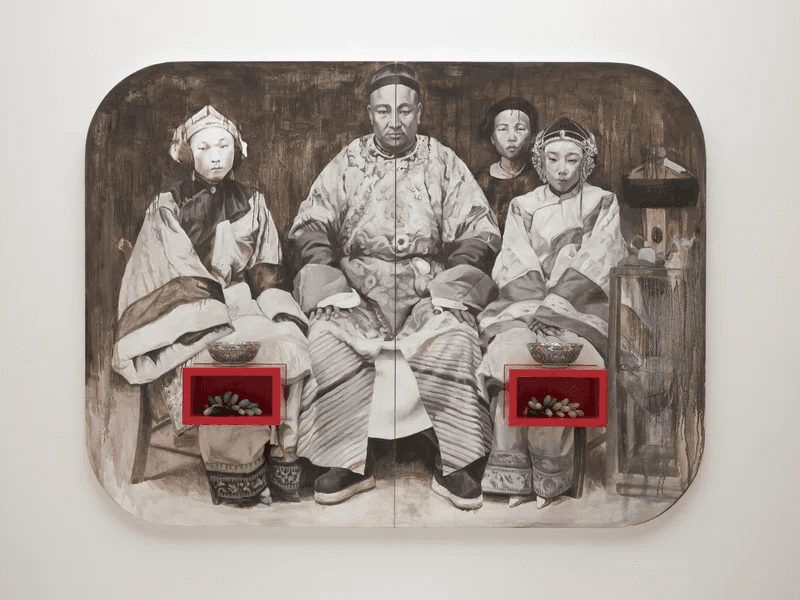
SFMOMA, Part 24: Floor 2, 1900 to Now. Family II (Hung Liu, 1991).
The paint is crying. That's the first thing — before the shaped canvas, before the jade, before the little ceramic bowls bolted to the surface like offerings. Hung Liu's oil paint drips. Thin washes of linseed oil run down the canvas in vertical tears, dissolving the edges of the figures, blurring the family group in its domestic interior until the whole thing looks like a memory developing in reverse — coming apart instead of coming clear. She called it weeping realism. A critic who respected her said what she'd accomplished with the dripping was to "dissolve" the rigid classicism she'd been trained in, in China, where even one drip would have been regarded as a lack of faith in Socialist Realism. Her question, the one the drips ask: "How do you paint the moment when history surrenders to memory?"
Family II (1991) is oil on shaped canvas — not rectangular but cut to a silhouette — with lacquered wood, jade, and ceramic bowls attached. A tea set juts from the surface on little platforms. The jade is an heirloom. The lacquered wood recalls Chinese furniture, Chinese funerary craft. The bowls are ritual vessels, the kind you'd set out for ancestors. The painting is a domestic altar: the family group rendered in loose, drippy oil, and then the offerings bolted on, as if the image alone weren't enough — as if the dead needed something to drink. Liu: "My painting is a memorial site for them." The curator Maureen Kienberger: one way she honors her subjects "is by offering them a kind of precious token."
Hung Liu lived exactly half her life in each country — thirty-six years in China, thirty-six in the United States. Born 1948 in Changchun, raised in Beijing; her father was imprisoned when she was an infant. The Cultural Revolution, 1968 to 1972: four years of forced farm labor, sketching in secret — the My Secret Freedom drawings, acquired by SFMOMA in 2018. Trained in Socialist Realism at the Central Academy of Fine Arts; taught art on national Chinese television. Waited four years for a passport to UC San Diego: "At every level, they tried to stop me." MFA in 1986, alongside Carrie Mae Weems and Lorna Simpson, studying with Allan Kaprow. Then Mills College, Oakland — head of painting, 1990 to 2012, twenty-four years, mentoring a generation including Stephanie Syjuco. Died of pancreatic cancer in Oakland, August 2021, age seventy-three — nineteen days before her retrospective opened at the National Portrait Gallery, the first solo show by an Asian American woman in that museum's history. The Wall Street Journal's David Littlejohn called her "the greatest Chinese painter in the U.S."
Preserve and destroy
"I want to both preserve and destroy the image." That's Liu on her method, and Family II is the sentence made physical. The source photograph — some Chinese family group, unidentified in the published sources — is preserved: you can still read the figures, the interior, the arrangement. And destroyed: the drips unmake it, the glazes surrender to serendipity, the figure-ground relationship breaks down. The shaped canvas refuses the rectangle. The attached objects refuse painting altogether. Every decision says the same thing: the image is not enough, and the image is too much. Keep it. Ruin it. Honor it.
The year matters. 1991 was her breakthrough Bay Area year — Bad Women at Rena Bransten, the NEA Painting Fellowship — and the year of her first return to China, where she found a catalog of late-nineteenth-century portraits of high-class prostitutes, photographed for wealthy men to shop from. "The women were doing the most hilarious things, like holding a book in hand, even though women were not allowed to learn to read and write. The purpose was to sell themselves." She painted them with crowns and medallions instead. The feminist engine of everything she did: take the women history used and give them the regalia history denied them. Family II, from the same year, is the domestic version — the family as altar, the ancestors as honored guests, the bowls as offerings. The prostitutes got crowns. The family gets tea.
The gift
SFMOMA's Family II came as a gift of the estate of Joyce L. Stupski, 2021. Joyce Stupski — Bay Area philanthropist, co-founder of the Stupski Foundation with her husband Larry, the former Charles Schwab president — died July 19, 2021. Hung Liu died August 7. Nineteen days apart. The Stupskis bought art as, in their phrase, "wall decorations," not investments. A painting about family and ancestral offering, given weeks after both deaths — the poignancy writes itself. The museum already held her monumental Avant-Garde shaped canvas, the My Secret Freedom drawings, and had given her the 1992 SECA Art Award. Family II is the hinge work: the breakthrough year, the first return, the altar form at its most distilled.
And here is the pairing the floor hands you, free of charge: Chinn's The Family (Part 23) and Liu's Family II — both 1991, both about family, hanging on the same floor. Chinn's is photorealist acrylic, a vanitas-memorial for a dying man, every detail sharp. Liu's is drippy oil on a shaped canvas with real bowls attached, an altar for ancestors, every edge dissolving. Same year, same theme, opposite methods: one preserves by precision, the other by weeping. Between them, a whole theory of what family painting can do.
So here's the thesis: Family II is an altar disguised as a painting, or a painting that gave up and became an altar. The drips say history surrenders to memory. The shaped canvas says the rectangle is a Western convention. The jade and the bowls say the dead need more than images — they need offerings, tokens, tea. Liu spent her career painting the women and families that Chinese history erased, and her method was always double: preserve the photograph, destroy the photograph, honor the subject. "I want to both preserve and destroy the image." The family is there. The family is dissolving. The bowls are real. Drink up. 🌁
Timeline — Hung Liu
1948 — born February 17, Changchun, China; raised in Beijing
1968–1972 — Cultural Revolution; four years forced farm labor; secret sketches
1981 — mural-painting degree, Central Academy of Fine Arts, Beijing
1986 — MFA, UC San Diego; emigrates to the US
1990–2012 — head of painting, Mills College, Oakland
1991 — paints Family II; Bad Women; first return to China; NEA Fellowship
1992 — SECA Art Award, SFMOMA
2021 — dies August 7, Oakland, age 73; estate gift brings Family II to SFMOMA