Abstract Sculpture From Car Parts
SFMOMA, Floor 4 · Ways of Seeing: Fourteen Artists.
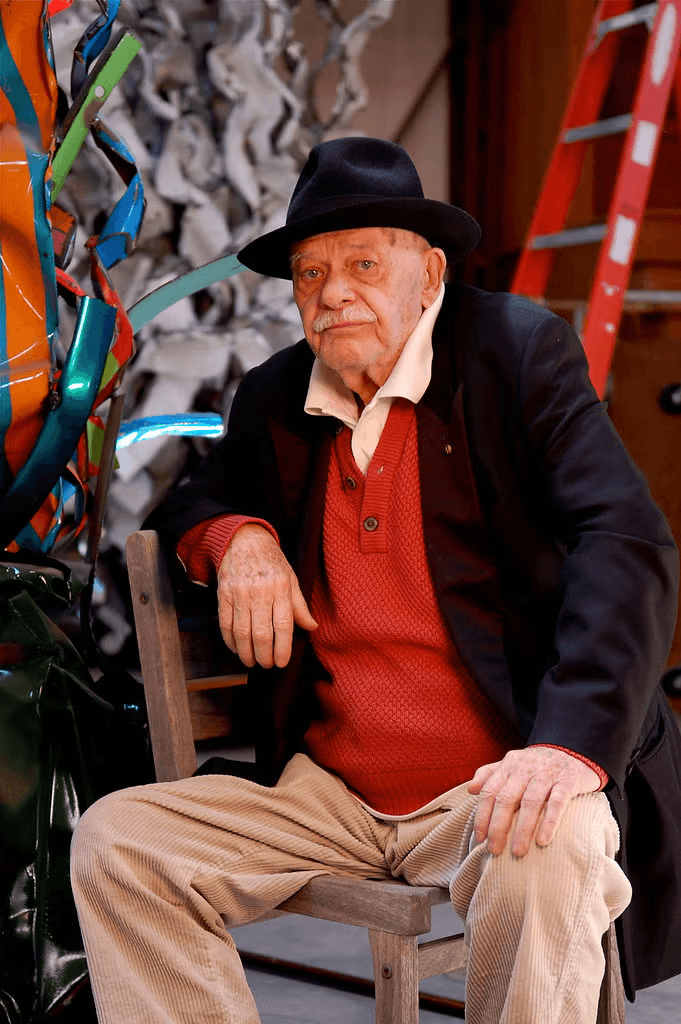
The City Gallery is where Ways of Seeing breathes out. Five sculptures by John Chamberlain stand across the floor, made of crushed and bent metal, many of them from car parts. They're loud with color, folded like cloth, and shiny where the chrome survived. Chamberlain is the artist given most of the space in this room, and he is the likeliest fourteenth name in the show's title.
People usually call his material junk. He didn't. "I think of my art materials not as junk but as—garbage," he said. And he refused the idea that he worked with found objects at all: "They're chosen, you see. The idea is that there has been a lot of magic implied in the choice."
Navy, Chicago, and the Poets (1927–1956)
John Chamberlain was born on April 16, 1927, in Rochester, Indiana. His parents divorced and he was raised mostly by his grandmother, spending much of his youth in Chicago. At sixteen he joined the Navy and served from 1943 to 1946.
He studied at the School of the Art Institute of Chicago in 1951–52. He turned to metal in 1952 and was welding by 1953; his early welded pieces show a debt to David Smith. Then, in 1955–56, he went to Black Mountain College in North Carolina, and there he studied with poets rather than painters: Charles Olson, Robert Creeley, Robert Duncan. He never became a poet, but his titles are full of odd words and word games, and his way of building, by choosing pieces that fit, has something of a poet's ear about it.
The First Car (1957–1962)
In 1957, staying with the painter Larry Rivers in Southampton, New York, he made Shortstop, the first sculpture in which he used scrap metal from cars. From 1959 his crushed-car sculptures started to succeed. They arrived at an exact moment. Abstract Expressionism was still the reigning style, and Pop was about to arrive. Chamberlain's sculptures sat on the line between them: the energy and twisting forms of gestural painting, made out of the most mass-produced object in America, already painted in the colors Detroit had picked.
Leo Castelli began representing him in 1962 and stayed his dealer until 1987.
The Room

Bijou (1961). Painted and chromium-plated steel: the earliest Chamberlain here. The color is car color, and the chrome shines from inside the crumples. Chamberlain didn't paint this; his decision was where each colored piece would fold and meet the next. He wanted his sculptures to have energy. "It just can't be a blob sitting there," he said. "It should be doing something." Bijou is a jewel, in name, and it does what a jewel does: it catches light on every face.

Crissum-Kiss (1967) and its touch object. Galvanized steel, about the size of a small suitcase, with a second piece nearby that visitors are allowed to handle. In the late 1960s Chamberlain stepped away from painted car metal and tried almost everything else: foam rubber tied with rope, melted Plexiglas, crumpled aluminum foil, and galvanized steel. One account says the galvanized pieces began as metal boxes from Donald Judd's studio, crushed in a baling machine and spot-welded together. Without car color, the folding is all you see: a gray sheet bent like paper. A crissum is the patch of feathers under a bird's tail. The touch object is there because these works are about force. Your hand learns what the eye only guesses.

Coconino (1969). Painted and chromium-plated steel. Back to color in the same years as the experiments. By now Chamberlain had represented the United States at the 1964 Venice Biennale, and in 1971 the Guggenheim gave him his first retrospective.

Fiddler's Foot (1978). Painted and chromium-plated steel, aluminum, car body parts, and plastic: the widest mix of materials here. By 1974 he was back to car metal as his main material. In his later work he also sprayed and buffed color onto the metal himself and used long, thin parts like bumpers, so the color was no longer only what the factory had chosen.

Fenollosa's Column (1983). Painted and chromium-plated steel, a vertical work, as the title says. Ernest Fenollosa was a nineteenth-century American scholar of Japanese art whose notes on Chinese poetry Ezra Pound later edited and published. A sculptor trained by poets named a column of crushed metal after one of modern poetry's sources. In the early 1980s Chamberlain moved to Sarasota, Florida, and the scale of his work grew. Asked about meanings, he answered sideways: "Even if I knew, I could only know what I thought it meant."
What the Room Shows
The five works cover twenty-two years: car color in 1961, gray galvanized steel in 1967, color again in 1969, mixed materials in 1978, a column in 1983. The method doesn't change. Metal is crushed, pieces are chosen, they are fitted, and then the work is stopped. "Stopping is the key," Chamberlain said. "You have to know when to stop."
He also suggested owners clean his sculptures, "at least once," because cleaning shows how they are put together. It's a good way to look at them in the museum, too: follow one piece of metal with your eye and see where it goes, under what, and against what.
Donald Judd and the Dia Foundation supported his work, and a large group of it is at the Chinati Foundation in Marfa, Texas. In 1998 Chuck Close made a 126-color screenprint portrait of him, John, which hangs in the Close room on this floor. Chamberlain later lived and worked on Shelter Island, New York. He died in New York on December 21, 2011, at eighty-four. A few months later the Guggenheim opened John Chamberlain: Choices, which ran until May 13, 2012. 🌁
Timeline — John Chamberlain
April 16, 1927 — Born in Rochester, Indiana.
1943–1946 — Serves in the U.S. Navy.
1951–1952 — School of the Art Institute of Chicago.
1952–1953 — Turns to metal; begins welding.
1955–1956 — Black Mountain College; studies with Olson, Creeley, and Duncan.
1957 — Shortstop, his first work with car metal, made at Larry Rivers's in Southampton.
1959 — Crushed-car sculptures begin to succeed.
1961 — Bijou.
1962 — Joins Leo Castelli.
1964 — Represents the U.S. at the Venice Biennale.
Late 1960s — Foam, Plexiglas, foil, and galvanized steel.
1967 — Crissum-Kiss.
1969 — Coconino.
1971 — First Guggenheim retrospective.
By 1974 — Back to car metal.
1978 — Fiddler's Foot.
Early 1980s — Moves to Sarasota, Florida.
1983 — Fenollosa's Column.
1987 — Leaves Castelli.
1998 — Chuck Close's portrait John.
December 21, 2011 — Dies in New York.
2012 — John Chamberlain: Choices at the Guggenheim.