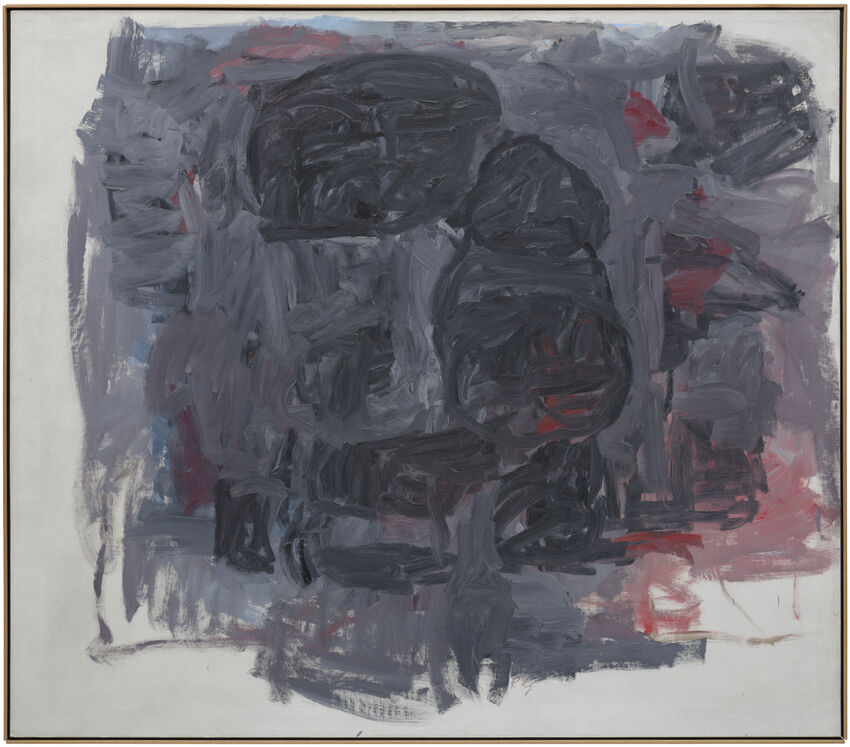
SFMOMA, Part 39: Floor 4, Fisher Collection, Ways of Seeing: Fourteen Artists.
The title says fall, as in autumn. The painting says fall, as in falling apart.
Late Fall (1963) is nearly six and a half feet tall, and it hangs in the Guston gallery like a held breath. The brushwork is still the great abstract machinery — the dragging strokes, the built-up grays, the touch no one in New York could match — but something has gone wrong inside it, or right, depending on how you read the next decade. The marks are clumping. Forms are gathering at the edges of recognition: lumps, heads, hoods, things that are almost objects and not quite. It's as if the abstraction is curdling, the way milk curdles — the smooth surface breaking into shapes it can't unmake.
Guston painted it in 1963, seven years before the Marlborough show that would get him excommunicated, and five years before he would start painting the hooded Klansmen in earnest. Nobody looking at Late Fall in 1963 could have predicted the cartoon cars. But the painting knows something the audience didn't. The figuration isn't coming. It's already here, pressing up from underneath like weather.
Philip Guston painted Late Fall in 1963, in oil on canvas. It measures 68 × 77½ inches — 172.7 × 196.9 cm. It belongs to the Doris and Donald Fisher Collection and is on view on Floor 4 as part of Ways of Seeing: Fourteen Artists, in the monographic Guston gallery of the reimagined Fisher Collection presentation that opened April 18, 2026. Entry is included with general admission.
The easy reading is: late abstract Guston, the transitional work, the bridge between the 50s abstractions and the 70s figuration. And that reading is accurate, as far as it goes. But the subject is sharper than that. Late Fall isn't a bridge. It's a symptom. Bridges are built on purpose; symptoms arrive uninvited. This painting is the sound of a style developing a conscience — of Guston's hand starting to paint things his mind hadn't approved yet. The tragedy and the glory of the next twenty years are both right here, in the curdling.
1963–1968: The long goodbye
What happened to Guston in the mid-60s is one of the least discussed and most important passages in postwar American painting, because it doesn't photograph well. There was no scandal, no manifesto, no dramatic break. There was a slowdown. The abstractions got darker, heavier, more congested — the paint still masterful, the touch still unmistakable, but the confidence leaking out of them like air from a tire. Late Fall is 1963; by 1966, Guston had more or less stopped painting altogether.
He'd hit the wall that every honest abstract painter of his generation eventually hit: the gesture had become a style, the style had become a performance, and he was sick of the performance. While the art world moved on to pop and minimalism — to Warhol's silk-screens and Judd's boxes, to everything cool and detached — Guston sat in Woodstock (he'd moved there in 1967) and didn't paint. For months. The painter's painter, the insider's insider, with nothing to say in the language he'd mastered.
And then, around 1968, the hoods came. Not as a decision — as a return. The hooded, faceless figures he'd been drawing since he was nineteen, since the shed in Los Angeles, since the thing he never spoke about. They came back as Klansmen in cartoon cars, smoking cigars, painting self-portraits, and Guston — who had spent fifteen years proving he could paint like a master — started painting like a man who didn't care whether you thought he could paint at all. The clumsiness was the point. Doing it well would have been a lie.
The curdling
Look at Late Fall with that story in mind and the painting changes. Those clumping forms at the edge of recognition — are they heads? Hoods? The question the painting won't answer is the question Guston spent the next decade answering, badly, on purpose. The abstraction isn't failing here. It's remembering. The hand remembers the shed, the hoods, the faces without faces, and the paint — which has always been smarter than the painter — starts making shapes before the mind gives permission.
This is why the Fisher hang matters, and why the monographic gallery is the right way to see him. In most museums, you get one Guston — the abstract one or the late one, depending on the curator's thesis — and the career reads as two different artists. Here, the arc is continuous: The Street (1956) on one wall, Late Fall (1963) a few feet away, the late objects down the line. You can watch the curdling happen in real time. The same dragging touch, the same bruised palette, and somewhere between 1956 and 1963, the paint starts dreaming of other things.
There's a temptation to read Late Fall as a tragedy — the great abstractionist losing his nerve. Resist it. The painting isn't weaker than The Street. It's more honest. The 50s abstractions were performances of certainty; this is the performance breaking down, and the breakdown is where the truth lives. Guston didn't lose abstraction. He outgrew the need to pretend it was enough.
The painting, again
So back to Floor 4, back to the held breath. Stand in front of Late Fall and let the almost-forms do their work: the lumps that want to be heads, the verticals that want to be figures, the whole surface trembling on the edge of becoming something it isn't supposed to be yet. It's the most suspenseful painting in the Guston room, because it's the only one that doesn't know its own ending.
And here's the thing I keep coming back to: we know how the story ends — the Klansmen, the shoes, the clocks, the vindication, the $25.9 million auction record, the young painters who cite him like scripture. The painting doesn't know any of that. In 1963, the future was just the curdling: the uncomfortable feeling that the thing you'd mastered wasn't the thing you needed. Late Fall is the portrait of that feeling, painted at the scale of a wall, in the most beautiful brushwork of its decade.
Go see it between the street and the brushes. It's the hinge the whole career turns on — the moment the paint started telling the truth before the painter was ready to hear it. 🌁
Timeline — Philip Guston
1956 — The Street; abstraction at its peak
1963 — paints Late Fall, oil on canvas, 68 × 77½ in.; the abstraction starts curdling, forms gathering at the edge of recognition
1966 — stops painting; the crisis years; the gesture has become a performance
1967 — moves to Woodstock, New York
1968 — the hooded figures return: Klansmen in cartoon cars, painted badly on purpose
1970 — the Marlborough show; the art world walks out
1971 — the Poor Richard Nixon drawings; satire as exorcism
1978 — the late studio objects: brushes, clocks, shoes
1980 — dies June 7, Woodstock, age 66
Today — Late Fall on view, Floor 4, Ways of Seeing: Fourteen Artists, the Doris and Donald Fisher Collection, SFMOMA, 151 Third Street