"The Spider Is an Ode to My Mother"

SFMOMA, Floor 6 · Memory and Matter: Personal and Collective Histories
The first thing you meet on Floor 6 is a steel spider about eleven feet tall, standing in the middle of the room with no barrier around it. You can walk underneath it. Louise Bourgeois made it in 1995, when she was eighty-three. "The Spider is an ode to my mother," she said. Three more works in the room go back fifty years earlier, to the wooden figures she made in New York in her thirties. Together they cover the two ends of a career that ran almost seventy years and drew, by her own account, entirely on her own life.
A Tapestry House on the Bièvre (1911–1932)
Louise Bourgeois was born in Paris on December 25, 1911, the middle child between an older sister, Henriette, and a younger brother, Pierre. Her parents, Louis Bourgeois and Joséphine Fauriaux, dealt in antique tapestries. They kept a gallery in Paris and a restoration workshop at home, first behind the house in Choisy-le-Roi, just outside the city, and from 1919 in Antony, where the river Bièvre ran through the garden.

The First World War took her father to the front. He was wounded in 1915, and Louise went with her mother to visit him in a hospital in Chartres. Around the end of the war her mother fell ill, by most accounts with the Spanish flu, and never fully recovered. Louise became her nurse. Her schooling was interrupted again and again so she could care for her mother and travel with her to warmer places for the winter.
From about 1923 she also worked in the family workshop. Old tapestries came in with worn or missing sections, and someone had to draw what was gone so the restorers could reweave it. Louise drew it. She became the workshop's specialist in legs and feet.
In 1922 the family hired an English tutor for the children, Sadie Gordon Richmond, only a few years older than Louise. Sadie lived with the family on and off for the next ten years, and she became Louis's mistress. Joséphine knew and put up with it. Louise took it as a betrayal by all three adults, and she never stopped returning to it.
Joséphine died in Antony on September 14, 1932. Louise was twenty.
Mathematics, Then Art (1930–1938)
In the early 1930s Bourgeois studied mathematics at the Sorbonne. Geometry appealed to her because it held still. "I got peace of mind, only through the study of rules nobody could change," she said. Her mother's death ended that. By her own later account she attempted suicide soon afterward.

She turned to art: art history at the École du Louvre, and a series of Paris studios and academies, among them the Académie de la Grande-Chaumière, where Brassaï photographed her in 1937. One of her teachers was Fernand Léger. "Louise, you are not a painter, you are a sculptor," she remembered him telling her.

In 1938 she set up a corner of her father's tapestry gallery to sell prints and paintings. One of the people who came in was Robert Goldwater, an American art historian. They married that year and moved to New York.
Three Sons and a Rooftop (1938–1949)
Bourgeois and Goldwater believed they could not have children, and in 1939 they went back to France to adopt a boy, Michel, born in 1936. He arrived in New York in 1940. That July Bourgeois gave birth to a son, Jean-Louis, and in November 1941 to another, Alain. By the end of 1941 she had three sons, the eldest five, an apartment on East 18th Street, and no family on her side of the Atlantic.
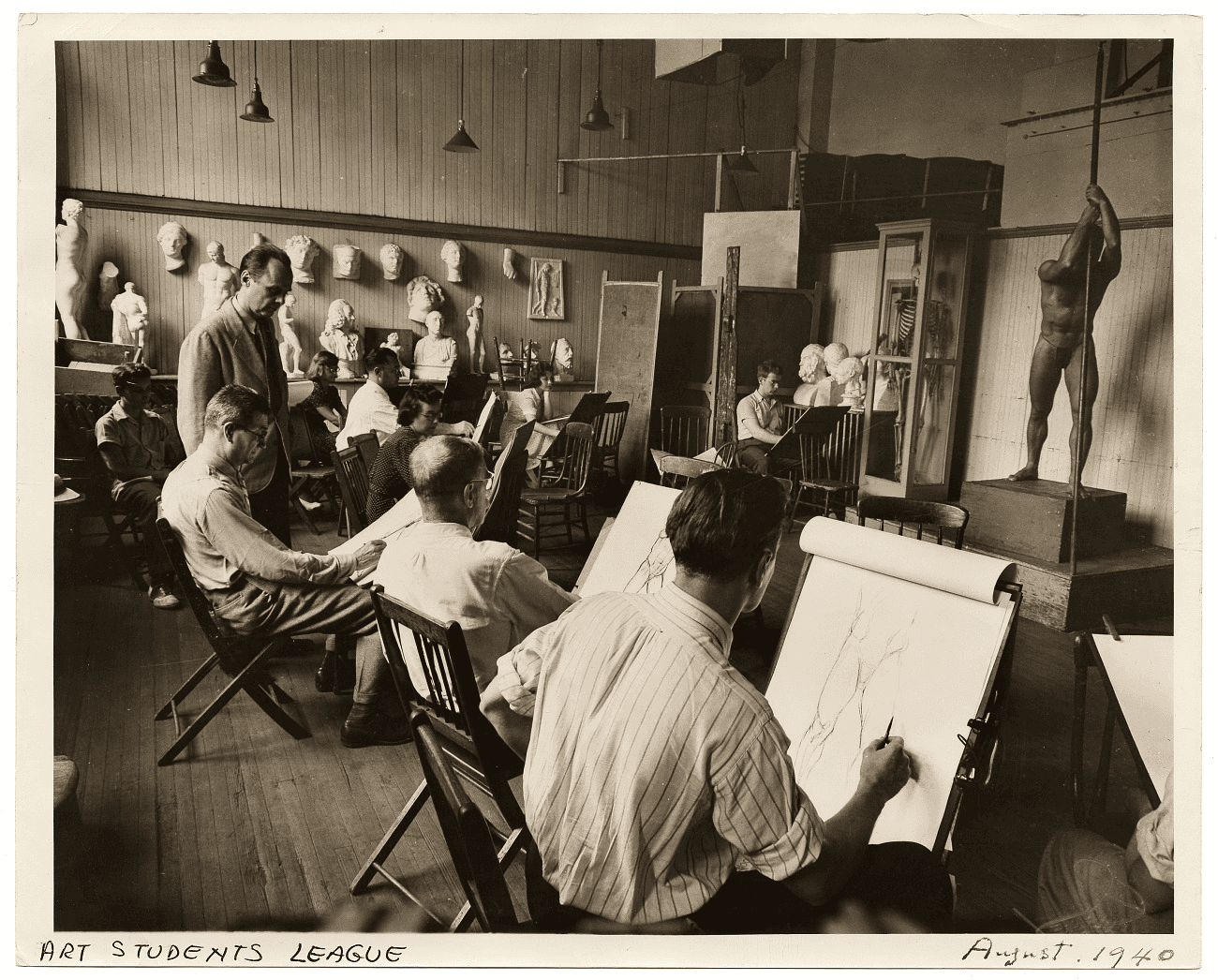
She enrolled at the Art Students League in 1939 to study painting with Vaclav Vytlacil. She made prints at home and, from 1946, at Atelier 17, the Paris print workshop that had relocated to New York during the war. Her first solo show, at the Bertha Schaefer Gallery in 1945, was of paintings. The best known paintings came in 1946–47, a series of four later titled Femme Maison.


Femme Maison means “woman house,” and plays on the French phrase for housewife. The title came later. Bourgeois painted the four canvases in 1946–47 and probably showed them at the Norlyst Gallery in 1947 under other names. Only in the 1970s, when the American women’s movement took them up, were they grouped as Femme Maison.
Each painting shows a woman standing upright, naked from the waist down, with a building where her head and upper body should be. The buildings differ: a brownstone, a neoclassical courthouse, a saltbox cottage, a French country house. All are places from Bourgeois’s own life. The woman’s identity is hidden by architecture, and her legs are left exposed.
The paintings come from the years when Bourgeois felt most confined. She had married quickly and left Paris abruptly in 1938. Her family was then cut off from her in occupied France, and she felt guilty for having gone. In New York she was raising three small boys. She suffered from agoraphobia, a fear of open and public spaces that kept her close to home. The house in these paintings is both her shelter and her trap.
A related canvas, Fallen Woman, lays the figure on her side, cut in two by a dark building. Looking back in the late 1980s, Bourgeois said she had painted the woman cut in half because “I experienced myself as cut in two.” In 1976 Lucy Lippard put a Femme Maison drawing on the cover of her book of feminist essays, From the Center. In 1984 Bourgeois made a small edition of Femme Maison prints from the 1947 drawing.
In 1947 Bourgeois published He Disappeared into Complete Silence, a book of nine engravings, each paired with a short parable she wrote herself. She had been making prints since 1946 at Atelier 17, the workshop the English printmaker Stanley William Hayter had founded in Paris and moved to New York during the war. There she worked beside artists from across occupied Europe. Early in 1947, her diaries show, she decided to gather her plates into a book, hoping it would get her work seen.
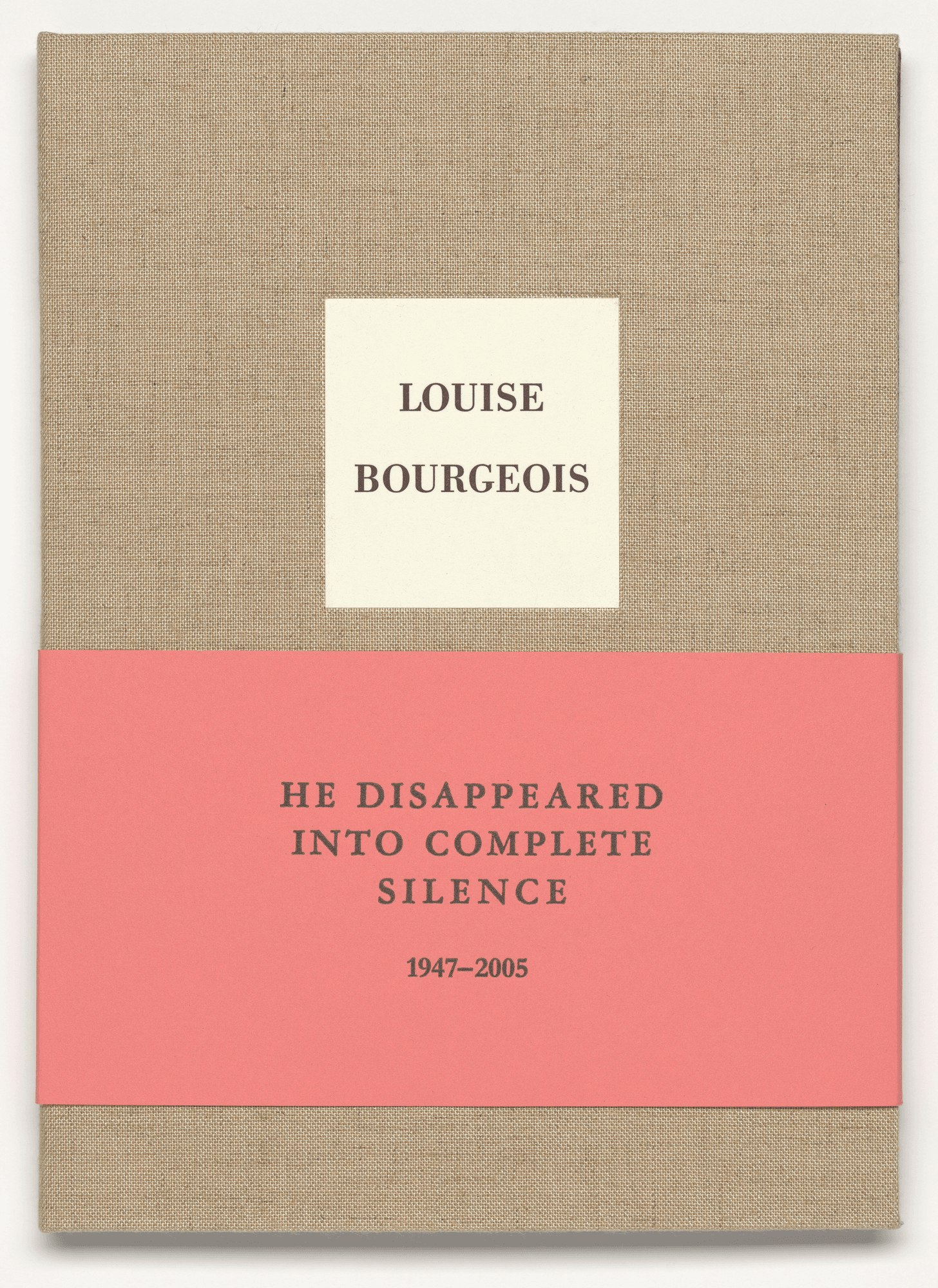
The project took up most of her year. The images were printed at Atelier 17. The text was set by Gemor Press, the small press run by the writer Anaïs Nin. The poet and critic Marius Bewley wrote the introduction, and Bourgeois met with him repeatedly to settle the titles and texts. Her notes list at least twelve more titles and several more parables that were cut. In the end she dropped the titles altogether and numbered the plates. The phrase that became the book’s title had first been meant for a single print.

The images are buildings that behave like people. Towers stand alone or in pairs, crowded together or set apart, and one column is banded like a silo. An early proof of the first plate was called The Solitary House. The parables are brief and bleak, mostly stories of a man and a woman who fail to reach each other. One ends: “Later on she died but he did not know it.”
Alfred Barr, the founding director of the Museum of Modern Art, bought a copy for the museum that year. It was one of the first signs of attention from the institution that would give her a retrospective thirty-five years later. Near the end of her life Bourgeois reworked the book for a second edition, published in 2005, and added a new plate: a spider.
The towers were sculptures on paper, and the real ones were already being made. Bourgeois had no studio, so she worked on the flat roof of the apartment building on East 18th Street, above the city, away from the children. There she began carving tall, thin figures out of wood, some of them in light balsa, and painting them black or white. A painting from 1948 shows that rooftop as her first sculpture studio. Another, Roof Song (1946–48), shows the figures themselves, standing upright in the open air like a small crowd. Within a year she would bring them indoors, to the floor of the Peridot Gallery.
The Personages (1945–1955)
The Personages are about eighty life-size figures Bourgeois carved in wood between 1945 and 1955. Most are tall, narrow, and tapered, and many come down to a single point at the bottom. In October 1949 she showed seventeen of them at the Peridot Gallery in New York, under the title Recent Work 1947–1949: Seventeen Standing Figures in Wood. She set them directly on the floor, without pedestals, in loose groups, so visitors moved among them the way they would move among guests at a party. Two more Peridot shows followed, in 1950 and 1953. Late in life she had the Personages cast in bronze. The two on Floor 6 are bronze casts made in 1989 and 1990 and painted to match the wooden originals; the Fishers bought them in 1997.

The Personages came out of homesickness, and Bourgeois said so herself. When she married Robert Goldwater in 1938 and left Paris, she did it quickly. At first she was optimistic about New York. Then the war came, France was occupied, and her family was cut off from her. According to the Met’s research for its 2022 show of her paintings, she felt isolated and anxious, and guilty for having left so abruptly. For the next several years she was in a foreign city raising three small boys, with her parents, sister, brother and Paris friends out of reach.

She worked through that loss first in paintings. Her pictures from around 1940 are full of figures standing near a house on a path or in a landscape. Confrérie (c. 1940) is one example: she later told the curator Deborah Wye it was a family portrait, with herself next to her parents. She called these early works “nostalgia pictures.” The Met traces the Personages directly to the visual vocabulary she built in these paintings and drawings after 1938. Thin vertical figures standing in for people, and buildings standing in for people, were already there.
The prints of 1946–47, especially He Disappeared into Complete Silence, pushed those figures toward three dimensions. Around the same time she started carving on the roof of the East 18th Street apartment building. There she made tall, narrow figures, some in balsa, painted black or white. Roof Song (1946–48) shows them standing up there in the open air.
Her own explanation came later, in 1976. She described them as “missed, badly missed presences” and as a tangible way of re-creating a missed past. In other words, she couldn’t bring her family and friends to New York, so she made stand-ins for them she could stand among. The word itself helps. In French a personnage is a character, as in a play. She wasn’t making portraits with faces. Each figure is a presence with its own posture and temperament.
That is why the way she showed them mattered as much as the carving. At the Peridot Gallery in October 1949, she put seventeen of them directly on the floor, with no pedestals, in loose clusters. The Met describes the effect as evoking the sociability of a party or a public square. Visitors walked among them as if joining a group of people. She was recreating company.
The series also changed over its ten years. The Kukje Gallery’s account divides it in two. The early figures were carved from a single piece of wood and are simple and clear. After about 1950 she began stacking repeated segments on a central rod, making more complex, modular figures. By the mid-1950s, after her father’s death in 1951 and the start of her psychoanalysis, the series ended and her work went quiet for years.
The broad interpretation is consistent across sources: museum labels, the Met and MoMA all say the figures stand in for the people she left behind. Specific identifications, such as “this one is her father,” are mostly speculation. The Museum of Fine Arts, Houston, for instance, offers several readings of one group: acquaintances, her own family, or friends left in France. Bourgeois herself tended to speak about the series as a whole rather than naming who each figure was.

Persistent Antagonism (1946–1948, cast 1989). Painted bronze, edition 1 of 6. A column about the height of a short adult and far narrower, white in its upper third and glossy black below, tapering at the bottom to a point that meets a small square black plinth. Where the colors meet, a tight collar rings the shaft. A metal cable threads through it, and from the cable hang eight thin, drooping elements, a small spiky skirt. Down the front of the black section runs a column of twelve short horizontal score marks that could be tallies. The title names a relationship, not a person: two forces that keep pushing against each other. The museum's label reads the spear-like shape as violence or isolation. SFMOMA owns the original painted-wood version, dated 1947–1949, which is not on view; the work in the room is the Fishers' bronze.
It began as a balsa-wood figure for the first Peridot shows. Hauser & Wirth, Bourgeois’s gallery, says the original was carved in balsa. It was shown at the Peridot Gallery in 1949 and again in 1950. That balsa original is the one SFMOMA owns; its own record dates it 1947–1949, and it is currently not on view. The Floor 6 piece is a later bronze cast. The editions carry the date 1946–48, so the conception goes back a year or so before the carving SFMOMA dates.
Bourgeois explained the title herself. According to the gallery, she said the “antagonism” came from feelings of isolation. The eight thin, finger-like forms hanging from the figure’s waist are what carry that feeling. So the “spiky skirt” you see on it isn’t decoration. In her account, it is the isolation. Its shape has two sources: New York and the body. The gallery reads the long silhouette as echoing the skyscrapers around her Manhattan home, and also as a phallic totem. The double reading fits her situation in the late 1940s. She had been uprooted to a city of towers, lived in a household of men (a husband and three sons), and was homesick for people she couldn’t reach.
The piece is pointed at both ends, and it barely touches its base. Bourgeois described this as something all the Personages share. In an interview with the sculptor Alain Kirili she said they end in a point that expresses “the fragility of verticality.” A figure that can only stand with effort is a figure under strain. That is the “persistent” part.

Woman with Packages (1949, cast 1990). Painted bronze, edition 2 of 6. A slim, matte white figure on a thin gray base, about five and a half feet tall. At the top, a rectangular opening holds an elongated oval with edges painted powder blue, so it seems lit from inside. Teardrop shapes, wide at the bottom, hang around the middle. On the left is one large white form. On the right is a small white one lying flat against the body, with a larger glossy black one attached to it that swings outward. Below, the body narrows to a point. Another cast is at the Pennsylvania Academy of the Fine Arts in Philadelphia.

The label suggests the hanging forms could refer to the burdens of motherhood, and a closely related work supports that reading. Quarantania (1947–1953) is a group of Personages now at Crystal Bridges Museum of American Art, and its central figure also carries packages. The museum reads the group as Bourgeois’s own household: herself at the center, burdened, surrounded by her husband and three sons. The title comes from quarante, French for forty; she turned forty in 1951. Crystal Bridges also points out that the tapered figures resemble the shuttles used in weaving, the tools of her parents’ trade. In 1949 Bourgeois had three sons between the ages of seven and thirteen and was making her debut as a sculptor. The figure carries its load unevenly, one side heavier than the other.
She came back to the title forty years later. Between 1987 and 1993, the same years she was having the 1949 figure cast in bronze, she carved a marble Woman with Packages. It sets rough organic forms against a precisely finished head and packages.
On their shared platform the two figures stand close but don’t touch, a small version of the groupings at Peridot: one a figure of isolation, the other a figure of burden.
Silence (1951–1964)
Louis Bourgeois died suddenly on April 9, 1951. His daughter was already fragile. According to the Jewish Museum’s research for its 2021 exhibition on her psychoanalytic writings, she had long suffered from insomnia, agoraphobia, compulsive thoughts, and aggressive and suicidal impulses. Her father’s death pushed her into a depression so deep that on some days she could not get out of bed, dress, or wash.
She first went to a psychiatrist, Leonard Cammer. In early 1952 she switched to Henry Lowenfeld, an analyst who, like her, had come to New York from Europe in 1938. In Berlin, Lowenfeld had trained with the Marxist analyst Otto Fenichel and belonged to Wilhelm Reich’s radical circle. In New York he joined the psychoanalytic mainstream and kept that past quiet. For the first several years she saw him four times a week. The intensive analysis lasted until 1966, and she went back to him on and off until his death in 1985. By his notes, Lowenfeld saw her central problem as her inability to accept her own aggression. She read Freud and his followers closely. She came to treat Freud himself as a kind of father figure, one she argued with: she faulted him for his blind spots about female sexuality and for failing to understand the artist.
Throughout, she wrote. Dreams, notes on sessions, lists, arguments with herself, all on loose sheets of paper, some of which she shared with Lowenfeld. The writing partly took the place of the work. In a 1957 note she called the dream diary very time-consuming, but said it gave her the “joy of creation” she used to get from working. In 2007, as Tate Modern was preparing her retrospective, two boxes of these writings were found in her house in Chelsea. After her death in 2010 her assistant, Jerry Gorovoy, found more. They were first exhibited in 2011–12, in Buenos Aires and then at the Freud Museum in London, under the title The Return of the Repressed.
Her sculpture nearly stopped. Through the 1950s and early 1960s there are long gaps in her production, and one account counts an eleven-year absence from the art world. Her standing had been rising just before the break. In 1951 Alfred Barr bought her Sleeping Figure (1950) for the Museum of Modern Art, and she had a third Peridot show in 1953. Then she largely went quiet. She became an American citizen in 1957. From 1958 to 1959 she ran a shop, Erasmus Books and Prints, stocked from the illustrated books and prints she had collected over the years. It opened on 11th Street, moved to Madison Avenue at 73rd Street, and closed within a year. In 1962 the family moved to 347 West 20th Street in Chelsea, her home for the rest of her life.
When she showed again, at the Stable Gallery in 1964, the work was unrecognizable. The upright, painted wooden figures were gone. In their place were soft, organic forms in plaster that swell, fold, and coil, closer to the inside of a body than to a person standing in a room. Fée Couturière (1963), a hanging plaster form like a nest or hive, is typical. In 1966 the critic Lucy Lippard included her in Eccentric Abstraction at the Fischbach Gallery, a show of what Lippard saw as a new “anti-form” sensibility. She hung beside Eva Hesse and Bruce Nauman, artists a generation or more younger. Bourgeois was fifty-four, and the young artists were arriving where she had already gone.

By the late 1960s she was traveling to Italy to work in marble and bronze, near the quarries of Carrara. She was carving pieces like Cumul I (1969), a cluster of rounded marble forms that the Centre Pompidou now owns. The analysis had not replaced the work after all; it had changed what the work was about. “Art is a guarantee of sanity,” she said.
Out in the Open (1973–1978)
Robert Goldwater died in March 1973. That year Bourgeois also joined a protest march in support of striking employees at the Museum of Modern Art. She carried a banner she had painted with the word “No,” over and over. She was sixty-one, newly widowed, and still known mainly to other artists.
The next year she made the work that changed that. The Destruction of the Father was first shown in 1974 at the 112 Greene Street gallery in New York, in an exhibition of her sculpture from 1970 to 1974. It is a room-size installation about eight feet high and twelve feet wide, made of plaster, latex, wood and fabric, lit from inside with red light. Rounded, swollen forms crowd the ceiling and walls like the inside of a cave or a body. At the center is a low table covered with lumps. According to one account, she made some of them by casting cuts of lamb and beef, still on the bone, in plaster and then coating them in latex. The work was earlier titled The Evening Meal.

Bourgeois told the story behind it many times. At dinner her father would hold forth to his captive family about how great he was. In her fantasy, the children finally grabbed him, pulled him onto the table and took him apart. “And he became the food,” she said. The table, she added, was also a bed: the place where your parents make you suffer, and the place where you sleep with your husband, give birth and die. She described the piece as extremely claustrophobic. “There is no way to escape,” she said. The father in the title was her own father, Louis, dead for more than twenty years, not Goldwater. In a 2008 documentary she reenacted one of his cruel dinner-table tricks with a tangerine peel. Critics now see the installation as the forerunner of the Cells she would build in the 1990s.
The work arrived as the women’s movement was looking for artists like her. From 1974 to 1977 she taught sculpture and printmaking at the School of Visual Arts. In March 1975 Artforum put her on its cover with a long article by Lucy Lippard, “Louise Bourgeois: From the Inside Out.” In 1977 Yale gave her an honorary doctorate. In 1978, at the Hamilton Gallery, she staged A Banquet/A Fashion Show of Body Parts, a performance with costumed participants inside a room-size sculpture called Confrontation. The same year, angry at being left out of an exhibition at the Whitney Museum, she made a series of rubbings she titled the Whitney Murders.
The Road to MoMA (1978–1982)
By the late 1970s Bourgeois was being noticed again, mostly by younger artists and feminist critics. In 1978 she turned the Hamilton Gallery in New York into a stage. Inside Confrontation, a room-size oval of wooden boxes and latex forms, she staged A Banquet/A Fashion Show of Body Parts, with friends and young artists parading in costumes covered in swollen, breast-like shapes. The same year she was left out of an exhibition at the Whitney Museum. She responded with a series of rubbings she titled the Whitney Murders. In 1979 she had a solo show at the Xavier Fourcade Gallery.


In 1980 she met Jerry Gorovoy. He was twenty-seven and working at the Max Hutchinson Gallery; she was sixty-eight. For his first curatorial project he included one of her works in a group show there. She then let him organize a solo exhibition, The Iconography of Louise Bourgeois, which ran at Max Hutchinson from September 6 to October 11, 1980. Many of her paintings from the 1940s hung there for the first time in more than thirty years. Gorovoy said they became friends while making it. Soon he was her assistant. He ran her studio, oversaw fabrication and managed her days, and he stayed with her for the next thirty years. That year she also bought a large loft in Brooklyn, the first studio big enough for sculpture on a monumental scale.

The museum show came through a younger curator. Deborah Wye first came across Bourgeois’s work on visits to New York: one sculpture in an exhibition at the Museum of Modern Art, then another in a gallery. She wanted to know more, and by 1976 she and Bourgeois had a working friendship. In 1979 Wye joined MoMA’s Department of Prints and Illustrated Books as an assistant curator, and she proposed a Bourgeois retrospective. By the autumn of 1981 it was announced. An Artforum review that November observed that, with the 1980 exhibitions and the coming retrospective, Bourgeois’s work was being recognized again.

By 1982 Bourgeois was represented by the Robert Miller Gallery, and Robert Miller commissioned Robert Mapplethorpe to photograph her for the catalogue. She was anxious about the sitting. She wore a favorite monkey-fur coat and brought Fillette (1968), a large latex-over-plaster phallus she called her “doll,” tucked under one arm. The title means “little girl.” In the portrait she grins at the camera. MoMA cropped the picture to a head shot for the catalogue and cut the sculpture out. The full image became one of the best-known artist portraits of its time.
Louise Bourgeois opened in MoMA’s West Wing galleries on November 6, 1982, and ran until February 8, 1983. Wye organized it with Alicia Legg, a curator of painting and sculpture, and Wye’s catalogue was the first monograph on the artist. Bourgeois was seventy. It was the museum’s first one-person survey of a woman artist in more than thirty years.
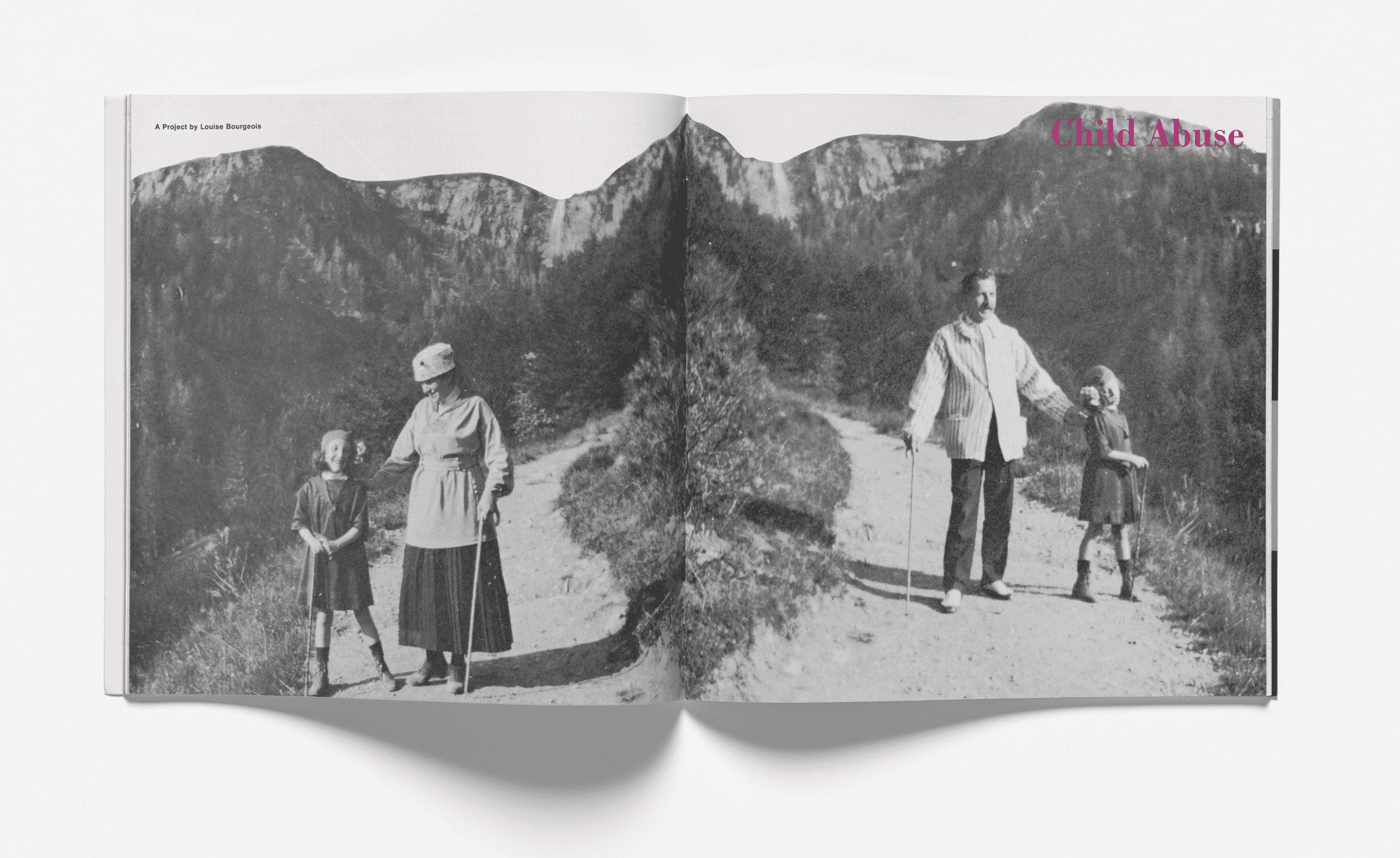
That December, while it was still up, Artforum published eight pages she made, titled Child Abuse: old family photographs, including one of Louise as a girl in a rowboat with Sadie, and her own account of the household. She wrote that her mother had kept her close in order to keep watch on her father. "I am a pawn," she wrote. For most of her career she had kept these things private. From then on she tied her work openly to her childhood.

In 1986 she made Articulated Lair, a room-size enclosure, and in 1991 she showed six Cells at the Carnegie International in Pittsburgh.

The Cells are enclosed rooms, often built from old doors, windows, or steel mesh, holding objects and sculptures that you look into but often cannot enter. "Each Cell deals with a fear. Fear is pain," she said. In 1993 she represented the United States at the Venice Biennale.
The Spiders (1994–1999)
The spider had been in Bourgeois's drawings since the 1940s; a drawing of 1947 is usually cited as the first. It became sculpture only in 1994, when she was eighty-two. SFMOMA owns one of the first, The Nest (1994), five steel spiders each tucked under the next larger one, not currently on view.

In 1995 she published Ode à ma mère, nine drypoints of spiders with her own text. She was direct about the source. "The Spider is an ode to my mother," she said. Her mother repaired weaving for a living, and in Bourgeois's telling she had a spider's qualities: clever, patient, useful, protective. On the gallery label she makes the point through the web. Break a spider's web, she said, and the spider doesn't get angry. "She weaves and repairs it."

Spider (1995). Steel, 131 by 188 by 134 inches: about eleven feet tall and more than fifteen feet across. It stands on eight legs built from irregular, jointed segments that look twisted and knotted, with a dark brown, mottled, weathered surface. Several legs end in sharp points that barely touch the floor. One sweeps out in a long arc before it narrows. Under the body, one curls into a thin hook. The body is small for the legs, made of layered, ribbed plates, with two rounded knobs that read as eyes and a fan of vertical ridges on top. The gallery lights throw the shadows of the legs across the floor around it. The Fishers acquired it in 1995, the year it was made.
The scale is the point. A spider is something you notice in a corner; this one you can walk under. In the audio on SFMOMA's pages for both spiders, recorded for The Nest, curator Alison Gass calls the form "a really amazing image of maternal being," far from the gentle, safe mothers of traditional art. What looks menacing from outside, she says, would feel to the young spiders underneath like shelter.

Spider I (1995, cast 1996). Bronze, 40 by 38¾ by 21 inches, about the size of a large dog, mounted roughly ten feet up the wall and climbing up and to the left. The patina is nearly black, glossy on the ridges. The legs are knobby and uneven; some taper to fine points, others end in small rounded tips or hooks, and the body shows tool marks. On the floor, the big spider is a shelter you can enter. On the wall, this one is closer to the spider you find in the corner of a room.
In 1999 she made Maman ("Mama"), the largest of the spiders, about nine meters tall, carrying a sac of marble eggs. It was shown in Tate Modern's Turbine Hall when the museum opened in May 2000. In 1999 she also received the Golden Lion at the Venice Biennale, given to a living master.
What the Room Shows
The room seems to set the young Bourgeois against the old one: figures from her thirties, spiders from her eighties. The labels complicate that. The Personages were carved in the late 1940s, but the two in the room were cast in bronze in 1989 and 1990. The spiders date from 1995 and 1996. All four objects, in the form you see them, were made within seven years of each other, after the MoMA retrospective, when Bourgeois was in her late seventies and early eighties and had begun returning to her earliest work.
The two pairs work the same way. Each puts an object in a room in place of a person. The Personages stand for people who were absent. The spiders stand for her mother, who had been dead for more than sixty years. Bourgeois died in Manhattan on May 31, 2010, at ninety-eight. 🌁
Timeline — Louise Bourgeois
December 25, 1911 — Born in Paris.
1912–1919 — Family lives in Choisy-le-Roi, with the tapestry workshop behind the house.
1915 — Her father is wounded in the war.
1919 — Family moves to Antony, on the Bièvre.
1922 — Sadie Gordon Richmond joins the household as English tutor.
1923 — Begins drawing missing sections of tapestries in the workshop.
September 14, 1932 — Her mother dies.
1930s — Studies mathematics at the Sorbonne, then art in Paris; Léger among her teachers.
1938 — Meets and marries Robert Goldwater; moves to New York.
1939 — Enrolls at the Art Students League.
1940–1941 — Adopted son Michel arrives; Jean-Louis born (1940) and Alain (1941).
1945 — First solo show, paintings, at the Bertha Schaefer Gallery.
1945–1955 — Carves the Personages.
1946–1947 — Femme Maison paintings.
1946–1948 — Persistent Antagonism.
October 1949 — Seventeen Standing Figures in Wood at the Peridot Gallery; Woman with Packages.
April 9, 1951 — Her father dies.
1952–1966 — Intensive psychoanalysis with Henry Lowenfeld.
1957 — Becomes a U.S. citizen.
1962 — Moves to 347 West 20th Street, Chelsea.
1964 — Plaster sculptures at the Stable Gallery.
1966 — Eccentric Abstraction, Fischbach Gallery.
1973 — Robert Goldwater dies.
1974 — The Destruction of the Father.
1982 — MoMA retrospective; Child Abuse in Artforum (December).
1989–1990 — Bronze casts of Persistent Antagonism and Woman with Packages.
1991 — Six Cells at the Carnegie International.
1993 — Represents the U.S. at the Venice Biennale.
1994 — First spider sculptures, including The Nest.
1995 — Spider; Spider I (cast 1996); Ode à ma mère.
1999 — Maman; Golden Lion, Venice Biennale.
May 2000 — Maman in the Turbine Hall at Tate Modern's opening.
May 31, 2010 — Dies in Manhattan.