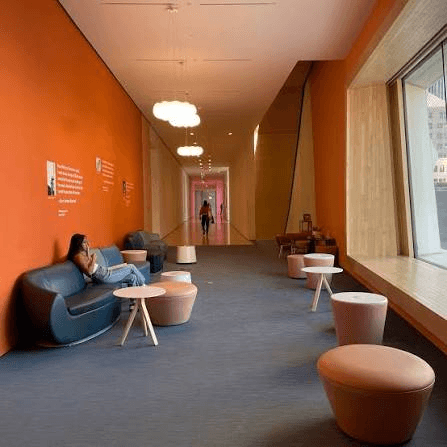
SFMOMA, Part 27: Floor 3, Pritzker Center for Photography.
On Floor 3, inside the largest photography space in any American art museum, there is a room that asks you to make a portrait of yourself without showing your face.
It is harder than it sounds, and that is the point. The Photography Learning Lounge — tucked into the Pritzker Center for Photography, free with admission, easy to walk past if you are hurrying to the big exhibitions — is SFMOMA's laboratory for what photography does to us. The interactive exhibits pose simple questions with complicated answers: How does photography shape what California looks like in your head? What is left of a portrait when the face is gone? You came to look at pictures. The Lounge asks you to notice that the pictures have been looking at you first.
The Photography Learning Lounge is open on Floor 3 as part of the Pritzker Center for Photography, included with general admission. The interactive space — supported by the McEvoy Family, with additional support from Nion McEvoy, the National Endowment for the Humanities, and the Institute of Museum and Library Services — invites visitors to explore how photography shapes perceptions of California, create a faceless self-portrait, and experiment with the medium hands-on.
The easy reading is that this is the kids' room — the education annex, the place you take restless ten-year-olds while the adults look at the real art. And children do love it here. But the subject is sharper than that. The Learning Lounge is the Pritzker Center's thesis statement in interactive form: photography is not a window, it is an instrument, and instruments change the people who use them. The big galleries show you what photographers saw. The Lounge shows you what seeing does.
2016: Fifteen thousand square feet of argument
To understand the Lounge, you have to understand the building it sits in.
When SFMOMA reopened its Snøhetta expansion in 2016, the Pritzker Center for Photography — funded by the Lisa and John Pritzker Family Fund — nearly tripled the museum's photography space to 15,000 square feet. SFMOMA was one of the first museums in the world to treat photography as fine art, and its collection now holds more than 17,800 photographic works, from 1839 to last week. The Center was the institutional bet: photography is not a department, it is a pillar.
But a pillar needs a public. The Center's architects — curatorial as well as physical — understood that photography's problem in 2016 was not prestige but invisibility. Everyone carries a camera; almost no one thinks about what the camera carries. The Learning Lounge was designed as the place where that thinking happens — not through wall texts but through doing. The exhibits are built on a simple insight: you understand photography's power fastest when you feel it working on you.
The faceless portrait
Take the signature activity: make a portrait of yourself without showing your face.
It sounds like a game, and visitors treat it like one — posing with hands, shadows, objects, reflections. But the exercise smuggles in a century of photographic theory. Portraiture's whole contract is the face: we read identity, emotion, truth in the forty-odd muscles around the eyes and mouth. Remove the face and the portrait has to find its subject elsewhere — in gesture, in context, in the things a person chooses to stand next to. What you discover, hunched over the interactive trying to be recognizable without being visible, is that identity was never in the face to begin with. It was in the decisions. The camera just taught us to look at the wrong place.
The California exhibit works the same way in reverse. Photography did not just record California; it invented it — the golden light, the coastline, the frontier, the dream. From Carleton Watkins's Yosemite to the Instagram present, the camera has been California's most effective real estate agent. The Lounge's interactive lets you feel the mechanism: how a frame, a filter, a vantage point manufactures the place it claims to document. You walk in assuming California looks like that because it looks like that. You leave understanding that it looks like that because a hundred thousand photographs agreed to say so.
Susan Sontag wrote in 1977 that photography is "an ethics of seeing." The Lounge is that sentence turned into a room. It does not teach photography as an art history subject. It teaches it as a literacy: the ability to notice when an image is doing something to you, and to decide whether to let it.
The Lounge, again
Back on Floor 3, back to the faceless portrait. What the Learning Lounge understands — and what makes it worth twenty minutes of your visit — is that photography's most important exhibition space is not a gallery. It is your phone, your feed, your own daily practice of framing and filtering.
Go make the faceless portrait. It will be awkward, and it is supposed to be. That awkwardness — the gap between the self you know and the image you can make — is the exact distance photography has always operated in. The Lounge just hands you the controls and lets you feel the gap yourself. 🌁
Timeline — the Center and the Lounge
1839 — photography is invented; within decades SFMOMA's future collection begins
1935 — SFMOMA founded; among the first museums to treat photography as fine art
1977 — Susan Sontag publishes On Photography: photography as "an ethics of seeing"
2016 — Snøhetta expansion opens; the Pritzker Center for Photography debuts at 15,000 square feet
2016 — the Photography Learning Lounge opens inside the Center, McEvoy Family support
Today — the Lounge open daily with admission, Floor 3, 151 Third Street