Training the Eye

SFMOMA, Floor 4 · Ways of Seeing: Fourteen Artists
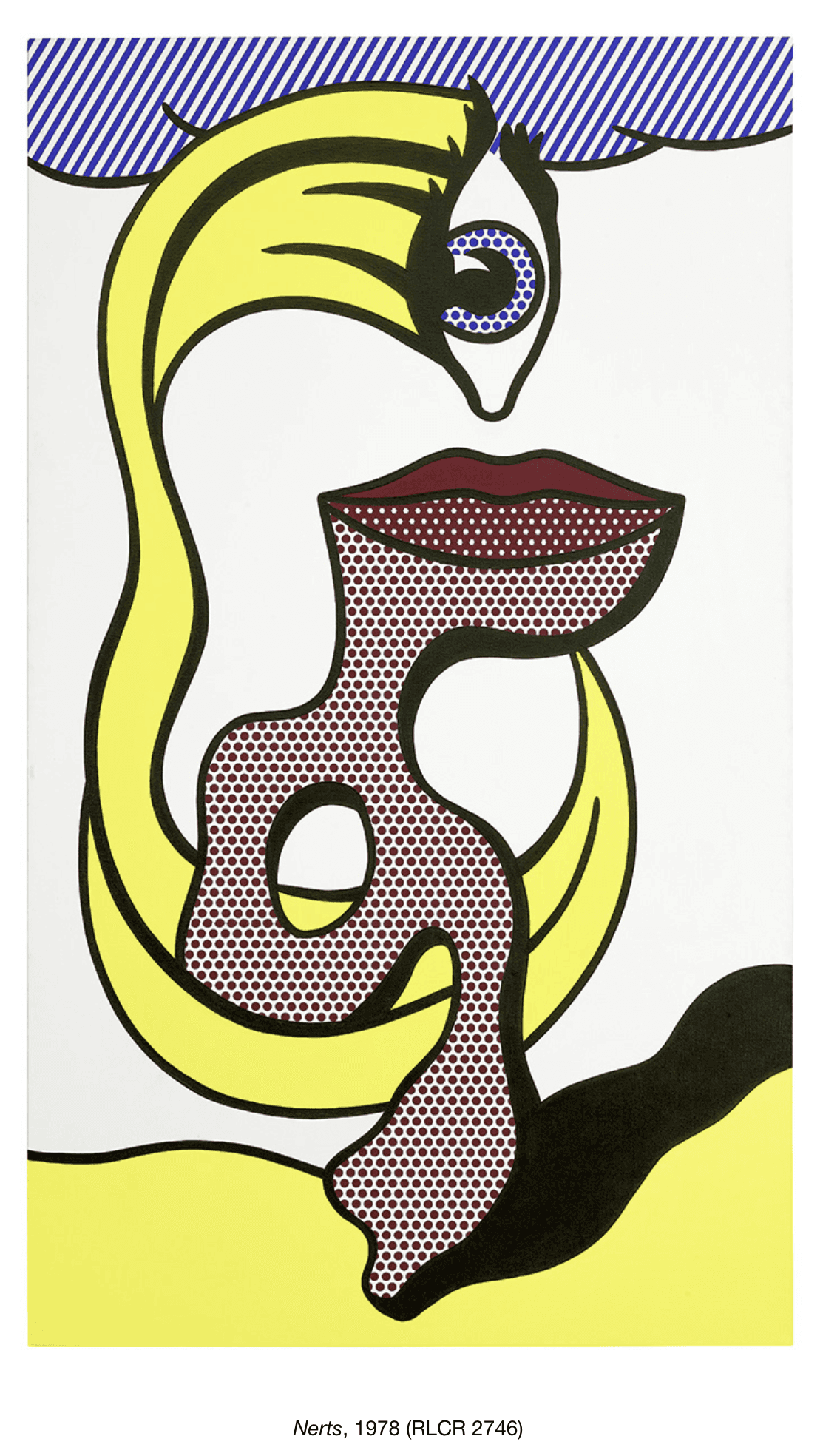
The first image a visitor sees on the fourth floor is not in a gallery. It hangs on the landing outside the elevators: a tall canvas by Roy Lichtenstein titled Nerts (1978). It shows a woman’s face taken apart. An oversized eye turned on its side sits at the top, its blue iris dotted with blue and white. Below it are full red lips outlined in black. Yellow hair curls down one side in a long C. A curling form beneath the lips is filled with dense red dots on a pale pink ground. A band of blue and white diagonal stripes runs across the top edge.`
Through the galleries, Lichtenstein shares a room with the German painter Sigmar Polke. His five works there span thirty-four years. Portable Radio (1962) is a small painting of a transistor radio with a real leather strap hung on a nail. Live Ammo (Tzing!) (1962) is a close-up of a soldier firing, lifted from a war comic. Figures with Sunset (1978) is fourteen feet of eyes, lips, mirrors, and a man in a red tie. Reflections: Whaaam! returns to his most famous war painting behind streaks of painted glare. Coup de Chapeau II (1996) is a bronze hat flying upward, seven feet tall and less than two inches deep.
The received account of Lichtenstein is that he copied comic strips. He enlarged cheap printed images, reproduced the dots of commercial printing, and hung the results in galleries as a cool joke about high and low culture. Part of that is accurate. What it leaves out is that every one of these works was painted by hand, and that the painter’s training was not in comics but in the science of how the eye takes in an image.
1923–1940 — New York
Roy Fox Lichtenstein was born in New York on October 27, 1923, into an upper-middle-class German-Jewish family. His father, Milton, was a real estate broker; his mother, Beatrice, was a homemaker. He grew up on the Upper West Side and graduated from the Dwight School in 1940.
As a teenager he loved jazz. He went to concerts at the Apollo Theater in Harlem and drew the musicians. In 1937 he took watercolor classes at the Parsons School of Design. In 1939 he saw Picasso’s Guernica at the Museum of Modern Art and began studying painting seriously. That summer he took classes at the Art Students League with Reginald Marsh, a realist painter of crowded city scenes: Coney Island beaches, burlesque houses, the Bowery.
In 1940 he left New York for the Ohio State University in Columbus.
1940–1949 — Ohio State and the Flash Lab
The reason to go to Columbus was Hoyt L. Sherman, a professor of fine arts who taught drawing as a problem of perception. Sherman ran what students called the flash lab. The flash lab was a darkened room in which an image was projected on a screen for about a tenth of a second, after which students drew what they had seen. With so little time to look, students could not copy details. They had to grasp the image as a whole: its main shapes, its contrasts, the way its parts held together. Sherman’s aim was to train students to see the structure of an image before its content.

In a 1963 interview Lichtenstein said that Sherman’s ideas on perception “were my earliest important influence.” He later cited the flash lab’s method as a source for his own work. The images he became famous for, enlarged from comic panels, are images built to be read in a glance.
In 1943 his studies were interrupted by the Army. He was assigned to programs in languages, engineering, and pilot training, each of which was canceled before he could finish. He served instead as an orderly, a draftsman, and an artist. At Camp Shelby in Mississippi he enlarged Bill Mauldin’s cartoons of ordinary soldiers. He was sent to Europe with an engineer battalion but saw no combat. He was discharged in January 1946.
His father died that year. Lichtenstein returned to Ohio State on the G.I. Bill and finished his BFA in 1946 and his MFA in 1949. In 1949 he married Isabel Wilson, a gallery assistant, and taught at Ohio State until 1951.
1951–1960 — The Search
In 1951 Lichtenstein had his first New York solo show, at the Carlebach Gallery, and moved to Cleveland, where he lived for six years. His sons David and Mitchell were born in 1954 and 1956. For most of the 1950s he made paintings of American historical and frontier subjects in a loose, Cubist-influenced style.

From 1957 to 1960 he taught at the State University of New York at Oswego, and from 1957 to 1961 he painted in the Abstract Expressionist manner then dominant in New York. By his late thirties he had a family, a teaching career, and a modest exhibition record, but no style of his own.
1960–1963 — Rutgers, Kaprow, and Look Mickey
In 1960 Lichtenstein joined the faculty of Douglass College, part of Rutgers University in New Jersey. A colleague there, Allan Kaprow, was staging happenings: unscripted events made of everyday materials and actions. Kaprow’s argument that art should take its material from ordinary life pushed Lichtenstein toward his own subject matter.

The well-known story of the breakthrough is that one of his sons pointed to a Mickey Mouse comic and said his father couldn’t paint as well as that. In 1961 Lichtenstein painted Look Mickey, Donald Duck hooking his own coattail on a fishing line while Mickey covers his mouth to laugh. It was his first large painting to use Ben-Day dots.
Ben-Day dots are the evenly spaced dots of color used in cheap commercial printing, such as comic books, to produce tints and shading from a few inks. In a printed comic they are tiny and mechanical. Lichtenstein enlarged them and painted them by hand, at first with a dog-grooming brush and later through perforated stencils.
Leo Castelli gave him a solo exhibition in February 1962. The paintings sold before the show opened.
1962 — Portable Radio
Portable Radio is from that first year of Pop. It is oil on canvas with aluminum and leather, 17¼ by 20 inches. It depicts a transistor radio in black outline on white. A tuner band runs across the top, marked with FM numbers from 88 to 108 and AM numbers from 55 to 160. A striped knob sits at the upper left. The left two-thirds is a speaker grille of dense black dots. At the right, “AmFm” is lettered in a handwritten style. A thin aluminum band wraps the sides of the canvas, and a real leather strap rises from the top to a nail in the wall, so the painting hangs the way the radio would.

SFMOMA’s curator John Zarobell describes the joke on the audio guide: the painting is entirely hand-painted, but with its strap it becomes the object it pictures. The work turns on the gap between an image and a thing. A radio is something heard. Lichtenstein made it something seen, flat and silent, and then gave the flat picture a handle.
1962 — Live Ammo (Tzing!)
From 1962 to 1964 Lichtenstein made a series of paintings from war comics, chiefly DC’s All-American Men of War and Star Spangled War Stories. Live Ammo (Tzing!) is from the first year of the series. It is oil on canvas, about the height of a person, set in a white frame. It shows a soldier in close-up aiming a weapon. His face is bright yellow, with hard black contours and dark shadows across one side of his head and under his chin. A netted helmet sits low on his brow, and its chin strap flies loose. His hand grips a rifle whose barrel runs off toward the right edge. At the upper left, in a gray diagonal burst, the red block letters “tzing!” and a wavy black “bweee!” spell out the sound of the bullet.

Lichtenstein had served three years in the Army without seeing combat. His war paintings come from the war as it was sold to children in ten-cent comics, not from his own experience of it. He kept a distance from their heroics. “The heroes depicted in comic books are fascist types,” he said, “but I don’t take them seriously in these paintings.” He said he used them “for purely formal reasons.”
The formal reason is visible in Live Ammo. The soldier’s face is reduced to three or four flat areas of color divided by black lines. The sound is lettering. The action is a diagonal. It is the kind of image a student in Sherman’s flash lab would be trained to grasp in a tenth of a second.
In 1963 the series produced Whaam!, a two-panel painting of a fighter plane blowing up another, adapted from a panel by Irv Novick in All-American Men of War. The Tate Gallery in London bought it in 1966, after a public argument among its trustees.
1964–1976 — Painting About Painting
After the war comics, Lichtenstein turned the same style on the history of art and on painting itself. In 1964 he became the first American artist to show at the Tate. In 1965 he began the Brushstrokes series, enlarged cartoon versions of the loose painted strokes of Abstract Expressionism, made with careful outlines and dots. In 1966 he began the Modern Paintings, based on Art Deco design. He resigned from Rutgers in 1964 and divorced Isabel Wilson in 1965. In 1968 he married Dorothy Herzka.
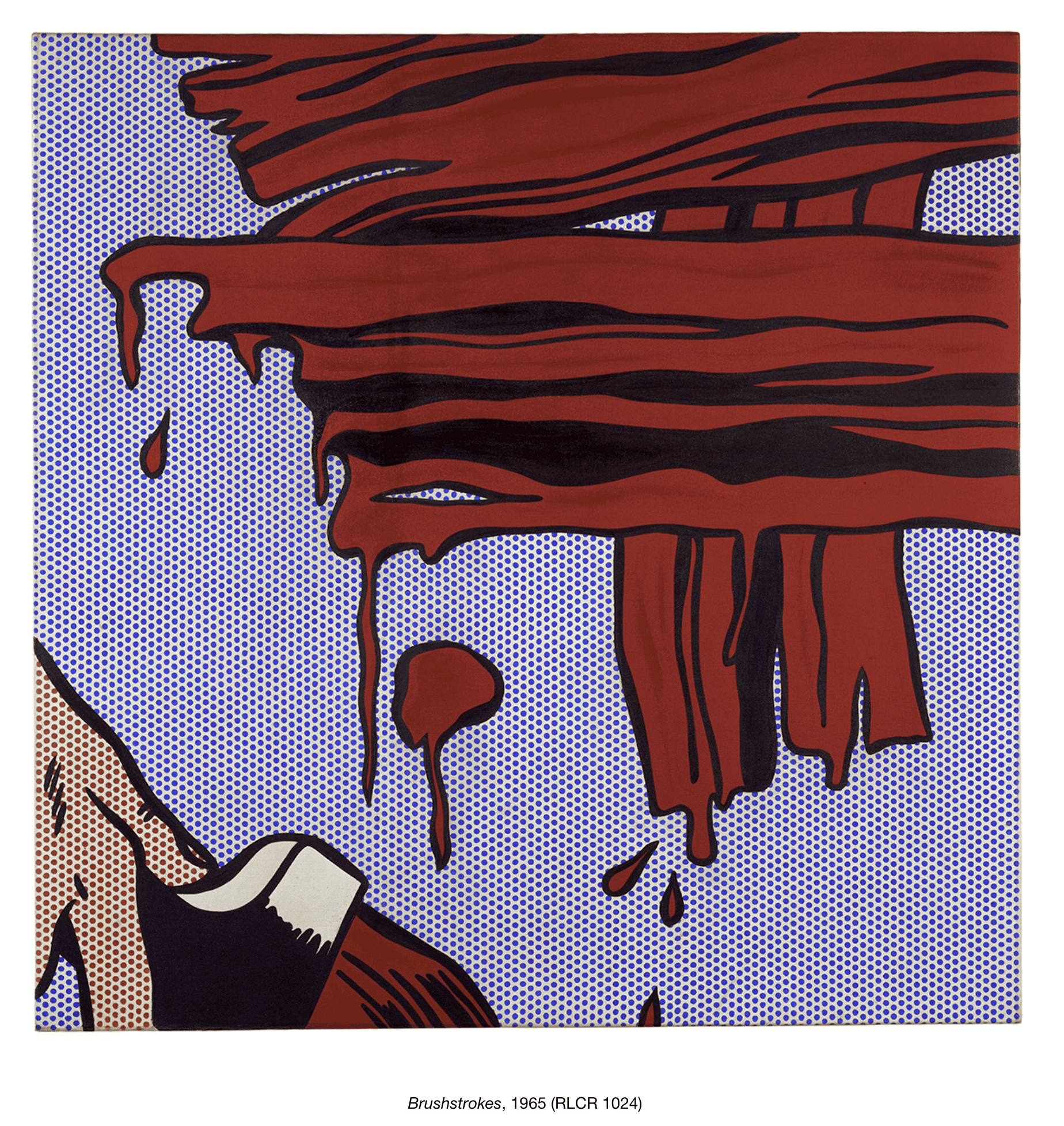
The Pasadena Art Museum gave him his first museum retrospective in 1967, and the Guggenheim gave him another in 1969. That year he began the Mirrors and painted the Rouen Cathedral series after Monet, both covered in earlier posts here. In 1970 he bought a carriage house in Southampton, on Long Island, and from 1971 to 1976 he made the Entablatures, paintings of the decorative bands on classical buildings.
1977–1979 — Surrealism: Figures with Sunset and Nerts
In the late 1970s Lichtenstein drew on Surrealism, especially the paintings of Salvador Dalí, René Magritte, and Picasso’s work of the 1920s and 1930s. He took their dreamlike settings, detached body parts, and impossible combinations and redrew them in his flat, outlined, dotted style. Recurring motifs include a single eye with a tear, lips floating free of a face, and objects standing in for heads.

Figures with Sunset is from 1978. It is Magna and oil on canvas, 107 by 167 inches, nearly nine feet by fourteen. Magna is an acrylic resin paint, developed in the late 1940s, that thins with turpentine like oil paint and dries quickly to a flat, even surface. Lichtenstein used it for the large flat color areas of his mature work.
The canvas is crowded with interlocking zones divided by thick black lines. At the left, woodgrain stripes rise under a cloud above blocky gray, olive, and blue structures. In the center a small half-sun with yellow rays sits over a dark blue band, beside a black pole with triangular flags. At the right a man with combed dark hair, a peach shirt, a red tie, and a white jacket looks toward the sun. SFMOMA’s description notes that he resembles photographs of the young Picasso. In front of him an abstract reclining figure, drawn in black lines and red dots, holds up an oval mirror. Red lips and a sideways eye sit on it, framed by a yellow arched shape and ribbons of hair. A black-and-white brushstroke crosses the sky.
The painting assembles quotations of Lichtenstein’s own earlier work alongside Surrealism: the mirror of the Mirrors, the brushstroke of the Brushstrokes, the woodgrain of his studio pictures, the comic-strip woman’s lips and eye. It puts the young Picasso in the scene as a spectator. The effect is a self-portrait of an artist’s sources, from Surrealism to comic books to his own catalogue.

Nerts, on the landing, is from the same year and the same vocabulary. The woman’s face from the romance comics of the early 1960s is split into eye, lips, and hair and scattered down the canvas like a Surrealist arrangement. Figures with Sunset is co-owned by the Fishers and SFMOMA, which acquired it in 1999.
1988–1990 — Reflections: Whaaam!
From 1988 to 1990 Lichtenstein made the Reflections series. In each work he repainted one of his own earlier images, or a famous image by someone else, as if seen behind glass, with streaks and bands of reflected glare cutting across it.

Reflections: Whaaam! returns to the 1963 painting. It is Magna and oil on canvas, nearly square, about the height of a person. The fighter jets are there in bold black outlines, Ben-Day dots, and primary colors, with green dominant. One jet explodes. A helmeted pilot in profile looks toward the blast from the foreground. Fragments of fuselage and a detached tail are scattered across the surface. Dark green letters spelling part of the title sit between the fuselage and tail. Across all of it run overlapping diagonal bands of white, red, and dotted pattern, the reflections, which hide parts of the image. A caption box at the top is mostly covered.
The reflections are painted in the same flat, outlined style as the image beneath them. The glare that should belong to a sheet of glass in front of the painting is made of the same material as the painting. The work is about seeing a famous picture: in a museum, behind protective glass, through glare, as a reproduction of a reproduction. The original source was a comic panel. Lichtenstein’s 1963 painting turned it into art. The 1990 version treats that painting as an object people look at through a pane. Whether the extra “a” in the title is deliberate, or simply a variant spelling of the sound, Lichtenstein did not say.
1990s — Coup de Chapeau II
In the 1990s Lichtenstein made more sculpture, cast in bronze and painted in his flat colors and black outlines so that solid objects look like drawings. The Guggenheim gave him a major retrospective in 1994, and he received the National Medal of Arts in the mid-1990s.
Coup de Chapeau II is from 1996. It is painted and patinated bronze, 89 inches tall, 30 inches wide, and less than 2 inches deep. It shows a yellow fedora flying upward. It rises from a flat black base in a sweeping curve, gripped near the bottom by a white cloud shape, with blue and white stripes running beside the yellow. A red-and-white jagged burst at mid-height marks an impact. At the top the hat is turned on its side. The front and back are outlined in thick, raised black lines. Displayed in a corner, the sculpture shows only its front face.

Coup de chapeau is French for a tip of the hat, a salute. The sculpture is a hat in flight, knocked upward by a cartoon burst. It is also a drawing made solid. It is three-dimensional, but so thin that from the front it reads as a flat image. A companion work, Coup de Chapeau I, was cast in 1997 and shown at that year’s Venice Biennale.
Lichtenstein died of pneumonia in New York in late September 1997. He was seventy-three.
The Room
Lichtenstein’s room shares walls with Sigmar Polke, who in 1963 helped found a German counterpart to American Pop. Both men took their imagery from mass printing, and both painted printing dots by hand. Polke’s dots, in the next post, are irregular and smudged. Lichtenstein’s are even.
Read in sequence, Lichtenstein’s works on Floor 4 track a single concern across three and a half decades. The radio is a picture that pretends to be an object. The soldier is an image built for a glance. The 1978 canvas collects images of images. The Reflections painting puts glare over his own famous picture. The hat is an object that pretends to be a picture. The account that he copied comic strips describes his sources. His subject, from the flash lab in Columbus on, was how an image is seen.
Timeline — Roy Lichtenstein
October 27, 1923 — Born in New York.
1937 — Watercolor classes at Parsons.
1939 — Sees Guernica at MoMA; summer classes with Reginald Marsh at the Art Students League.
1940 — Enters Ohio State; studies with Hoyt L. Sherman.
1943–1946 — Army service; draftsman and artist; Europe with an engineer battalion.
1946 — Father dies; BFA, Ohio State.
1949 — MFA, Ohio State; marries Isabel Wilson.
1951 — First New York solo show, Carlebach Gallery; moves to Cleveland.
1954, 1956 — Sons David and Mitchell born.
1957–1960 — Teaches at SUNY Oswego; paints in an Abstract Expressionist style.
1960 — Joins Douglass College, Rutgers; meets Allan Kaprow.
1961 — Paints Look Mickey.
February 1962 — First Castelli show sells out; paints Portable Radio and Live Ammo (Tzing!).
1963 — Paints Whaam!; tells an interviewer Sherman was his earliest important influence.
1964 — First American to show at the Tate; resigns from Rutgers.
1965 — Begins the Brushstrokes; divorces Isabel Wilson.
1966 — Tate buys Whaam!
1967 — First museum retrospective, Pasadena.
1968 — Marries Dorothy Herzka.
1969 — Guggenheim retrospective; begins the Mirrors; Rouen Cathedral series.
1970 — Moves to Southampton.
1971–1976 — Entablatures.
1978 — Paints Figures with Sunset and Nerts.
1988–1990 — Reflections series, including Reflections: Whaaam!
1994 — Guggenheim retrospective.
1996 — Makes Coup de Chapeau II.
1997 — Coup de Chapeau I at the Venice Biennale; dies in New York in late September.
1999 — SFMOMA and the Fishers acquire Figures with Sunset.
April 18, 2026 — Six works in Ways of Seeing: Fourteen Artists.