SFMOMA, Part 34: Floor 4, Ways of Seeing: Fourteen Artists.
Before the eight-foot painting, there was this: a Polaroid, some ink, and tape.
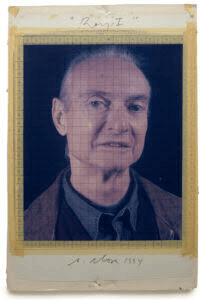
The Roy/maquette is thirty-five inches tall — modest by Chuck Close standards, almost intimate — and it wears its working life on its surface. A color Polaroid of Roy Lichtenstein's face forms the base: the white hair, the heavy features, the direct gaze. Over it, Close has drawn in ink and graphite, testing the grid, auditioning the marks that will become the painting. Masking tape holds the whole thing to its foamcore mount, the way tape holds a life together during renovations. It is a study, a rehearsal, a crime-scene photo of a portrait being born. And it is the most human-scaled thing in the room.
Chuck Close, Roy/maquette, 1994 — Polaroid (color dye diffusion transfer print), ink, graphite, and masking tape on foamcore, 35 × 23 1/2 in. (88.9 × 59.7 cm). The Doris and Donald Fisher Collection at SFMOMA. On view on Floor 4 in Ways of Seeing: Fourteen Artists, part of Reimagined: The Fisher Collection at 10. Entry included with general admission (SFMOMA, 151 Third Street; Mon–Tue 10–5, Wed closed, Thu 12–8, Fri–Sun 10–5). The finished painting, Roy I (1994) — oil on linen, 102 1/8 × 84 in. — hangs nearby.
The easy reading is: a sketch, a curiosity, the famous painting's rough draft. But the subject is sharper than that. The maquette is where Close's whole method is visible at once — the photograph, the grid, the hand — before the finished painting swallows the evidence. It is the Rosetta Stone of the late style. And it records something the big canvas can't: the sitting itself, the morning Roy Lichtenstein came to the studio and let his friend take his picture.
The Polaroid sitting
Close's process always began with a photograph, and by the 1970s the camera was a Polaroid — the instant print, the image you could hold sixty seconds after the shutter. He preferred it for a reason that was social as much as technical: "I'd rather set up a camera and slowly take six or seven images, then look at what I've got and keep refining it. And I like the dialogue with the subject, collaborating with the sitter. I like Polaroids . . . because the sitter can instantly see the results and offer feedback."
Read that again: the sitter can see the results and offer feedback. The most controlling portraitist of his generation — the man who reduced faces to grids and rebuilt them cell by cell — built collaboration into the first step. The Polaroid sitting was a negotiation. Lichtenstein would have seen this very print developing in Close's hands, would have watched his own face emerge in chemical color, would have had opinions. The maquette is, among other things, a record of a friendship's working morning.
You can see the negotiation in the marks. The ink drawing over the Polaroid isn't tentative — Close knew what he was doing — but it is exploratory in the way the finished painting can't afford to be. Here a patch of color is tried and abandoned. There the grid is adjusted, a line moved a fraction. The tape is the giveaway: this is a working document, handled, revised, lived with. The eight-foot Roy I presents itself as inevitable. The maquette confesses that it wasn't.
1994: From tape to monument
The leap from this object to the finished painting is the whole of Close's art in miniature. The Polaroid is 35 inches; the painting is 102. The maquette fits on a wall you could reach across; the painting needs a museum. And yet every decision in the big canvas was rehearsed here: which cells get which colors, where the grid falls on the features, how the invented palette — the roses and teals that were never on Lichtenstein's actual skin — will distribute across the face.
There is a temptation to treat the maquette as lesser — the study versus the masterpiece, the sketch versus the real thing. Resist it. The maquette does something the painting can't do: it shows the hand. In Roy I, the thousands of marks resolve into a face and the labor disappears into likeness. Here, the labor is the subject. The ink is fresh, the tape is visible, the Polaroid's chemical gloss catches the light differently than the drawn marks. It is a collage of stages — photograph, drawing, painting — and it makes visible the central fact of Close's late work: that a portrait is not a single act but a relay, from camera to grid to hand, each stage translating the last.
The show, again
Stand in front of the maquette after standing in front of Roy I and the scale shift does something to your body. The big painting made you feel small; this makes you feel like a peer. You are looking at something close to the size of the thing Close actually held, at the distance he actually worked. The tape is at eye level. The ink lines are the width of a pen stroke you could make yourself.
And then look at Lichtenstein's face in the Polaroid — unguarded in a way the painting never is, mid-negotiation, a man letting his friend figure out how to paint him. The finished portrait is a monument. This is a morning. Monuments are for the public; mornings are for friends. Close painted his circle for decades — Rauschenberg, Sherman, Serra, Glass, Agnes Martin — and every one of those eight-foot faces started as a morning like this one: a camera, a sitter who trusted him, a print developing in someone's hands.
I like the tape best. It is the least artistic thing in the room and the most honest: this is how the work got made, held together, revised, held together again. The grid is the theory. The tape is the practice. And the practice, as always, is where the person lives. 🌁
Timeline — Chuck Close
Late 1970s — Close adopts the Polaroid as his portrait camera; the instant print enables collaboration with sitters
1988 — Spinal injury; the grid moves from hidden scaffolding to visible subject
1994 — Close photographs Roy Lichtenstein; makes the Roy/maquette (Polaroid, ink, graphite, masking tape on foamcore); paints Roy I (oil on linen, 102 1/8 × 84 in.)
1997 — Roy Lichtenstein dies, New York, age 73
2021 — Chuck Close dies, Oceanside, New York, age 81
Today — Roy/maquette on view, 151 Third Street