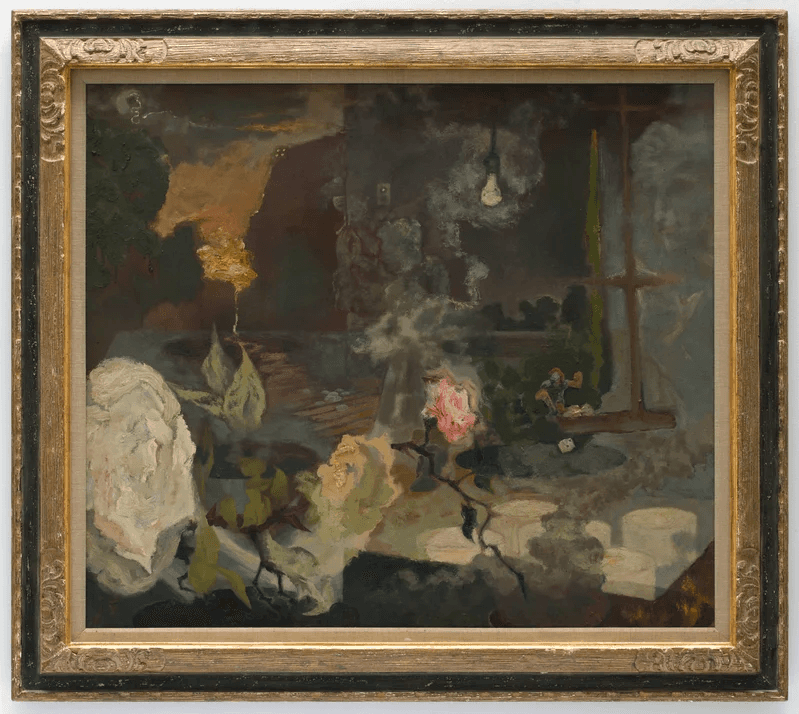
SFMOMA, Part 39: Floor 2, 1900 to Now.The Cast of Dice (Jess, 1958).
The gallery goes dark here. The Cast of Dice, 1958 — thirty-eight by forty-four inches of oil on canvas, set in a found frame, acquired by SFMOMA in 2013 — is a Christian nocturne painted by a man who had fled the century's darkest science. You approach it the way you approach a chapel at night: the forms resolve slowly, the way eyes adjust. A guardian figure looms at the left. A cross stands at the center that is also, unmistakably, a window — its arms holding panes of dim light. A crucified figure. And at the foot of the cross, soldiers, bent over their game, casting lots for a dead man's garments. The oldest image of chance against fate, painted in the year the American century started calling itself an empire.
It is a painting about gambling at the scene of a sacrifice. The dice — the lots — are still falling. And at the exact center of the darkness, impossibly, a rose glows.
The frame
Jess always found his frames. He didn't buy them; he discovered them, in junk shops and on curbs, and the frame was never packaging — it was part of the spell, the first decision of the painting. The frame around The Cast of Dice is heavy, worked, old — the kind of frame that has already lived one life and been recruited for a second. It does something a new frame can't do: it tells you the image inside is a survival, something rescued. Jess's whole method was rescue — of images, of meanings, of the discarded. The found frame is the thesis in wood and gilt: nothing here is new, and everything here is still happening.
The nocturne
The painting is dark the way a church is dark — not empty dark, but occupied dark, dark with presences. Jess builds the night in layers: blacks that are really deep blues, browns that hold red like banked coals. Against this, the figures emerge as if remembered rather than seen. The guardian figure at the left — tall, watchful, half-dissolved into the gloom — seems less painted than stationed there, a sentinel the darkness posted. The cross-window at the center does the painting's strangest work: it is simultaneously the instrument of execution and a source of light, a cross you can see through. Through its panes comes the dimmest illumination in the picture, and you understand, slowly, that the light is coming from the other side of the sacrifice — from whatever the cross opens onto.
The crucified figure is rendered with a restraint that makes it worse. No theatrical agony, no Baroque twist. Just the fact of it, in the dark, while the soldiers below attend to their game. That is the painting's moral composition: the eternal happening at the center, the trivial bent over it. The soldiers aren't villains; they're absorbed. The dice matter to them. That absorption — that total, ordinary human capacity to gamble while God dies overhead — is what Jess is painting. He had worked on the bomb. He knew about absorption.
The lots
Casting lots for Christ's garments comes from the Gospels — John 19:24, the soldiers dividing the seamless robe, fulfilling the psalm: "They parted my garments among them, and for my vesture they did cast lots." It is scripture's own image of randomness inside providence: the most momentous death in the Christian story, and at its foot, men playing a game of chance for a piece of cloth. Theologians have read it for two thousand years as the collision of the trivial and the cosmic, the accidental and the ordained.
Jess makes it the title. The Cast of Dice. Not the crucifixion — the dice. The painting's theological engine is chance itself: the fall of lots, the throw that decides. Think about who is painting this. Burgess Franklin Collins — the name he was born with — had been a chemist on the Manhattan Project, working on plutonium production. He had helped make the fuel of the first artificial suns. Then, in 1948 or 1949, he had a nightmare — an apocalyptic one, the accounts agree on the scale if not the details — and he walked away from science entirely. He took a new name: Jess. Just Jess.
A man who helped build the bomb, who dreamed the end of the world, who quit — painting soldiers dicing at the foot of the cross. The dice in the painting are not just scripture. They are the twentieth century's own lots: the cast that decided which cities burned, the throw of history that no one at the table controlled. Jess knew, in his body, what it meant to be one of the men bent over the game while something eternal happened overhead. He had been at the table. The nightmare was his resignation letter.
The rose
And then the rose. At the center of the gloom — not at the edge, not as an afterthought, but at the compositional heart — a rose glows. It is the painting's contradiction and its proof. Jess told the scholar Christopher Wagstaff, in the conversations that became the record of his intentions, that he never presented an entirely hopeless situation. Not once. However dark the nocturne, however complete the sacrifice, however absorbed the gamblers — something glows.
The audio interpretation that accompanies the painting reaches for Ezra Pound: "In the gloom, the gold gathers the light about it." It could be the painting's epigraph, and it is also its method. The gloom is real — Jess never cheats the darkness, never lights the scene falsely. The soldiers are still dicing. The cross is still a cross. But the gold — the rose, the gathered light — is also real, and it is placed where you cannot miss it once you've seen it. The painting asks you to hold both: the lots are still falling, and the rose hasn't gone out. Despair is accurate. It is not complete.
This is the whole of Jess's mature doctrine in one image, years before the great collage paste-ups of the 1960s would make him famous. The erudition worn lightly — scripture, Pound, the occult, the romantic tradition, all present, none announced. The romance — the rose at the center of a crucifixion scene, the most romantic possible contradiction. The occult Catholicism — the guardian figure, the cross that is a window, the sense that the visible is only the outer court of the real. And underneath it, the painter's discipline he carried from his scientific life into his artistic one: the belief, stated as doctrine, that every point of color is autonomous. Each touch of paint a free citizen. No touch conscripted.
The chemist who quit
Stay with the biography, because the painting requires it. Born August 30, 1923, in Long Beach, California, as Burgess Franklin Collins. A brilliant science student. Recruited into the Manhattan Project's plutonium work — the fuel work, the part that made the bombs possible. He was twenty-two when the bombs fell. Then the nightmare, 1948 or 1949: apocalyptic, annihilating, the kind of dream that reorganizes a life. He left science. He took the name Jess — shed the patronymic, shed the profession, shed the century's most powerful knowledge — and enrolled at the California School of Fine Arts to study painting with Clyfford Still.
Still. The most uncompromising of the Abstract Expressionists, the man who would rather destroy a painting than explain it. Jess studied with him and then did the opposite of Still in every way that mattered: where Still was austere, Jess was abundant; where Still was abstract, Jess was figurative; where Still refused reference, Jess collected it — scripture, romance, comics, the occult, Victorian engraving. But he kept something from Still, and it's in this painting: the seriousness. The refusal to decorate. The understanding that a painting is a place where something real happens, not a surface where something pretty sits.
The galleries
With the painter Harry Jacobus and the poet Robert Duncan, Jess co-founded the King Ubu Gallery in San Francisco — named for Jarry's monstrous king, a Dada-surrealist joke that was also a declaration. The King Ubu became the Six Gallery, and the Six Gallery, in October 1955, hosted the reading where Allen Ginsberg premiered Howl. The room that night held the whole San Francisco Renaissance. Jess was there at the hinge of it — not as a poet but as the painter who understood what the poets were doing, the ex-chemist who had traded one kind of transformation for another.
The gallery years matter to The Cast of Dice because 1958 is a gallery-years painting — early Jess, before the paste-ups, when he was still working primarily in oil, still building his symbolic world one canvas at a time. You can feel the scene in it: the erudition, the theatricality, the willingness to stage the biggest subjects — crucifixion, chance, fate — in a San Francisco studio, in a found frame, in the dark.
Duncan
And then there is Robert Duncan — the thread that runs through this whole floor of the museum. Duncan co-published the magazine Epitaph with the painter Virginia Admiral, whose Astrazione No. 1 hangs in this series as Part 34. Admiral to Duncan to Jess: a line drawn through Bay Area poetry and art, through two generations. Jess met Duncan around 1950 — the accounts vary, 1949 or 1951, the way accounts of important meetings always vary — and they were partners for nearly four decades, until Duncan's death in 1988.
Duncan was the great romantic modernist of American poetry, the magus of the San Francisco Renaissance, and his influence on Jess is everywhere in this painting: the occult learning, the romance, the belief that images are not decorations but powers. But the influence ran both ways. Duncan's poetry learned from Jess's painting how to collage, how to let disparate orders of reality occupy the same field. The partnership was one of the century's great artistic marriages — two men building, side by side, a shared symbolic world. When Duncan died in 1988, Jess lived sixteen more years, until January 2, 2004, in San Francisco. The found frame holds.
1958
Place the painting in its year. 1958: the paste-ups are coming — the great collage novels in images, Tricky Cad and the Narkissos cycle, the work that will make Jess's reputation. But in 1958 he is still a painter of oils, still working out the symbolic lexicon in the old medium. The Cast of Dice is the lexicon at its most concentrated: guardian, cross-window, crucifixion, dice, rose. Every element will recur, transformed, in the collages. The painting is a seed — a dark seed, planted in the gloom, with the gold already gathering.
And the doctrine holds it all: every point of color autonomous. Look closely at the rose and you see it — the paint is not blended into submission but left as discrete touches, each one free, each one voting. The ex-chemist's democracy of matter. No touch conscripted, not even for the rose. Especially not for the rose.
So here's the thesis: The Cast of Dice is Jess's 1958 nocturne of chance against fate — soldiers gambling at the foot of the cross while a guardian watches and a cross that is also a window lets in the dimmest light, a glowing rose at the center because he told Christopher Wagstaff he never presented an entirely hopeless situation, all of it in a found frame, by the ex-Manhattan Project plutonium chemist who dreamed an apocalypse in 1948 or 1949 and walked away from science. Admiral published Epitaph with Duncan; Duncan loved Jess for thirty-eight years; Jess studied with Clyfford Still, co-founded the room where Howl premiered, and believed every point of color was autonomous. "In the gloom, the gold gathers the light about it." 🌁
Timeline — Jess
1923 — born August 30, Long Beach, as Burgess Franklin Collins
1940s — plutonium chemist, Manhattan Project; apocalyptic nightmare 1948–49; quits science, takes the name Jess
Late 1940s — studies painting with Clyfford Still, California School of Fine Arts
ca. 1950 — meets Robert Duncan (accounts vary: 1949–1951); partnership until 1988
1950s — co-founds King Ubu Gallery → Six Gallery; the room where Ginsberg premiered Howl
1958 — paints The Cast of Dice
1960s — the great collage paste-ups
1988 — Duncan dies
2004 — Jess dies January 2, San Francisco, age 80
2013 — SFMOMA acquires The Cast of Dice