The Beginnings of Colonial American Art

Preface: The colonial history of the US, and what came to become part of colonial American Art.
If we are to trace all the way back to the beginning of American Art, we should count De Bry as the beginning of the beginnings. Theodor de Bry (1528–1598) was a Flemish engraver, publisher, and goldsmith, born in Liège, who became one of the most influential image-makers of the early European encounter with the Americas. He's best known for his Grands Voyages and Petits Voyages series — multi-volume, richly illustrated accounts of European exploration published from the 1590s onward, filled with copperplate engravings depicting Native peoples, landscapes, and colonial encounters.
He didn't travel to the Americas himself. Instead, he worked from other people's firsthand material — most famously the watercolors of John White (from the Roanoke colony) and Jacques Le Moyne (from the French Florida expedition), as well as Bartolomé de las Casas's writings on Spanish atrocities against Indigenous peoples in the Caribbean. De Bry's engravings translated those sources into dramatic, widely circulated images that shaped how Europeans pictured the "New World" for generations — everything from idealized noble-savage imagery to gruesome depictions of colonial violence.
John White is one of those figures where the personal tragedy almost overshadows the historical importance of his work, though both matter. He was an English artist, born around 1539, who first went to the Americas in 1585 as part of Richard Grenville's expedition to Roanoke Island (in present-day North Carolina) — the same venture that included the scientist Thomas Harriot. White's job was documentary: he painted watercolors of the landscape, plants, animals, and especially the Algonquian-speaking peoples he encountered, working closely alongside Harriot, who handled the written ethnographic and scientific observations. The two of them together produced what's still considered the single most detailed firsthand visual and written record of an Eastern Seaboard Native society before sustained European contact reshaped it.
Walter Raleigh, who financed and organized the Roanoke expeditions, deliberately paired Harriot and White for exactly this purpose: Harriot to record scientifically and in writing, White to record visually. They weren't working in isolation from each other — they actually traveled together on exploratory legs of the expedition, including a trip north from Roanoke into the Chesapeake Bay area and up the Elizabeth and Nansemond rivers, gathering data side by side in the field.
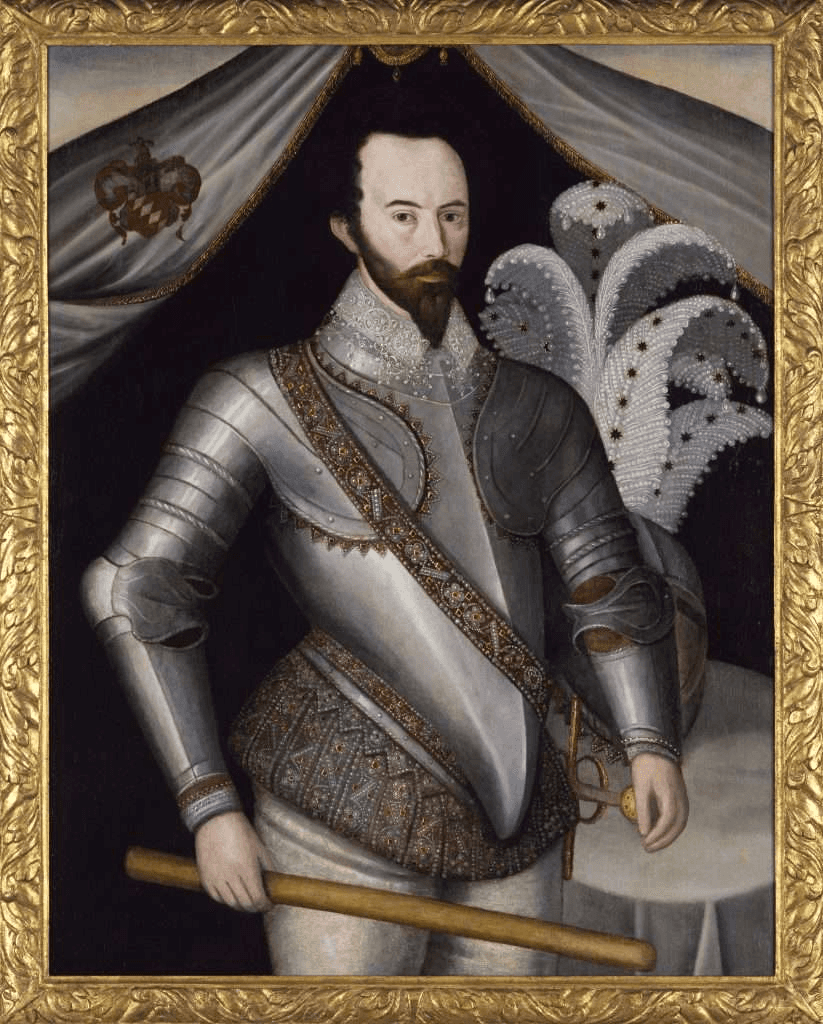
Sir Walter Raleigh (c. 1554–1618) was one of the great swashbuckling figures of the Elizabethan court — soldier, explorer, poet, and, for a long stretch, one of Queen Elizabeth I's favorites. He rose fast through court favor in the early 1580s, was knighted in 1585, and picked up the perks that came with royal attention: estates in Ireland, the captaincy of the Queen's Guard, a seat in Parliament. He's the kind of figure who shows up at the intersection of nearly every major English adventure of the period — soldiering in Ireland, privateering against Spanish shipping, writing poetry, and eventually chasing the legend of El Dorado in South America later in life (which, incidentally, is what got him executed in 1618, after a failed expedition violated a peace treaty with Spain and cost him what remained of royal goodwill).
By the 1580s, Spain already had a huge, wealthy American empire, and England was desperate to get a foothold before Spain's position became unchallengeable. A colony north of Spanish Florida would give England both a base for its own claims and a forward position from which privateers could harass Spanish treasure fleets sailing up the coast — colonization and piracy were not separate projects in Raleigh's mind, they reinforced each other. Economic upside was the other obvious pull. Nobody knew yet what North America actually contained, so expeditions like Harriot and White's were partly a resource-scouting mission — what can be grown, mined, traded, or extracted. Tobacco came back from these ventures and got marketed at court as something close to a wonder crop; it wasn't a wild guess that something valuable might turn up.
And personally, Raleigh needed exactly this kind of high-visibility, prestige-generating project. Court favor under Elizabeth was a constant performance — you kept your position by continually demonstrating usefulness and boldness to the crown, and "the man who delivered England's first American colony" was precisely the kind of legacy that could cement a courtier's standing. Elizabeth herself never set foot in the Americas, of course, but the whole venture was framed around her — the colony and the surrounding territory were named "Virginia" in her honor, since she was the unmarried "Virgin Queen." So there's also a flattery dimension baked directly into the branding.
Raleigh never actually sailed to Roanoke himself — he financed and organized from London, sending others (Grenville, then White) to do the actual crossing and settling, which is fairly typical of how these Elizabethan colonial ventures worked: the promoter takes the financial risk and reputational stake, career soldiers and specialists like Harriot and White do the fieldwork. And when the colony vanished and things went badly, it was Raleigh's investment and reputation on the line, not his life — his fortunes at court had already started to slide by the early 1590s anyway, mostly over his secret marriage to Elizabeth Throckmorton, which the Queen took as a personal betrayal and which landed him briefly in the Tower of London.
The division of labor that Harriot and White had was fairly precise. Harriot was the expedition's mathematician and surveyor — he'd go out with angle-measuring instruments and do actual land surveying, establishing latitude and longitude, sketching triangulated survey data either into a notebook or directly onto paper mounted on a plane table in the field. White then took that raw technical survey work and turned it into finished, accurate maps — so even the cartography was a two-step, two-person production: Harriot's measurements first, White's draftsmanship second.
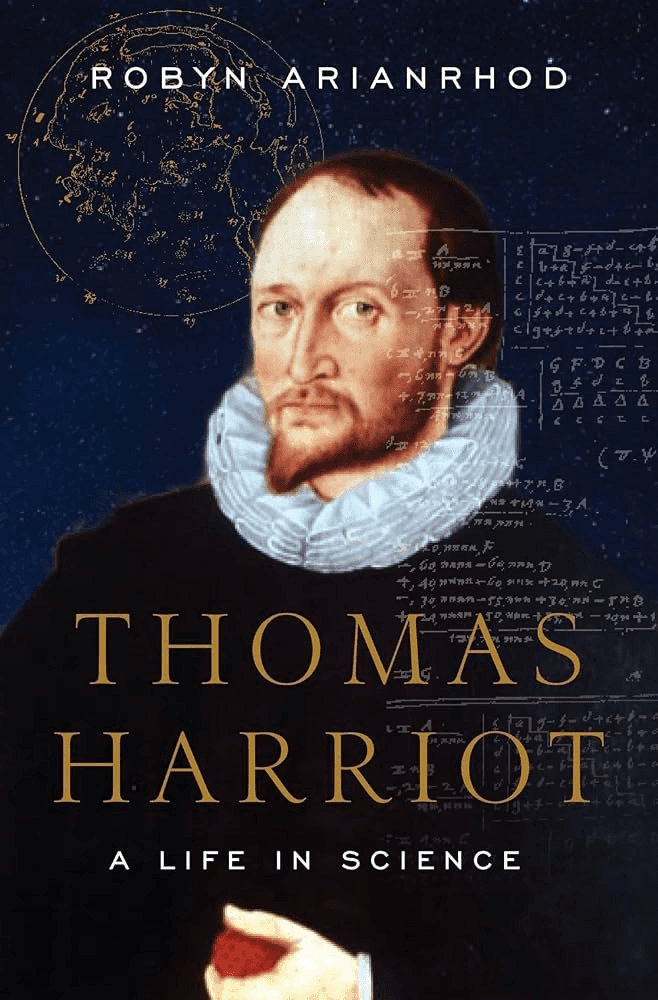
Thomas Harriot (c. 1560–1621) is a genuinely underrated figure — arguably one of the sharpest scientific minds of the entire Elizabethan era, and one who's mostly remembered today for a side project (Roanoke) rather than the actual scientific work that made him remarkable. He went to Oxford in 1577 at seventeen and stood out immediately for mathematical talent at a time when math wasn't especially prized in English university culture — it was seen as a somewhat marginal, almost suspect discipline compared to theology and classics. After his degree in 1580 he moved to London and ended up working for Walter Raleigh at Raleigh's Durham House residence, where his actual job was intensely practical: teaching Raleigh's sea captains open-ocean navigation, training them on instruments like the astrolabe, cross-staff, and sextant. This is the era before reliable longitude calculation, so a mathematician who understood celestial navigation was a serious strategic asset for anyone planning transatlantic voyages.
Before he ever set foot in America, Harriot did something that turns out to matter enormously for the Roanoke project specifically: two Algonquian men, Manteo and Wanchese, had been brought to England in 1584 after an earlier reconnaissance voyage, and Harriot worked directly with them to learn their language — going as far as inventing his own phonetic alphabet to transcribe Algonquian sounds accurately. So by the time he actually sailed to Roanoke in 1585, he wasn't arriving cold; he had language preparation most other Europeans in the Americas at that point simply didn't have, which is part of why his ethnographic writing in A Briefe and True Report carries more credibility than a lot of contact-era colonial writing.
The far more interesting part of Harriot's life happened after Roanoke, largely out of public view because he rarely published anything in his lifetime — a huge amount of his work only became known from surviving manuscripts. He's credited with independently developing an early form of algebraic notation and inequality symbols. He calculated an orbit for what would later be recognized as Halley's Comet. And most strikingly, in July 1609 — weeks before Galileo — Harriot pointed a telescope at the Moon and made the first known telescopic drawing of it, going on to produce what's considered the first proper lunar map by 1611, and he was also among the earliest people anywhere to observe sunspots, in 1610. He simply never rushed to publish or claim priority the way Galileo did, so history gave Galileo most of the credit for discoveries Harriot arguably made first or in parallel.
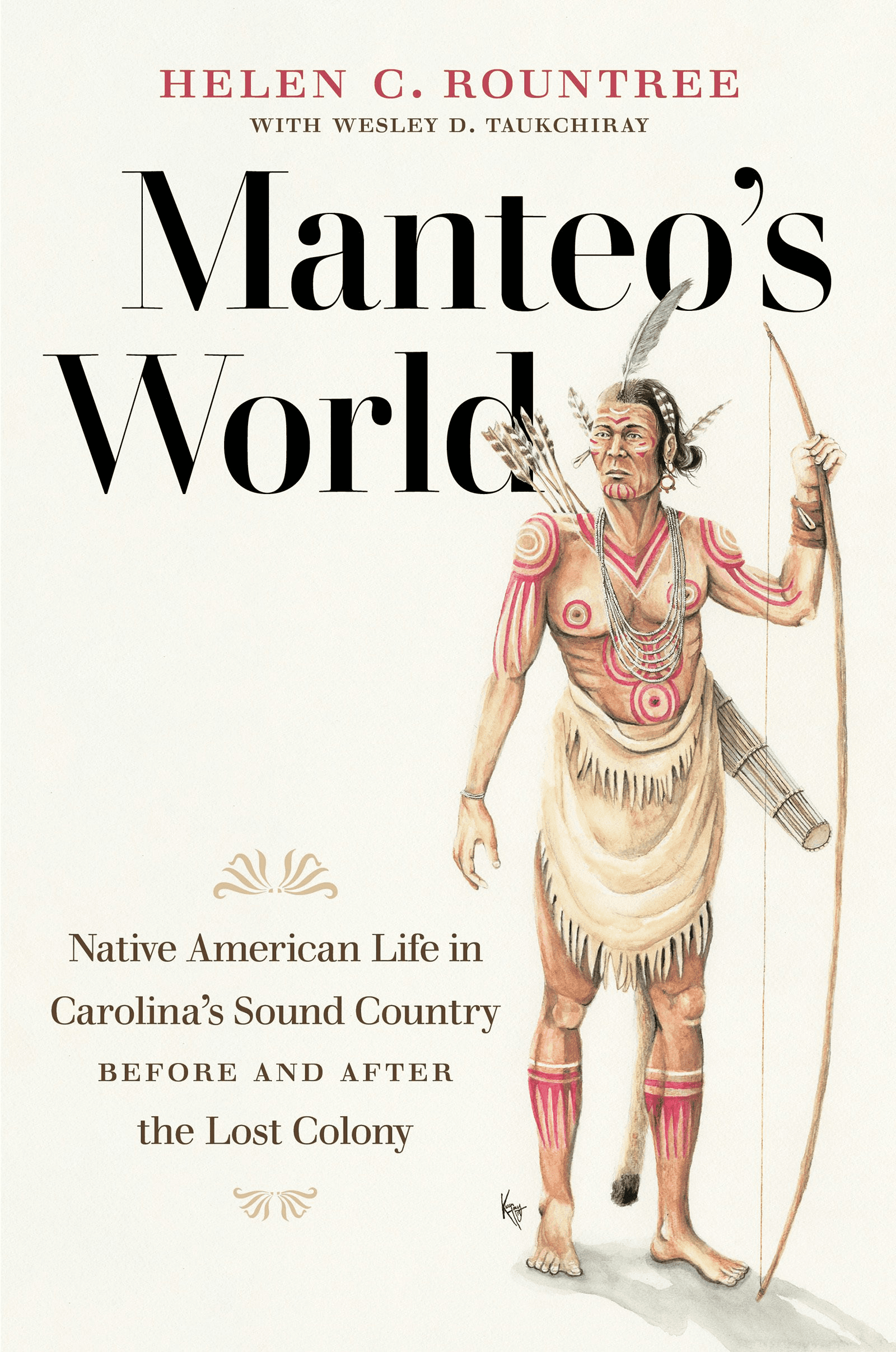
Manteo and Wanchese were two Algonquian men from the Croatan/Roanoke area of coastal North Carolina, taken to England in 1584 by an earlier English reconnaissance voyage led by Philip Amadas and Arthur Barlowe — the scouting trip that happened before Harriot, White, or the actual colonizing expeditions. The English described them as "lustie men" (meaning strong, vigorous) and brought them back essentially as living resources: proof of the New World's existence for skeptical investors, and — more practically — informants who could teach the English about the land, the people, and above all the language, before anyone committed to a full colonization attempt.
They were hosted at Raleigh's own London residence, Durham House — the same place where Harriot was based — and dressed in English clothing (brown taffeta), since they'd arrived in tanned skins and furs. This is exactly where Harriot's language work comes in: he spent real time with both men working out Carolina Algonquian, testing his phonetic alphabet, building the vocabulary and cultural knowledge that made his later ethnographic writing possible. In effect, Manteo and Wanchese were Harriot's actual language teachers, a full year before he ever set foot in Virginia himself.
But the two men reacted to the whole experience completely differently, and it ended up mattering enormously once everyone got back to America. Manteo engaged — cooperated closely with Harriot, apparently picked up English, and by most accounts came away viewing an alliance with the English as workable, maybe even advantageous for his own position. Wanchese, by contrast, treated the whole thing more like captivity than diplomacy — resisted learning English, stayed suspicious, didn't build the same rapport.
That divergence then played out for real once they both returned to Roanoke in 1585. Manteo became genuinely indispensable to the English — guide, translator, go-between — and in August 1587 he was formally baptized into the Church of England, the first Native American on record to convert that way, which was almost certainly as much a political move by Raleigh's colonial project as a spiritual one. It cost him something with his own people too — some Croatan apparently regarded him as having gone over to the other side. His fate after the colony vanished in 1590 is unknown; he may have left with the colonists, or with Croatan relatives, but there's no clear record.
Wanchese went the opposite direction entirely. Once he saw firsthand how demanding and destabilizing the English presence became — Ralph Lane's colonists leaning hard on local communities for food during a poor harvest year — Wanchese aligned with Chief Pemisapan's faction, which actively resisted and ultimately turned hostile toward the English. After Pemisapan was killed by Lane's men, Wanchese is credited by Manteo's own account with leading the pressure campaign that drove off the small garrison Grenville had left behind on Roanoke in 1586. After that, he disappears from the historical record. It's a striking pair of case studies in how contact-era diplomacy could split two men from the same community into opposite trajectories — one becoming the English colonial project's most trusted Native ally, the other becoming its earliest organized resistance.
The same division of labor that Harriot and White had carried over to the ethnographic material, which is the part that ends up mattering most for the de Bry engravings. Harriot's job, per Raleigh's brief, was to document "the appearance, character, and practices of the Indians" in writing — body and clothing, diet, house and town layout, religious practice, farming, fishing, hunting, boatbuilding, and how they made war. White's watercolors were built to sit directly alongside that text as illustration, not as independent artwork — a village scene White painted would correspond to a passage Harriot wrote describing that same village's layout or customs. The final product, Harriot's A Briefe and True Report of the New Found Land of Virginia, was designed from the outset to be read with White's images beside it.
De Bry is really the third stage of that same pipeline: in 1590 he engraved White's watercolors into copperplate and set them alongside Harriot's text in a single multilingual volume, which then went through seventeen editions between 1590 and 1620 — meaning the Harriot/White partnership, filtered through de Bry's press, became essentially the standard European reference on Algonquian life for the next several decades.
In 1587, White went back to Roanoke, this time as governor of a new colonizing expedition meant to be a real, self-sustaining settlement with women and children, not just soldiers and prospectors. His own daughter Eleanor was among the colonists, married to Ananias Dare, and while there she gave birth to Virginia Dare — remembered as the first child born to English parents in the Americas. Shortly after, White sailed back to England for supplies, expecting to return within months.
He didn't get back for three years. England's war footing against the Spanish Armada meant Queen Elizabeth froze non-military shipping, and by the time White finally made it back to Roanoke in August 1590, the colony — all ~115 people, including his daughter and granddaughter — had vanished. No bodies, no signs of battle, just an abandoned fort and the word "CROATOAN" carved into a post, along with "CRO" carved into a nearby tree. That's the entire evidence trail for what's become known as the Lost Colony of Roanoke, and it's never been conclusively resolved — White himself suspected they'd relocated to Croatoan Island but bad weather forced his ships back to England before he could search further. He never returned to the Americas again and died around 1593, apparently never learning what happened to his family.
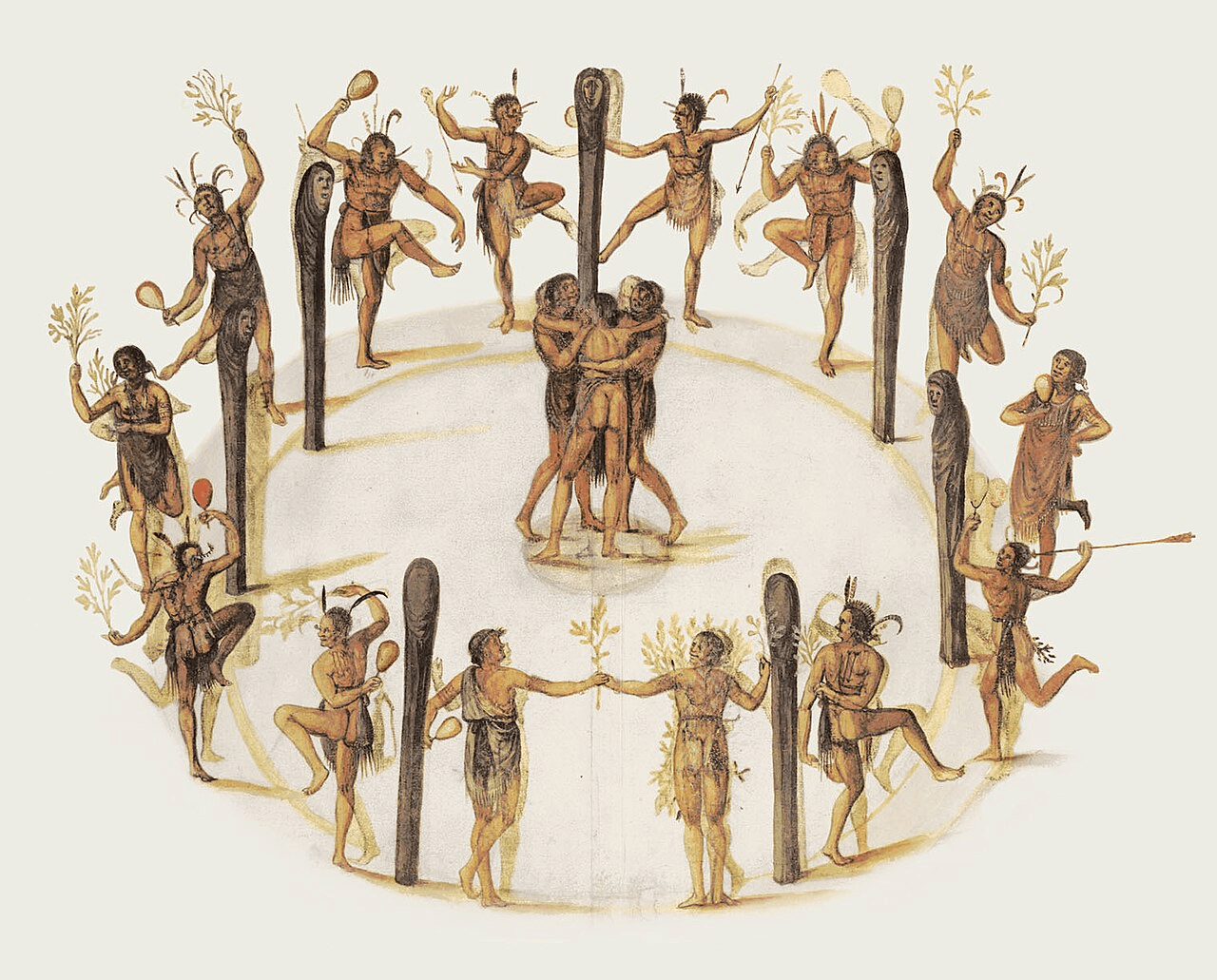
The watercolors survived, though — they're held today in the British Museum's print room — and this is the direct link back to de Bry: Theodor de Bry engraved White's paintings for the 1590 America volume (Part I of the Grands Voyages, paired with Harriot's text, A Briefe and True Report of the New Found Land of Virginia). So in a real sense, almost everything most people picture when they imagine "first contact" imagery of Eastern Woodlands Native peoples traces back to White's on-the-ground paintings, filtered through de Bry's engraving studio in Frankfurt before it ever reached a European audience — with all the same caveats about artistic license that apply to de Bry's other work. 🇺🇸