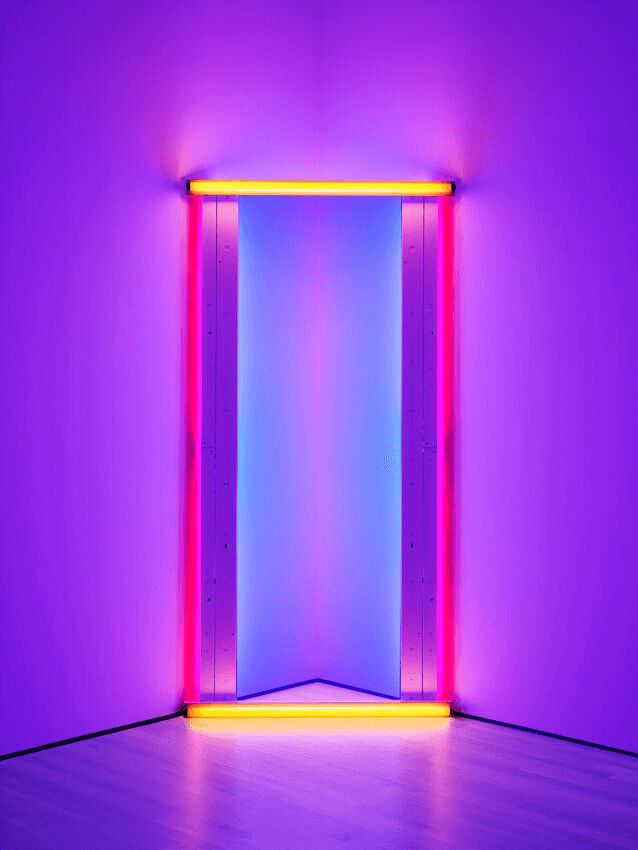
SFMOMA, Part 41: Floor 4, Ways of Seeing: Fourteen Artists.
The yellow gets you first. Two eight-foot tubes running horizontal, burning parallel across the gallery wall, and behind them the blue ones climbing in verticals until the whole arrangement closes into a square — and then, behind that, the red, thrown upward toward the ceiling like an afterthought that turns out to be the whole point. It doesn't sit there. Nothing in this room sits there.
Dan Flavin's untitled (to Barnett Newman) two, 1971, is on view on Floor 4 as part of Ways of Seeing: Fourteen Artists, part of Reimagined: The Fisher Collection at 10. Yellow, red, and blue fluorescent light, 96 × 48 inches, from the Doris and Donald Fisher Collection. Entry is included with general admission; SFMOMA, 151 Third Street, is open Mon–Tue and Fri–Sun 10 a.m.–5 p.m., Thu noon–8 p.m., closed Wed.
The easy reading is: a dead friend's name on a label, primary colors for a painter of primary colors. But the subject is sharper than that. Barnett Newman died on July 4, 1970. Afterward Flavin went to his studio and saw the unfinished canvases of Who's Afraid of Red, Yellow and Blue — the huge fields Newman had been wrestling into paint right up to the end — and came away electrified. He answered in tubes. This is one of four related works, numbered one through four, made for Flavin's 1971 solo show at Dwan Gallery in New York, each one reconfiguring the same rectangle of yellow, red, and blue. A memorial you can't look at so much as stand inside.
1969–1970: a studio after a death
Newman's last series was the boldest thing he ever painted: four enormous canvases in pure red, yellow, and blue, named with a barroom taunt at the theorists who had declared painting dead. Flavin, born in Queens in 1933 and already famous for making sculpture out of store-bought fluorescent tubes, had been carrying on a friendship with Newman across the divide of medium. When Newman died, Flavin did what he'd always done with dedications — he made the genre work harder. The "monuments" for V. Tatlin (1964–1990) were already a running joke against the whole idea of the monument: eight-foot towers of cheap light dedicated to a revolutionary who never built anything. The Newman works are the other side of that coin. Where the Tatlin monuments mock their own modesty, these mourn with it.
1971, Dwan Gallery: one rectangle, four configurations
The series logic matters. Each of the four Newman pieces works the same handful of commercial fixtures into a different corner construction — a rectangle investigated serially, the way Newman himself investigated the vertical zip across canvas after canvas. Flavin didn't paint Newman's colors; he bought them, off the shelf, in the exact fluorescent hues any office building used. That was the point. Newman had made red, yellow, and blue into fields of near-religious intensity; Flavin handed them back as light itself, refusing to stay inside the frame. The piece can't be seen head-on the way a painting can. The red escapes upward. The yellow doubles on the wall. You're not looking at a tribute to Newman — you're standing in the thing Flavin took from him.
The show, again
The Flavin gallery on Floor 4 is part of a floor of monographic rooms — fourteen artists, fourteen small worlds, with the artists' own words on the panels. Go back to the Flavin piece late in the day, when the crowd thins, and watch the red on the ceiling do something the label never mentions: it moves when you move, because your shadow interrupts it. Flavin knew a room could be broken down and played with "by planting illusions of real light, electric light, at crucial junctures in the room's composition." Fifty-five years later, the illusion still holds. The dedication in parentheses is just the title. The work is the rest of the room.
I walked out of that gallery with yellow on the backs of my hands, and I didn't wash it off until I got home. 🌁
Timeline — Dan Flavin
1933 — Born in Queens, New York, on April 1.
1963 — the diagonal of May 25, 1963: a single yellow fluorescent tube laid diagonally across a wall. His first mature fluorescent work, and the day the readymade got plugged in.
1964 — Begins the "monuments" for V. Tatlin, a decades-long series of light-towers dedicated to the Russian Constructivist — partly homage, partly an ironic joke about monuments made from discount fixtures. It runs until 1990.
1970 — Barnett Newman dies on July 4. Flavin visits the studio, sees the unfinished Who's Afraid of Red, Yellow and Blue canvases, and answers them in fluorescent color.
1971 — untitled (to Barnett Newman) one–four debuts at Dwan Gallery, New York: four corner constructions serially investigating the same rectangle of yellow, red, and blue light.
1996 — Flavin dies; his final project, the permanent installation in Marfa, Texas, is completed in 2000.
Today — untitled (to Barnett Newman) two on view, 151 Third Street