
SFMOMA, Part 15: Floor 2, 1900 to Now. Valley Creek Disaster Area (Thornton Dial, 2004).
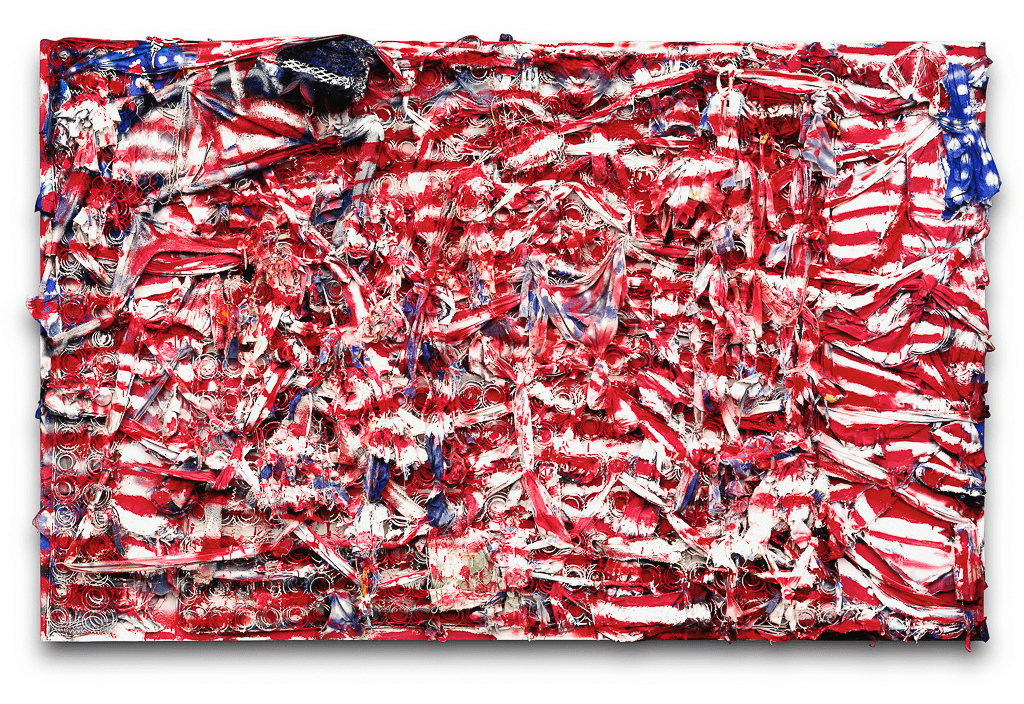
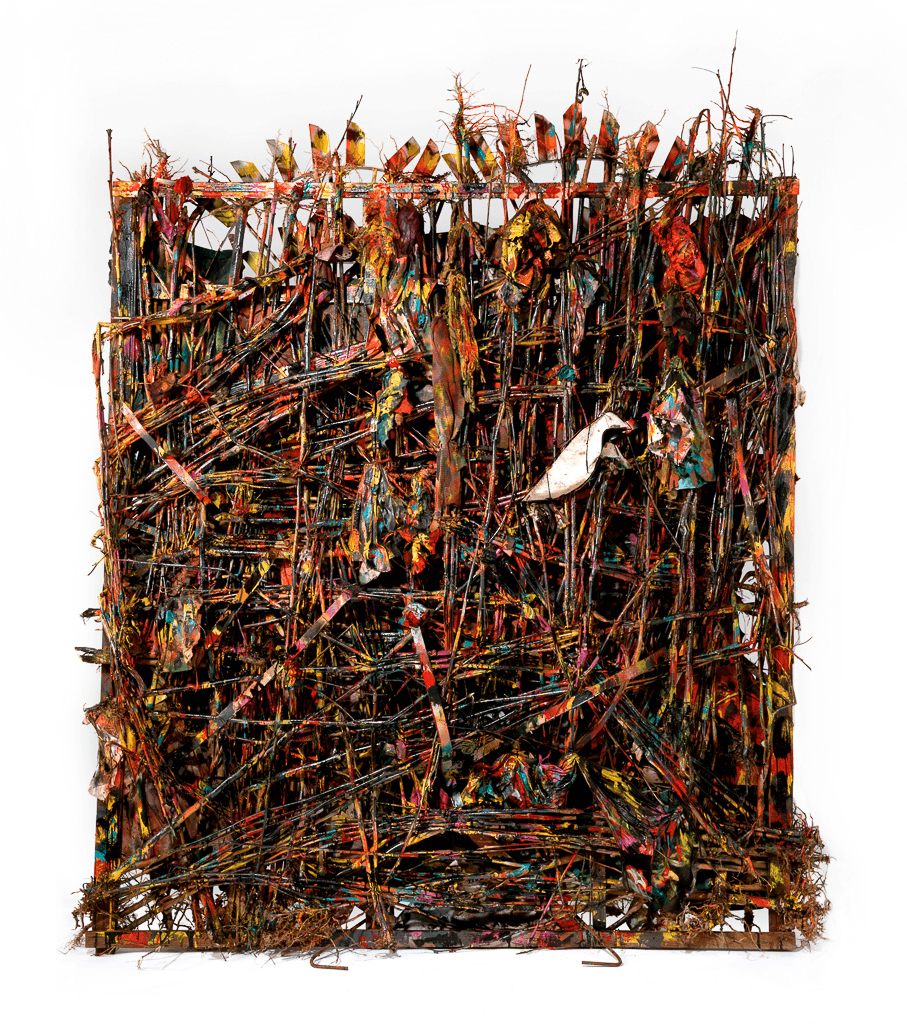
It looks like the aftermath of something, because it is. Tin, wood, cloth caning, wire, corn shucks, chicken wire, enamel, spray paint — the material list reads like an inventory of a flooded basement, and that's the point. Thornton Dial built his art out of what the world threw away, and Valley Creek Disaster Area is what happens when the world throws away a neighborhood. The surface is dense as geology: scrap metal and farm waste bound under paint, caked on until the objects are almost unrecognizable. Stand close and a towel looks like coral. Stand back and the whole thing resolves into an aerial view — a landscape seen from above, after the water came through.
The piece documents a 1983 flood that devastated Black neighborhoods in the Birmingham, Alabama area — including Dial's own — when, as the Souls Grown Deep Foundation puts it, flood control measures were put in place too slowly in the Black impoverished areas of the city under siege. Dial rendered it from above: the flotsam and jetsam of a ruined urban landscape, turned into what the foundation calls "a poetic contemplation of loss and the capriciousness of power, in both nature and society." Valley Creek is a real waterway, running through downtown Birmingham past Bessemer, where Dial lived. The disaster in the title is weather. The disaster in the painting is who the city chose to protect.

Dial made it in 2004, twenty-one years after the flood, deep in the disaster-haunted phase of his late career — the years of Victory in Iraq (2004), barbed wire on a ten-foot canvas, and Don't Matter How Raggly the Flag, It Still Got To Tie Us Together (2003). His disasters were never just weather. From Birmingham's creeks to New Orleans after Katrina, the subject was always the same: catastrophe as a lens on power. Who gets the sandbags. Whose street the water takes.
Ten thousand left
"Art ain't about paint. It ain't about canvas. It's about ideas," Dial said in an interview. "I have found how to get my ideas out and I won't stop. I got ten thousand left."
He was born in 1928 in Emelle, Alabama, on a former cotton plantation where his family worked as sharecroppers. School through fourth grade. Thirty years as a metalworker at the Pullman-Standard railcar plant in Bessemer until it closed in 1981. He made art in his yard for decades and hid it — his wife Clara Mae made him bury the "junk," and he would dig it up later and reuse the materials. When the Atlanta collector Bill Arnett found him in 1987, Dial was storing sculptures in a chicken coop. He offered one for twenty dollars. Arnett refused the price as too low. They settled on two hundred. It was his first sale. He was fifty-nine.

What happened next is the most argued-over discovery story in American art. The breakthrough was a split 1993 New York show — Thornton Dial: Image of the Tiger, at the New Museum of Contemporary Art and the American Folk Art Museum simultaneously. The split venue encoded the whole debate: was he a contemporary artist or a folk artist, an insider or an outsider? 60 Minutes ran a segment accusing Arnett of exploiting an illiterate Black artist. Dial defended Arnett. The argument has never really ended, but the art world voted with its walls: the 2000 Whitney Biennial, the 2011 retrospective Hard Truths (the Wall Street Journal called it first-rate Art with a capital A; Time said what he does "can be discussed as art, just art, no surplus notions of outsiderness required"), the Met hanging his History Refused to Die (2004) facing Pollock's Autumn Rhythm in 2018. The critic Michael Kimmelman called him "preternaturally gifted." He died in 2016, at eighty-seven, after several strokes.
The "outsider" label was always the wrong frame, and Dial's case is what broke it. He wasn't outside anything — he was a Black metalworker in Bessemer making art out of the material conditions of his life, which happened to be the material conditions of American history: segregation, industrial decline, flood, war. The Souls Grown Deep Foundation, Arnett's vehicle, has spent decades placing his work in the Met, the National Gallery, the Smithsonian — insisting, correctly, that this is contemporary art, not a curiosity. SFMOMA's acquisition in 2024 is the latest chapter: a Bessemer metalworker's aerial view of a drowned Black neighborhood, "new to the collection," on Floor 2.
The scrapyard as archive
Look at the material list again: tin, wood, cloth caning, wire, corn shucks, chicken wire, enamel, spray paint. This is not a palette. It's an archive. Every material carries a history — the tin of a roof, the wire of a fence, the corn shucks of a farm, the spray paint of a tag. Dial's great subject, across fifty years, was how history feels when it's made of junk. The German parallel is Kiefer, all lead and ash; the American parallel is Rauschenberg, whose combines Dial's work is always compared to — but Rauschenberg went to Black Mountain College and Dial went to the Pullman plant, and the difference matters. One man's found objects are another man's life.

The deepest American parallel is Noah Purifoy: born in Snow Hill, Alabama, turned to art around retirement age, built monumental work from found material, made catastrophe his subject — 66 Signs of Neon (1966), from the debris of the Watts rebellion. Purifoy had an MFA from Chouinard and ran the Watts Towers Arts Center. Dial had a fourth-grade education and a timecard. Same grammar, opposite ends of the credential spectrum. The work doesn't care about the difference.
So here's the thesis: Valley Creek Disaster Area is a history painting that refuses to look like one. No generals, no treaties, no allegorical figures — just tin and chicken wire and spray paint, arranged the way a flood arranges a neighborhood, which is to say without regard for what anyone intended. Dial's ten thousand ideas were all like this: the grand narratives of American life, told in the materials America threw away. The flood is the subject. The scrapyard is the medium. The accusation — that the city let the Black neighborhoods drown — is in the title, plain as a headline. He didn't need to paint it. He built it out of the wreckage.
Stand in front of it on Floor 2 and think about what "new to the collection" means. The museum is eighty-nine years old. Dial died in 2016. The flood was in 1983. Some arrivals take a while. 🌁
Timeline — Thornton Dial
1928 — born September 10, Emelle, Alabama, on a former cotton plantation
1940 — moves to Bessemer, Alabama, at twelve
1951–1981 — metalworker, Pullman-Standard railcar plant, Bessemer
1987 — "discovered" by Bill Arnett; first sale, $200
1993 — Image of the Tiger, New Museum and American Folk Art Museum, New York
2000 — Whitney Biennial
2004 — paints Valley Creek Disaster Area
2011 — retrospective Hard Truths, Indianapolis Museum of Art
2016 — dies January 25, McCalla, Alabama, age 87
2024 — SFMOMA acquires Valley Creek Disaster Area (Souls Grown Deep Foundation)