Created on
Updated on
Filmmaking in the Age of AI(17): VFX: Georges Méliès
what a crazy and intense person
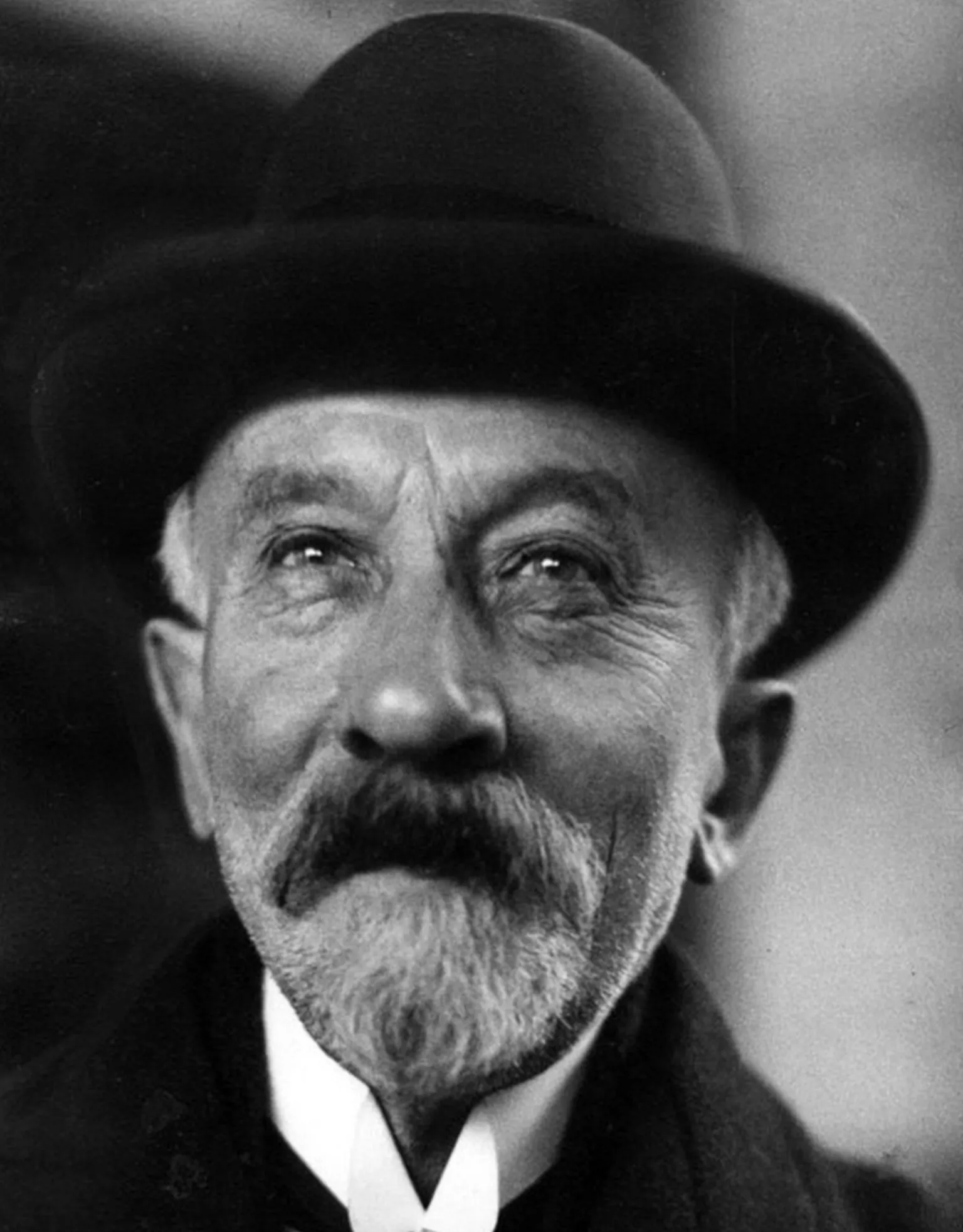
Preface: Co-written with Claude. A bit dense. Read more at Georges Méliès' rare autobiography to be reprinted(https://www.bbc.com/news/uk-england-oxfordshire-43643115).
I have started experimenting with a few AI video generators, and the results were astounding. Very realistic environment, perspective, lighting, and body movement, though I don't think it's replacing human performance at all yet, but I can see this replacing reel stories, short instruction videos such as the ones you see before your flight takes off, and most of the commercial for shots that don't involve people, b-rolls, inserts etc etc. While I'm still experimenting on that before I can give you a full report, let's move on to the VFX bit of filmmaking, the bit that I'm a bit more familiar with.
In 1896, Georges Méliès was filming a street scene in Paris. His hand-cranked camera jammed mid-shot — a mechanical failure, nothing more. He fixed it, kept shooting, and thought little of it. When he screened the footage later, he saw something that stopped him cold. The jam had created an involuntary cut: a bus driving through the frame had, in the space of a frozen instant, become a hearse. Pedestrians had changed direction. Men had turned into women. The camera had lied, and the lie was seamless. He could have shrugged at a technical glitch. Instead, he recognized it as a technique. What Méliès understood — immediately, intuitively — was that the camera doesn't record reality. It records whatever is in front of it, for as long as you let it run. Stop it, change what's in front of it, start it again: the film doesn't know. The audience doesn't know. Only you know. And if only you know, you control what they believe.That insight is the foundation of every visual effect ever made. It sounds obvious now. In 1896 it was genuinely revolutionary. His most famous film, Le Voyage dans la Lune (1902), is worth treating as a technical inventory, not just a cultural milestone. In fourteen minutes, it synthesizes live action, painted backdrops, practical miniatures, matte work, and the substitution splice — with thirty distinct scenes, each one a separate compositional problem solved in camera. The capsule embedding itself in the Man in the Moon's eye is probably the most reproduced single image in the history of VFX; it's been the symbol of the Visual Effects Society for decades. What's less discussed is the engineering behind it.
Miniatures and scale photography
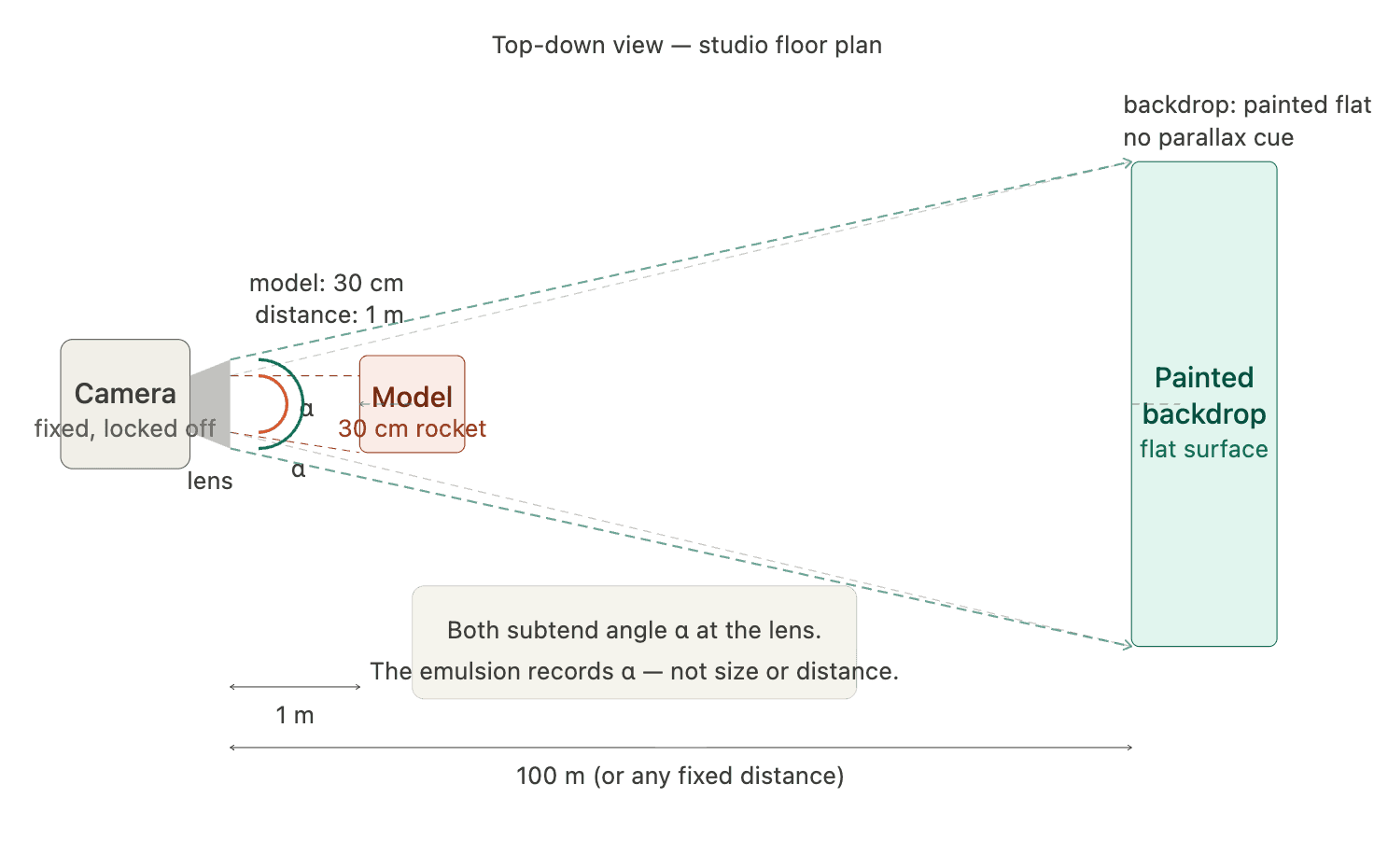
The rocket in Le Voyage dans la Lune approaching the lunar surface is a scale model — a miniature filmed close to the lens against a painted backdrop. The optical principle Méliès exploited is straightforward: a photographic image has no inherent depth information. The emulsion records angular size, not actual size. A small object at close range subtends the same angle as a large object at distance, and the film cannot distinguish between them. The practical constraint of miniature photography at this stage was camera movement. Any lateral camera motion introduces parallax — the apparent relative displacement of foreground and background objects as the viewpoint shifts — and parallax is scale-dependent.
Parallax is something you experience every time you look out a car window. Close objects — a fence post, a road sign — fly past fast. Distant objects — a hill, a building on the horizon — barely seem to move at all. Both are moving relative to you at the same speed, but they don't look like it. That difference in apparent speed is parallax, and it's caused entirely by the difference in distance between you and each object. Now apply that to a film camera shooting a miniature. The model rocket is 30 centimetres from the lens. The painted backdrop is 10 metres away. When the camera is locked off — completely stationary — this distance difference is invisible. The flat image collapses depth. The model and the backdrop both appear to occupy the same plane.
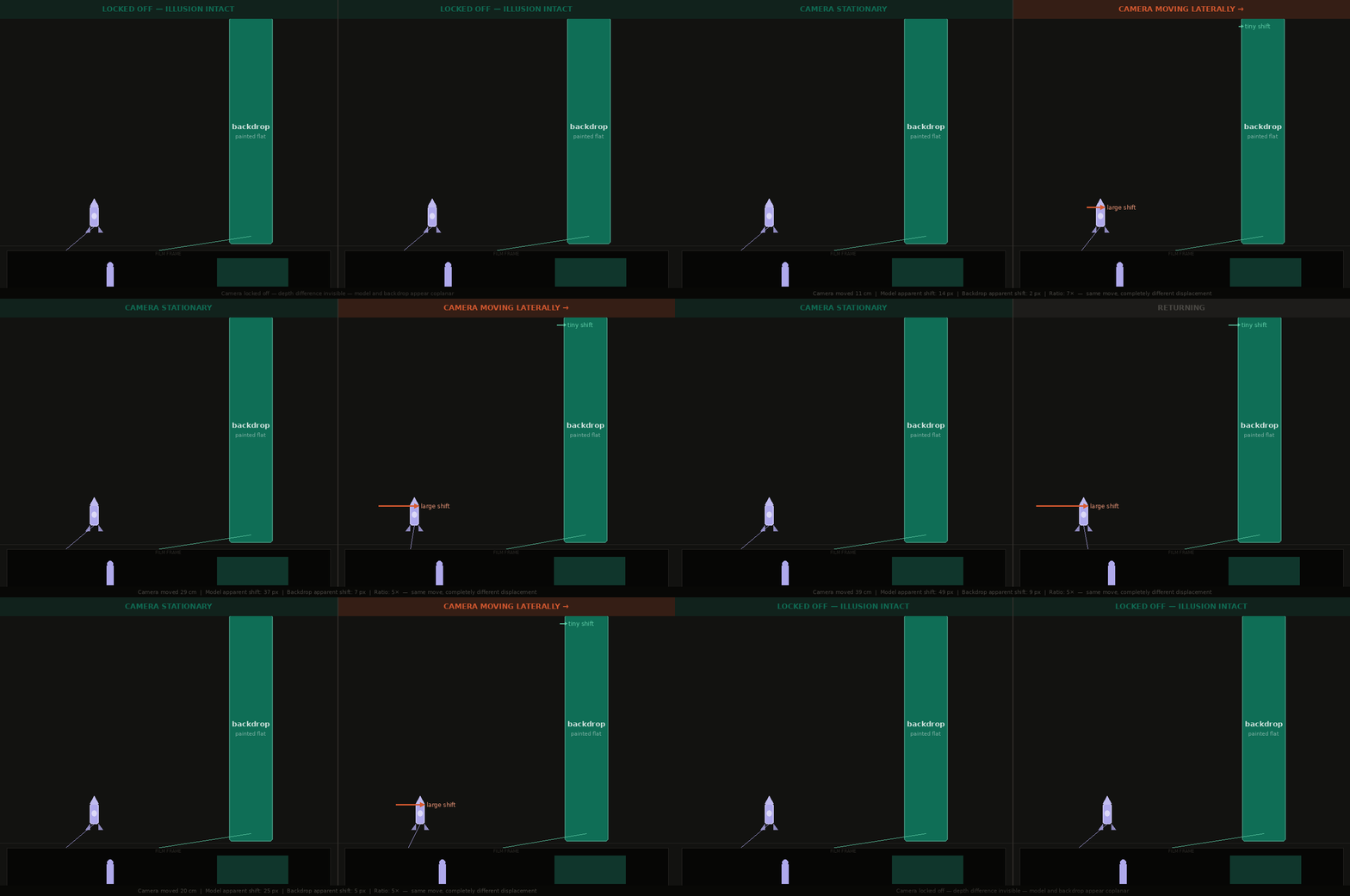
The moment the camera moves sideways, everything changes. The model, being close to the lens, shifts dramatically across the frame — it moves the way that fence post flies past. The backdrop, being far away, barely shifts at all — it moves the way the distant hill barely moves. In a single camera move, the illusion is destroyed. The audience can now see that these two objects are not in the same place. They're at completely different distances. The model is tiny and close. The backdrop is flat and far. The scale deception collapses instantly. This is why the locked-off camera wasn't an aesthetic choice for Méliès — it was a physical requirement. Every compositing technique he used, whether matte work, miniatures, or forced perspective, depended on the camera staying absolutely still. Move it even slightly and parallax revealed the truth about every distance relationship in the frame simultaneously.
The deeper point is that parallax is scale-dependent in a specific way: the closer the object to the camera, the more dramatically parallax affects it. A model one meter from the lens experiences roughly ten times the apparent lateral shift of an object ten meters away for the same camera movement. The only solution is no movement at all. A moving camera reveals that the model and the backdrop are not at the same distance, and that the model is not the size it appears to be. Méliès solved this by keeping his camera locked off, as he did for all his composite work. The fixed camera position that was a limitation of his matte technique was simultaneously a requirement of his miniature work.
Forced perspective
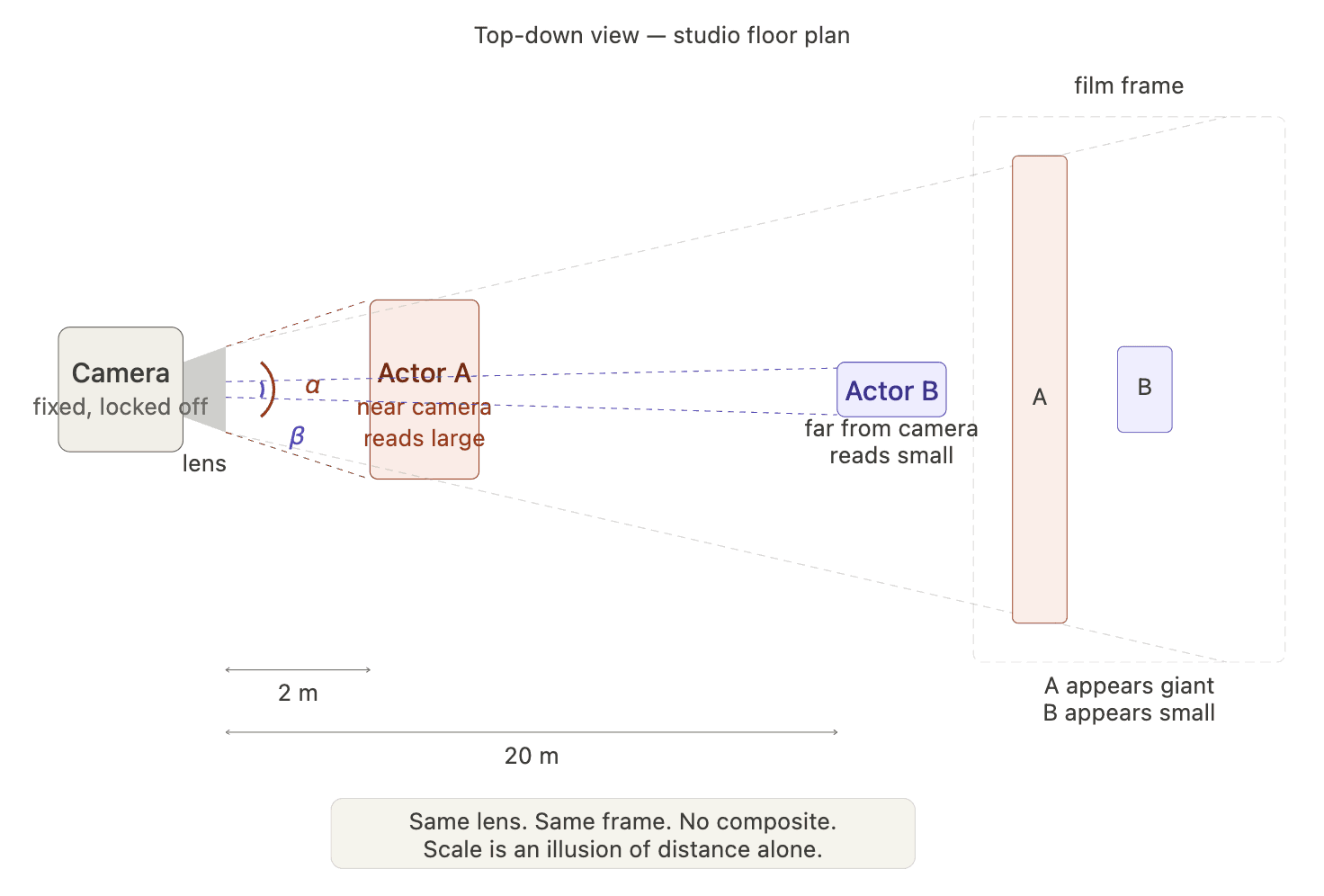
Forced perspective is miniature work's close relative — the manipulation of apparent scale through the deliberate arrangement of objects and figures at different distances from the lens. Where miniatures replace a full-scale object with a small-scale physical proxy, forced perspective uses actual objects and actors but positions them so that their relative angular sizes in the frame misrepresent their actual scale relationship. A full-size actor standing far from camera next to a small prop close to camera will read as a giant next to a normal-sized object, or a normal figure next to an enormous one, depending on framing and context.
Méliès used forced perspective throughout his fantasy work for exactly the kind of scale transformations his theatrical magic-show background had trained audiences to expect — figures growing or shrinking, objects appearing enormous or tiny. The technique requires no post-production intervention: it is achieved entirely through blocking and lens choice, in the single exposure, at the time of shooting. The camera does the work. More on this at: https://neiloseman.com/the-history-of-forced-perspective/
Double exposure for superimposition
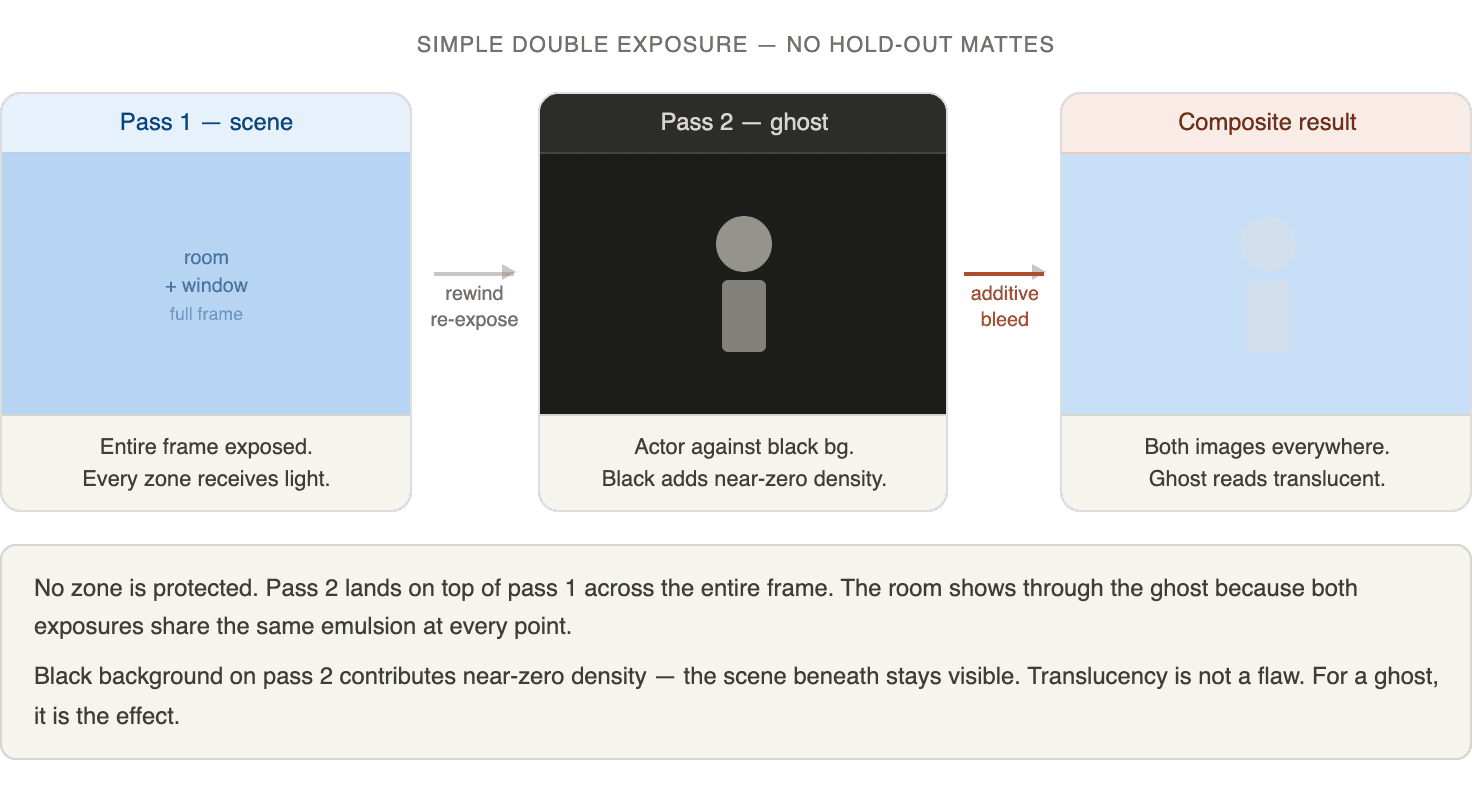
Distinct from the multi-pass matte composite used in The One-Man Band, the simple double exposure — two passes on the same film strip without hold-out mattes — produces additive superimposition: both images are present simultaneously in every part of the frame, with the second exposure layering over the first.
Without hold-out mattes (simple double exposure) — you just run the film through twice with no blocking at all. On pass one, the entire frame gets exposed. On pass two, the entire frame gets exposed again, on top of the first exposure. Every part of the frame now carries both images simultaneously — there's no zone that has only image one or only image two. They exist everywhere at once, stacked on top of each other. The first image shows through the second. Which is exactly why ghosts photographed this way look ghostly — the wall behind them is visible through their body, because the wall was captured in pass one and the actor in pass two, and both are present in every pixel of that area simultaneously.
The practical shortcut Méliès used to make the ghost figure darker and more distinct: shoot the ghost pass against a completely black background. Black on film adds almost no density — a black area in pass two contributes virtually nothing to the already-exposed emulsion from pass one. So the ghost appears against the scene normally, but wherever the ghost's body is, the actor's exposure from pass two sits on top of the scene from pass one — translucent, not solid, because the scene is still partially showing through.
With hold-out mattes (like The One-Man Band) — before each pass, you paint black onto a glass pane to block specific zones of the frame from receiving light. Black on film = no exposure. So zone A gets exposed on pass one, zones B through G stay dark and unexposed, available for later passes. Each element occupies its own clean spatial territory. They don't overlap.
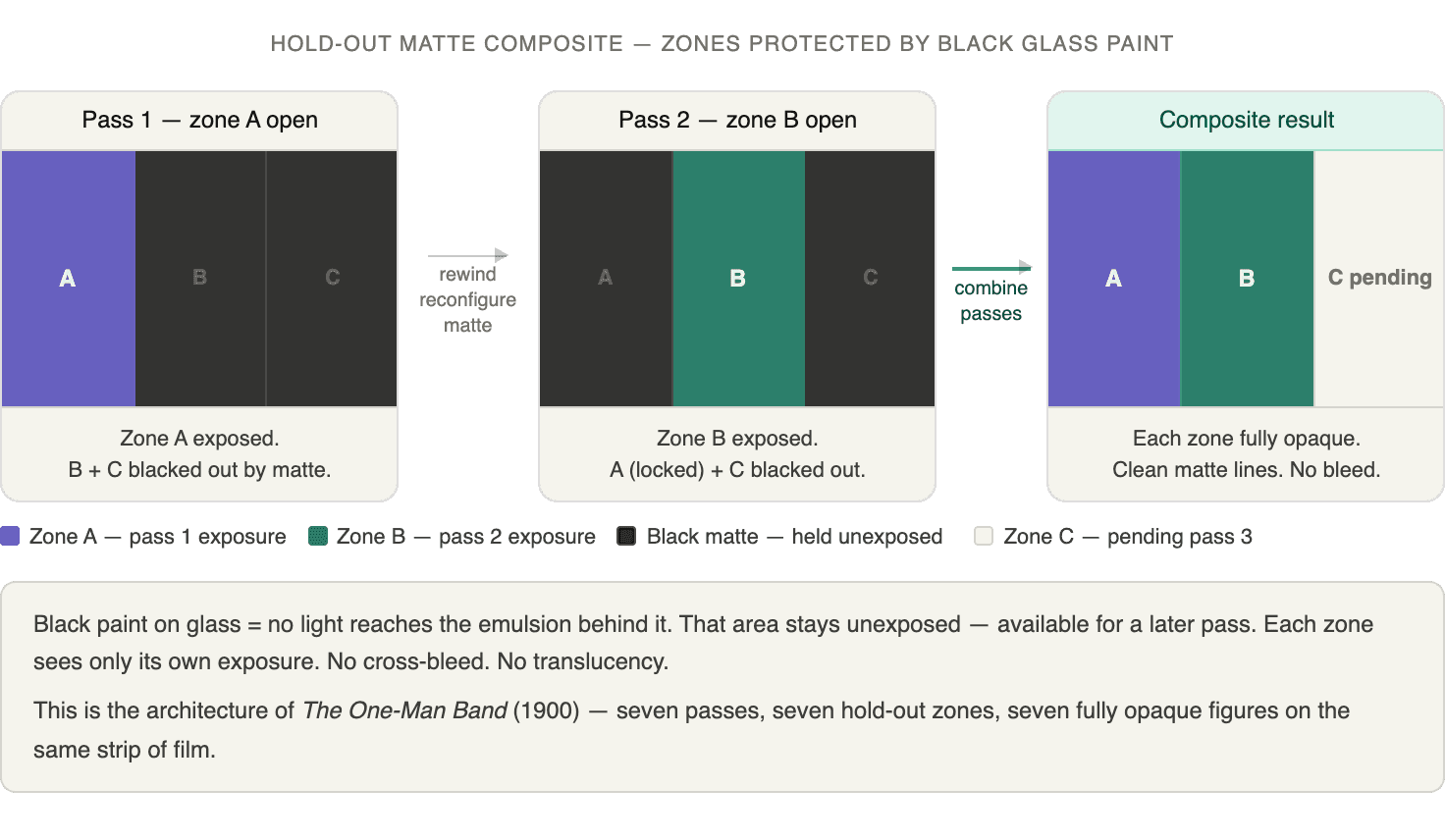
The One-Man Band is two minutes long. Méliès plays all seven members of a small orchestra simultaneously — violin, drum, horn, cello, flute, oboe, lute — occupying seven different positions in the same frame at the same time. He shot it by dividing the frame into seven vertical zones and exposing each one independently on the same strip of film. Before each pass, he mounted a glass pane painted black in front of the lens. Black paint on orthochromatic film stock reads as zero light — the emulsion behind it stays unexposed, holding that space open for a later pass. He would expose one zone, stop the camera, rewind the film by hand to frame one — no frame counter, no mechanical feedback, just physical consistency — reconfigure the matte glass to open the next zone while blacking out all previously exposed areas, and shoot again. Seven passes total.
The hard part wasn't the concept. It was the execution across seven repetitions of the same process. Each rewind had to be accurate to within a few frames or the matte lines would drift and figures would appear to float off their marks. The lighting had to remain consistent across all seven passes — a cloud crossing the glass ceiling of the Montreuil studio between pass three and pass four would produce a visible tonal mismatch between those two musicians. Actor positioning had to be reproduced exactly on each pass so the spatial logic of the frame held. And there was no way to check any of this until the film was developed. When it worked — and it did — the result was seven fully opaque, spatially coherent figures sharing the same first-generation negative, none of them photographed at the same time, no optical printing, no compositing table. Just black paint on glass and a hand-cranked camera.
Hand-painted color
Color in Méliès' films was not captured — it was applied. Selected prints were hand-colored frame by frame by a workshop of colorists, each assigned a single color and a single element to paint across the entire length of the film: one colorist painted all the costumes blue, another all the fire orange, another all the sky sequences a particular shade of pink. The division of labor was industrial — Méliès ran a production line of colorists, not individual artists working frame to frame with creative autonomy.
The key idea is this: a single film print is thousands of individual frames. Coloring it by hand meant someone had to physically paint each frame one at a time. To make that survivable at scale, the Thuillier workshop divided the work like a factory assembly line — not one artist doing everything, but each worker responsible for exactly one color on exactly one type of element, across the entire film.
The Thuillier workshop was the film coloring studio that hand-painted Méliès' prints — and almost every other major French film of the era that came in color. It was run by two sisters, Élisabeth and Berthe Thuillier, out of Paris. They weren't unique to Méliès — they were essentially a service business that multiple film producers contracted. But Méliès was one of their biggest clients, and the color prints of Le Voyage dans la Lune that survived were produced there. What's historically significant about them is the scale. By the early 1900s they were running a workshop of around 200 women — all employed specifically to paint film frames by hand. This was before any chemical or mechanical color process existed for cinema. If you wanted a color print, you paid someone to paint it. The Thuilliers built the infrastructure to do that at production volume.
The division of labor system — one worker, one color, all frames — was their industrial innovation. It's the same logic as a textile factory or a print shop: break a complex task into the simplest possible repeatable unit, then run many workers in parallel. Applied to film, it meant they could produce dozens of color prints of the same film without the quality degrading from print to print, because no individual worker was making any creative decisions. Their names were largely unknown for most of film history. They got significant scholarly attention relatively recently — partly through the Women Film Pioneers Project, which has documented their work and their role in early cinema. The 2011 restoration of Le Voyage dans la Lune brought them back into focus because the restored color print was traced directly to their workshop's work.
Élisabeth Thuillier is now credited as one of the most important figures in early cinema color — not as a filmmaker, but as the person who built the system that made color cinema commercially viable before Technicolor existed(which went bankrupt anyway). The key insight the diagram makes visible: the Thuillier workshop solved a creative problem by turning it into an industrial one. One worker never saw the full picture — they only ever saw their one color, their one element, repeated 13,000 times. The artistic result looked hand-crafted. The process was a factory floor. That's also why the colors in surviving Méliès prints are so consistent — not because the colorists were skilled painters making judgment calls on every frame, but because they were doing mechanical repetition with zero variation. A machine couldn't have done it more uniformly.
The VFX relevance of hand-painted color is that it represents the first instance of post-capture image alteration in cinema — modifying the recorded image after the fact to add information that the camera did not and could not capture. Orthochromatic film stock was not sensitive to the full visible spectrum; certain colors photographed as indistinguishable gray tones. Painting color onto the print restored chromatic differentiation that the photochemical process had collapsed. This is, in conceptual terms, the same operation as color grading in a digital intermediate: the captured image is treated as a starting point, and color information is applied in post to achieve an intended result that the camera alone could not produce.
Practical effects: smoke, fire, and on-set transformation
Méliès' on-set practical effects were designed, engineered, and repeatable — not incidental. The smoke used in Selenite dissolution sequences was produced by theatrical flash pots, timed to the camera stop and actor exit. In Le Voyage dans la Lune, the moon's inhabitants — the Selenites — have a specific property: when struck by one of the astronomers' umbrellas, they explode into a puff of smoke and vanish. This happens repeatedly across several shots. The audience sees a figure in costume, a blow lands, the figure disappears in smoke. Clean, instantaneous, repeatable. That effect required coordinating three things simultaneously: a practical smoke source, a camera operation, and an actor's exit. All three had to happen in the right sequence within a fraction of a second.
A flash pot is a theatrical device — it predates cinema entirely, coming directly from stage magic and theater. At its simplest it's a small metal container holding a pyrotechnic charge: a mixture of flash powder (typically magnesium or aluminum powder combined with an oxidizer) that when ignited produces a sudden burst of light, a loud crack, and a dense cloud of smoke. Stage magicians had been using them for decades before Méliès came along — they were standard equipment at the Théâtre Robert-Houdin, the magic theater he owned and ran. He didn't invent the flash pot. He knew exactly what it could do because he'd been using it on stage for years before he made a single film.The smoke a flash pot produces is dense, opaque, and — critically — short-lived. It blooms fast and dissipates within a few seconds. That temporal profile is exactly what the stop-substitution technique required: the smoke needed to be present long enough to bridge the cut, then gone before it became a problem for the next shot.
Here's the full sequence of what actually happened on set, frame by frame in operational terms: The camera is rolling. The actor in the Selenite costume is on his mark. The astronomer's umbrella comes down. At the moment of contact — or just before — Méliès signals the flash pot operator. The charge fires. Smoke blooms into the frame. In the same instant, Méliès stops the camera. The camera stopping is not a cut in the editorial sense — the film simply stops advancing through the gate. The frame at which the camera stopped is the last frame of the first exposure. Now, with the camera stopped and smoke filling the set, the Selenite actor has a window of a few seconds — while the smoke obscures the frame — to exit the set entirely. He walks off. The smoke continues to dissipate. When enough smoke remains to still be visually convincing but the actor is clear of the frame, Méliès restarts the camera. The film begins advancing again from exactly the frame where it stopped. The second exposure begins with smoke present and the actor absent. The camera continues rolling as the smoke clears — and the Selenite is simply gone.
Why the smoke was essential to the mechanics? Without the smoke, the stop-substitution cut would be visible. A straight cut — figure present one frame, figure absent the next — reads as a jump even to an early cinema audience. The smoke provides what editors would now call a transition element: something that's present on both sides of the cut, bridging the discontinuity. The eye follows the smoke rather than noticing the splice. The smoke also solved a practical problem: it gave the actor time to exit without rushing. A fast exit without smoke cover risks catching the actor mid-movement at the frame where the camera restarts — a half-vanished figure, one foot still visible at the edge of the set. The smoke buys two or three seconds of cover, which is a generous window.
The timing precision required. What made this difficult was the coordination between three independently operated elements: the flash pot operator had to fire on cue, the actor had to begin his exit the moment the smoke bloomed, and Méliès had to stop and restart the camera within the right window. Too early on the restart and the actor is still visible through thinning smoke. Too late and the smoke has cleared entirely, leaving an empty frame that doesn't match the density of the transitional frames. Méliès had an advantage here that's easy to overlook: he was a trained stage magician. The entire discipline of stage magic is the engineering of precisely timed, multi-person mechanical sequences that appear spontaneous to an audience. Coordinating a flash pot, an actor exit, and a camera stop was not fundamentally different from coordinating a stage illusion — it was the same skill set applied to a new medium. He'd been rehearsing this kind of precision his entire professional life before he made his first film. More on this in the next post.☀️