Created on
Updated on
Filmmaking in the Age of AI(22): Picasso's Cubism
Inspired by African Art
Preface: Co-written with Claude.
Picasso was born in Málaga, Spain in 1881. His father was an art teacher, so unlike Renoir, he had formal artistic training from childhood — he was a prodigy in the most literal sense, technically masterful before he was a teenager. He first came to Paris in 1900 at nineteen, for the World's Fair, and kept bouncing between Barcelona and Paris over the next few years. The key biographical event that shaped what came next: his close friend Carlos Casagemas shot himself in 1901 over a woman. Picasso painted The Death of Casagemas in his homage, and it marked the beginning of the Blue Period.
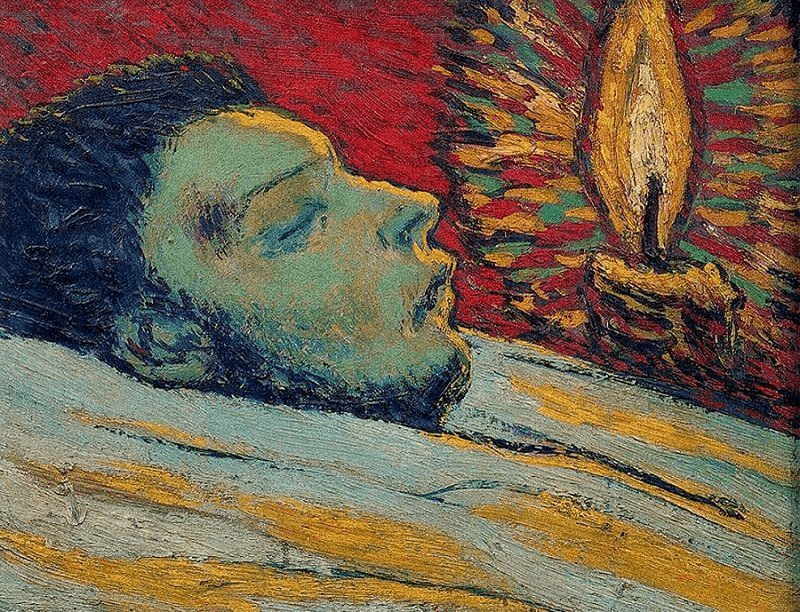
Before Montmartre, Picasso was making the work he is least famous for and that tells you most about who he was at the time. The Blue Period is exactly what it sounds like — everything painted in cold blues and blue-greens, depicting beggars, the blind, prisoners, prostitutes, the poor. It's technically brilliant and emotionally suffocating. He was broke, grieving, and painting his own despair. This was not a calculated artistic statement so much as a direct record of his psychological state. In 1904, the poor, unknown Spaniard Pablo Picasso moved into an artists' building called Le Bateau-Lavoir, which he shared with ten others. In his studio there, he painted Les Demoiselles d'Avignon — and revolutionized 20th-century art.
The Bateau-Lavoir was a former piano factory that got converted into cheap artist studios in 1889. Someone bought a derelict building on a hillside in Montmartre, divided it into roughly twenty tiny workshops along a corridor, and rented them out for almost nothing. It was a labyrinth of corridors and makeshift staircases containing twelve artists' studios and thirty rooms, sharing a single water source. Picasso's studio was at the top. Fernande Olivier, who became his partner, described in her memoirs a large rusted iron stove, a black painted trunk, canvases and tubes of paint everywhere, and a mouse that Picasso kept in the drawer of a table. He was 23. He was poor enough that art dealers exploited him openly — later in life Picasso described one dealer as "a past master at assessing the exact degree of an artist's desperation and squeezing maximum benefit from it."
The move to Montmartre changed his work almost immediately. The beginning of his relationship with Fernande Olivier was surely an influence in his shift from the hunger and hardship of the Blue Period to the lighter and warmer Rose Period. The Rose Period work is warm, figurative, gentle — circus performers, harlequins, acrobats. Picasso grew fascinated with Montmartre's Cirque Medrano, featuring circus freaks, trapeze artists, actors, musicians and dancers. Being around kindred spirits and outcasts marked the beginning of his two-year Rose Period — an optimistic study of entertainers in meditative moments. He was painting people on the margins of society but now with warmth rather than despair.
Les Demoiselles d'Avignon(1907) by Picasso
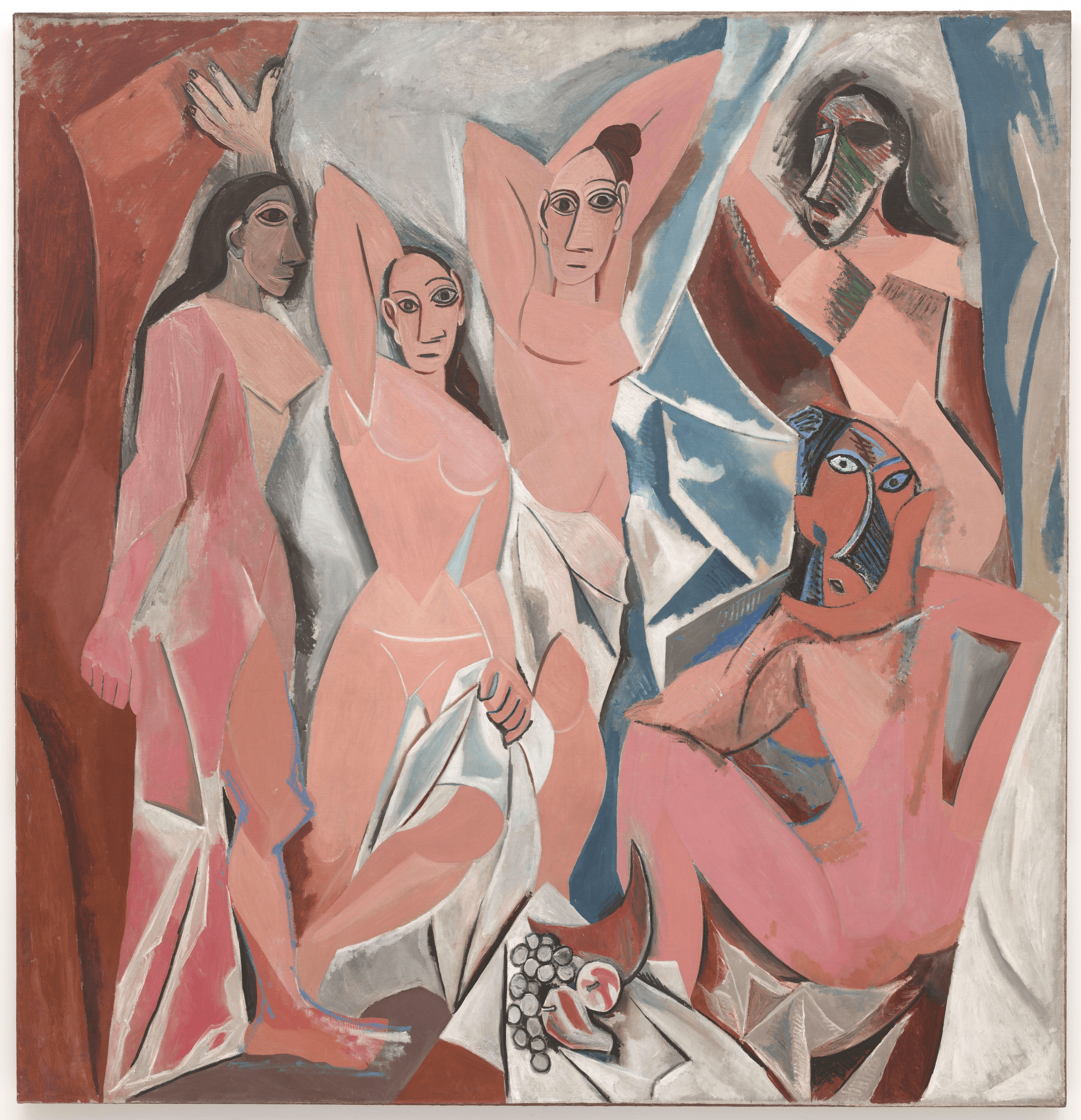
This painting was made in his studio in the Bateau-Lavoir. The same room where he slept, fought with Fernande, received guests, and kept a pet mouse in a drawer. Fernande described it when she first visited: a bed base on four legs in one corner, a rusty cast iron stove with an earthenware wash bowl on top, a wicker chair, easels, canvases of every size, tubes of paint scattered on the floor, paintbrushes, jerrycans for the petrol lamps, a bowl of etching acid, no curtains.
Picasso worked at night. He would sleep through the morning, start painting in the afternoon, and work deep into the night by lamplight — which is one reason the studio needed jerrycans for the petrol lamps. The building itself was a weird, squalid structure echoing from morning to night with every kind of noise: discussion, singing, shouting, calling, the sound of buckets used to empty the toilet clattering on the floor, doors slamming, suggestive moaning coming through closed studio doors. His social life ran parallel to all of this. He and Fernande regularly attended Gertrude Stein's Saturday night salons, where he had first seen Matisse's work. He partook of Montmartre nightlife, went to the Médrano circus, frequented Au Lapin Agile. But Picasso was also possessive and controlling — Fernande noted he was jealous and rarely let her out of his sight, and would sometimes lock her in the studio when he went out. Fernande describes in her memoirs Picasso's obsessive work habits and his fascination with African masks at the Trocadéro Museum, which inspired this painting.
The preparation started in October 1906, when Picasso came back from a summer in Gósol, a remote village in the Spanish Pyrenees, where he had spent months painting in a completely different mental state — calm, productive, removed from the Paris competition. He returned with something shifted in him. It was an October 1906 evening spent closely studying a Teke figure from Congo owned by Matisse that first sparked the studies for what would become Les Demoiselles. That same night, the first sketches appeared. Then in spring 1907, the Trocadéro museum visit happened. Picasso experienced a "revelation" while viewing African art there. He described standing alone in that museum surrounded by masks and fetish figures and suddenly understanding what art could be used for — not beauty, but power. Protection. Exorcism. He said later that Les Demoiselles was his first exorcism painting.
From October 1906 through the painting's completion in 1907, Picasso was vying with Matisse to be perceived as the leader of modern painting. Matisse had shown Le Bonheur de Vivre — a lush, Edenic, joyful work — and much of the art world considered him the dominant force. Les Demoiselles was in part a direct response to that painting. Where Matisse made paradise, Picasso made a confrontation. Around the same time, a mathematician named Princet was introducing Picasso and others at the Bateau-Lavoir to Henri Poincaré's ideas and the concept of the fourth dimension — the idea that objects could be depicted from multiple viewpoints simultaneously, projected onto a flat surface. Picasso's sketchbooks for the painting show this influence directly. He made over 800 sketches and studies before touching the final canvas. The painting went through radical revisions — in an earlier sketch, the figure on the left was a male medical student, skull in hand, entering the brothel, but Picasso decided the customer added narrative that would detract from the overall impact. He stripped it back until it was only the five women, staring out, nothing softened.
The painting shows five nude figures — prostitutes from a Barcelona brothel on Avignon Street. The three women on the left show rounded Iberian features, while the two on the right have fragmented planes influenced by African masks. The painting is internally inconsistent — two different artistic revolutions happening on the same canvas simultaneously. He created hundreds of sketches and studies over nine months to prepare for the final work. The five figures are not stylistically consistent — the three on the left are drawn from Iberian sculpture, the two on the right from African masks. The painting looks like two different artistic revolutions happening on the same canvas because it literally is. He repainted the right side after the Trocadéro visit, mid-work.
He showed it to his circle in July 1907. Matisse and Derain were among those who saw it first, and their reaction was so negative that Picasso did not exhibit it publicly for almost a decade, finally placing it on view in 1916. Matisse thought it was a bad joke. Braque said it disturbed and haunted him for months — which ultimately drove him toward Picasso, not away. That haunting became Cubism. He called it Le Bordel d'Avignon — the brothel. The softer title came later, from André Salmon, who renamed it for its first public showing to reduce the outrage. Picasso never liked Salmon's title and would have preferred las chicas de Avignon instead. It wasn't really Cubism yet. Les Demoiselles is more accurately the foundation upon which Cubism is constructed — it is not yet Cubism itself. What it did was demolish perspective, flatten the picture plane, and fragment the figure. Actual Cubism developed in the years after, in close collaboration with Georges Braque. Picasso described himself and Braque as "two mountaineers, roped together" — at once collaborators and competitors. Together they pioneered the analytic Cubist technique, taking objects apart and analyzing the shapes. ☀️