Created on
Updated on
Filmmaking in the Age of AI(32): Terminator 1 & 2 (1984/1991)
a feverish dream about the future
Preface: Co-written with Claude.
James Cameron
James Cameron was born in 1954 in Kapuskasing, Ontario — a small pulp mill town in northern Canada. His father was an electrical engineer. His mother was an artist. That combination — technical precision and visual imagination — is probably the most accurate way to describe what Cameron became as a filmmaker. He was obsessive and intellectually restless as a kid. He read voraciously — science fiction especially, Asimov, Clarke, the hard SF writers who took physics seriously. He was also deeply interested in the ocean from early childhood, which becomes relevant later when you look at The Abyss, Titanic, and his post-filmmaking career as a deep sea explorer. His family moved to Brea, California in 1971 when Cameron was seventeen. He enrolled at Fullerton College studying physics, then dropped out. He drove a truck for a while. He wasn't directionless exactly — he knew he wanted to make films — but he had no clear path into the industry and no film school pedigree.
It's worth sitting with that for a moment. The man who would eventually make the two highest-grossing films in history at the time of their release — Titanic and Avatar — was in his early twenties driving a truck in Southern California with no clear path into the industry he wanted to work in. This ought to make everyone in their 20s a bit more relaxed, the expectation is not to figure it out early on. Just like many of us in our 20s, even though we don't know what we want to do, most of us we aren't idle during this period. Just like how we were, and are, he was reading, drawing, writing, studying. He had seen Star Wars in 1977 and it hit him the way it hit a lot of people — but his response wasn't just enthusiasm. It was closer to a technical challenge. He started studying how the film had been made, what ILM had done, what the effects pipeline looked like. He went to the library at USC and read everything he could find about film production.
This is a pattern you see repeatedly with the filmmakers in this series. Lucas teaching himself by working in the editing room at USC. Kubrick teaching himself by obsessively watching films at the Museum of Modern Art. Cameron teaching himself by reading in his truck cab and his apartment. None of them waited for formal permission to become filmmakers. They studied the craft as if they were already practitioners of it, and then found whatever entry point presented itself. For Cameron the entry point was a $20,000 short film he and some friends financed themselves in 1978 — Xenogenesis, a science fiction short that was essentially a proof of concept demonstrating he could direct and that he understood how to achieve effects on a minimal budget. That short is what eventually got him in front of Roger Corman's people.
Corman was the legendary low-budget producer who had given first breaks to Coppola, Scorsese, Ron Howard, Jonathan Demme, and dozens of others. His operation was a school in the most practical sense — you learned by doing, under impossible constraints, with no margin for error. Cameron talked his way into a miniature model building job on a Corman production called Battle Beyond the Stars in 1980. He had no professional experience. He got the job partly by showing Corman's team drawings and designs he had done himself. From model building he moved to production design, then to special effects work. He was absorbing everything — how sets were built, how effects were achieved, how a production was organized from the ground up. In 1981 he was hired as effects director of photography on a low budget science fiction film, then briefly as director on a different project before being fired after a day. The producers who fired him concluded he was too difficult, too demanding, too unwilling to compromise. Those same qualities — applied to his own projects rather than someone else's — became the foundation of his entire career.
The science fiction film, Piranha II, had its production take place in Italy and the Caribbean. It was chaotic from the beginning. Cameron and the producer Ovidio Assonitis clashed immediately and continuously. Assonitis had final cut and exercised it aggressively — he eventually locked Cameron out of the editing room entirely and finished the film himself. Cameron flew back to Rome at one point and broke into the editing room at night to re-cut sequences he felt were wrong, working alone until morning. Assonitis discovered this and removed his changes. The finished film is not Cameron's film in any meaningful sense. He has disowned it completely. He doesn't count it in his filmography. When people ask about his directorial debut he says The Terminator. However, the Piranha II experience did something important. While he was in Rome, sick with a fever, unable to sleep, furious about what was happening to the production — he had a dream. A metallic figure emerging from flames, dragging itself across the floor, relentless. The image stayed with him when he woke up. He started writing around it.
The Terminator
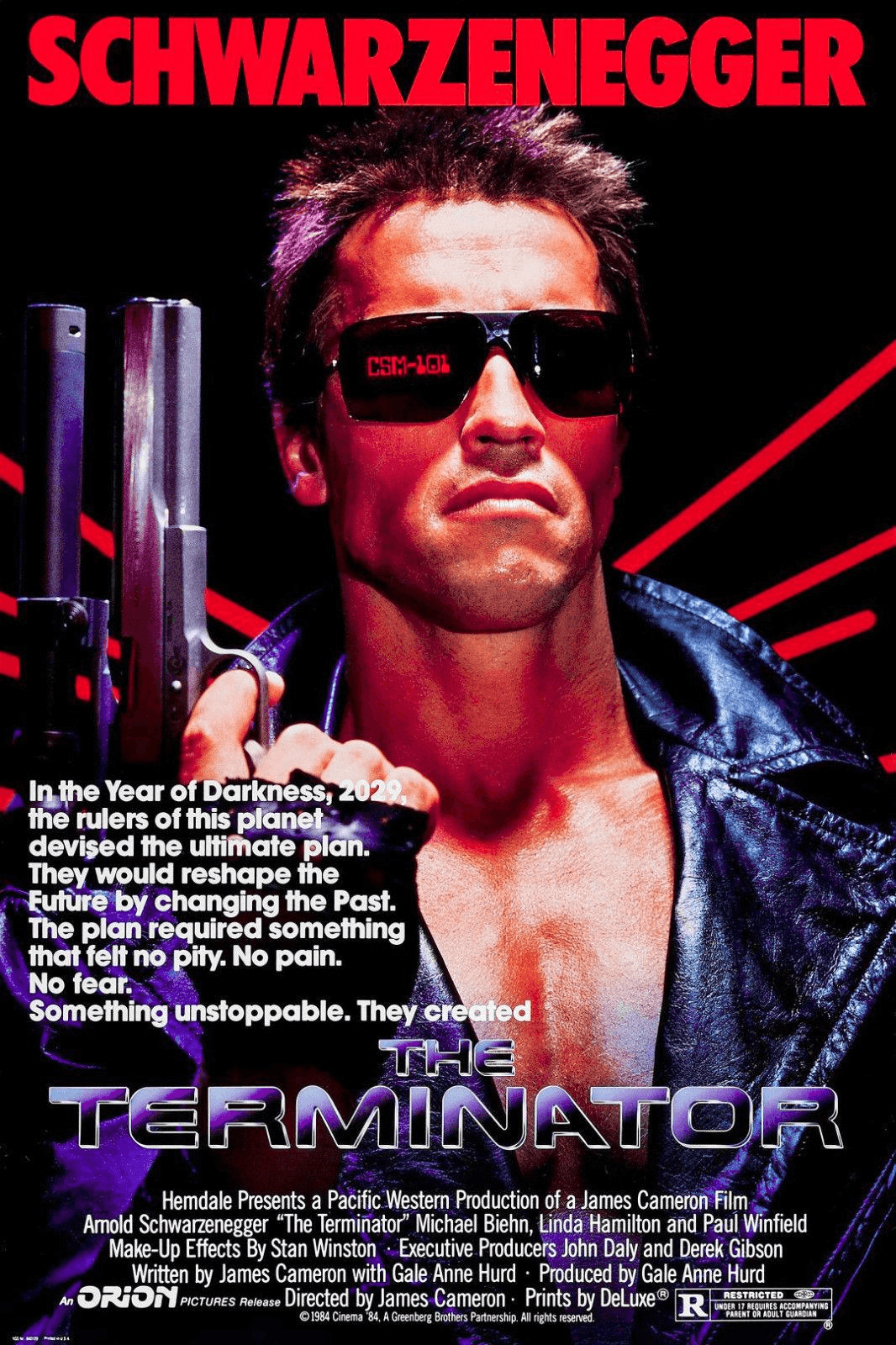
He started writing in Rome while the Piranha II situation was still unraveling. The core concept came together quickly — a machine sent back from the future to kill a woman whose unborn son would lead the human resistance against an AI that had destroyed civilization. The machine would be unstoppable, relentless, would not feel pain or fear or remorse. It would look human. It would not stop. The time travel mechanic bore strong similarities to Harlan Ellison's Outer Limits episode "Soldier" from 1964. "Demon with a Glass Hand," another 1964 Ellison episode, has also been cited by fans as a possible influence — but Ellison himself denied it, writing that the Terminator "was not stolen from 'Demon with a Glass Hand,' it was a ripoff of my OTHER Outer Limits script, 'Soldier.' Ellison later sued over this and received a settlement and a credit acknowledgment. Cameron has always maintained the similarities were coincidental. The legal resolution suggested otherwise.
But the emotional core of the film was Cameron's own. The thing that made The Terminator more than a chase movie was the love story — the idea that Kyle Reese had traveled back through time partly out of mission and partly out of love for a woman he had only ever known through a photograph. That Sarah Connor would become the mother of humanity's savior not because she was already extraordinary but because what happened to her made her extraordinary. The film was about the making of a warrior, not the story of one. At the time, Cameron was broke. He had no money, no agent, no industry connections of any significance. He wrote the script and started trying to get it made with essentially nothing. He got the script to producer Gale Anne Hurd, who had also worked in the Corman orbit. They struck a deal — she would produce, he would direct, and he sold her the rights to the script for one dollar on the condition that he directed it. If he wasn't the director, the rights reverted. It was the only leverage he had and he used it as absolutely as possible. Hurd got the script to Hemdale Film Corporation, a British production company that was operating in Hollywood. John Daly at Hemdale agreed to finance it. The budget was $6.4 million — not enormous even by 1984 standards, but enough to make something real.
Arnold Schwarzenegger
Just as I was writing this, I was about to say I have a personal connection to Arnold Schwarzenegger's story. You see, when I was in sixth grade, I was tasked with writing for a writing competition about a person and story that inspired me, and I chose the story of how Rocky was made. I thought it was Schwarzenegger, but it was actually Sylvester Stallone, I got the two mixed up. The submission eventually won bronze, the same competition that I later found out some of the Chinese directors working today also entered into. They won gold. Even though it's not Stallone, Schwarzenegger had his own version of the same story, of how he broke into the industry. A kid from a tiny village in rural Austria who decided at fifteen that he was going to be the greatest bodybuilder in the world, then decided he was going to be a Hollywood movie star, and then actually did both through a combination of freakish physical gifts and a will that most people who encountered him described as unlike anything they had seen before. And the Hollywood version of this is about how a man with an unpronounceable name, an accent nobody thought would work on screen, and a body that most casting directors thought was too extreme for leading man roles — became the biggest box office star in the world by the mid-1980s. Both valid, different sides of the same coin.
Schwarzenegger won Mr. Universe at twenty and Mr. Olympia seven times — the most prestigious bodybuilding title in the world. By the early 1970s he was the most famous bodybuilder alive, which in 1970s America was not the same as being famous famous, but it was enough to get him in rooms. The documentary Pumping Iron in 1977 changed his visibility significantly. It followed the 1975 Mr. Olympia competition and Arnold was its undeniable center of gravity — charismatic, funny, psychologically dominant, clearly performing for the camera in a way none of the other competitors were. He understood instinctively that the camera was there and that it was an opportunity. The documentary gave mainstream American audiences their first real look at him as a personality rather than just a physical specimen. Hollywood didn't know what to do with him. His early film appearances were awkward. Hercules in New York in 1970, filmed when his English was so limited his voice was dubbed by someone else. Stay Hungry in 1976 — a legitimate film with Jeff Bridges where he was actually quite good, won a Golden Globe for New Star, but the role didn't lead anywhere. The Villain in 1979, a comedy western that nobody saw.
The consistent feedback from Hollywood was that the accent was too thick, the name was too foreign, the body was too extreme. Leading men were supposed to look like men, not like anatomical diagrams. Studios kept trying to find ways to use him that worked around what he actually was rather than building on it. Conan the Barbarian in 1982 was the breakthrough because director John Milius understood something nobody else had — that Arnold's limitations as a conventional actor were irrelevant for a character who was supposed to be a force of nature rather than a psychologically complex human being(ouch). The film grossed $70 million worldwide. Cameron understood something about Arnold that even Conan hadn't fully exploited. The quality that made Arnold slightly wrong as a conventional human character — the deliberateness of his movement, the slight delay between stimulus and response, the sense that something was being calculated behind the eyes rather than felt — was exactly right for a machine wearing a human body. Arnold's limitations as an actor were the T-800's defining characteristics.
Water Tentacles
The Terminator wasn't technically revolutionary in the way Star Wars or 2001 were. It didn't invent new tools or build new pipelines. What it did was something different and arguably more important for the long-term direction of genre filmmaking — it proved that emotional and narrative discipline could make limited technical means feel like more than they were. The film's central illusion isn't a VFX illusion. It's a storytelling illusion. This is always important when we use VFX: if it doesn't serve the story, then it doesn't need to be there. You believe the Terminator is unstoppable not because of anything the effects department did, but because Cameron structured every scene to reinforce that belief. Every time a character tries something that should work — shooting it, running from it, hiding from it — it doesn't work. The threat is built through repetition and consequence, not through spectacular effects.
However, Terminator 2 was way more technically innovative than 1. The Terminator was made with existing tools used cleverly under constraint. T2 was made by building tools that didn't exist, at a scale and cost that had never been attempted for a single effects problem. The gap between the two films is essentially the gap between 1984 and 1991 in computing power, software capability, and ILM's accumulated research. Seven years in VFX terms is an enormous span — longer than the gap feels culturally because the two films are so closely linked in people's minds.
The specific technical problems T2 solved that The Terminator couldn't even attempt: The T-1000 is a liquid metal shape-shifting machine. It morphs between forms. It heals itself when damaged. It mimics specific people with photographic accuracy. It flows through solid surfaces. Every single one of those capabilities required digital technology that either didn't exist or hadn't been applied to a photorealistic character before 1991. The Terminator's effects were all photochemical and practical — camera angles, prosthetics, stop-motion, optical printing. T2's central effect was computational — the T-1000 exists as mathematics rendered into images by computers, composited into live action footage with a precision that made audiences genuinely unsure what they were seeing. The T-1000 is one of the most consequential VFX achievements in cinema history, so let's go a little deeper.
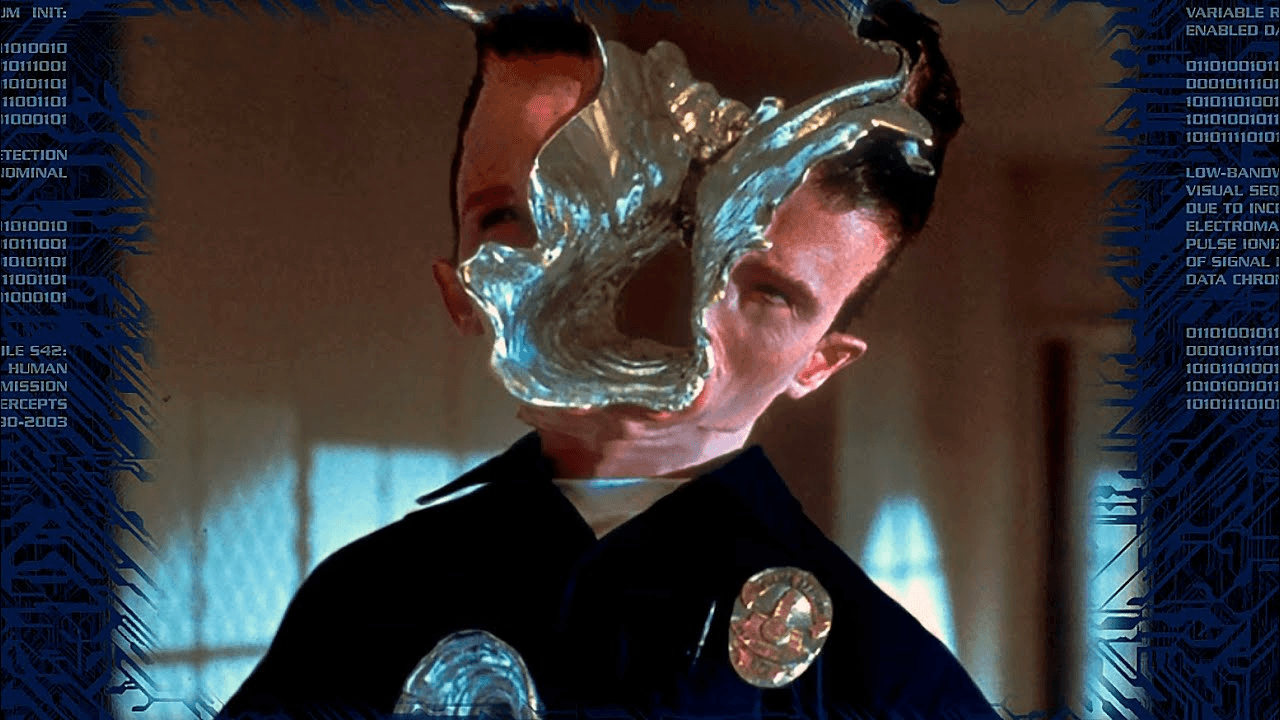
Cameron wanted a character that was made of liquid metal. Not a robot. Not a machine in a suit. Something that was genuinely fluid — that could flow, morph, heal, and transform between states with photographic realism. It needed to pass as a specific human being — Robert Patrick as the police officer — and then seamlessly transition into impossible states. Bullet holes healing over. Arms becoming blades. The entire body melting and reforming. He had been thinking about this character since before T2 was greenlit. The T-1000 concept existed in his mind before he knew whether the technology to realize it existed. His approach was to describe what he wanted first and then find out whether it was achievable — the same approach he took on The Abyss with the pseudopod. ILM's response when Cameron first described the T-1000 was essentially: we don't know if we can do this. Not no — but genuine uncertainty about whether the technology was there.
The pseudopod(the water tentacle) in The Abyss had been the proof of concept. That sequence had demonstrated that a CGI object could be made to look physically present in a real environment — that the rendering, lighting, and compositing could be done at a level of fidelity that convinced audiences. The Abyss came out in 1989. Cameron was making a film about a deep sea oil drilling crew that encounters an alien intelligence living at the bottom of the ocean. The aliens communicate by sending up a tendril of water — the pseudopod — that rises out of the ocean, enters the underwater habitat, and takes on the faces of the crew members to communicate. Cameron's brief to ILM was similar to what he would later give them for the T-1000 — he described what he wanted and asked whether it was possible. The pseudopod needed to be made of water, needed to move with fluid organic logic, needed to reflect its environment accurately, and needed to take on recognizable human faces convincingly enough that the audience would feel something when it looked at them. ILM's solution involved several distinct technical problems solved in sequence.
The pseudopod's form and motion were created using a software system ILM developed specifically for the sequence. The basic shape was a simple geometric form — essentially an elongated teardrop — that could be deformed and animated by the computer. The animators keyframed the major positions and the software interpolated the movement between them, producing the fluid organic motion that makes the pseudopod feel like something alive rather than something mechanical. This sounds straightforward now. In 1989 it required building the software tools from scratch because nothing existed that could do it. The animation system ILM developed for the pseudopod was a direct precursor to the tools they would use on T2.
Making the pseudopod look like water rather than plastic was the harder problem. Water has a specific optical behavior — it refracts light passing through it, it reflects the environment around it, it has a surface tension that creates a specific kind of edge. Simulating all of that simultaneously in 1989 was at the absolute limit of what the computers could handle. ILM's rendering team developed a shader — a piece of software that tells the computer how a surface interacts with light — specifically for the pseudopod's water surface. The shader had to calculate refraction, reflection, and surface tension simultaneously for every point on the pseudopod's surface. Yes, VFX is all science, my friend. On the computers available in 1989 each frame took an enormous amount of time to render — hours per frame in some cases. The sequence runs about seventy-five seconds in the finished film. At twenty-four frames per second that's roughly 1,800 frames. Each frame rendered individually, checked, adjusted, re-rendered if necessary.
The sequence where the pseudopod takes on the faces of the crew members — specifically Mary Elizabeth Mastrantonio's face — was the most technically demanding part. ILM needed to take a scan of the actress's face and map it onto the pseudopod's surface in a way that was recognizable and emotionally legible while still looking like water. The face scanning technology available in 1989 was primitive compared to what exists now. The scans were low resolution by subsequent standards. The mapping process — taking the scanned geometry and applying it to the pseudopod surface — required significant manual work to produce something that looked right. This is now a well-established step in pipeline, called FACS, which is becoming more or less obsolete because of AI, unless you require certain precision. The result in the finished film is about ten seconds of screen time. The face is recognizable. The water quality holds. The emotional effect works — there's something genuinely affecting about seeing a human face rendered in liquid form, looking back at you with something that might be curiosity or might be intelligence or might be both.
The pseudopod demonstrated three things that made T2 possible. First, that a CGI object could be composited into live action footage convincingly enough to fool audiences. This is the beginning of mixed reality I supposed, or should I say, XR? The pseudopod exists in the same frame as real actors in a real environment and it reads as physically present. The lighting matches. The reflections are plausible. The audience doesn't question it. Second , that fluid, organic movement could be achieved digitally. The pseudopod doesn't move like a machine or like a cartoon. It moves like something alive. That organic quality was essential for the T-1000, which needed to feel like a living thing made of metal rather than a robot. Third — that reflective surfaces could be rendered at sufficient fidelity to convince. The water surface of the pseudopod is reflective and refractive simultaneously, math, math, physics, computer engineering. The T-1000's chrome surface was a harder version of the same problem — but ILM now knew the problem was solvable.Cameron watched the pseudopod sequence in the finished film and knew immediately that the T-1000 was achievable. The pseudopod was water. The T-1000 was chrome. Different surface properties, significantly harder rendering problem — but the same fundamental approach. We will move onto T-1000 next. ☀️
REFERENCE LIST
Wikipedia, James Cameron — en.wikipedia.org/wiki/James_Cameron
Wikipedia, The Terminator — en.wikipedia.org/wiki/The_Terminator
Wikipedia, Arnold Schwarzenegger —en.wikipedia.org/wiki/Arnold_Schwarzenegger
Wikipedia, Conan the Barbarian (1982 film) — en.wikipedia.org/wiki/Conan_the_Barbarian_(1982_film)
Wikipedia, Soldier (The Outer Limits) — en.wikipedia.org/wiki/Soldier_(The_Outer_Limits)
Wikipedia, Demon with a Glass Hand — en.wikipedia.org/wiki/Demon_with_a_Glass_Hand
Box Office Mojo, Conan the Barbarian (1982) — boxofficemojo.com
IMDB, James Cameron biography — imdb.com/name/nm0000116/bio
IMDB, Arnold Schwarzenegger — imdb.com/name/nm0000216
Britannica, Arnold Schwarzenegger — britannica.com/biography/Arnold-Schwarzenegger
Schwarzenegger.com, official biography — schwarzenegger.com/bio
Academy of Achievement, James Cameron — achievement.org/achiever/james-cameron
California Museum, James Cameron — californiamuseum.org/inductee/james-cameron
Lemelson-MIT, James Cameron — lemelson.mit.edu/resources/james-cameron
Collider, “The Terminator Ripped Off This Sci-Fi Story… Legally Speaking” — collider.com
TheTerminatorFans.com, “Harlan Ellison and Those Age Old Terminator Plagiarism Claims” — theterminatorfans.com