Created on
Updated on
The Oldest Surviving Script is Egyptian
1980 BCE, Egypt | Ramesseum Dramatic Papyrus
Preface: Welcome to this very long series of filmmaking in the age of AI(2026).
Ramesseum Dramatic Papyrus
The story usually told is that theater begins in Athens — Thespis stepping out of the chorus around 534 BCE to become the first actor, tragedy growing out of hymns sung to Dionysus. That’s the version embedded in nearly every “history of theater” survey. It’s also wrong by about a millennium and a half, if you’re willing to call what came before it theater at all — which is itself the interesting fight.
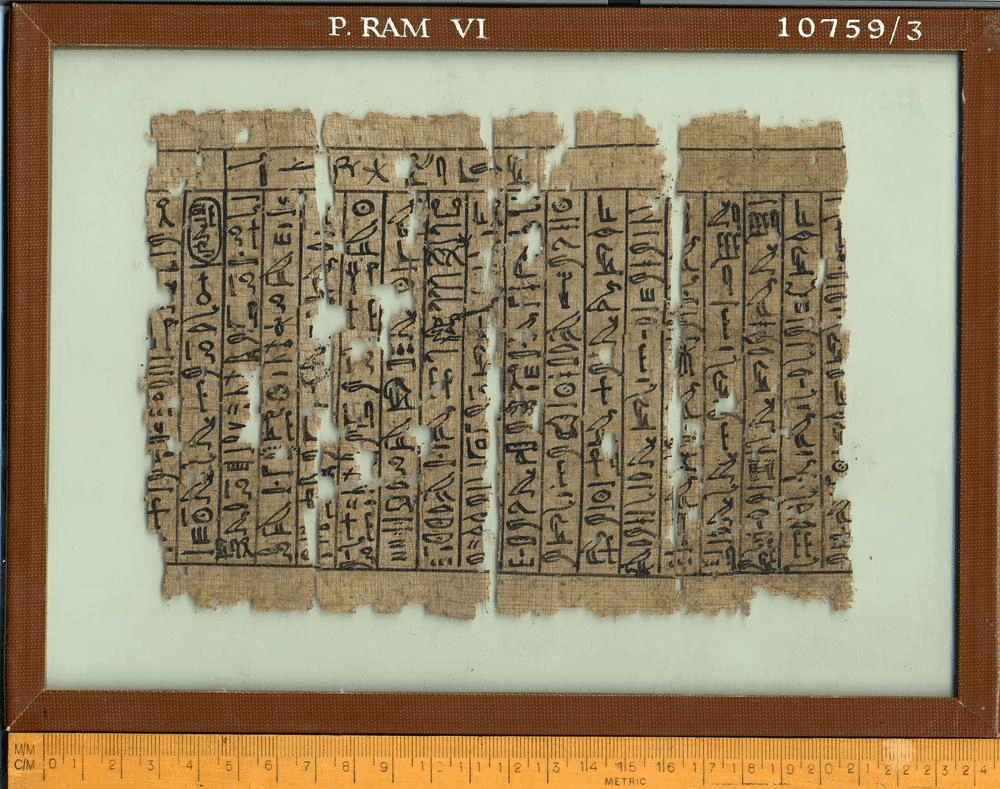
The Ramesseum Dramatic Papyrus — a scroll found in 1895–96 in the mortuary temple of Ramesses II, now in the British Museum — contains a ceremonial play written for the coronation or Sed jubilee festival of Senusret I, dated to around 1980 BCE. It’s laid out like a script: the text runs in vertical columns with the pharaoh, playing the role of Horus, appearing repeatedly across scenes divided by ruled lines, illustrated underneath almost like a comic strip. That’s roughly 1,450 years before Thespis.
It’s a roll of papyrus about 7 feet long and 10 inches wide, covered in hieroglyphic writing arranged in narrow up-and-down columns, with little illustrated scenes running along the bottom — picture a comic strip laid underneath a wall of text. It’s the oldest surviving papyrus with pictures on it that we know of. It was dug up in 1895–96 by a British archaeologist, James Quibell, at a site called the Ramesseum — which is the memorial temple built for Ramesses II, near Luxor in southern Egypt. That’s where the papyrus’s name comes from; it has nothing to do with Ramesses II personally, he’s just the guy whose temple complex it happened to be buried under.
It was buried in the tomb of what looks like a working ritual specialist — someone whose job mixed medicine and magic — along with a bunch of his other professional papers, including medical texts and magic spells. And the papyrus itself was written roughly three hundred years after the events it describes, in a different city than where those events took place. So think of it less like “the official court program from the event” and more like a professional’s personal working copy of an old ceremonial script, kept and reused generations later, the way a modern priest might own a worn prayer book that’s a copy of something written centuries earlier.
The story it tells is about King Senusret I, an actual historical pharaoh who ruled starting around 1971 BCE. The papyrus casts him in the role of the god Horus, over and over, across 47 short scenes. For a long time, the standard interpretation was that this was a script for Senusret I’s own coronation — the ceremony crowning him king, performed live in front of an audience. More recent scholarship pushes back on that and reads it instead as a memorial ceremony — a ritual performed to honor Senusret I after his death, not a live coronation while he was still alive. That’s a meaningful difference: one version is “this is what happened at his crowning,” the other is “this is how his successors ritually remembered and honored him once he was gone.” Current specialists lean toward the second reading. Each of the 47 scenes follows a repeating three-part pattern, and it’s worth walking through because it’s genuinely close to how a modern script works:
First, a line describing what happens in the story — something like “this event occurred,” describing an action from the myth.
Second, a line explaining what that mythical event corresponds to in the real ceremony — essentially, “and this represents/equals this real object or action” — connecting the symbolic story to the physical ritual actually being performed in front of people.
Third, a stage direction telling the performers what to say out loud at that point.
So a single unit might work like: “[Story event happens in the myth] → [that event stands for this real object/action in our ceremony] → [here’s the line the performer says].” That’s functionally a scene, an annotation explaining the symbolism, and a line of dialogue with a cue — which is why this papyrus reads much more like an actual theatrical script with stage directions than the Abydos material does. The Abydos stela describes that a ritual happened and roughly what order things went in; this papyrus is closer to the actual shooting script.
The Osiris mysteries at Abydos
Every year, Egyptians held a religious festival at Abydos to reenact the death and rebirth of the god Osiris. It happened during a specific month (Khoiak, which lines up roughly with October–November, when the Nile floodwaters were receding). We know a lot about how this festival worked because a government official named Ikhernofret had a stone monument carved describing his part in it, sometime between 1870–1840 BCE, under King Senusret III.
The festival had four parts, like four scenes:
A priest put on a jackal mask and played a god called Wepwawet (“Opener of the Ways”). He led a procession, symbolically clearing the path and chasing off Osiris’s enemies.
Osiris’s funeral was reenacted — his statue was carried out of the temple in a ceremonial boat (the boat had a name, the Neshmet barque, but you can just think of it as “the ceremonial boat Osiris’s statue rode in”).
A staged battle: actors physically acted out the fight between the gods Horus and Set (Osiris’s son fighting Osiris’s murderer).
Osiris’s statue was carried back into the temple, representing his resurrection.
Ikhernofret held a priestly title that basically meant “keeper of the secrets” — someone trusted enough to be let into the restricted, non-public part of the ritual. His own description of his job was dressing the statue of the god and overseeing the ceremonial boat. This detail matters because it tells us the festival wasn’t one single play everyone watched start to finish. It was two layers: an outer layer that regular people could watch (the processions, the staged battle), and an inner layer — the actual “secret” rites — that only a small number of priests ever saw.
Regular townspeople gathered on the hills overlooking the desert valley to watch the public parts. The people playing “extras” in the crowd battle scene weren’t professional performers — they rotated. A baker or a shoemaker might spend one afternoon a year putting down their tools to play a soldier fighting for Horus, then go back to their normal job the next day.
This mix — some of it watched by a crowd, some of it hidden, with ordinary people occasionally stepping into acting roles — is exactly why scholars can’t agree on whether to call this “theater.” There’s a helpful way of thinking about this from a modern performance scholar named Richard Schechner. He points out that ritual and theater are different in one key way: in a ritual, people believe the act itself actually causes something to happen — performing the rite is what brings Osiris back to life, which in turn was believed to bring back the flood and confirm the king’s right to rule. Pilgrims gathered on the wadi’s ridges to watch the processions and the staged battle; the innermost rites happened in a sanctuary they never entered. Masked priests carried the divine roles, but the cast rotated — ordinary Abydos residents took turns playing extras in the crowd combat, meaning the same person who sold you bread might be swinging a prop weapon as a follower of Horus a few weeks later.
That rotating-cast, public/private structure is exactly what makes the “was this actually theater” argument unresolved rather than pedantic. There’s a useful frame from performance theorist Richard Schechner that scholars keep reaching for here: ritual and theater sit on a spectrum defined partly by whether participants are doing (ritual, where the action is efficacious — it’s supposed to actually accomplish something, like ensuring Osiris’s resurrection and by extension the Nile flood and the king’s legitimacy) or showing doing (theater, where the action represents something for an audience, with no claim that the performance itself works). Abydos doesn’t sit cleanly on either side. The bystanders on the ridge are watching, which looks theatrical — but the priests performing the rites believe, and want you to believe, that the rite is actually restoring Osiris, not just depicting his restoration. Aristotle’s own definition of drama as mimesis — imitation of an action — would count it, since Plato and Aristotle both use “imitation” broadly enough to cover ritual reenactment.
Put the two texts next to each other and the pattern becomes clear: the consensus seems to be that neither one is really competing with Thespis for the title of “first play,” because that’s the wrong question to ask of either of them. The Osiris mysteries are old, public, and clearly performed — priests in masks, a rotating cast of townspeople, a real audience gathered on the ridges — but nobody involved would have called it pretending; it was efficacious ritual that happened to look like theater from the outside. The Ramesseum papyrus is the reverse problem: it has the internal architecture of an actual script — scene, gloss, cue — closer to a shooting script than anything the Abydos material offers, but we don’t actually know if anyone ever performed it in front of a crowd, or whether it functioned as a private memorial text read rather than staged. One has the audience but not the script; the other has the script but maybe not the audience. Theater, in the sense Athens will later hand down — actors who know they’re pretending, performing for spectators who know they’re watching pretending — doesn’t cleanly exist yet in either case.
To me, it matters less who’s the first. All I need to know is that performing theater as an community event, or as a ritual has existed long before Athens. Agreeing with the Egyptians had an “actor” that fits Aristotle’s definition of theater or not, these performances had all elements of theater. Masked role-play, mythic reenactment, a written text organized into scenes with cues, are already sitting in Egypt fourteen centuries before Thespis steps out of the chorus.☀️