Minimalism or Abstract Expressionism?

SFMOMA, Floor 4 · Ways of Seeing: Fourteen Artists.
Agnes Martin's room asks you to slow down more than any other on this floor. Seven paintings, most of them six feet square, made of pale bands and pencil lines so fine that from the doorway some look blank. Up close, the line wavers where the pencil caught the weave of the linen. That small wobble is the human part, and it is what Martin wanted you to find. The paintings span 1957 to 1995: almost her whole working life, including the years she stopped.
A Late Start (1912–1957)
Agnes Martin was born on March 22, 1912, in Macklin, Saskatchewan, one of four children of Scottish Presbyterian farmers. The family moved to Vancouver in 1919. In 1931 she came to the United States to help her pregnant sister in Bellingham, Washington, and stayed.
She trained first as a teacher, at the college of education in Bellingham and then at Teachers College, Columbia University, where she earned a BA in 1942. In 1947 she went to the University of New Mexico's summer field school in Taos, and she later studied at UNM in Albuquerque. She returned to Columbia for an MA in modern art in 1952. At Columbia she heard D. T. Suzuki lecture on Zen Buddhism, and Asian thought, Taoism especially, stayed in her work from then on. She became a U.S. citizen in 1950.
She was forty-five when the dealer Betty Parsons invited her to New York.
The Room: Before the Grid

Wheat (1957). Oil on linen, slightly larger than a poster, in a thin wood frame: the smallest and oldest work here, and the only one in oil. It was made in the year Martin moved to New York, before the grid had become her format. The title names a field crop, something that grows in even rows across open land. It shows where she started, an abstract painter whose titles still pointed at the natural world.
Coenties Slip (1957–1967)
In 1957 Martin settled at Coenties Slip, a row of old waterfront lofts at the southern tip of Manhattan. Her neighbors included Ellsworth Kelly, Robert Indiana, Jack Youngerman, and the weaver Lenore Tawney. In the late 1950s she began using the grid, and by the early 1960s she had arrived at her signature format: a six-foot-square canvas covered with a graphite grid drawn by hand.
She also had schizophrenia, a diagnosis not documented until 1962, and was at times hospitalized, including at Bellevue. Her paintings from these years are not about illness, but they were made by a woman who knew how much effort calm can take.
The Room: The Grid Years

Night Sea (1963). Crayon, gold leaf, and oil on linen, six feet square. Blue in layers, crossed by a grid of thin gold lines and touches of yellow crayon. It is the one painting in the room that shines. Most of Martin's grids are pencil on pale grounds; here the field is dark and the lines catch the light, the way moonlight breaks on water. It is the closest she came to a picture.

Drift of Summer (1965). Acrylic paint and graphite on linen, six feet square. Back to pale: fine pencil lines over a light ground. The title is a mood, not a subject. From across the room it reads as a soft haze; walk up and it becomes a structure. The painting is two things depending on how close you stand.
The Seven-Year Silence (1967–1974)
In 1967 Martin left New York. Ad Reinhardt, a friend, had died that year; the buildings at Coenties Slip were being torn down; a relationship had ended. From 1968 she lived in Cuba, New Mexico. For several years she did not paint. Sources disagree on exactly when she started again, but by 1974 she was making new paintings.
The Room: After the Return
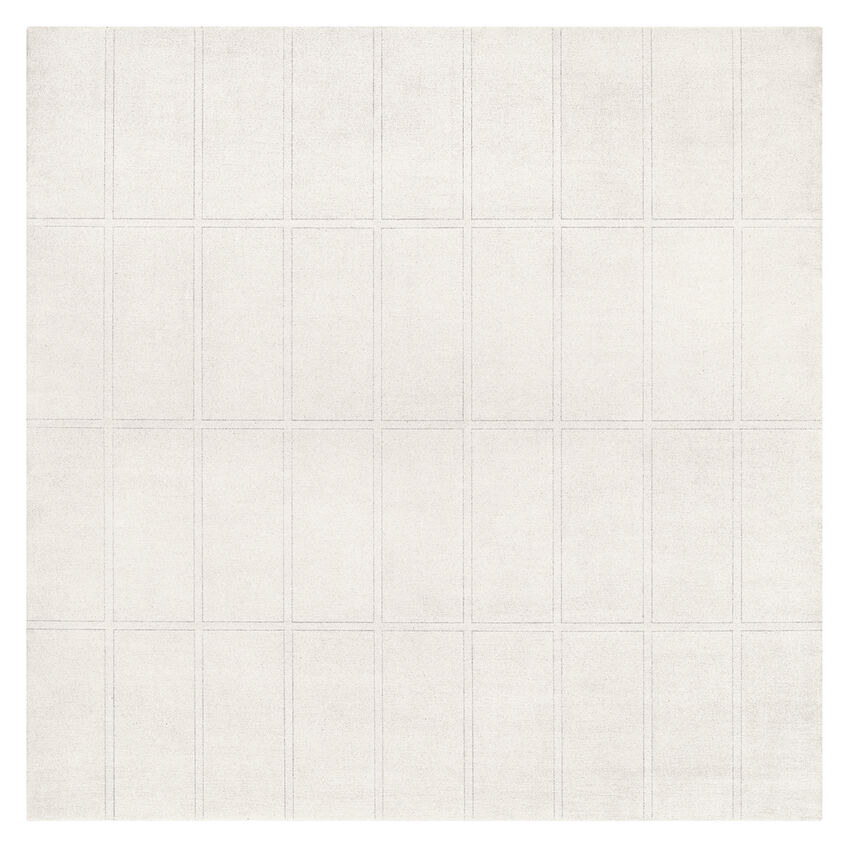
Untitled #5 (1977). Gesso, graphite, and ink on linen. That year she moved to Galisteo, New Mexico, where she lived until 1993. The paintings after her return mostly dropped the small-celled grid for horizontal bands, sometimes only lines, sometimes washes of pale color. This one uses ink alongside graphite.

Untitled #9 (1981). Acrylic paint, colored pencil, and gesso on linen, six feet square. Color comes back faintly here, in pencil, alongside thin acrylic. The bands are calm and even. Martin numbered rather than named her paintings in these years, so a title tells you only its place in a year's group.

Untitled #5 (1988). Acrylic paint and graphite on linen. The same format, seven years later: bands and lines, slight differences in tone. The repetition is the point. Each painting is a new try at the same quiet.

Untitled #9 (1995). Acrylic paint and graphite on linen, five feet square, a bit smaller than the others. In 1993 Martin had moved into a retirement residence in Taos, where she lived for the rest of her life. She was eighty-three. The bands and lines are the same as before; only the canvas has shrunk.
Three years after this painting, Chuck Close photographed Martin for the portrait that hangs in his room on this floor: a face lined like her canvases, built from a grid.
What the Room Shows
Martin said in 1989, "Beauty and perfection are the same. They never occur without happiness." The paintings here are not perfect: lines waver, edges show the hand, the grid is drawn, not printed. That's how they reach the feeling she was after. You can see someone trying for perfection, which is what makes it moving.
In 1997 she received the Golden Lion for contribution to contemporary art at the Venice Biennale. She died in Taos on December 16, 2004, at ninety-two. 🌁
Timeline — Agnes Martin
March 22, 1912 — Born in Macklin, Saskatchewan.
1919 — Family moves to Vancouver.
1931 — Moves to Bellingham, Washington.
1942 — BA, Teachers College, Columbia University.
1947 — UNM summer field school in Taos.
1950 — Becomes a U.S. citizen.
1952 — MA in modern art, Columbia.
1957 — Wheat; moves to New York at Betty Parsons's invitation; settles at Coenties Slip.
Late 1950s — Begins using the grid.
1962 — Schizophrenia first documented.
1963 — Night Sea.
1965 — Drift of Summer.
1967 — Ad Reinhardt dies; Martin leaves New York.
1968–1977 — Lives in Cuba, New Mexico.
By 1974 — Painting again.
1977 — Untitled #5; moves to Galisteo, New Mexico.
1981 — Untitled #9.
1988 — Untitled #5.
1993 — Moves to a retirement residence in Taos.
1995 — Untitled #9.
1997 — Golden Lion, Venice Biennale.
1998 — Chuck Close photographs her for Agnes.
December 16, 2004 — Dies in Taos.