Two Rooms, Twenty-Five Years

SFMOMA, Floor 4 · Ways of Seeing: Fourteen Artists.
Warhol gets two rooms on this floor, and between them they hold the start and the end of his painting life. The west room begins in 1961, with pictures painted by hand from cheap newspaper ads, and runs into the silkscreens of 1963–64: a deadly can of tuna and a wanted criminal. The east room jumps to the 1980s: a German artist, a New York photographer, Marilyn turned inside out, and Warhol's own face, twice, from 1986, the year before he died. Triple Elvis [Ferus type] hangs in the west room too; it had its own post earlier in this series, so this one is about everything around it.
Pittsburgh to Madison Avenue (1928–1960)
Andrew Warhola Jr. was born in Pittsburgh on August 6, 1928, to working-class Rusyn immigrants from the village of Mikó, then in Austria-Hungary, now Miková in Slovakia. At eight he caught a strep infection that led to Sydenham's chorea, a nervous disorder. With no antibiotics, he spent long stretches in bed, drawing and making scrapbooks of movie stars.
He won a scholarship to the Carnegie Institute of Technology and earned a BFA in pictorial design in 1949. That June he moved to New York with his classmate Philip Pearlstein. In September, the art director Tina Fredericks at Glamour gave him a commission to draw shoes, and his commercial career began. From 1955 he drew ads for the shoe company I. Miller, and won an Art Directors Club award for them in 1956.
By 1960 Warhol knew advertising better than any fine artist did. What he did next was paint it.
The West Room: Painting the Ads (1961)

Before and After [3] (1961). Casein on linen, about four and a half by six feet. A woman's face in profile, twice, white against black. On the left, a large downward-pointing nose; on the right, a small upturned one. It is an enlarged illustration from a magazine ad for cosmetic surgery. In April 1961 paintings like this one, based on ads and comics, appeared in a Bonwit Teller window on Fifth Avenue.
The picture is a punchline and also not one. The ad promised that you could buy yourself a new face. Warhol painted the promise at the size of a history painting, and left it flat and cold, the way the ad was.

Telephone [1] (1961). Crayon and synthetic polymer paint on canvas, almost six feet tall. A single telephone, painted by hand. In 1961 Warhol was still making these images with a brush, keeping the drips and wobbles that a hand leaves. Within a year he would give that up.
The West Room: The Screen and the Disaster (1962–1964)
In 1962 Floriano Vecchi of Tiber Press taught Warhol the basics of silkscreen. A photograph could be transferred to a mesh screen and printed onto canvas over and over, with no drawing at all. His first solo Pop show in New York opened at the Stable Gallery on November 6, 1962. By 1964 his studio, the Factory, was at 231 East 47th Street.
At the same time Warhol began what became known as the Death and Disaster series: car crashes, the electric chair, suicides, poisonings, all taken from newspaper photographs.

Tunafish Disaster (1963). Silver paint and black silkscreen ink on linen, about four and a half by six feet. Two Detroit women, Mrs. Brown and Mrs. McCarthy, ate sandwiches made from tainted canned tuna and died. Newsweek covered the story as "Two Tuna Sandwiches." Warhol printed the can, its label reading "tuna," and wire-service text including "Seized shipment: Did a leak kill . . ." in rows across the silver.
This is the dark side of the soup can. The same supermarket product Warhol made famous as a symbol of sameness and plenty here turns lethal. The repetition no longer means abundance. It means a news story printed so many times it stops meaning anything.

Most Wanted Men No. 12, Frank B. (1964). Silkscreen ink on linen, a diptych: one man's mug shot in front view and profile, each on its own canvas. Warhol was commissioned to make a mural for the New York State Pavilion at the 1964 World's Fair. He enlarged police photographs from a 1962 NYPD pamphlet of the city's thirteen most wanted men. Officials objected, and around the fair's opening in April 1964 the installed work was painted over in silver. Because Warhol worked from screens, he could print the faces again, and he made separate canvases of the men, this among them.
The New York State pavilion was meant to celebrate the state. Warhol gave it its criminals, at the scale of heroes.
Between the Rooms (1964–1978)
On June 3, 1968, the writer Valerie Solanas shot Warhol at the Factory. He nearly died and spent close to two months in the hospital. In the fall of 1969 he started Interview magazine. In the 1970s he made his money from commissioned society portraits, silkscreened from his own Polaroids.
The East Room: Looking Back (1979–1986)
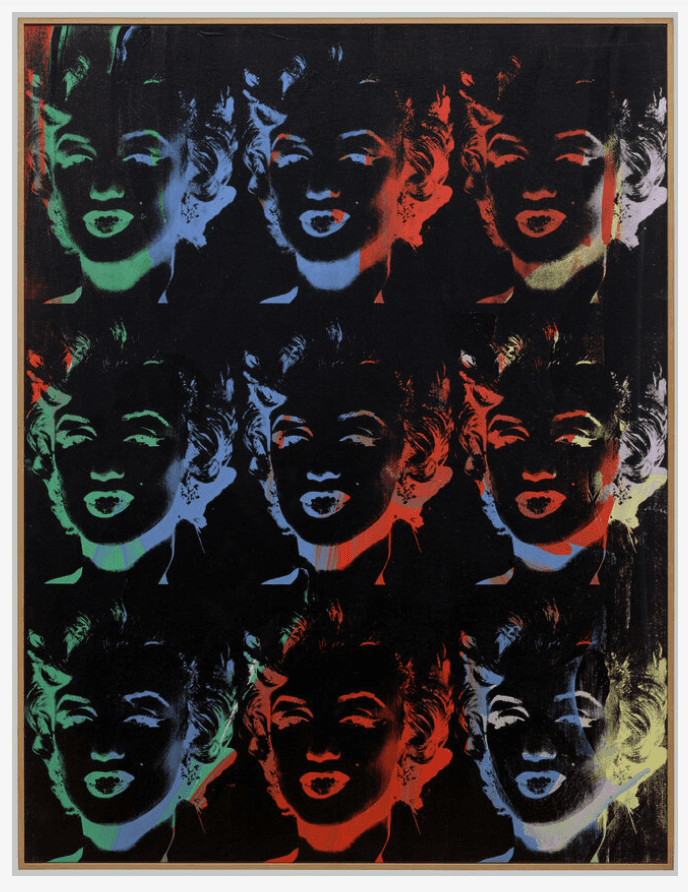
Nine Marilyns [Reversal series] (1979/1986). Acrylic and silkscreen on linen, nine faces in a three-by-three grid. In 1962 Warhol made his first Marilyn paintings from a 1953 publicity still for Niagara. In 1979 he went back to the same screen and printed it in reverse, like a photographic negative: highlights go dark, shadows glow. By then his early images had become famous artworks in their own right, and the Reversals paint the paintings, not the actress.

Robert Mapplethorpe (1983). Acrylic and silkscreen on linen, roughly poster-sized. Mapplethorpe was a photographer like Warhol, making his own pictures of New York's downtown and of celebrities. In 1986 Mapplethorpe photographed Warhol in turn, a portrait close in composition to Warhol's self-portraits of the same year. Mapplethorpe died of AIDS complications in 1989.

Joseph Beuys [Camouflage] (1986). Acrylic and silkscreen on linen, tall as a garage door. Warhol and Joseph Beuys, the German artist who made art out of felt, fat, and teaching, met at an exhibition opening in Düsseldorf in 1979. Later that year Beuys came to the Factory to be photographed in his felt hat. Warhol made portraits of him from that Polaroid from 1980 to 1986. Beuys died in January 1986. This version lays a military camouflage pattern over his face. The two are often called unlikely friends: the German who spoke of art as a way to change society, and the American who said he liked business.


Self-Portrait [Camouflage] (1986) and Self-Portrait (1986). Both large and square. In the first, camouflage covers Warhol's own face. In the second, his face is lavender, his spiky white wig stands up from his head, and everything else is black. The art dealer Anthony d'Offay commissioned this series for a show at his London gallery in 1986. They were the last self-portraits Warhol completed. In the camouflage version, his face is half hidden; in the other, it floats like a mask in the dark.
Warhol went into New York Hospital on February 20, 1987, for gallbladder surgery the next day. He died on February 22, at fifty-eight.
What the Two Rooms Show
In the west room, Warhol paints things that want to be noticed: an ad, a product, a front page, a wanted poster. In the east room, he paints people, including himself, and covers them in reversal and camouflage. In 1961 he was showing how images sell. In 1986 he was showing how a face can hide in plain sight. Read in order, the two rooms are a portrait of an artist who made himself into an image and then, near the end, showed how little that image gave away. 🌁
Timeline — Andy Warhol
August 6, 1928 — Born in Pittsburgh.
c. 1936 — Sydenham's chorea; long periods in bed drawing.
1949 — BFA in pictorial design, Carnegie Tech; moves to New York in June; first Glamour commission in September.
1955 — Begins I. Miller shoe ads.
1956 — Art Directors Club award.
April 1961 — Paintings in a Bonwit Teller window, including Before and After.
1961 — Before and After [3]; Telephone [1].
1962 — Learns silkscreen; first Marilyns; NYPD pamphlet of thirteen most wanted men issued; Stable Gallery show opens November 6.
1963 — Tunafish Disaster; Triple Elvis [Ferus type].
1964 — Thirteen Most Wanted Men painted over at the World's Fair; Most Wanted Men No. 12, Frank B.; the Factory at 231 East 47th Street.
June 3, 1968 — Shot by Valerie Solanas.
1969 — Founds Interview.
1979 — Begins the Reversal series; meets Joseph Beuys in Düsseldorf; photographs him in New York.
1983 — Robert Mapplethorpe.
January 1986 — Beuys dies.
1986 — Joseph Beuys [Camouflage]; Self-Portrait [Camouflage]; Self-Portrait; London show at Anthony d'Offay; Nine Marilyns completed.
February 22, 1987 — Dies in New York.
1989 — Mapplethorpe dies.