Monuments Made of Light Bulbs
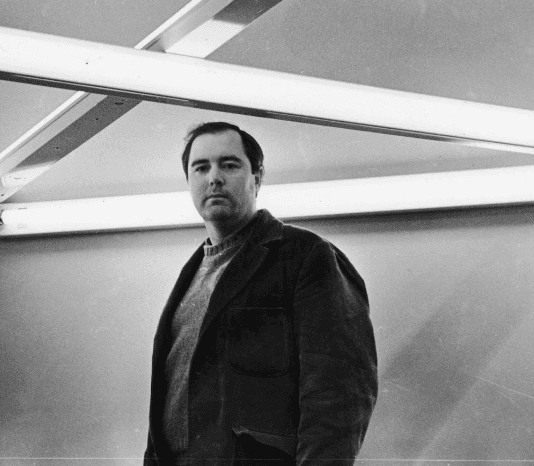
SFMOMA, Floor 4 · Ways of Seeing: Fourteen Artists.
Dan Flavin's room holds two works, and they hardly feel like objects at all. Each is built from fluorescent tubes and fixtures you could buy at a hardware store. What you actually see is the light: a cool white glow pooled on the floor in one corner, red and blue and yellow mixing into colors no single tube gives off in another. Both works are dedicated to other artists, a dead Russian revolutionary and a friend who had just died. Flavin made memorials out of the least permanent material he could find.
Seminary, Air Force, Museum Guard (1933–1961)
Dan Flavin was born in Jamaica, Queens, on April 1, 1933, with a twin brother, David. From 1947 to 1952 he studied for the priesthood at the Immaculate Conception Preparatory Seminary in Brooklyn. He left before ordination, but the language of icons and devotion stayed in his titles.
In the Air Force he trained as a meteorological technician in 1954–55 and took art classes through a University of Maryland extension program in Korea. Back in New York in 1956, he briefly attended the Hans Hofmann School, studied art history at the New School, and then studied painting and drawing at Columbia.
What he did instead was work in museums. From 1959 he was a mailroom clerk at the Guggenheim. He was a guard and elevator operator at the Museum of Modern Art and, in 1961, a guard at the American Museum of Natural History. Like Brice Marden, whose room is next door, Flavin learned a lot about art by standing in front of it all day.
In 1961 he married Sonja Severdija. In 1962 his twin brother died.
From Icons to a Single Tube (1961–1963)
Flavin's first works with electric light were what he called "icons" (1961–63): eight shallow, painted boxes with lights attached to them. One was dedicated to his brother. They were still objects on a wall, with light as an addition.

Dan Flavin, icon VII (via crucis), 1962–64. © Stephen Flavin/Artists Rights Society (ARS), New York. Photo: Bill Jacobson Studio, New York

Dan Flavin, the diagonal of May 25, 1963 (to Constantin Brancusi), 1963. © Stephen Flavin/Artists Rights Society (ARS), New York. Photo: Billy Jim, New York
Then, in 1963, he put a single eight-foot fluorescent tube, yellow, on a wall at a 45-degree angle. He called it the diagonal of May 25, 1963 and dedicated it to the sculptor Constantin Brancusi. That was his breakthrough. There was no box, no painting, no object to make. A commercial light fixture was the whole work, and the light it threw on the wall and the room was part of it. SFMOMA owns a version of the diagonal. For the rest of his life Flavin used only standard tubes, in standard lengths and colors.
The Room

"monument" for V. Tatlin (1969). A stepped tower of cool white tubes about eight feet tall, the two longest in the center and shorter ones on either side, mounted flat against the wall. The light pools on the floor in front.
Vladimir Tatlin was the Russian Constructivist who in 1919–20 designed the Monument to the Third International, a spiraling iron-and-glass tower meant to stand taller than the Eiffel Tower in revolutionary Petrograd. It was never built. Flavin began his series of "monuments" for Tatlin in 1964 and kept making them until 1990, about fifty in all. He wrote in 1965 that the series "memorialises Vladimir Tatlin, the great revolutionary."
The quotation marks around "monument" are the joke and the point. A monument is supposed to be stone or bronze and last forever. These are tubes that burn out and must be replaced. Tatlin designed a monument that was never built; Flavin built ones that never stay lit. Both are monuments mostly as ideas.
The SFMOMA version dates from 1969, five years into the series. By then Flavin had shown with the artists soon called Minimalists, and he had become one of the movement's central names. The tower's symmetry gives it the shape of a building or skyline, made entirely of light.

untitled (to Barnett Newman) two (1971). An open rectangle of red, yellow, and blue tubes set across a gallery corner at 45 degrees. Where the colors meet in the air and on the walls, they mix into purples, pinks, and greens. A deep blue dominates the center.
Barnett Newman, the Abstract Expressionist painter and Flavin's friend, died in 1970. Between 1966 and 1970 Newman painted four large works titled Who's Afraid of Red, Yellow and Blue, a challenge to the idea that the primary colors belonged to the geometric abstraction of Mondrian. In 1971 Flavin showed four works dedicated to Newman, and he limited them to red, yellow, and blue. This is the second.
Newman's paintings put the primaries in flat fields of paint. Flavin's put them in light, which doesn't stay flat. Red and blue tubes don't make a red-and-blue room; they make a violet one. Flavin's tribute to Newman is in some ways an argument with him: color, for Flavin, was not something you could fix on a surface.
The corner matters, too. A corner is the part of a room people rarely look at. Set across one, the work lights the two walls and the floor around it, and the whole corner becomes part of the piece.
What the Room Shows
Flavin called his work "as plain and open and direct an art as you will ever find." That is true of the materials. But both works here are full of memory: a dead revolutionary's unbuilt tower, a friend's last paintings. A former seminarian made memorials out of fixtures from an office ceiling. They glow, they need upkeep, and someday their tubes will have to be replaced. In that way they are like candles more than statues.
Flavin divorced Sonja Severdija by 1979 and married the artist Tracy Harris at the Guggenheim in 1992. He died of complications of diabetes in Riverhead, New York, on November 29, 1996, at sixty-three. Two days before his death he finished the design for his last work, the lighting of the church of Santa Maria Annunciata in Chiesa Rossa in Milan, installed the following year. 🌁
Timeline — Dan Flavin
April 1, 1933 — Born in Jamaica, Queens, with a twin brother, David.
1947–1952 — Immaculate Conception Preparatory Seminary, Brooklyn.
1954–1955 — Air Force meteorological training; art classes in Korea.
1956 — Returns to New York; Hans Hofmann School, the New School, Columbia.
1959 — Mailroom clerk at the Guggenheim.
1961 — Guard at the American Museum of Natural History; marries Sonja Severdija; begins the "icons."
1962 — His twin brother dies.
1963 — the diagonal of May 25, 1963 (to Constantin Brancusi).
1964 — Begins the "monuments" for V. Tatlin.
1965 — Writes that the series "memorialises Vladimir Tatlin, the great revolutionary."
1966–1970 — Barnett Newman paints Who's Afraid of Red, Yellow and Blue.
1969 — SFMOMA's "monument" for V. Tatlin.
1970 — Newman dies.
1971 — Shows four works dedicated to Newman, including untitled (to Barnett Newman) two.
By 1979 — Divorced from Severdija.
1990 — Makes the last of the Tatlin "monuments."
1992 — Marries Tracy Harris.
November 29, 1996 — Dies in Riverhead, New York.
1997 — Santa Maria Annunciata in Chiesa Rossa, Milan, installed.