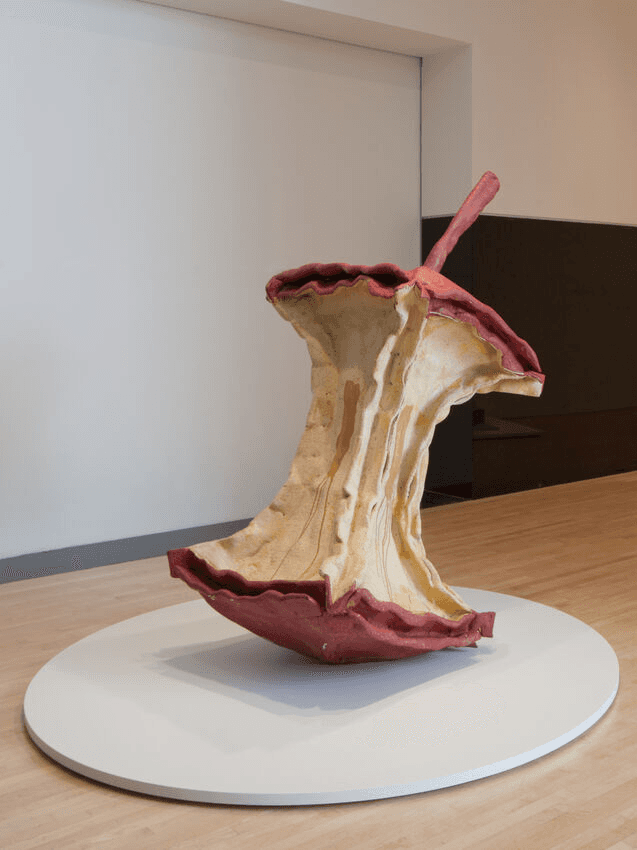
SFMOMA, Floor 3 · Ongoing, part of "Reimagined: The Fisher Collection at 10".
At Rincon Park on San Francisco's Embarcadero, a 70-foot bow and arrow made of fiberglass and steel is driven into the grass. Only the two ends of the bow and the feathered tail of the arrow show above ground. The Bay Bridge runs behind it. On weekends people sit on the lawn underneath and photograph each other in front of it.
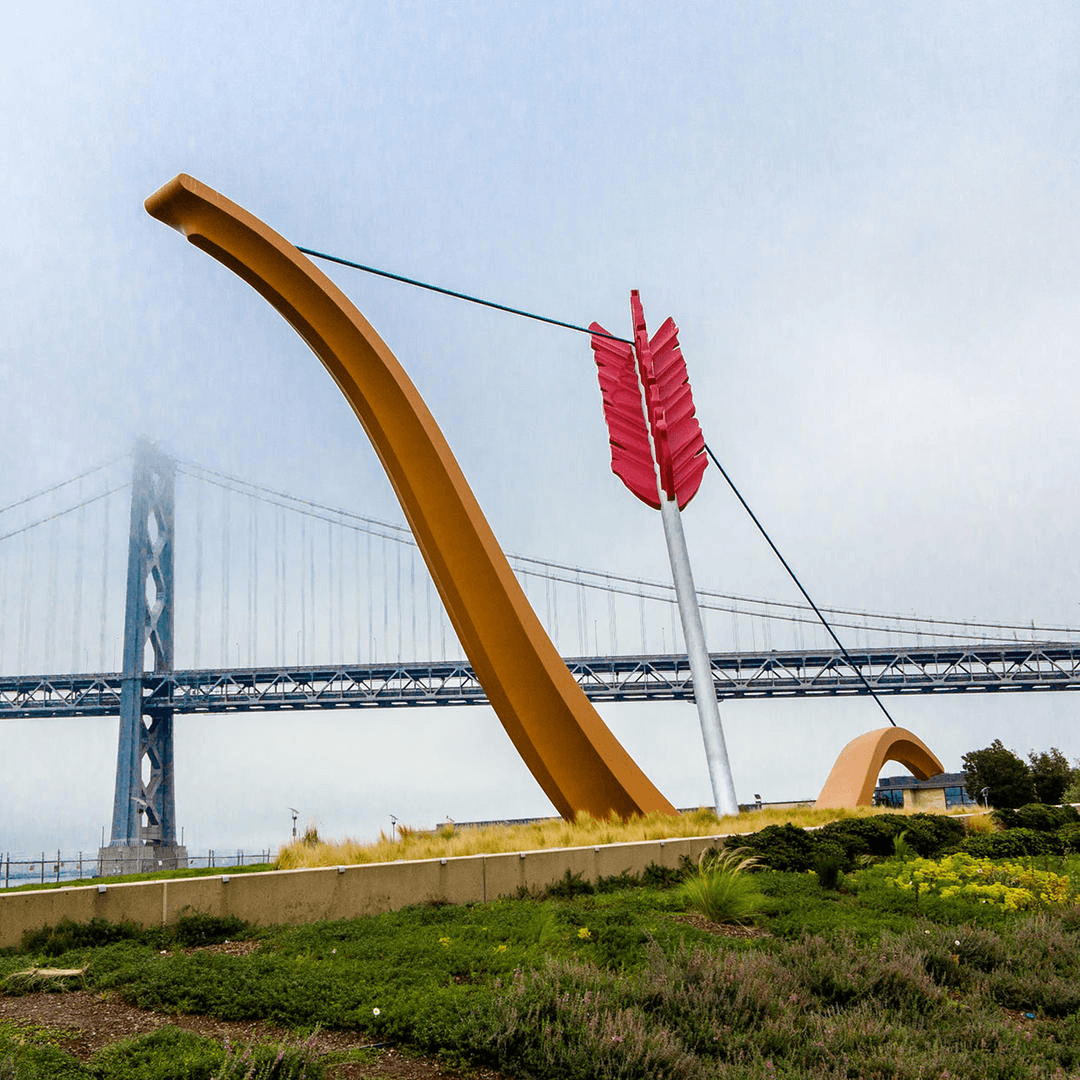
One floor of SFMOMA holds the same object at about five feet tall. A visitor standing over the model looks down on the arrow. The scale relationship of the park is reversed. The visitor becomes the giant.
is a single gallery of works from the Doris and Donald Fisher Collection. It holds models for four of the pair's large-scale public sculptures, related works from the late 1980s and early 1990s, and several pieces by Oldenburg from the late 1960s and early 1970s. It was the first gallery to open in the museum's reinstallation of the Fisher Collection. Large photographs of the finished sculptures in their cities hang behind the models.
The received story credits these monuments to Oldenburg, the Pop artist of soft typewriters and giant hamburgers. The gallery title carries two names. The full list of authors is longer than that.
1961 — "I Am for an Art…"
Claes Oldenburg was born in Stockholm in 1929 and grew up in Chicago. In 1961 he wrote a manifesto as a long run of declarations, including "I am for an art that is eaten, like a piece of pie." He sold plaster food and clothing out of a storefront on the Lower East Side. He made soft sculptures of hard objects: typewriters, toilets, light switches.
The program was simple. Take an ordinary object. Change its scale or its material. The familiar becomes absurd.
At the end of the 1960s Oldenburg began fabricating at architectural scale. Lipstick (Ascending) on Caterpillar Tracks (1969) was installed at Yale University, where it became a site of student protest. He began proposing monuments for cities in drawings and models.

The early works in this gallery show that program heading toward architecture. Geometric Mouse, Scale C is a hinged black metal head with chains hanging from its eyelids. Study for Typewriter Eraser: Final Position stands a brush of rope bristles upright on a pink foam wheel. Both are objects that look as though they are waiting to become buildings.
1970 — The Stedelijk
Coosje van Bruggen was born in Groningen in 1942. She studied art history at the University of Groningen. In 1970 she was an assistant curator at the Stedelijk Museum in Amsterdam, involved with the first wave of Dutch Conceptual art, when Oldenburg's first major retrospective traveled there. She was assigned to help install it. That is where they met.
Through the early 1970s she taught art history and fine arts at the academy in Enschede and wrote criticism. She would go on to write books on John Baldessari, Bruce Nauman, Hanne Darboven, and Frank Gehry's Guggenheim Bilbao, serve on the selection committee for Documenta 7, and contribute to Artforum.
1976 — Two Sculptures, Two Authorships
In 1976 Oldenburg's 45-foot Clothespin went up in downtown Philadelphia. It was his first sculpture realized at urban scale, and it is his alone.

The same year, Oldenburg re-installed Trowel I, a giant garden trowel first shown at the Sonsbeek exhibition in 1971, in the sculpture garden of the Kröller-Müller Museum in Otterlo. Van Bruggen advised him on its placement, design, and fabrication. The collaboration is usually dated from that project. They married in 1977. In 1978 she moved to New York.
The "Large-Scale Projects" are the more than forty urban sculptures the two made together from 1976 to 2009. The name was van Bruggen's. They worked through drawings, models, and written notes. Oldenburg signed his work with both names from 1981 on.
That date matters for the received story. For roughly the first five years of the collaboration, the signature still showed one author. The monuments that made Oldenburg's public reputation largely carry two.
The museum's wall text states that the pair treated their models as finished artworks, not studies. The Fishers collected them that way.
1987 / 1992 — Barcelona
The fabrication model Sculpture in the Form of a Match Cover with Loose Matches shows an open matchbook folded back to form a base, five matches rising from it, four of them bent as if used, one upright and crowned by an angular blue flame. Loose matches, some burned black, lie across the platform among tiny black human silhouettes for scale.

The artists visited Barcelona in 1986. The city had one of the most ambitious urban sculpture programs in Europe and was expanding it for the 1992 Olympics, with commissions going to Frank Gehry, Arata Isozaki, Richard Meier, and others. Most new work was going to the waterfront and the center. Oldenburg and van Bruggen chose Vall d'Hebron, a hillside area being built as Olympic housing that would afterward become an ordinary residential neighborhood.
The site faced a reconstruction of Josep Lluís Sert's 1937 pavilion for the Spanish Republic at the Paris World's Fair, the building where Picasso's Guernica was first shown. Mistos went up in 1992, its flaming match about 20 meters tall. Oldenburg compared its front view to the facade of the Sagrada Família. Van Bruggen tied the single burning match to a line from Don Quixote about the lance and the pen.
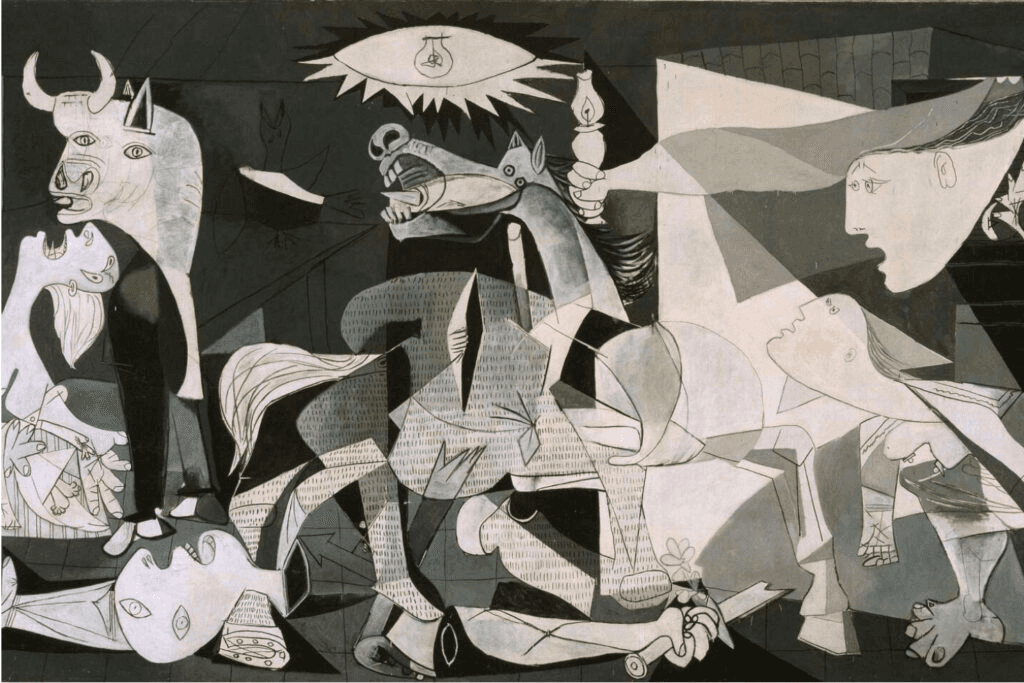
The matchbook was by then an object on its way out of daily life. Van Bruggen said as much. On weekends, skateboarders use the fallen steel matches as ramps.
1994 — Frankfurt
DG Bank commissioned Inverted Collar and Tie in 1993. The finished sculpture, about 39 feet tall and seven and a half tons, stands in front of an office tower in Frankfurt's Westend, near the banking district. A white shirt collar sits upside down on a dark plinth. A striped tie rises out of it in a twisting sweep, its two ends splitting at the top.

The model in the gallery, Inverted Collar and Tie — Third Version, is about five feet tall. At that height the joke is easy to read. The uniform of the people who paid for the sculpture is turned upside down in front of their building.
1996 — Lincoln, Nebraska
Torn Notebook Study #1 is a spiral notebook ripped down the middle and held open in midair, its jagged pages flecked with paint. The full sculpture, 22 feet tall, stands at the University of Nebraska–Lincoln. Its pages carry cut-out lines of cursive handwriting.
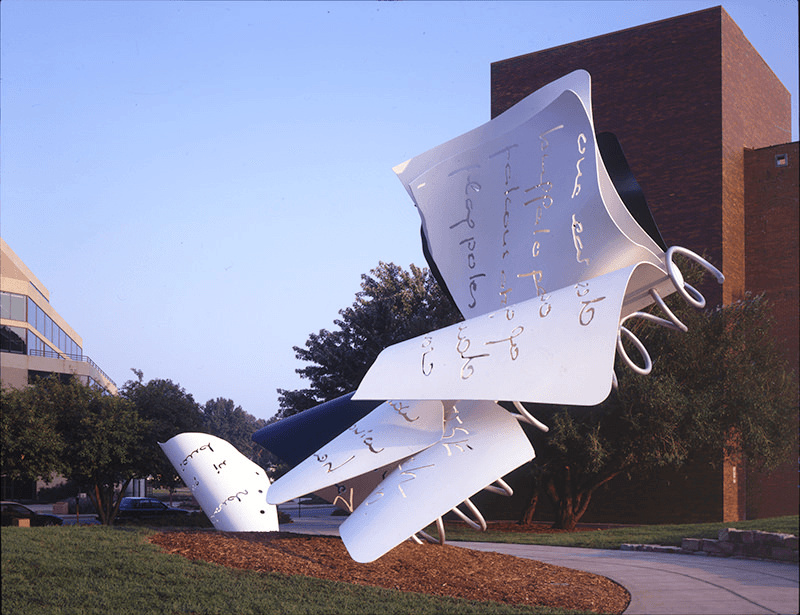
Among the four models, this is the only one that places its object in an institution of learning. The notebook belongs to a student. It is torn.
2002 — Rincon Park
Donald and Doris Fisher, founders of Gap, commissioned Cupid's Span in the late 1990s for a new park on the Embarcadero. The artists described San Francisco as the home port of Eros. The taut curve of the bow echoes the suspension cables of the Bay Bridge. From some angles the form reads as a sailboat.

Burying the arrow was van Bruggen's idea, as if Cupid had crashed into the city. Ted Mann, SFMOMA's project assistant curator for the Fisher Collection, says the Fishers did not dictate the form and the artists would not have accepted it if they had. According to Mann, van Bruggen in particular spoke of the sculptures as humane statements tied to the human body.
A rumor persists that the sculpture was placed to keep anything from blocking the bay view from Gap headquarters across the street. No evidence supports it. The rumor survives because it describes a real condition. Private money paid for a public monument on public land.
2016–2026 — The Collection as Monument
Van Bruggen died of cancer in Los Angeles in January 2009. Oldenburg died in New York in 2022.
The Fisher Collection came to SFMOMA in 2016 on a 100-year loan, when the museum's expansion opened with nearly six times its former gallery space. Reimagined: The Fisher Collection at 10 rehangs nearly 250 works by 35 artists across roughly 60,000 square feet. Thinking Big opened first, as a preview of the new design. The galleries replace bare white walls with large photographs, color, and quotations from the artists.
The authorship on Floor 3 has three layers. Oldenburg supplied the method in 1961. Van Bruggen co-authored every large-scale project from 1976 on, named the category, and buried the arrow. The Fishers paid for the bow in the park and owned the models in the gallery.
Cupid's Span stands on city land as a gift. Its model sits in a public museum as part of a private collection on loan. Both carry the same two names. 🌁
Timeline — Thinking Big
1929 — Claes Oldenburg is born in Stockholm.
1942 — Coosje van Bruggen is born in Groningen.
1961 — Oldenburg writes his "I am for an art…" manifesto.
1969 — Lipstick (Ascending) on Caterpillar Tracks is installed at Yale.
1970 — Oldenburg and van Bruggen meet when his retrospective travels to the Stedelijk Museum, Amsterdam.
1971 — Trowel I is first shown at Sonsbeek 71.
1971–1976 — Van Bruggen teaches at the academy in Enschede.
1976 — Oldenburg's Clothespin is installed in Philadelphia. Oldenburg and van Bruggen re-install Trowel I at the Kröller-Müller Museum; their collaboration begins.
1977 — They marry.
1978 — Van Bruggen moves to New York.
1981 — Oldenburg begins signing all work with both names.
1986 — The pair visit Barcelona.
1987 — Sculpture in the Form of a Match Cover model.
1992 — Mistos is installed in Vall d'Hebron, Barcelona, for the Olympics.
1993 — DG Bank commissions Inverted Collar and Tie.
1994 — Inverted Collar and Tie is installed in Frankfurt.
1996 — Torn Notebook is installed at the University of Nebraska–Lincoln (year unverified).
Late 1990s — Donald and Doris Fisher commission Cupid's Span.
2002 — Cupid's Span is installed at Rincon Park, San Francisco.
January 2009 — Van Bruggen dies in Los Angeles.
2016 — The Fisher Collection comes to SFMOMA on a 100-year loan.
2022 — Oldenburg dies in New York.
Early 2026 — Thinking Big opens as the first gallery of Reimagined: The Fisher Collection at 10.
April 18, 2026 — The remaining Fisher Collection galleries on Floors 4–6 open.