Works and the Years That Made Them

SFMOMA, Floor 4 · Ongoing, part of Reimagined: The Fisher Collection at 10.
The fourth floor of SFMOMA is a run of rooms, each given to one artist. Ways of Seeing: Fourteen Artists is the largest section of the 2026 reinstallation of the Doris and Donald Fisher Collection. The rooms hold Andy Warhol, Gerhard Richter, Sigmar Polke, Roy Lichtenstein, Cy Twombly, Philip Guston, Joan Mitchell, Elizabeth Murray, Agnes Martin, Brice Marden, Dan Flavin, Richard Serra, and Chuck Close. John Chamberlain’s crushed-metal sculptures fill the open gallery near the elevators. The show shares its title with John Berger’s 1972 BBC series on how images are looked at.
A single-artist room invites the visitor to read a whole career, decades of work and a lifetime of biography. This post does something narrower. It takes one work from each artist, orders the works by the year they were made, and asks what was happening to the artist that year.
Read that way, the floor looks different. Many of these works were made under pressure: a mural censored before a World’s Fair opened, a painter starting over on a New Mexico mesa, a jaw treated for cancer, a sculptor paralyzed from the neck down, a public sculpture cut apart by the federal government.
1962 — Rome: Cy Twombly, Second Voyage to Italy (Second Version)
Twombly settled in Rome in 1957. There he met Tatiana Franchetti, sister of his patron Baron Giorgio Franchetti. They married at New York City Hall in 1959 and bought a palazzo on Via di Monserrato. In 1962 he began a cycle of paintings drawn from classical myth, including the first of several versions of Leda and the Swan.
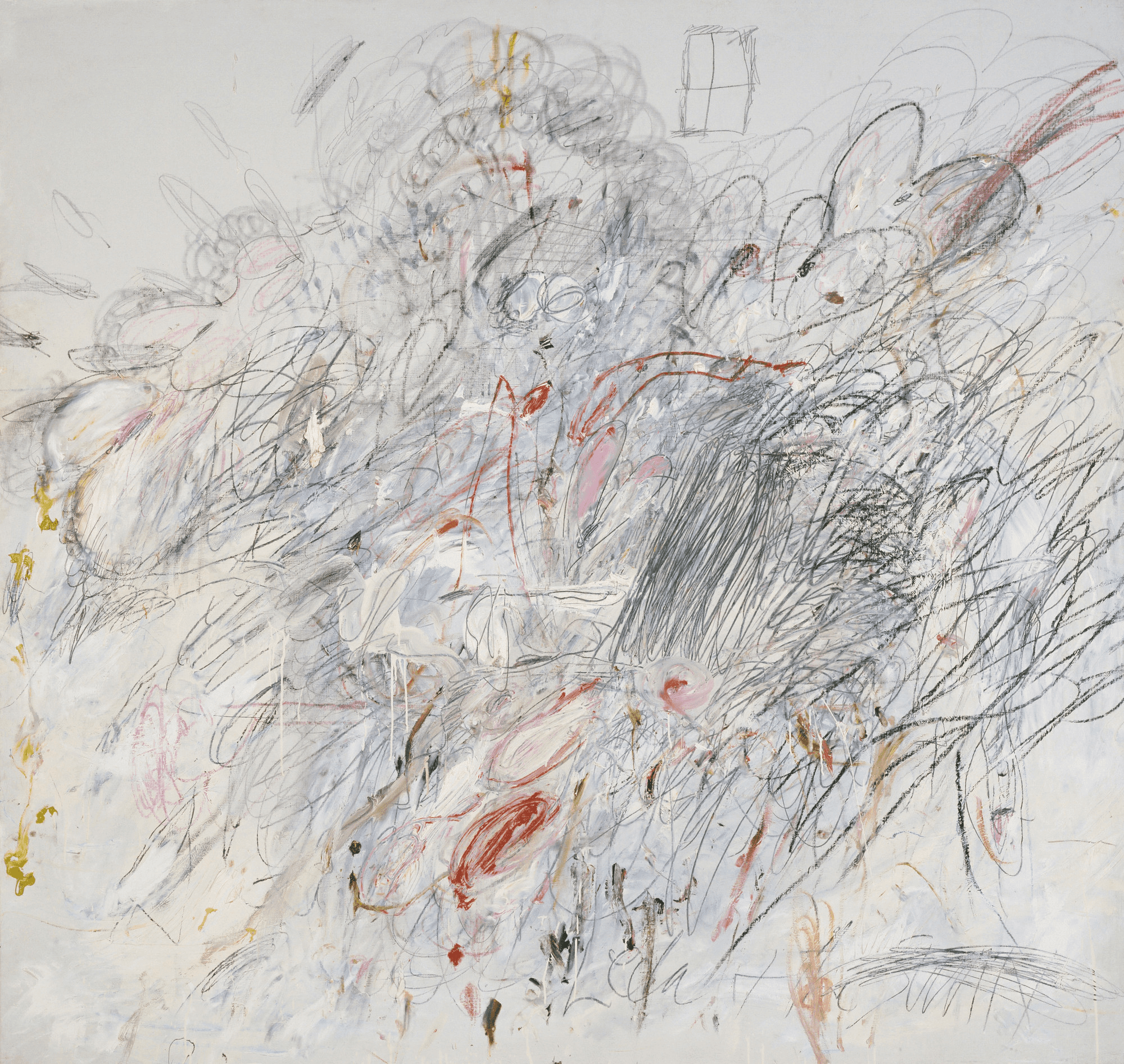
Second Voyage to Italy (Second Version) is from that year. Graphite, crayon, and thinned oil move across a pale linen ground. The year is written by hand on the canvas. The first version hangs in Rome’s Galleria Nazionale under a double title that names Keats’s unfinished poem The Fall of Hyperion. Keats died in Rome in 1821.

An American who had moved to Italy was painting a journey to Italy. New York was turning to Pop. When Twombly showed new paintings at Leo Castelli’s gallery in 1964, Donald Judd wrote that there wasn’t anything to them.
1962 — New Jersey: Roy Lichtenstein, Live Ammo (Tzing!)
The same year, Roy Lichtenstein was teaching art at Douglass College, part of Rutgers. In February 1962 he had his first solo exhibition at Castelli, of paintings copied and enlarged from comic strips and advertisements. He had served in the U.S. Army in Europe during World War II.
Live Ammo (Tzing!) belongs to a group of 1962 paintings taken from war comics, each built around a single frame and a printed sound effect. The battle is drawn the way a ten-cent comic drew it, in hard outlines and flat color, with the noise of a bullet spelled out.

The room also holds Reflections: Whaaam! (1990), in which Lichtenstein returned to his 1963 air-combat painting Whaam! and repainted it as if seen behind glass. Twenty-eight years separate the two pictures.
1964 — Queens: Andy Warhol, Most Wanted Men No. 12, Frank B.
In 1962 the architect Philip Johnson, arts commissioner for the New York State Pavilion at the coming World’s Fair, invited ten artists to make works for the building. Warhol took his images from a February 1962 New York Police Department booklet, The Thirteen Most Wanted. He enlarged the mug shots and silkscreened them onto Masonite panels. The twenty-foot mural was installed on the pavilion’s facade by April 13, 1964.

On April 16, less than a week before the fair opened, Johnson told Warhol to remove or replace it within twenty-four hours. The reported reason was that Governor Nelson Rockefeller feared the images, most of them of men of Italian descent, would offend part of his electorate. The mural was painted over in aluminum paint before the public saw it. Warhol proposed portraits of Robert Moses, the fair’s president, instead. Those were rejected too.
That summer Warhol reused the same screens to make twenty smaller diptychs, front view and profile, titled Most Wanted Men. No. 12, Frank B. is one of them. The painting on SFMOMA’s wall is what survived a censored mural.

The room also holds Tunafish Disaster from his 1963 death-and-disaster pictures. Triple Elvis hangs nearby.
1966 — Düsseldorf: Sigmar Polke, Springbrunnen (Fountain)
Polke’s family fled East Germany in 1953. After an apprenticeship in a Düsseldorf stained-glass workshop, he entered the Düsseldorf Art Academy in 1961, where Joseph Beuys’s influence was everywhere. In 1963 he and two fellow students, Gerhard Richter and Konrad Lueg, staged a storefront exhibition in Düsseldorf and named their approach Kapitalistischer Realismus, Capitalist Realism. It was a German answer to American Pop, taken from the advertising of West Germany’s economic miracle.

Polke was still a student in 1966, when he painted Springbrunnen. That year he had his first solo exhibition, at Galerie René Block in West Berlin. He had been painting newspaper halftone dots by hand, one at a time, with the eraser end of a pencil. The dots imitated mechanical reproduction but were made by a human hand.
The Polke room opens directly into the Richter room. The two men who named Capitalist Realism together hang side by side.
1967 — New York: John Chamberlain, Crissum-Kiss
Chamberlain began adding scrap metal from cars to his sculpture in 1957. From 1959 he worked almost entirely with crushed automobile parts, which made him the sculptor of the American car body. By the mid-1960s he was pushing away from it. In 1966 he made sculptures of rolled and tied urethane foam. In 1967 he began making films.

Crissum-Kiss (1967) is made of galvanized steel, the plain gray metal of buckets and ductwork, instead of the painted chrome of wrecked cars. Beside it is a touch object made of the same material, one of several on this floor, meant to be handled. The gallery also holds Bijou (1961), Coconino (1969), Fiddler’s Foot (1978), and Fenollosa’s Column (1983). Together they show Chamberlain leaving the car body and returning to it.
1969 — Ottawa: Dan Flavin, “monument” for V. Tatlin
On May 25, 1963, Dan Flavin mounted a single yellow fluorescent tube on a wall at a 45-degree angle and dedicated it to Constantin Brâncuși. From then on he worked only with commercial fluorescent fixtures, in a limited set of colors and stock lengths.

In 1964 he began a series of pyramidal wall pieces dedicated to Vladimir Tatlin, the Russian Constructivist whose Monument to the Third International, designed in 1919–20 as a spiral tower taller than the Eiffel Tower, was never built. Flavin made fifty of them between 1964 and 1990. The quotation marks around “monument” are his. The SFMOMA version dates from 1969, the year of his first major retrospective, at the National Gallery of Canada in Ottawa.
A tower designed as a revolutionary monument was answered with a set of hardware-store light tubes. When a tube burns out, the museum replaces it.
1974 — Düsseldorf: Gerhard Richter, 256 Farben (256 Colors)
Richter left East Germany for the West in 1961, two months before the Berlin Wall went up. Through the 1960s he painted from black-and-white photographs, blurring them as he went. His first color-chart painting, 10 Colors, dates from 1966. In 1969 he made his first gray monochromes. In 1971 he became a professor at the Düsseldorf Academy, where he taught for more than fifteen years.

256 Farben belongs to the large color-chart paintings of 1973–74. SFMOMA dates it 1974/1984. Each color sits in its own rectangle on a grid, and the arrangement was chosen by chance, not composition. A painter who had built a reputation on images from photographs was now painting with no image at all.
The room spans most of Richter’s career: Portrait Müller (1965), Brigid Polk (1971), Wald (4) (1990), and Fenster (2002).
1977 — Galisteo: Agnes Martin, Untitled #5
Agnes Martin came to New York in 1957 at the invitation of the dealer Betty Parsons. She took a loft at Coenties Slip in lower Manhattan, among Ellsworth Kelly, Robert Indiana, Jack Youngerman, and Lenore Tawney. Wheat (1957), in this room, dates from her arrival. In New York she was hospitalized repeatedly for symptoms of schizophrenia.

In 1967 she left abruptly. Ad Reinhardt had died, the Coenties Slip buildings were coming down, and a relationship with the artist Chryssa had ended. Her last painting before leaving was Trumpet (1967). She spent about eighteen months traveling across Canada and the American West, then settled on a mesa near Cuba, New Mexico, where she built an adobe house. She did not paint for years. She completed a new group of paintings in 1974, and they were shown regularly from 1975.
Untitled #5 (1977), in gesso, graphite, and ink on linen, comes from the first years after that return. In 1977 she moved to Galisteo, New Mexico, on land she owned for the first time. The octagonal Martin room is described in the earlier post on the Fisher floors. This painting is the one made after the silence.
1978 — Woodstock: Philip Guston, As It Goes
Guston was one of the celebrated abstract painters of the New York School. The Street (1956) and Late Fall (1963), in this room, come from those years. In 1967 he moved to Woodstock, New York, and gave up abstraction.
In 1970 he showed the new paintings at the Marlborough Gallery in New York: cartoonish hooded Klansmen, shoes, cigarettes, light bulbs, and clocks, painted in thick pink and red. Most critics condemned the show. Hilton Kramer’s review in The New York Times was titled “A Mandarin Pretending To Be A Stumblebum.” Guston withdrew further into Woodstock.
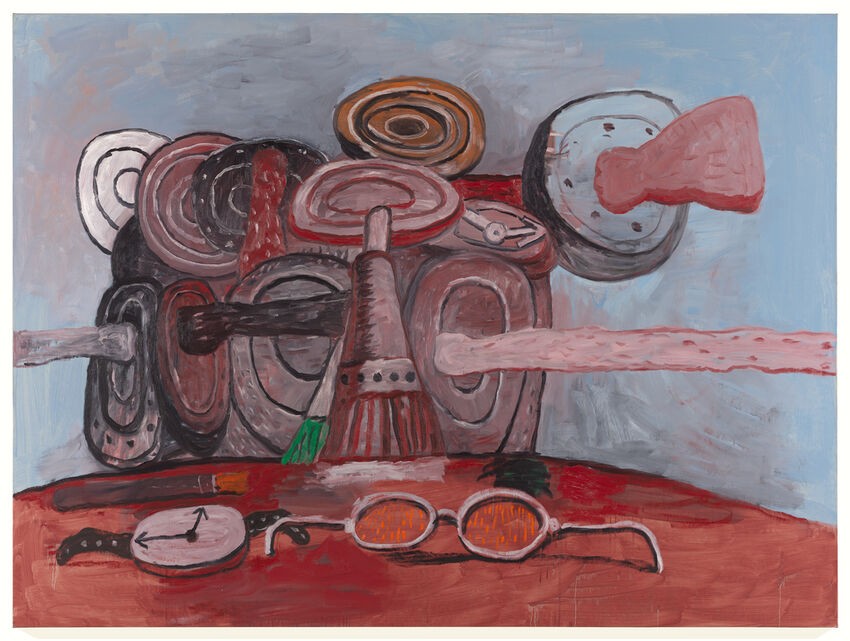
As It Goes (1978) and Brushes (1978) belong to the late work he made there in that isolation. He kept painting in the style that critics had rejected. He died in Woodstock on June 7, 1980, at sixty-six. The room places the abstract and the figurative paintings together, so the break is visible.
1987 — New York: Elizabeth Murray, My Manhattan, January
Elizabeth Murray made paintings that refused the rectangle. Her canvases took irregular outlines, projected off the wall, and broke apart. She met the poet Bob Holman in 1980 and married him in 1982. She raised three children, a son from her first marriage and two daughters with Holman.

My Manhattan, January is from 1987. In May of that year her first survey, Elizabeth Murray: Paintings and Drawings, co-organized by the Dallas Museum of Art and the MIT List Visual Arts Center, opened at MIT. It included a painting made of two canvases shaped like a broken coffee cup on its saucer.
A touch object for My Manhattan, January sits beside it. Murray shares her room with Joan Mitchell. Of the fourteen artists on this floor, three are women: Murray, Mitchell, and Martin.
1989 — Vétheuil: Joan Mitchell, Bracket
Mitchell bought an estate at Vétheuil, outside Paris, in 1967 and worked there for the rest of her life. In 1984 she was diagnosed with advanced oral cancer. She refused the recommended removal of her jaw and was treated with radiation instead. The treatment succeeded but killed part of the jawbone. In December 1985 she had a hip replacement that did not go well. While recovering, she worked in watercolor at a small easel.
On April 28, 1987, her dealer and close friend Xavier Fourcade died. Harm’s Way (1987), in this room, dates from that year. A retrospective of her work toured the United States through 1988 and 1989.

Bracket (1989) was painted during that tour. In October 1989 she opened her first exhibition at Robert Miller Gallery in New York. She died of lung cancer in Paris on October 30, 1992. The room also holds Marie Stadler Artichaud (1956), painted thirty-three years before Bracket.
1989 — New York: Richard Serra, The United States Courts Are Partial to Government
In 1979 the General Services Administration commissioned Richard Serra to make a sculpture for Federal Plaza in Manhattan. Tilted Arc, installed in 1981, was a curved wall of weathering steel 120 feet long and 12 feet high that cut across the plaza. Office workers petitioned against it. At a hearing in March 1985, 122 people testified to keep it and 58 to remove it. A five-member panel voted 4–1 for removal. Serra sued in 1986 and lost. He argued that the work was site-specific and that moving it would destroy it. It was cut apart and removed in 1989.

That year Serra made a group of large black paintstick drawings, horizontal diptychs nearly nine feet high and over fifteen feet wide. In SFMOMA’s audio guide he links them to the destruction of Tilted Arc. The United States Courts Are Partial to Government is one of them. Its title states his position on the verdict. Its form is two black masses set side by side.
SFMOMA and the Fishers acquired it together in 1994. The room also holds his lead props, House of Cards and Floor Pole Prop. Sequence is covered in an earlier post.
1996–1997 — The Bowery: Brice Marden, Epitaph Painting 1
Marden began in New York in 1966 as Robert Rauschenberg’s studio assistant. His early paintings were single-color panels of oil and beeswax, like Untitled (1968) in this room. In 1984 an exhibition of Japanese calligraphy turned him toward line. From 1989 to 1991 he painted the Cold Mountain series, named for the eighth-century Chinese hermit poet Han Shan (寒山), whose poems he read in Red Pine’s English translation. They were the largest paintings he had made. He insisted they were not writing and that he was not trying to make a language.

The Sisters (1991–93) and Epitaph Painting 1 (1996–97), both in this room, come out of that turn. In the Epitaph painting the calligraphic line loops across the canvas in long continuous strokes. Through those years Marden worked in a studio on the Bowery and spent summers at his house on the Greek island of Hydra. He died in 2023.
1998 — New York: Chuck Close, Agnes
In December 1988 Chuck Close felt chest pain at a ceremony in New York honoring local artists. He gave his speech, then went to Beth Israel Medical Center, where a seizure left him paralyzed from the neck down. The cause was a collapsed spinal artery. After months of therapy he regained some movement in his arms and used a wheelchair for the rest of his life.
He kept painting with a brush strapped to his wrist. Assistants laid out the grid. Each cell became a loose patch of color, and the faces resolved only from across the room. Close also had prosopagnosia, difficulty recognizing faces, and said that painting faces helped him remember them.

Agnes (1998) is a portrait of Agnes Martin, more than eight feet tall. Beside it hangs the Polaroid maquette Close made that year and marked with a grid. Martin was eighty-six and living in a retirement residence in Taos. The room also holds Roy I, with its 1994 maquette, and Lorna (1993).
In December 2017 several women accused Close of sexual misconduct, and the National Gallery of Art canceled a planned exhibition. After his death in 2021, his neurologist attributed the behavior to frontotemporal dementia diagnosed in 2015. The museum hangs the work. The record stands beside it.
Agnes hangs a few rooms from Martin’s own paintings. Close painted her face from a gridded Polaroid with a brush strapped to his wrist. Martin painted grids for most of her life. 🌁
Timeline — Ways of Seeing
1957 — Agnes Martin moves to Coenties Slip, New York; paints Wheat. Cy Twombly settles in Rome. John Chamberlain begins using car parts.
1959 — Twombly marries Tatiana Franchetti.
1961 — Gerhard Richter leaves East Germany; Sigmar Polke enters the Düsseldorf Academy.
February 1962 — Roy Lichtenstein’s first solo show at Leo Castelli; Live Ammo (Tzing!) painted that year.
1962 — Twombly paints Second Voyage to Italy (Second Version).
May 25, 1963 — Dan Flavin makes his first fluorescent work.
1963 — Polke, Richter, and Konrad Lueg launch Capitalist Realism in Düsseldorf.
1964 — Flavin begins the Tatlin “monuments.” Judd pans Twombly’s Castelli show.
April 16, 1964 — Warhol is told to remove Thirteen Most Wanted Men from the World’s Fair; that summer he makes the Most Wanted Men canvases.
1966 — Polke paints Springbrunnen; first solo show in West Berlin. Richter makes his first color chart. Brice Marden starts as Rauschenberg’s assistant.
1967 — Martin leaves New York. Guston moves to Woodstock. Joan Mitchell buys her Vétheuil estate. Chamberlain makes Crissum-Kiss.
1969 — Flavin’s “monument” for V. Tatlin; retrospective in Ottawa.
October 1970 — Guston’s Marlborough show is panned.
1971 — Richter begins teaching at the Düsseldorf Academy.
1974 — Martin completes her first paintings since 1967; Richter’s 256 Farben.
1977 — Martin moves to Galisteo; paints Untitled #5.
1978 — Guston paints As It Goes.
1979 — Tilted Arc commissioned.
1980 — Guston dies in Woodstock, June 7.
1981 — Tilted Arc installed at Federal Plaza.
1984 — Mitchell diagnosed with oral cancer. Marden sees a Japanese calligraphy exhibition.
1985 — Tilted Arc hearing; panel votes 4–1 for removal.
1987 — Xavier Fourcade dies, April 28. Elizabeth Murray paints My Manhattan, January; her first survey opens at MIT.
December 1988 — Chuck Close is paralyzed by a spinal artery collapse.
1989 — Tilted Arc removed; Serra makes The United States Courts Are Partial to Government. Mitchell paints Bracket.
1989–1991 — Marden paints the Cold Mountain series.
1992 — Mitchell dies in Paris, October 30.
1994 — SFMOMA and the Fishers acquire Serra’s drawing.
1996–1997 — Marden paints Epitaph Painting 1.
1998 — Close paints Agnes.
2004 — Martin dies in Taos.
2016 — Fisher Collection galleries open at SFMOMA.
April 18, 2026 — Ways of Seeing: Fourteen Artists opens.