Man with Ladder

SFMOMA, Floor 4 · Ways of Seeing: Fourteen Artists.
In the City Gallery, among John Chamberlain's crushed car sculptures, a workman has stopped for a moment. He leans on an open wooden stepladder, one foot on the bottom step, his forearm hanging over a rung. A yellow extension cord hangs in loops from his right hand. He has a thick brown mustache, a blue baseball cap on backwards, a red plaid shirt with the sleeves rolled up, jeans with paint on them, and worn gray Reebok sneakers. His eyes look down at nothing.

Visitors walk around him. Some of them wait for him to move. He is Duane Hanson's Man with Ladder (1994), and he is the only Hanson on this floor. One sculpture is enough to tell the story of an artist who spent his life making people that nobody looks at impossible to overlook.
A Dairy Farm in Minnesota (1925–1951)
Duane Elwood Hanson was born on January 17, 1925, in Alexandria, Minnesota. His parents, Dewey and Agnes Hanson, were Swedish immigrants who ran a dairy farm and sold milk in their small town. He was an only child and worked with his hands from early on, carving wood. At thirteen he carved a version of Gainsborough's The Blue Boy.

He started at Luther College in Decorah, Iowa, which had little art training, and in 1944 he went to the University of Washington in Seattle to study art. There he learned from the wood sculptor Dudley Carter. He came back to Minnesota and graduated from Macalester College in St. Paul in 1946, then taught high school art. In 1951 he earned an MFA at Cranbrook Academy of Art in Michigan, where he studied under the Swedish sculptor Carl Milles.
Seven Years in Germany (1953–1960)
In 1953 Hanson moved to West Germany and taught art in the U.S. Army school system for seven years, four in Munich and three in Bremerhaven. There he met another art teacher, George Grygo, who was working with polyester resin. Hanson took up the material. It would become the basis of everything he is known for.
He came back to the United States in 1960. His first marriage, to Janice Roche, ended in 1965, and she took custody of their three children. He moved to South Florida and taught at a junior college in Miami.
The Angry Years (1966–1970)
Around 1966 Hanson began casting life-size figures in fiberglass, and from 1967 he cast them from living models. The sculptor George Segal was already making life-size figures cast from real people, in white plaster. Hanson went the other way: resin, fiberglass, car-body filler, painted skin, real hair, real clothes.


The first figures were violent. Abortion (1966) was inspired by an illegal backroom procedure. Accident (1967) showed a motorcycle crash. Riot (1967), Football Players (1969), and Vietnam Scene (1969) followed, and Race Riot (1969–71) had seven figures, including a white policeman and a Black man in a struggle. Hanson admired the nineteenth-century French Realists, Daumier and Millet, artists who showed ordinary and suffering people at a time when that was itself a political act. He later destroyed many of these early works.
In 1968 he married Wesla Host, a Florida schoolteacher. The dealer Ivan Karp had urged him to come to New York, and in 1969 he moved to Manhattan, living on the Bowery.
The Quiet Turn (1970–1994)
In 1970 Hanson changed course. Instead of riots and wars, he made Supermarket Shopper, Hardhat, and Tourists: ordinary Americans, life-size, doing ordinary things, often looking tired, bored, or lost in thought. In 1972 his work was shown at Documenta 5 in Kassel, West Germany, and he became known internationally. In 1973 he moved to Davie, Florida, where he lived for the rest of his life.
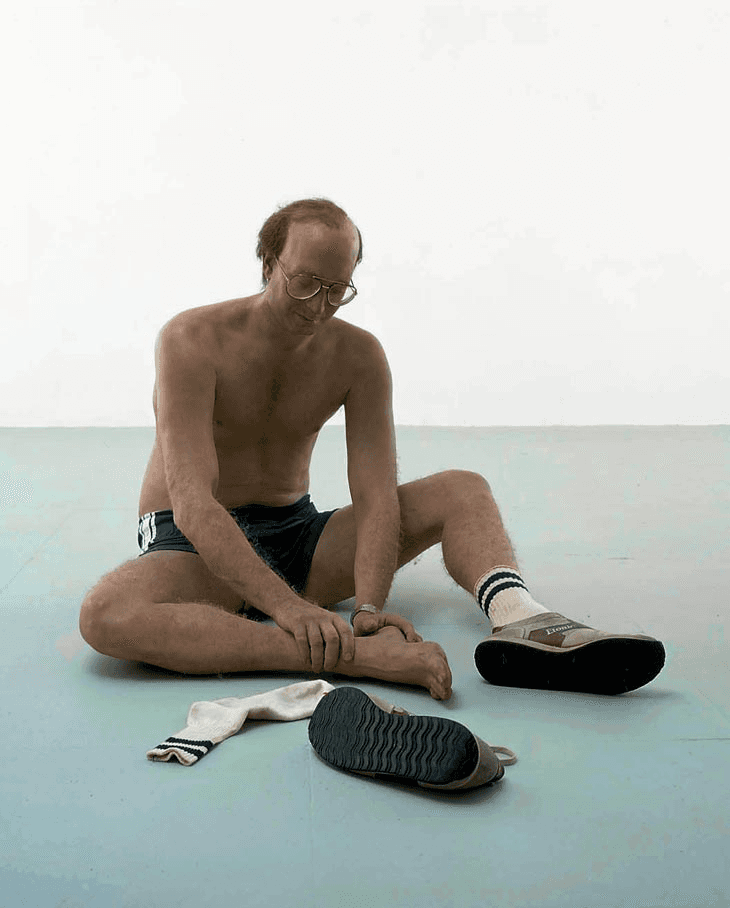


The working method stayed the same for the next twenty years. He cast friends and family from life, assembled the body from the molds, painted the skin with veins and blemishes, added hair strand by strand, and dressed the figure in thrift-store clothes or the model's own. Each figure took months. He cast his own children too: his son for Surfer (1987), his daughter for Cheerleader (1988). Among his working people were a museum guard and a housepainter.
"I don't reproduce life," Hanson said, "I make a statement on human values." And: "In the turmoil of everyday life, we too seldom become aware of one another."
The Work
Man with Ladder (1994). Acrylic enamel paint, fiberglass, polyester compound, glass eyes, hair, clothing, a ladder, and an extension cord. It stands directly on the gallery floor with no pedestal, which is the point. A sculpture on a pedestal tells you it's art. A man on the floor next to a ladder tells you he's there to fix the lights.
The details are what keep you looking: the paint spatters on the ladder and on the shirt, a yellow "caution" label on the ladder's top section, the slight belly, the bags under the eyes. Nothing is made to be beautiful. The man isn't posed, he's caught between tasks, and that pause is where the feeling is. Hanson's people are almost never doing anything heroic. They wait, rest, or stare. You catch them in the moment when nobody is watching, which is also the moment when they are most themselves.
The museum's audio story about the work comes from Bill Fisher, son of Doris and Don Fisher, who founded Gap. He says the sculpture stood in a lobby at Gap's offices, where visitors often took it for a real worker. Doris noticed the man was wearing Gap jeans, and that helped decide the purchase. What drew the Fishers, he says, was "the humanity of the piece."
That's a funny story and also a revealing one. A sculpture about a worker nobody notices stood in a corporate lobby, where people did exactly what Hanson's art predicts: they didn't notice him, or they mistook him for staff. In a museum, behind a stanchion, he finally gets looked at.
The Last Years
Man with Ladder is one of Hanson's last works. In 1994 a retrospective at the Montreal Museum of Fine Arts toured to Texas and Japan. He died of non-Hodgkin lymphoma in Boca Raton, Florida, on January 6, 1996, eleven days before his seventy-first birthday.
The critic Peter Schjeldahl wrote that Hanson's figures "curiously become ever more affecting as their period looks recede in time." Thirty years on, the backwards cap, the plaid, and the Reeboks already look like the 1990s. The man is getting older without moving. 🌁
Timeline — Duane Hanson
January 17, 1925 — Born in Alexandria, Minnesota.
c. 1938 — Carves a version of The Blue Boy at thirteen.
1944 — Studies art at the University of Washington.
1946 — BA, Macalester College.
1951 — MFA, Cranbrook Academy of Art.
1953–1960 — Teaches in U.S. Army schools in Munich and Bremerhaven; meets George Grygo.
1960 — Returns to the United States.
1965 — First marriage ends; moves to South Florida.
c. 1966 — Begins life-size fiberglass figures; Abortion.
1967 — Begins casting from live models; Accident; Riot.
1968 — Marries Wesla Host.
1969 — Moves to Manhattan.
1969–1971 — Race Riot.
1970 — Supermarket Shopper, Hardhat, Tourists.
1972 — Documenta 5, Kassel.
1973 — Settles in Davie, Florida.
1987–1988 — Surfer and Cheerleader, cast from his children.
1994 — Man with Ladder; Montreal retrospective.
January 6, 1996 — Dies in Boca Raton, Florida.