The Painting That Left the Wall

SFMOMA, Floor 4 · Ways of Seeing: Fourteen Artists
In the same room as Joan Mitchell’s three paintings, two canvases by Elizabeth Murray do something the Mitchells do not. They leave the wall. My Manhattan, January projects sixteen inches into the room. Its outline is irregular, its lower right corner comes to a point aimed at the viewer, and four raised teal shapes stand off its surface like the curling legs of a table. Near its center is a hole eight inches across, cut clean through, so the white gallery wall shows behind it. Things to Come is larger, nearly ten feet on a side and more than two feet deep. Two of its corners peel back from the front like the pages of a book. Behind them are the raw canvas, the wooden frame, and paint splashed on the supports. At its center is another hole, about six inches deep, also opening onto the wall.
Each work has a touch object beside it, so visitors can feel the shapes with their hands.

Elizabeth Murray. Things to Come, 1988
The received account of Murray stresses play. Critics have called her style cartoon Cubism. SFMOMA’s own gallery text for Things to Come describes cartoon-like water droplets rolling across the surface and a painter drawing on coffee cups and graffiti to make forms that are “bold, lively, and energetic.” Robert Storr, who organized her retrospective at the Museum of Modern Art in 2005, gave a different account after her death: “There’s a great deal of pain and a great deal of tragedy and a great deal of anger in her work.” Both descriptions come from people who knew the work well. The two paintings in this room bear out both.
1940–1958 — Chicago and Bloomington: Drawing for a Quarter
Elizabeth Murray was born in Chicago on September 6, 1940, into a working-class family that struggled to make ends meet. Her father’s debts kept the family moving. The New York Times later called her childhood “hardscrabble.” In 1953 the family settled in Bloomington, Illinois.
She drew constantly, mostly cartoons and comic-strip figures, and sold sketches to classmates for a quarter each. Disney was an early and lasting influence. Her father told her she would be an artist.
The family could not afford art school. Her high-school art teacher in Bloomington, Elizabeth Stein, helped pay for it. In 1958, instead of going to Illinois State University nearby, Murray enrolled at the School of the Art Institute of Chicago.
Two things from this period run through her mature work. One is the cartoon: the bouncing line, the exaggerated shape, the object with a personality. The other is the household under strain, where furniture and dishes are things that get moved, broken, and replaced.
1958–1962 — The Art Institute: Cézanne and de Kooning
The School of the Art Institute sits beside one of the great museum collections in the United States, and Murray learned there by looking. She studied Cézanne, Picasso, and Willem de Kooning in the galleries. Of Cézanne’s paintings she said, “I felt the soul behind them.” But she added that she “learned how to paint from looking at de Kooning rather than Cézanne.” She also saw the work of Lee Bontecou, whose wall reliefs of canvas and steel opened into dark central holes. She took evening courses at the University of Chicago.
In 1960 she met the sculptor Don Sunseri, a fellow student. She graduated with a BFA in 1962.
1962–1964 — Mills College, Oakland
Murray went west for graduate school, to Mills College in Oakland, from 1962 to 1964. There she met the painter Jennifer Bartlett, who became a lifelong friend. She married Sunseri in San Francisco in 1963.

The Bay Area art scene of the early 1960s was dominated by Funk, a loose, irreverent movement that made rough, humorous objects from cheap materials and treated New York’s seriousness as a target. Murray absorbed it, alongside the Bay Area painters Frank Lobdell and William Wiley. She made object paintings that projected into space, including one titled Poverty (1964), since destroyed. She received her MFA from Mills on June 17, 1964.
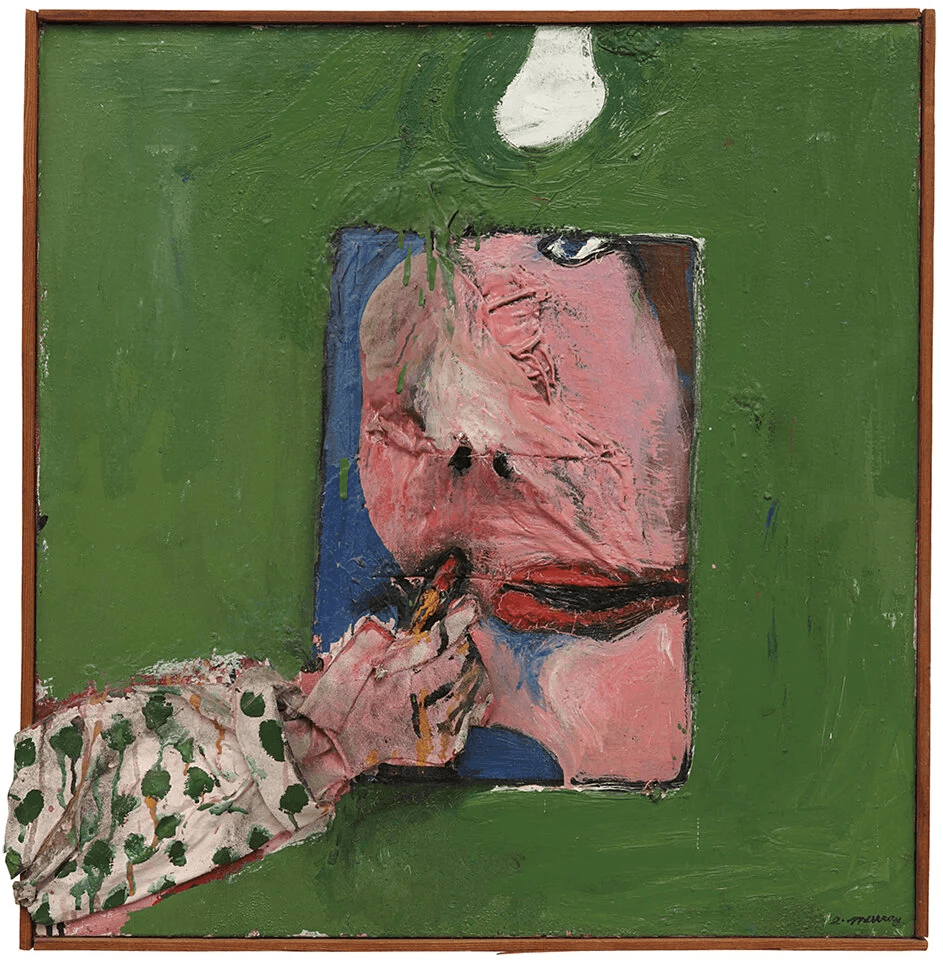
N.H. Lockwood, 1963-67. Oil and cloth on canvas in artist handmade frame. 26 1/4 x 25 3/8 in (66.7 x 64.5 cm). Collection of the Murray-Holman Family Trust, New York
Mills gave her the permission Chicago had not. A painting could be funny, physical, and built out of everyday junk, and still be serious.
1965–1972 — Buffalo and New York: Back to Paint
From 1965 to 1967 Murray taught at Rosary Hill College in Buffalo, New York. In 1967 she moved to New York City, first to a loft on West 28th Street and then to Westbeth, the subsidized artists’ housing in the West Village. Her son Dakota was born in 1969. She taught at the Dwight School to support the family.
New York in the late 1960s was hostile to painting. Minimalism and Conceptual art dominated, and many critics treated painting as finished. In 1971 Murray abandoned three-dimensional work and went back to oil on canvas. The family moved to Cooper Square. In 1972 her painting Dakota’s Red was included in the Whitney Annual, her first major museum exhibition.

Dakota's Red, 1971. Oil on canvas. 69 x 46 1/8 in (175.3 x 117.2 cm). Private collection
In 1973 she showed a series riffing on Cézanne’s portraits of his wife in the Whitney Biennial. “I think Madame Cézanne is me,” she said, “kooky as that may sound.” The joke carried a claim. A woman painter could put herself in the position of the wife who sat for the master, and paint from that side.
1973–1980 — Breaking the Rectangle
In 1973 Murray separated from Sunseri and began showing with Paula Cooper Gallery in SoHo. She taught at Bard College from 1974 to 1977, at Yale from 1977 to 1980, and at the School of Visual Arts. For several years she made geometric paintings based on mathematical figures: F Painting and Wave Painting (1973) and two Möbius Band paintings (1974), based on a strip twisted and joined into a loop with a single surface.
In 1975–76, while a visiting instructor at CalArts near Los Angeles, she began shaping her canvases. She credited the painter Ron Gorchov, whose stretched, saddle-shaped paintings she had seen in New York: “Ron influenced me enormously.”
A shaped canvas is a painting whose outline departs from the standard rectangle, so the edge itself becomes part of the composition. In the 1960s Frank Stella had used shaped canvases to make painting look like a hard-edged object. Murray used the shape for the opposite purpose. Her outlines bulged, curved, and broke the way a cartoon body does.
Her first solo show at Paula Cooper opened in November 1976. Its centerpiece, Beginner (1976), was built around what Murray called a “Tweety Bird shape.” In Tug and With (1978), she combined geometric and biomorphic forms inside angular shaped frames for the first time. In 1979 the Whitney bought Children Meeting.
1980–1986 — Family and the Fractured Still Life
In 1980 Murray met the poet Bob Holman. They married on October 22, 1982, and their daughter Sophie was born that December. A second daughter, Daisy, followed in 1985. Murray now had three children, the oldest thirteen, the youngest newborn. In 1982 she bought a house in Washington County in upstate New York. In 1983 the Museum of Modern Art acquired Painter’s Progress (1981), a painting assembled from many separate canvases that together outline a palette with brushes.
Through the early 1980s she broke her paintings into multiple canvases. Yikes (1982) is two canvases with a gap between them. Keyhole (1982) layers canvases around a central opening. Her subjects became household objects: cups, glasses, spoons, tables, chairs, shoes. She painted them tipped over, splashing, stretched, or about to fall. Storr called these “emphatically unstill lifes.”
The choice of subject had consequences. In the late 1960s and 1970s, many women artists avoided imagery that marked their work as female, in order to be taken seriously by critics and dealers. Murray painted coffee cups and kitchen tables, the objects of the home where she was raising children and working. The work did not hide who made it.
The Mid-1980s Method: Building the Stretcher
In the mid-1980s Murray began building elaborate, bulging supports for her paintings. A stretcher is the wooden frame a canvas is pulled over and fastened to. Most painters buy them as plain rectangles. Murray designed hers as sculpture, curved and projecting, so the canvas took on a three-dimensional shape before she put any paint on it. She ran a shop with an assistant to build them.
She described the result as a joke she played deliberately: “To have something that is three-dimensional, and then model on top of it. It was playing with one illusion on top of another.” The stretcher made a real object. The paint on top added shading and highlights that pretended to be another object. Once the structure was built she could not change it, so she worked on the surface: “Since I can no longer change the structure, I can add or take things away, and I do.”
Storr observed that the round shapes, cords, and dark openings in the paintings of this period suggest birth. Murray herself was reluctant to explain her imagery. She said she had always been “quite reluctant to analyze my work in that linear way.”
1987 — My Manhattan, January
In 1987 Murray’s first survey exhibition, Elizabeth Murray: Paintings and Drawings, opened at the Dallas Museum of Art on March 1. Organized with the MIT List Visual Arts Center, it traveled to Cambridge and on to other American museums. In April and May she showed new work at Paula Cooper. That year she bought a farm at Granville, in upstate New York, which became her family’s second home and later her studio.

Elizabeth Murray. My Manhattan, January, 1987
My Manhattan, January is from that year. It is oil on canvas over a shaped support, 83¼ by 107¼ inches and 16 inches deep. Its colors are cool: greens, soft teals, pale blues, and white lines, around a vivid orange-red core. Near the center a large orange-red oval has a darker brushed center and shadows along its inner edges, like the inside of a cup seen from above. Just to its left is the hole, its edges painted mottled blue and ringed in white and pale blue. A thick white ribbon trails from that ring, loops down and to the right, climbs back along the curved top edge, and swells at the left into a large off-white and teal teardrop. Red teardrop marks radiate from the oval and the hole, some running over onto the canvas edges like splashes. Smaller circles sit at the lower center and lower left. Four raised teal elements stand off the surface, along the top, at the upper right, and near the lower left. SFMOMA’s description identifies them as curling table legs.
The painting combines the two scales Murray worked in. The title names a city in its coldest month. The imagery is a tabletop with a cup on it, legs splayed, liquid flying. The hole punches through both. It shows the actual white wall of the museum, so the painting’s center is not paint at all.
1988 — Things to Come
In September 1988 Murray’s survey arrived at the San Francisco Museum of Modern Art, where it ran from September 14 to November 13. The same year her work went to London in an exhibition of the Saatchi Collection.
Elizabeth Murray. Things to Come, 1988
Things to Come is from 1988. It is oil on canvas, 115 by 113 inches and 27 inches deep, about the size of two large wardrobes side by side. Its main colors are ultramarine blue and golden yellow. Bent and broken planes of each fill the canvas. The upper and lower masses nearly meet around a circular hole near the center, about six inches deep, edged in textured reddish brown. A jagged split like a lightning bolt runs from the top edge down almost to the hole.
The corners do the most unusual work. The upper left corner is rolled back and tucked under, exposing its raw underside, the wooden frame, and paint splashed on the supports. Its tip wraps forward around the front like a tentacle, painted with off-white teardrops on black and reddish pink. The upper right corner is also peeled back, its exposed canvas marked in red, blue, black, and yellow. A row of yellow triangles snakes down its front and back up. The lower section sweeps into a long curling arc that ends at the right in a yellow flourish. The lower left corner curls away from the wall, and its tip touches the bottom of the central hole. At the lower right the canvas ripples in folds over exposed supports and unfinished edges.
SFMOMA’s gallery text describes thick palette-knife paint and brushwork that is “flicked, flung, and splattered,” and cartoon water droplets rolling across the surface. Murray built the surface from everyday subjects, coffee cups and graffiti among them.
Things to Come shows its own construction. The rolled corners reveal the stretcher, the canvas edge, and the drips that landed on the frame while she worked. A painting usually hides how it was made behind a flat front. This one peels its front back to show what holds it up.
The title is open. It can be read as a promise, or as a warning. Murray did not say which.
1989–2007 — After the Survey
In 1989 Storr published a cover story on Murray in Art in America. MoMA included her in its 1990–91 exhibition High & Low: Modern Art and Popular Culture and acquired Dis Pair (1989–90). In the early 1990s she moved away from the heavily built-out supports. Her paintings became flatter and her color brighter, in works like Bounding Dog (1993–94). In 1999 she received a MacArthur Fellowship.

In October 2005 MoMA opened her retrospective, curated by Storr, with more than seventy paintings and works on paper made between 1963 and 2005. It traveled to Valencia, Spain, in 2006. She was ill with lung cancer by then. In February 2007 she received the College Art Association’s Distinguished Artist Award for Lifetime Achievement, nineteen years after Joan Mitchell received it as its first recipient. She died at her home in Washington County, New York, on August 12, 2007. She was sixty-six.
The Room
The Murray and Mitchell paintings share a gallery, and they share a period. Harm’s Way and My Manhattan, January were both painted in 1987; Bracket and Things to Come within a year of each other. Mitchell, fifteen years older, painted abstraction drawn from remembered landscape and kept the canvas flat. Murray, trained on Cézanne and cartoons, kept the cup and the table and broke the canvas around them.
Both of Murray’s paintings here have a hole at the center. Through each one the visitor sees the museum wall. The work offers the bounce and splash that the gallery text describes, and the breakage, splitting, and peeling that Storr read as pain. The paintings do not settle which reading is right. 🌁
Timeline — Elizabeth Murray
September 6, 1940 — Born in Chicago.
1953 — Family moves to Bloomington, Illinois.
1958 — Enters the School of the Art Institute of Chicago, with tuition help from her teacher Elizabeth Stein.
1960 — Meets Don Sunseri.
1962 — BFA, School of the Art Institute of Chicago.
1962–1964 — Mills College, Oakland; meets Jennifer Bartlett.
1963 — Marries Sunseri in San Francisco.
June 17, 1964 — MFA, Mills College; makes Poverty (destroyed).
1965–1967 — Teaches at Rosary Hill College, Buffalo.
1967 — Moves to New York.
1969 — Son Dakota born.
1971 — Abandons three-dimensional work; returns to oil painting.
1972 — Dakota’s Red in the Whitney Annual.
1973 — Madame Cézanne paintings in the Whitney Biennial; separates from Sunseri; begins showing with Paula Cooper.
1975–1976 — Begins shaping canvases while teaching at CalArts.
November 1976 — First solo show at Paula Cooper; Beginner.
1978 — Tug and With combine geometric and biomorphic forms in shaped frames.
1979 — Whitney buys Children Meeting.
1980 — Meets Bob Holman.
October 22, 1982 — Marries Holman; daughter Sophie born in December.
1983 — MoMA acquires Painter’s Progress.
1985 — Daughter Daisy born.
March 1, 1987 — First survey opens at the Dallas Museum of Art; paints My Manhattan, January; buys the Granville farm.
1988 — Paints Things to Come; survey at the San Francisco Museum of Modern Art, September 14–November 13.
1989 — Storr’s Art in America cover story.
1999 — MacArthur Fellowship.
October 2005 — MoMA retrospective opens.
February 2007 — CAA Distinguished Artist Award for Lifetime Achievement.
August 12, 2007 — Dies in Washington County, New York.
April 18, 2026 — Both paintings hang in Ways of Seeing: Fourteen Artists.