The Painter Who Went Back

SFMOMA, Floor 4 · Ways of Seeing: Fourteen Artists
The Guston room holds five paintings made over twenty-two years. The earliest, The Street (1956), is a dense mass of red strokes, jagged and scraped, floating in a pale field of gray and lavender. It depicts nothing. The latest two, both from 1978, depict a great deal. Brushes shows paintbrushes standing in two cans against a blue wall. As It Goes shows a stack of ringed shapes, pink fists reaching in from both sides, a clock lying face up with no numbers, and a pair of round spectacles with orange lenses. Between them hangs Rug III (1976), a pile of tangled legs ending in hobnailed shoe soles, heaped on a red rug.

Philip Guston. The Street, 1956
The received story of Guston turns on 1970. That year he exhibited cartoonish paintings of hooded Klansmen, cigarettes, shoes, and clocks at the Marlborough Gallery in New York. He had been one of the most admired abstract painters in America, and critics treated the new work as a betrayal. Hilton Kramer’s review in The New York Times was titled “A Mandarin Pretending to Be a Stumblebum.” In this account, Guston gave up abstraction late in life, and posterity eventually vindicated him.
The five paintings in this room, and the life that produced them, support a different account. Guston did not leave figuration in middle age. He returned to it. He had started as a narrative painter of politics and violence, with hooded figures already in his work in the 1930s. Abstraction was the middle chapter of his career.
1913–1927 — Montreal and Los Angeles
Guston was born Phillip Goldstein in Montreal on June 27, 1913, the youngest of seven children of Louis and Rachel Goldstein, Jewish immigrants from Odessa who had fled the pogroms in the Russian Empire. In 1919 the family moved to Los Angeles. His father, who had been a blacksmith in Odessa, found little work there.
In 1923 his father hanged himself in a shed behind the house. Phillip, ten years old, found the body.
His mother enrolled him in a correspondence course from the Cleveland School of Cartooning in 1926. He spent much of his adolescence drawing comics, alone in a closet he used as a studio, lit by a single bare bulb. The bare bulb hanging from a cord would become one of the most persistent images in his late paintings.
1927–1935 — Manual Arts, Otis, and the Murals
In 1927 he entered Manual Arts High School in Los Angeles, where his classmates included Jackson Pollock and Reuben Kadish. Guston and Pollock produced a pamphlet attacking the school’s emphasis on sports over art. Both were expelled. Pollock later returned and graduated; Guston did not.
In 1930 he won a scholarship to the Otis Art Institute and left after three months. He was largely self-taught after that. He studied the Italian Renaissance in reproductions, especially Piero della Francesca and Masaccio, and saw paintings by Giorgio de Chirico in the collection of Walter and Louise Arensberg in Hollywood. De Chirico’s empty squares and stacked objects stayed with him for life.

Philip Guston (American, born Canada, 1913–80). Mother and Child, ca. 1930. Oil on canvas, 40 x 30 in. (101.6 x 76.2 cm). Promised Gift of Musa Guston Mayer to The Metropolitan Museum of Art, New York. Photograph by Genevieve Hanson
The Los Angeles of his youth was politically violent. The Ku Klux Klan was active in the city, and the police broke up labor actions. In 1932, at eighteen, Guston painted a mural with Kadish for the John Reed Club, a leftist artists’ organization, to raise money for the defense of the Scottsboro Boys, nine Black teenagers falsely accused of rape in Alabama. Local police defaced it.
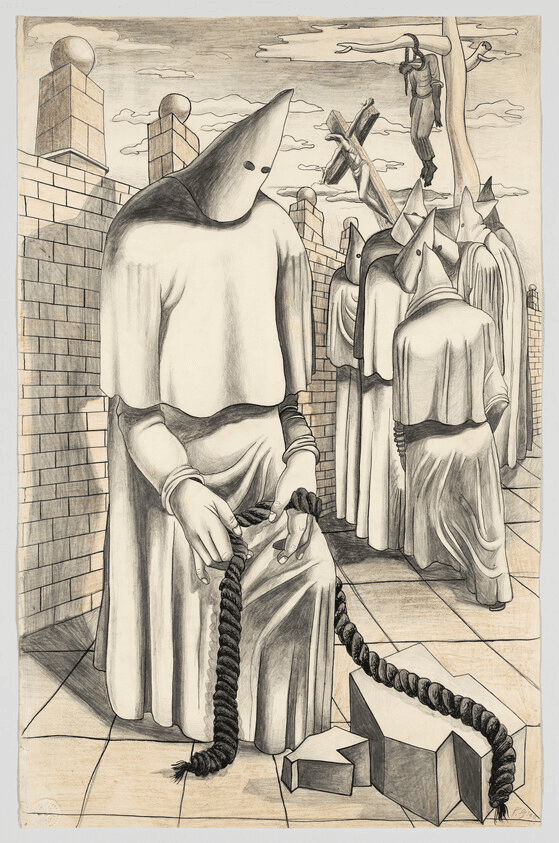
Philip Guston. Drawing for Conspirators. 1930.
In 1934 Guston, Kadish, and the critic Jules Langsner traveled to Mexico, drawn by the public murals of Diego Rivera, José Clemente Orozco, and David Alfaro Siqueiros. In Morelia, on a wall of a former palace of the Emperor Maximilian, they painted The Struggle Against Terror, a large fresco of torture and persecution that includes hooded figures. The work was later covered over, then rediscovered and restored.

Philip Guston and Reuben Kadish, The Struggle Against Terrorism (1934–35). © The Estate of Philip Guston Courtesy the Estate and Hauser & Wirth.
By the mid-1930s he was using the name Guston.
1935–1947 — The WPA and the Turn
In 1935 Guston moved to New York and joined the Federal Art Project of the Works Progress Administration, the Depression-era program that employed artists to paint public murals. He painted a mural on the facade of the WPA building at the 1939 New York World’s Fair, which won first prize, and later murals for a post office in Commerce, Georgia, and the Social Security Building in Washington, D.C.
In 1937 he married Musa McKim, a painter and poet he had met at Otis. Their daughter, Musa, was born in 1943.
The war ended the mural programs. Guston took teaching posts as artist in residence at the State University of Iowa from 1941 to 1945 and at Washington University in St. Louis from 1945 to 1947. His easel paintings of these years show children in paper hats and masks, playing at war with trash-can lids and sticks. His first New York show was at Midtown Galleries in 1945.

Philip Guston. The Tormentors, 1947-1948
In 1947 he received a Guggenheim Fellowship and moved to Woodstock, New York. There he painted The Tormentors (1947–48), his first abstract painting. He was thirty-four.
1950–1959 — Abstraction: The Street
In New York in the early 1950s Guston joined the circle of painters around Willem de Kooning, Franz Kline, and Jackson Pollock, his old classmate. He showed at the Peridot Gallery in 1952, then with Charles Egan, and from 1955 with Sidney Janis, the dealer who also represented Pollock and de Kooning. The Museum of Modern Art included him in 12 Americans in 1956 and in The New American Painting in 1958, the exhibition that toured Europe to present Abstract Expressionism as the leading American art.
His paintings of the early 1950s were unusual within the movement. They were built of short, hatched strokes in pinks, reds, and grays, clustered near the center of a pale field and thinning out toward the edges. Critics, comparing them to Monet’s late water lilies, called the style “abstract impressionism.” The comparison emphasized beauty and light. It missed the clustering, which made the strokes look like a crowd pressing together.
The Street is from 1956. It is oil on canvas, 76 by 71½ inches, signed and dated “Philip Guston 56” near the bottom edge. A dense central mass of saturated reds is laid on in jagged, thick strokes and scraped passages, with black and maroon blocks pushed into it. A muted orange shape at the left and blue-gray strokes near the bottom are partly covered by the red. The surrounding field is pale gray, lavender, and off-white, and thins at the top to an open area with a small patch of pale green at the right.
By 1956 the strokes had grown heavier and darker than in the early 1950s. The red mass in The Street is no longer a shimmer of light. It is a congested block, closer to a heap of objects than to a reflection on water. The title points to a city. The painting was shown in Guston’s exhibition at the Sidney Janis Gallery in February and March 1958. The Fishers bought it at auction at Christie’s in New York in 2005.
1960–1967 — Darkening: Late Fall
Guston grew uneasy with abstraction while he was at the top of it. In 1960 he spoke at a panel discussion about the myth he had inherited, the idea of “painting as autonomous, pure and for itself,” which he called “ridiculous and miserly.” He represented the United States at the Venice Biennale that year. In 1962 the Solomon R. Guggenheim Museum gave him a full retrospective in its new Frank Lloyd Wright building, which traveled to Europe and Los Angeles.
His paintings of the early 1960s darkened. Grays and blacks spread across the pale grounds, and the color drained to a few accents. Large dark shapes appeared, solid and rounded, like heads or boulders, sitting heavily in the field.
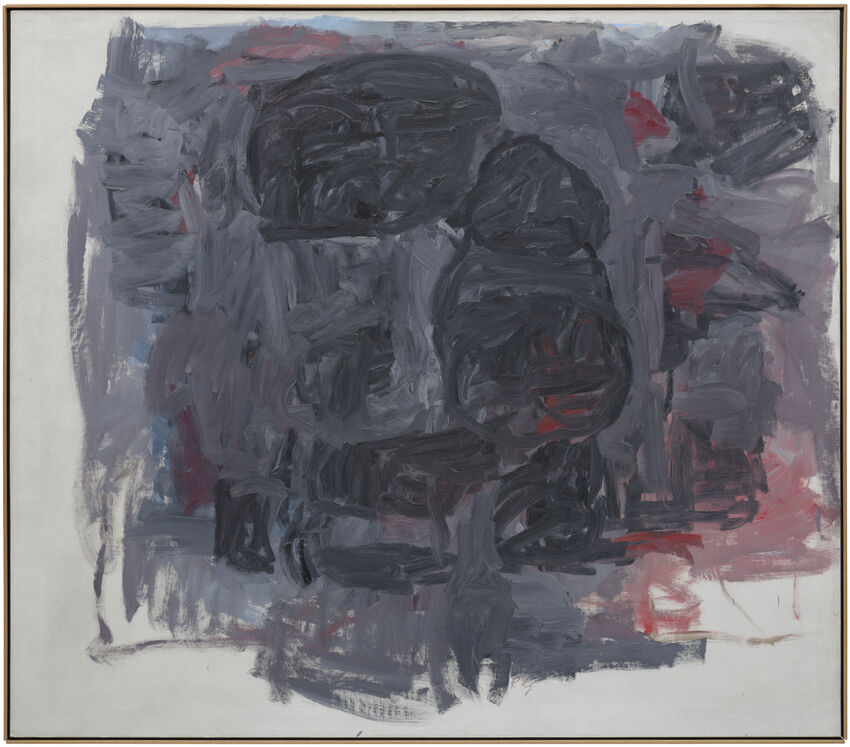
Philip Guston. Late Fall, 1963
Late Fall is from 1963, the year after the Guggenheim retrospective. It is oil on canvas, 68 by 77½ inches. Smoky grays and near-blacks dominate. Thick, block-like strokes build the surface. Two large rounded dark forms sit near the upper center. Choppier strokes form a lattice across the lower half, and touches of red appear toward the right and lower right.
The red that filled the center of The Street has shrunk to a few marks at the edge. The two dark rounded forms are not identifiable objects, but they behave like objects. They have weight and position, and they sit above a structure like figures on a platform. Five years later, the forms that would fill his late paintings, the heads, the shoes, the piled things, came out of shapes like these.
In 1966 the Jewish Museum in New York showed a large group of his recent paintings, and the critical response was negative. Guston painted little for the next two years and drew constantly. In 1967, after a winter in Sarasota, Florida, he moved permanently to Woodstock.
1968–1971 — The Return
In August 1968 the police attacked demonstrators at the Democratic National Convention in Chicago. Guston began making small paintings of hooded figures: Klansmen smoking, driving through cities in open cars, sitting in rooms. He described them as self-portraits: “I perceive myself as being behind the hood.” He was asking what it would be like to be evil, to plan and commit violence, and he put himself inside the hood to ask it.
With the hoods came a vocabulary of plain objects, painted in thick pink, red, and black with cartoon outlines: shoes, cigarettes, light bulbs, clocks, books, easels, brushes, and stacks of bricks. The cartoon style came from the comic strips he had copied as a boy. The objects came from the studio and from the lives of the people who would wear the hoods.

Philip Guston. Thoughts. 1972
The Marlborough show opened in October 1970. Kramer’s review ran on October 25. Time’s critic Robert Hughes titled his “Ku Klux Komix.” Most of the art world agreed with them. Willem de Kooning reportedly told Guston the paintings were about freedom. Hughes later changed his mind.
From 1970 to 1971 Guston was artist in residence at the American Academy in Rome. He made oil paintings on paper of Roman ruins and Italian scenes, then went back to Woodstock and continued in the style the critics had rejected.
1972–1978 — The Late Work: Rug III, Brushes, As It Goes
Through the 1970s Guston lived mostly in Woodstock with Musa McKim. He joined the David McKee Gallery in 1974. From 1973 to 1978 he taught a monthly graduate seminar at Boston University. He painted at great speed, often finishing a large canvas in a day. The work he did not want sold he marked “N.F.S.”

Philip Guston. Rug III, 1976
Rug III is from 1976. It is oil on canvas, 69 by 110⅛ inches. A dense, almost sculptural mass of leg-like forms, interlaced and bent, ends in shoe soles studded with black dots like nail heads. The pile sits on a deep red rug against a pink and off-white background. One sole near the center is ochre-orange. A strip of brown wooden floor shows at the far right, and the signature “Philip Guston” sits on the rug at lower right.
SFMOMA’s audio guide asks “Why paint a pile of legs?” The curator Michael Auping places the painting in the political unrest after the Vietnam War. He reads the heavy soles as working people’s shoes and the tangle of legs as humanity, and he points out the pun Guston could have meant: sole and soul. Auping describes Guston as moving constantly between his own experience and social events, alone in his studio while the world went on outside.
Piles of bodies were not a new image for Guston. The Morelia mural of 1934 shows victims of persecution, and Guston said in his late years that the camps of the Holocaust had haunted him. Rug III contains no Klansmen and no violence. It contains only legs and shoes, stacked like things in storage, on a domestic rug.
In 1977 Musa McKim had a stroke. She recovered, and Guston’s paintings of the following years include images of her face, sometimes rising from the bottom edge of the canvas. 1978 was his last year of teaching.

Philip Guston. Brushes, 1978
Brushes is from 1978. It is the smallest painting in the room, oil on canvas, 42 by 48 inches. Two clusters of tall rounded brush handles in red, pink, brown, and black stand in two cylindrical containers along the bottom edge, against a mottled light blue background. The forms have heavy dark outlines and streaky brushwork. The left container seems to sit on a red surface, but the surface stops, and the right container appears to float. Brushes in a can are the most ordinary sight in any painter’s studio. Guston paints them as a crowd of figures, with heads and bodies, packed together like the strokes of The Street.
As It Goes is also from 1978. It is oil on canvas, 76 by 102¼ inches, unsigned and undated. Against a pale blue-gray background, a pile of ringed shapes made of concentric circles is stacked up the center. Pink and gray arms with clenched fists reach in from the left and right. A clock lies face up near the center, with hands but no numerals. Two brush-like forms stand in front of a large gray circle. The bottom third of the canvas is a reddish surface holding an oval like a pocket watch and a pair of round spectacles with orange lenses.
The painting assembles the late vocabulary in one place: the pile, the fist, the brush, the clock with no numbers, the spectacles. The ringed shapes may be read as the soles of shoes seen end on, or as targets, or as rolls of something stored. Guston did not explain them. The title is an idiom of resignation. The clock without numerals measures time it cannot count.
The catalogue raisonné records that the Fishers bought As It Goes at Sotheby’s in New York in 1993. They collected Guston’s late figurative work at a time when its market value was still well below his abstractions.
1979–1980 — San Francisco
In 1979 Guston had a serious heart attack. He recovered slowly and went back to painting. That year his late work had its first international showing, at the Hayward Gallery in London.
In May 1980 the San Francisco Museum of Modern Art opened a major retrospective of his work, from the 1930s murals through the late figurative paintings. Guston attended the opening on May 15. The exhibition was scheduled to travel to Denver, Chicago, Washington, and New York.
He died of a heart attack in Woodstock on June 7, 1980, three weeks after the San Francisco opening. He was sixty-six.
After
Musa McKim and their daughter, Musa Mayer, kept the paintings Guston had marked “not for sale.” On the advice of David McKee, McKim willed more than a hundred paintings to seventy-five public museums. She died in 1992. The late work, rejected in 1970, became the most influential part of his career for painters of the following decades.
The hooded figures remained contested. In September 2020, four museums postponed a traveling retrospective, Philip Guston Now, citing concern over how the Klan paintings would be received. More than two thousand artists signed an open letter criticizing the decision. The exhibition opened at the Museum of Fine Arts, Boston, in May 2022.
The Room
None of the Klan paintings hang in this room. The five works trace another line: from a red abstraction in 1956, through a darkened field in 1963, to piled legs in 1976 and the tools of the studio in 1978.
The red of The Street returns in the red rug of Rug III, twenty years later. In 1956 the red was the subject. In 1976 it is the floor the subject lies on. Kramer read the change as a mandarin pretending to be a stumblebum. Guston’s own history suggests the opposite sequence: a mural painter of hooded tormentors and piled victims who spent two decades in abstraction and then went back to them. 🌁
Timeline — Philip Guston
June 27, 1913 — Born Phillip Goldstein in Montreal.
1919 — Family moves to Los Angeles.
1923 — Father dies by suicide; Phillip, ten, finds the body.
1926 — Correspondence course with the Cleveland School of Cartooning.
1927 — Enters Manual Arts High School; meets Jackson Pollock; later expelled.
1930 — Three months at the Otis Art Institute.
1932 — John Reed Club mural for the Scottsboro defense; defaced by police.
1934–1935 — The Struggle Against Terror, Morelia, Mexico, with Reuben Kadish and Jules Langsner.
1935 — Moves to New York; joins the WPA Federal Art Project.
1937 — Marries Musa McKim.
1939 — First prize for the WPA building mural, New York World’s Fair.
1941–1947 — Teaches at the State University of Iowa and Washington University in St. Louis.
1947 — Guggenheim Fellowship; moves to Woodstock; The Tormentors, his first abstract painting.
1955 — Joins the Sidney Janis Gallery.
1956 — Paints The Street; included in MoMA’s 12 Americans.
1958 — The Street shown at Sidney Janis; The New American Painting tours Europe.
1960 — Calls the idea of pure painting “ridiculous and miserly”; Venice Biennale.
1962 — Retrospective at the Guggenheim Museum.
1963 — Paints Late Fall.
1966 — Jewish Museum exhibition poorly received; stops painting for two years.
1967 — Settles permanently in Woodstock.
1968 — Begins the hooded-figure paintings after the Chicago Democratic Convention.
October 1970 — Marlborough Gallery exhibition; Kramer’s review, October 25.
1970–1971 — American Academy in Rome.
1973–1978 — Teaches at Boston University.
1974 — Joins the David McKee Gallery.
1976 — Paints Rug III.
1977 — Musa McKim’s stroke.
1978 — Paints Brushes and As It Goes.
1979 — Heart attack; first international showing of late work, Hayward Gallery, London.
May 15, 1980 — Attends the opening of his retrospective at the San Francisco Museum of Modern Art.
June 7, 1980 — Dies in Woodstock.
1993 — The Fishers buy As It Goes at Sotheby’s.
2005 — The Fishers buy The Street at Christie’s.
2020 — Philip Guston Now postponed.
April 18, 2026 — The five paintings hang in Ways of Seeing: Fourteen Artists.