Married Twice

SFMOMA, Part 2: Frieda and Diego Rivera.
On the second floor of SFMOMA, in the collection galleries titled 1900 to Now, hangs a painting about three feet tall. A woman and a man stand side by side against a plain background. She wears a long green dress with a ruffled hem, a red fringed shawl and a strand of beads, and her black hair is braided and wrapped on top of her head. Her feet are tiny, almost doll-like, and seem to float above the floor. He is twice her width. He wears a dark suit over a blue work shirt and heavy boots, and holds a palette and four brushes in his right hand. Her hand rests lightly in his left. Above them a dove carries a ribbon with a dedication in Spanish.
This is Frieda and Diego Rivera, painted by Frida Kahlo in San Francisco in April 1931. Albert M. Bender gave it to the museum in 1936. SFMOMA owns it outright; it is not part of the Fisher loan.
The familiar reading of the painting is a wedding portrait: a young wife beside the famous husband, small and decorative next to the man who holds the tools. That reading is not wrong. But the painting was made by a twenty-three-year-old woman on her first trip outside Mexico, in a foreign city, using a dress, a name and a dedication to say who she was. It is a portrait of a marriage, and it is also a record of an identity being assembled in public.
1926–1930: Bender's Campaign
Diego Rivera came to San Francisco because a group of Bay Area artists and patrons had spent four years trying to bring him there. In 1926 the sculptor Ralph Stackpole, the painter Ray Boynton and others visited Mexico City, saw his murals, and came home as advocates. Albert Bender, the Dublin-born insurance broker who was already the city's most active art patron, used his connections to promote Rivera's work. He invited Rivera to the Bay Area in late 1926.
The invitation took four years to succeed. Rivera's politics stood in the way. He was a well-known Communist, and getting him into the United States meant working around visa trouble at a time of tense relations between Washington and Mexico City. He arrived in November 1930. Over the next months he painted three murals in the Bay Area. The first, Allegory of California, was for the stairwell of the Pacific Stock Exchange's luncheon club. The others were a fresco at the Atherton home of Sigmund and Rosalie Stern, and The Making of a Fresco Showing the Building of a City at the California School of Fine Arts.
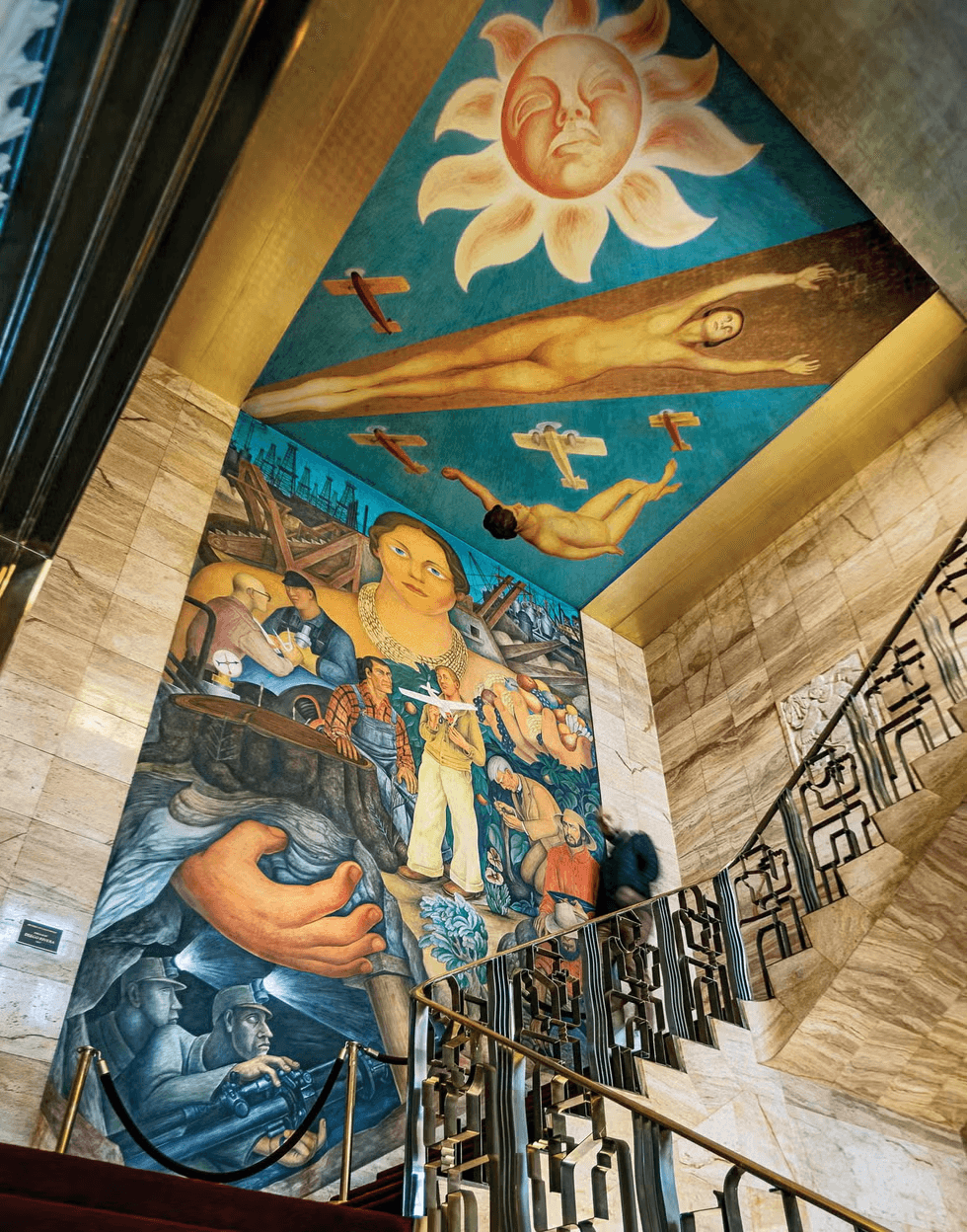
The building commissions went to Rivera. Kahlo came as his wife.
August 21, 1929: Coyoacán
Kahlo and Rivera had married fifteen months earlier, in a civil ceremony in Coyoacán, outside Mexico City. She was twenty-two. He was forty-two and had been married before. The difference in their sizes was part of how others saw the match. A remark attributed to her parents called it the marriage of an elephant and a dove.
Kahlo had not set out to be a painter. At six she contracted polio, which left her right leg shorter and thinner than the left. In 1922 she entered the National Preparatory School in Mexico City, one of about 35 girls among 2,000 students, and studied natural sciences with the aim of becoming a doctor.
On September 17, 1925, she and her boyfriend boarded a crowded wooden bus in Mexico City. The driver tried to pass an electric streetcar, and the streetcar crashed into the side of the bus. A steel handrail went through her body. She later said it pierced her "the way a sword pierces a bull." Her pelvis was fractured and her abdomen and uterus punctured. Her spine was broken in three places, her right leg in eleven places. Her right foot was crushed and dislocated, her collarbone broken and her shoulder dislocated. She survived, but the injuries shaped the rest of her life: pain, surgeries, and long periods confined to bed.
She spent three months in bed after the accident, and that is when she began to paint. Her mother had a special easel made that she could use lying down, and her father, a photographer, lent her his oil paints. A mirror was fixed above the easel so she could see herself. The arrangement explains a great deal of what followed. Her first subject was the one she could always see, and self-portraiture became the core of her work. Her early paintings were mostly portraits of herself, her family and her friends.
In 1928 she was introduced to Rivera, already the most famous painter in Mexico, and asked him to judge whether her paintings showed enough talent for her to pursue a career as an artist. He encouraged her to go on. By the time they married in 1929 she had a small body of work and had never shown any of it in public.
November 1930: 716 Montgomery Street
The couple stayed in Ralph Stackpole's studio at 716 Montgomery Street, at the edge of North Beach, for about six months. It was Kahlo's first time outside Mexico. She wrote to her mother that the city was very beautiful, and that she had seen the ocean for the first time. She described its immigrant neighborhoods one by one: the Russians who dressed as they did in Russia, the Greeks, the Japanese, and "most of all the Chinese."
On November 9, 1930, she met Dr. Leo Eloesser, a thoracic surgeon at San Francisco General Hospital, who treated her and became one of her closest friends for the rest of her life. That winter the photographer Edward Weston photographed her and wrote that she caused "much excitement on the streets of San Francisco."
The excitement was about her clothes. In San Francisco, Kahlo dressed as a Mexican woman deliberately: long skirts, embroidered blouses, rebozos and heavy jewelry. She told her mother that the American women, las gringas, liked her a great deal and paid close attention to all the dresses and rebozos she had brought.
The Name
The painting's title spells her name Frieda, with an e. This is the German spelling. Her father, Guillermo Kahlo, was a photographer born in Germany, who had emigrated to Mexico in 1891. Her mother, Matilde Calderón, was Mexican, of mixed Indigenous and Spanish descent. Kahlo later dropped the e, and Frida became the name she was known by.
She also adjusted her birth year. Born in July 1907, she often gave it as 1910, the year the Mexican Revolution began. The daughter of a German immigrant chose to present herself as a child of the Revolution. In San Francisco she was presenting herself as Mexican to an American public. Each was a choice about which part of her background to put forward.
April 1931: The Painting
The composition borrows from Mexican colonial portraiture and folk painting: stiff frontal figures, a flat background, and a written inscription identifying the sitters. The dove's ribbon reads, in Spanish: "Here you see us, me, Frieda Kahlo, with my beloved husband Diego Rivera. I painted these portraits in the beautiful city of San Francisco, California, for our friend Mr. Albert Bender, and it was in the month of April of the year 1931."
Everything in the image about work belongs to him. He holds the palette and brushes; she holds nothing but his hand. His boots are planted, and her feet barely touch the ground. Her head tilts toward him.
The inscription points the other way. "I painted these portraits." Rivera may be shown holding the brushes, but the dedication states who made the picture.
Two Readings
The first reading comes from Hayden Herrera, whose 1983 biography Frida did more than any other book to make Kahlo famous. Herrera takes the painting at face value: Kahlo presents herself as the wife of the great artist. On this reading the picture records where she stood in 1931. She was twenty-three and had never exhibited. She had come to San Francisco because her husband had commissions there. He held the brushes, and she held his hand.
The image gives this reading a great deal to work with. Rivera's bulk is planted on the floor; Kahlo seems to float beside him, anchored only by his hand. Her head tilts toward him. His head turns away. He is dressed for work, she is dressed for display. The format itself is old. A man and a woman stand side by side, full-length, stiffly posed, and a text identifies them. This is the convention of the colonial marriage portrait, the kind of picture made to record a union rather than two individuals.
The second reading comes from the art historian Margaret Lindauer. In Devouring Frida (1999), she argues against the habit of reading every Kahlo painting as a direct transcript of her life: her marriage, her injuries, her suffering. Lindauer calls that habit a "devouring mythology," because it turns paintings into biography and leaves no room for Kahlo's choices as an artist. Read that way, Frieda and Diego Rivera is an early public statement by a woman about to become a professional painter, and the inscription is its center. The dove's ribbon names who made the picture, where, for whom and when, in the first person: I painted these portraits. The image shows the husband as the painter. The text, which Kahlo wrote and placed above both their heads, makes her the author.
SFMOMA's own commentary points to a third possibility between the two. Because Rivera was so much taller, heavier and more established, the exaggerated contrast may be less a truthful record than a veiled critique of the subordinate role Kahlo was expected to play. The same commentary notes that the stiff, paired figures recall Egyptian statues of pharaohs and their queens. On that reading, she was already casting herself in a larger and older role than "wife of Diego Rivera."
The painting does not choose among these readings, and Kahlo left no statement that settles it. What can be said is that every reading depends on the same two elements, set against each other: an image in which the man holds the tools, and a sentence in which the woman says she made it.
November 1931: First Public Showing
Frieda and Diego Rivera was shown in the Sixth Annual Exhibition of the San Francisco Society of Women Artists, from November 4 to December 3, 1931. It was the first public exhibition of any work by Kahlo. By then she and Rivera had left San Francisco. In December 1931 the Museum of Modern Art in New York opened a Rivera retrospective, only the second solo exhibition in the museum's history.
Her public debut was a painting of herself as his wife, shown in a women's exhibition in a city she had already left.
1936: Into the Museum
Bender gave the painting to the San Francisco Museum of Art in 1936, a year after it opened. It was part of the gift of more than 1,100 objects that formed the core of the young museum's collection. Bender died in 1941. Kahlo had her first solo exhibition in 1938, at the Julien Levy Gallery in New York. Her work was shown in Paris the following year.
December 8, 1940: City Hall
The marriage in the painting did not last a decade. Both were unfaithful, and the deepest injury was Rivera's affair with Kahlo's younger sister, Cristina. They were granted a divorce in November 1939. Rivera told the press it was a matter of legal convenience, with no sentimental, artistic or economic reasons behind it. Kahlo answered with work. That year she painted The Two Fridas, two seated versions of herself, one in a European dress and one in Mexican dress, their hearts exposed and joined by a single artery. She was determined to earn her own living from painting.
In 1940, Mexican politics drove both of them north. On May 24 an armed raid on Leon Trotsky's house in Coyoacán by Stalinist gunmen, led by the painter David Alfaro Siqueiros, failed to kill him. Rivera had brought Trotsky to Mexico and had broken with him since, and he feared he would be implicated or targeted next. With help from the actress Paulette Goddard and the artist Irene de Bohus, he left Mexico and arrived in San Francisco on June 1. The architect Timothy Pflueger had arranged for him to paint in Art in Action at the Golden Gate International Exposition on Treasure Island, where visitors watched artists at work in a converted airplane hangar. There he began Pan American Unity.
On August 21, 1940, Trotsky died after an assassin attacked him in his house. Kahlo had known the killer socially. She and Cristina were arrested and held for two days. The next month, ill and in pain from her spine and a fungal infection on her hand, she traveled to San Francisco to be treated by Leo Eloesser. She spent time in St. Luke's Hospital in the Mission District. Eloesser treated her body and also advised her on the marriage: he urged her to reconcile with Rivera. While she was in the city she also had a brief affair with a young art dealer, Heinz Berggruen.
On December 2 Rivera's mural was unveiled to a crowd estimated at 25,000 to 30,000. Kahlo is in it, standing with a palette and brushes: in his mural he gave her the painter's tools that, in her 1931 portrait, he had held himself. Six days later, on December 8, 1940, Rivera's fifty-fourth birthday, they married again in a civil ceremony at San Francisco City Hall. Reporting the wedding, the Oakland Tribune identified her as "an artist in her own right."
The second marriage was made on her terms. According to Rivera's later account, Kahlo set three conditions. She would support herself from her own work. They would split the household expenses equally. And they would not have sexual relations. Rivera accepted. Back in Mexico they kept separate spaces: the Blue House in Coyoacán was their home, while Rivera kept his San Ángel house as a studio and second apartment. In the dining room of the Blue House she kept two stopped clocks, one marking the divorce and one the remarriage.
They married twice. Both times she stood beside him, but the second marriage was in the city where she had first painted them as a couple, and on conditions she had written herself. 🌁
Timeline — Frieda and Diego Rivera
1907 — Frida Kahlo born in Coyoacán, July 6 1925 — Bus accident; Kahlo begins painting during recovery
1926 — Bay Area artists visit Rivera in Mexico City; Albert Bender invites him north
1929 — Kahlo and Rivera marry in Coyoacán,
August 21 1930 — Kahlo and Rivera arrive in San Francisco in November; stay at 716 Montgomery Street; Kahlo meets Leo Eloesser,
November 9 1931 — Kahlo paints Frieda and Diego Rivera in April, dedicated to Albert Bender
1931 — The painting is shown at the San Francisco Society of Women Artists,
November 4 – December 3: Kahlo's first public exhibition
1931 — Rivera retrospective opens at the Museum of Modern Art, New York
December 1936 — Bender gives the painting to the San Francisco Museum of Art
1939 — Kahlo and Rivera divorce
1940 — Kahlo and Rivera remarry at San Francisco City Hall,
December 8 1941 — Albert Bender dies