An Authorized Replica

SFMOMA, Part 1: Fountain.
In SFMOMA's collection there is an object catalogued as Marcel Duchamp, Fountain, 1917/1964. It is a white urinal lying on its back, about fifteen inches high and two feet long. "R. Mutt 1917" is painted in black on its rim. The museum bought it in 1998 with funds from Phyllis C. Wattis. Unlike the Fisher works upstairs, the museum owns it outright.
In 1917 Duchamp bought a urinal from a plumbing showroom, signed it with a fake name, submitted it to an art exhibition, and in doing so turned choosing an object into making art. A century of conceptual art follows from that moment. In 2004 a poll of five hundred British art-world figures named Fountain the most influential modern artwork.
The object in San Francisco complicates almost every part of that story. It is not the urinal from 1917. That one was never exhibited and disappeared within weeks. SFMOMA's Fountain was produced in 1964 for a Milan gallery, modelled from a photograph. Even the 1917 original has a disputed author.
1917: Fifth Avenue
A readymade is a manufactured object that an artist selects, sometimes alters slightly, and presents as a work of art. Duchamp had been making them since 1913, when he mounted a bicycle wheel on a kitchen stool. He came to New York in 1915. By 1917 he was a celebrity in avant-garde circles, known as the painter of Nude Descending a Staircase, which had caused a scandal at the 1913 Armory Show.
According to the account that circulated later, Duchamp went with the collector Walter Arensberg and the painter Joseph Stella to the showroom of J. L. Mott Iron Works at 118 Fifth Avenue, where he bought a flat-backed porcelain urinal. He took it to his studio, turned it ninety degrees so it rested on its back, and painted "R. Mutt 1917" on it. Duchamp later explained the name. He took Mott, changed it to Mutt after the daily comic strip Mutt and Jeff, and added Richard, French slang for a moneybags.
This purchase story rests on recollections recorded decades after the event. Researchers have since argued that Mott did not sell this model of urinal.
April 1917: The Independents
The Society of Independent Artists was founded to break the power of juries. Its first exhibition opened in April 1917 at the Grand Central Palace in New York. The rule was simple: any artist who paid six dollars could show work, with no jury and no prizes. Duchamp was on the board and chaired the hanging committee.
Fountain arrived under the name Richard Mutt, an artist from Philadelphia. The board refused it. The objections reported at the time were that it was indecent, and that a plumbing fixture was not a work of art at all but plagiarism of a manufacturer's product. The Blind Man later put it this way: "Without discussion, this object disappeared and never was exhibited." Duchamp resigned from the board.
April 11, 1917: A Letter to Suzanne
On April 11, the day after the exhibition opened, Duchamp wrote to his sister Suzanne in France. In the commonly cited translation, he said that one of his female friends, using the pseudonym Richard Mutt, had sent in a porcelain urinal as a sculpture. Since there was nothing indecent about it, he wrote, there was no reason to refuse it.
Duchamp never repeated that attribution. Later in life he claimed Fountain as his own without qualification. Since the early 2000s, writers including Irene Gammel, Elsa's biographer, and later Glyn Thompson and Julian Spalding, have argued that the "female friend" was the Dada poet and artist Baroness Elsa von Freytag-Loringhoven. Their case rests on three points. The letter was written at the time, before any legend had formed. The newspapers gave Richard Mutt's home as Philadelphia, a city Elsa is said to have had ties to. And she worked with plumbing herself: God, a cast-iron plumbing trap mounted on a miter box and made in 1917, is now usually credited to her together with the Philadelphia painter Morton Schamberg.
The case against her is stronger on the record. Elsa never claimed Fountain, in public or in private, in the decade she lived after 1917. Louise Norton, whose address was on the entry label, wrote in a draft dated to 1972 that Duchamp "sent in a porcelain urinal which he titled, Fountain by R. Mutt." In a 1978 interview, Norton and Beatrice Wood, the two women closest to the submission, said they had never met the Baroness. Dawn Ades and Alastair Brotchie read the letter more narrowly. In their reading, "sent in" means a female friend physically submitted the object under the pseudonym. Duchamp, as head of the hanging committee, had reason to hide his own hand, even from his sister.
The weight of evidence favors Duchamp. The letter remains the one document that points elsewhere, and it has not been fully explained.
May 1917: The Blind Man
The only photograph of the 1917 Fountain was taken by Alfred Stieglitz at his gallery 291, with the urinal set in front of a Marsden Hartley painting, The Warriors. It was published in the second issue of The Blind Man, a small magazine edited by Duchamp, Henri-Pierre Roché and Beatrice Wood, alongside an unsigned editorial titled "The Richard Mutt Case."

The editorial argued that whether Mr. Mutt made the fountain with his own hands did not matter. "He CHOSE it." He had taken an ordinary article of life and placed it so that its useful significance disappeared under a new title and point of view. The theory of the readymade entered print through this defense of a rejected object, which very few people had seen.

1917–1963: Disappearance and Return
The original urinal was lost soon afterward. No one knows what became of it. For the next three decades Fountain existed as Stieglitz's photograph and as a story.
Duchamp brought it back gradually. From 1938 he made miniature versions for the Boîte-en-valise, a portable box of reproductions of his own works. In 1950 he let the dealer Sidney Janis acquire a urinal in Paris and sign it for an exhibition in New York; that version is now at the Philadelphia Museum of Art. In 1963 the Swedish critic Ulf Linde made a version for an exhibition in Stockholm, which Duchamp signed afterward.
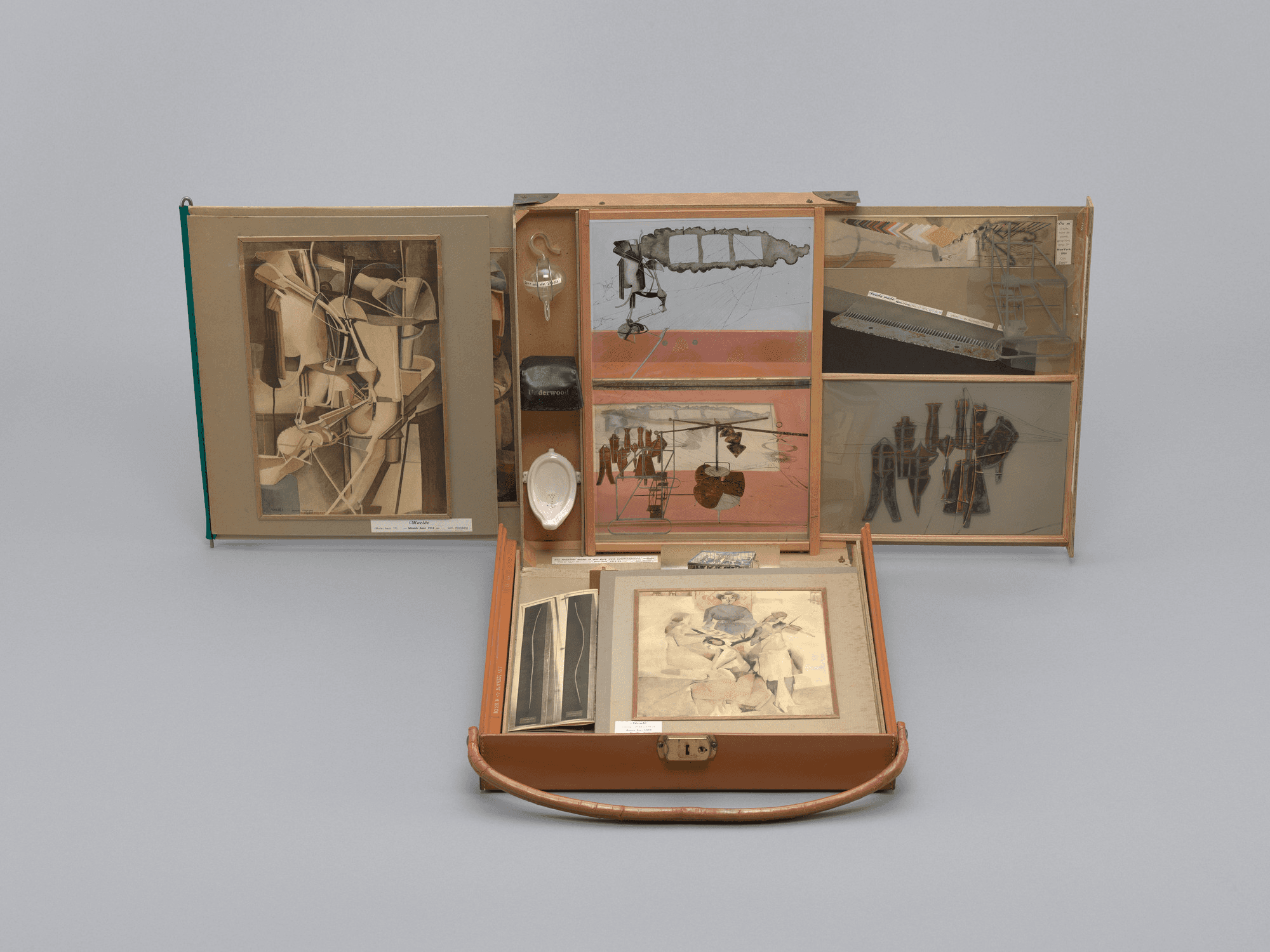
Each step moved further from the original premise. The readymade had been defined as a mass-produced object chosen, not made. By the 1960s the objects carrying its name were being chosen, sourced or fabricated by other people, with Duchamp's signature as the link back to 1917.
1964: Milan
In 1964 the Milan dealer Arturo Schwarz produced an authorized edition of Duchamp's readymades. For Fountain, the original was gone and the model was no longer manufactured. A prototype was modelled in clay from Stieglitz's photograph, working closely with Duchamp, and technical drawings were made from it. According to Tate's technical research, the copies were then probably slip-cast by a sanitary-ware manufacturer, in glazed earthenware painted to resemble the original porcelain. The 1964 Fountain is a sculpture modelled on a photograph of a mass-produced urinal. Duchamp signed each copy, "R. Mutt 1917" on the front and "Marcel Duchamp 1964" on the back. The 1964 Fountain is a handmade sculpture of a mass-produced urinal. Duchamp approved and signed the copies.
The edition comprised eight numbered copies, plus copies outside the numbering for Duchamp, for Schwarz, and for exhibition, along with a prototype. Number 1 of 8 is SFMOMA's. Number 2 is at Tate Modern in London, number 3 at the National Gallery of Canada in Ottawa, number 6 at the National Museum of Modern Art in Kyoto, and number 8 at the Indiana University art museum. Duchamp's own copy is at the Centre Pompidou in Paris. Every Fountain that any museum now owns comes from 1950 or later.
1998: San Francisco
SFMOMA acquired its copy in 1998, through a gift from Phyllis C. Wattis, one of the museum's major donors of the period. The next year, number 5 of the edition sold at Sotheby's for $1,762,500.
The copies have their own afterlife. In 1993, at an exhibition in Nîmes, the French performance artist Pierre Pinoncelli urinated into a Fountain and then struck it with a hammer. In 2006 he attacked the Pompidou's copy with a hammer as well. He argued that he was completing the work by returning it to its use. Both times the courts treated the damage as an attack on a valuable artwork.
The museum's own label gives the 1917 date first and the 1964 date second. It describes the piece as the fourth full-scale version and lists the medium as "ceramic, glaze and paint." The object is honestly described. It is, however, not the object the story is about. 🌁
Timeline — Fountain
Seventeen authorized versions of Fountain have been created, according to a list compiled by Cabinet magazine.Two of them, including the 1917 original, are lost.
1917: Original version, lost.
1950: Signed by Duchamp at the request of art dealer Sidney Janis for a gallery exhibition. Acquired by the Philadelphia Museum of Art in 1998
1953: "Selected for sale at auction to benefit a friend of Duchamp" in Paris. Location unknown.
1963: Made by Ulf Linde for an exhibition in Stockholm. Signed by Duchamp in 1964. Donated to Moderna Museet in 1965
1964: Galleria Schwarz edition
Eight versions made for sale:
1/8: Bought by the San Francisco Museum of Modern Art in 1998.
2/8: Bought by Tate Modern in London in 1999.
3/8: Bought by the National Gallery of Canada in 1971.
4/8: Bought by an unnamed collector in 2002.
5/8: Bought by Dimitris Daskalopoulos in 1999 for $1.76 million, a record-high price at the time for a Duchamp work.
6/8: Bought by the National Museum of Modern Art, Kyoto in 1987.
7/8: In the collection of Musée Maillol in Paris.
8/8: Bought by Indiana University Art Museum in 1971.
Two artist's proofs:
Duchamp's: Bought by the Musée National d'Art Moderne in Paris in 1986.
Schwarz's: Bought by an unnamed collector in 2002 for $1.08 million.
Two museum versions:
I/II: Donated to the Israel Museum in Jerusalem in 1972.
II/II: Donated to the National Gallery of Modern Art in Rome in 1997.
Prototype version: Bought by Andy Warhol in 1973. Bought by Dakis Joannou from Warhol's estate for $65,750 in 1988