
SFMOMA, Part 29: Floor 2, 1900 to Now. Leaky Ride for Dr. Leakey (James Rosenquist, 1983).
Sixteen and a half feet wide, three panels, left to right: a pencil — the most basic technology, "how we convey [our ideas] from one generation to another" — then bolts, that "could be screwed together, creating a pressure point" — then a black form turning into a vortex, "a sense of a galaxy, of space, of time travel. The Big Bang. The birth of the universe" — then a woman's face, "represents now... pulled apart, allowing you to look behind that surface, into infinity." That's SFMOMA's curatorial reading, and the painting invites exactly that kind of storyboard scan: pencil, bolts, vortex, face. Writing, machinery, the Big Bang, the present moment. A timeline of everything, in oil, 1983.

The title is a pun, and the pun is the key. Dr. Leakey is Louis Leakey (1903-1972), the Olduvai Gorge paleoanthropologist — mentor to Goodall, Fossey, Galdikas — "very, very famous for his work in the excavations of the earliest human skeletons in the Great Rift Valley," as SFMOMA's Gary Garrels puts it: "a key to read the painting as a kind of cosmological picture about the place of humanity in the cosmos." "Leaky" for "Leakey." A leaky ride — a leaking boat, a ride that won't hold water, a pun in the great Rosenquist tradition of surrealist-pun titling. No recorded explanation from the artist survives; the 1985 MoMA drawing Drawing of Leakey suggests the interest went beyond wordplay. But the pun is doing philosophical work: Leakey dug up the earliest humans; Rosenquist paints the cosmos leaking — time, the Big Bang, the present face pulled apart. The ride leaks. Everything leaks: the pencil's line, the bolts' pressure, the galaxy's edge, the face's surface. History surrenders to cosmology.
James Rosenquist was the odd one out of Pop. Born 1933 in Grand Forks, North Dakota; Minneapolis School of Art at fourteen; Art Students League in 1955. Then the billboards — the Midwest, then Times Square, lead painter for Artkraft-Strauss, International Brotherhood of Painters — until 1960, when a fellow painter fell from the scaffolding and he quit. The studio at Coenties Slip, near Indiana and Kelly and Youngerman. First solo at the Green Gallery, 1962 — sold out. F-111, 1965: eighty-six feet, fifty-one interlocking panels, a fighter jet flying "through the flak of consumer society," the anti-Vietnam allegory that made him. Moved to Aripeka, Florida, in 1976 — thirty years of cosmos and nature paintings. The 2009 fire that destroyed the house, the studios, the warehouse. The 2003 Guggenheim retrospective. The memoir, Painting Below Zero. Died 2017, age eighty-three.
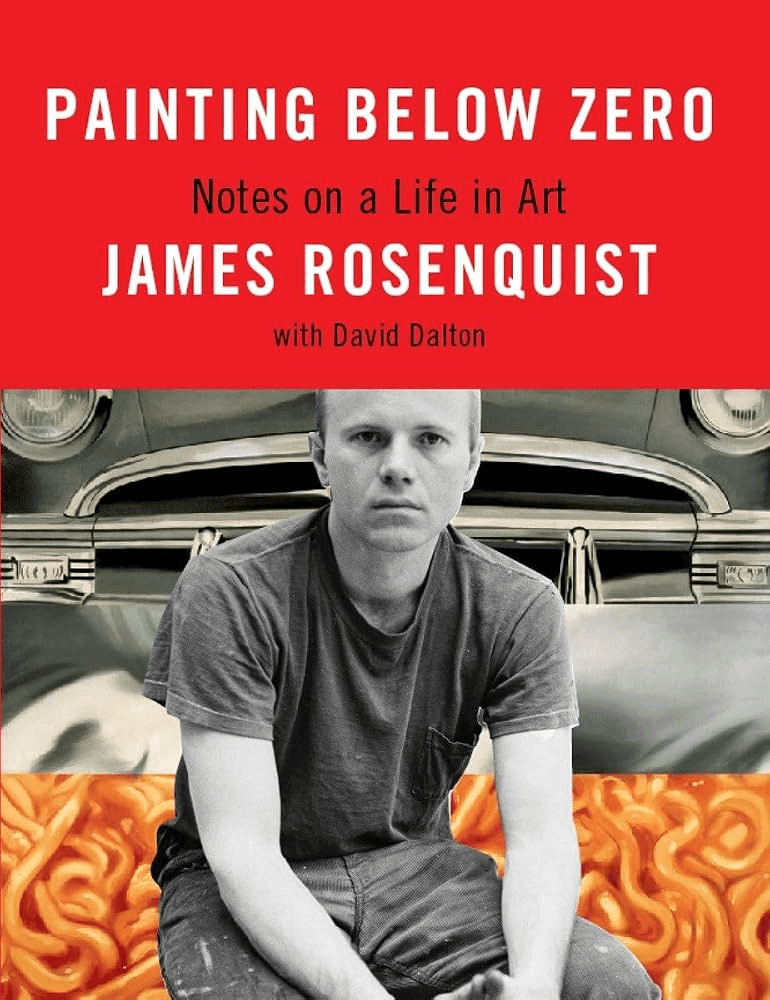
He maintained he "was never concerned with logos or brand names or movie stars" — "antipop," his word. The billboard years weren't celebration; they were labor, and hated labor: "Critics say Pop artists love their subject matter... Bullshit! I just hated it." The evidence: General Outdoor Advertising, 1957 — 147 whiskey billboards, and on one label, where it should have said "This spirit is made from finest grains," he painted "Mary had a little lamb, its fleece was white as snow." At twenty-three, on a grey expressway billboard, he secretly mixed green and red and yellow into the old sign-painters' pots — "it reminds me now of a Jasper Johns. The other sign painters went, 'Oh no!... We'll all get fired!'" The saboteur inside the sign shop. Marilyn Monroe I (1962) dismembers the star "as if to imply that her personality had been shattered by the pressures of fame" — not a celebration, an autopsy.
The language of symbols
SFMOMA's label invites you to "discover Rosenquist's language of symbols," and the 1980s are when the language went cosmic. The seventies and eighties are widely treated as his less-celebrated period — the Daily Princetonian on the 2003 retrospective: "paintings from the 70s and 80s seem too caught up in space exploration... less mysterious and more confusing." The Art Newspaper in 2017: "Although his art never lost its grandeur of scale... it never again achieved the timeliness that gave F-111 much of its power." But the retrospective rehabilitated him as a "visual poet" — Walter Hopps's phrase: "not like Warhol or Lichtenstein... not so much a Pop artist as an imagist." "He orchestrates combinations that seem absurd — a French horn and a black hole — but those combinations also make a curious sense, both formally and psychologically." The collage studies behind the big paintings, the survey revealed, were "truly outstanding."
Leaky Ride is the long tail of Pop: the movement's grammar — enlargement, cropping, scale shifts, grisaille against color, deadpan craft, the billboard's fragment-logic — applied to non-consumer subjects. No soup cans. No starlets. A pencil, bolts, the Big Bang, a face. "In collage there is a glint... you see parts of things and you rationalize and identify danger by bits and pieces. It's very quick. It's about contemporary life." The contemporary life of 1983: the decade's turn to "geo-political, existential and environmental themes." Pop grew up and looked at the sky and got scared.
It came to SFMOMA with the 1992 Anderson gift — the thirty-work Pop tranche — and it is SFMOMA's only Rosenquist painting. The museum's other Rosenquists are all prints, none currently on view. Sixteen and a half feet of 1983 cosmology, the sole painting, in the donor-authored Pop room: the shock isn't the subject, it's the date. The technique is 1960s Times Square. The anxiety is 1980s deep space.
So here's the thesis: Leaky Ride for Dr. Leakey is Pop's grammar speaking cosmology — the billboard painter's fragment-logic applied to the Big Bang. Pencil (writing), bolts (machinery), vortex (the universe's birth), face (now, pulled apart). Leakey dug up the first humans; Rosenquist paints the ride leaking — time, space, the present, all seeping through the panels. "Antipop," he said; "Bullshit! I just hated it," he said of the subject matter they claimed he loved. The hate made the poetry. Hopps had it: "a visual poet... combinations that seem absurd... but those combinations also make a curious sense." Sixteen feet of absurd sense, the museum's only Rosenquist painting, leaking at the seams. 🌁
Timeline — James Rosenquist
1933 — born November 29, Grand Forks, North Dakota
1950s — billboard painter; Times Square, Artkraft-Strauss
1960 — quits after a fellow painter's fatal fall; Coenties Slip studio
1962 — first solo, Green Gallery; sells out
1965 — F-111; eighty-six feet of anti-war Pop
1976 — moves to Aripeka, Florida; the cosmic turn
1983 — paints Leaky Ride for Dr. Leakey
1992 — Anderson gift brings it to SFMOMA; the museum's only Rosenquist painting
2017 — dies March 31, New York, age 83