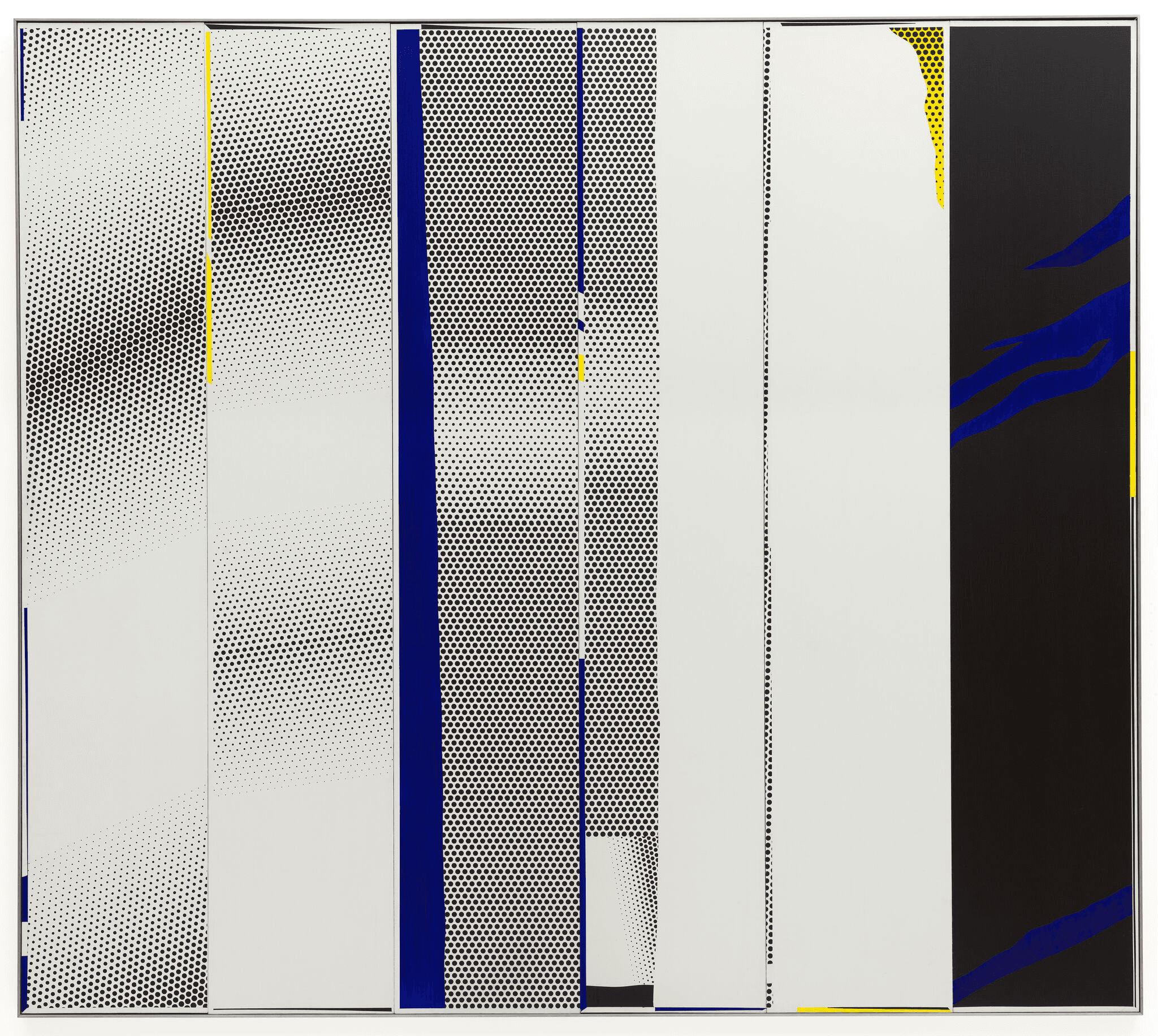
SFMOMA, Part 28: Floor 2, 1900 to Now. Mirror #2 (Six Panels) (Roy Lichtenstein, 1970).
There is no mirror here. Six panels, eight by nine feet, oil and Magna — diagonal slashed light bands crossing the panel seams, Ben-Day dot fields signaling glass smoothness, hard black outlines, small "blips" and zigzag "jumps." It is cartoon shorthand for mirror-ness: everything a cartoonist draws to tell you this is a mirror, with the mirror itself deleted. A real mirror shows the world. A Lichtenstein mirror shows only the convention for drawing one. A picture of a picture-of-nothing.
The artist explained it himself — via Kimmelman, quoted by Christie's; build the whole series around this: "Mirrors are flat objects that have surfaces you can't easily see since they're always reflecting what's around them... There's no simple way to draw a mirror, so cartoonists invented dashed or diagonal lines to signify 'mirror.' Now, you see those lines and you know it means 'mirror,' even though there are obviously no such lines in reality. If you put horizontal, instead of diagonal, lines across the same object, it wouldn't say 'mirror.' It's a convention that we unconsciously accept."
The convention we unconsciously accept. That's the entire painting, and it's the most abstract thing Lichtenstein ever made — near-abstraction in comic-strip vocabulary. The Mirrors (1969-72) arrive at the hinge: classic Pop behind him, the 1966 art-history appropriations underway, the work cooling into something more conceptual. Graham Bader, in Hall of Mirrors (MIT Press, 2010): the Mirrors "exemplify Lichtenstein's late-'60s shift of focus to the embodied experience of his own viewers — and thus culminate and conclude his practice of the decade." They "figure a dissolution of painter and spectator alike." You stand in front of a mirror that reflects nothing, and the nothing includes you.
The long mirror history
Every mirror in art history is a metaphysical claim. Van Eyck's Arnolfini Portrait (1434): the convex mirror on the back wall expands the world to include the viewer — you're in the room. Velázquez's Las Meninas (1656): the mirror at the back holds the king and queen, positioned where the viewer stands — you are the monarchs. The mirror is the painting's way of saying: the world continues past the frame, and you're in it.
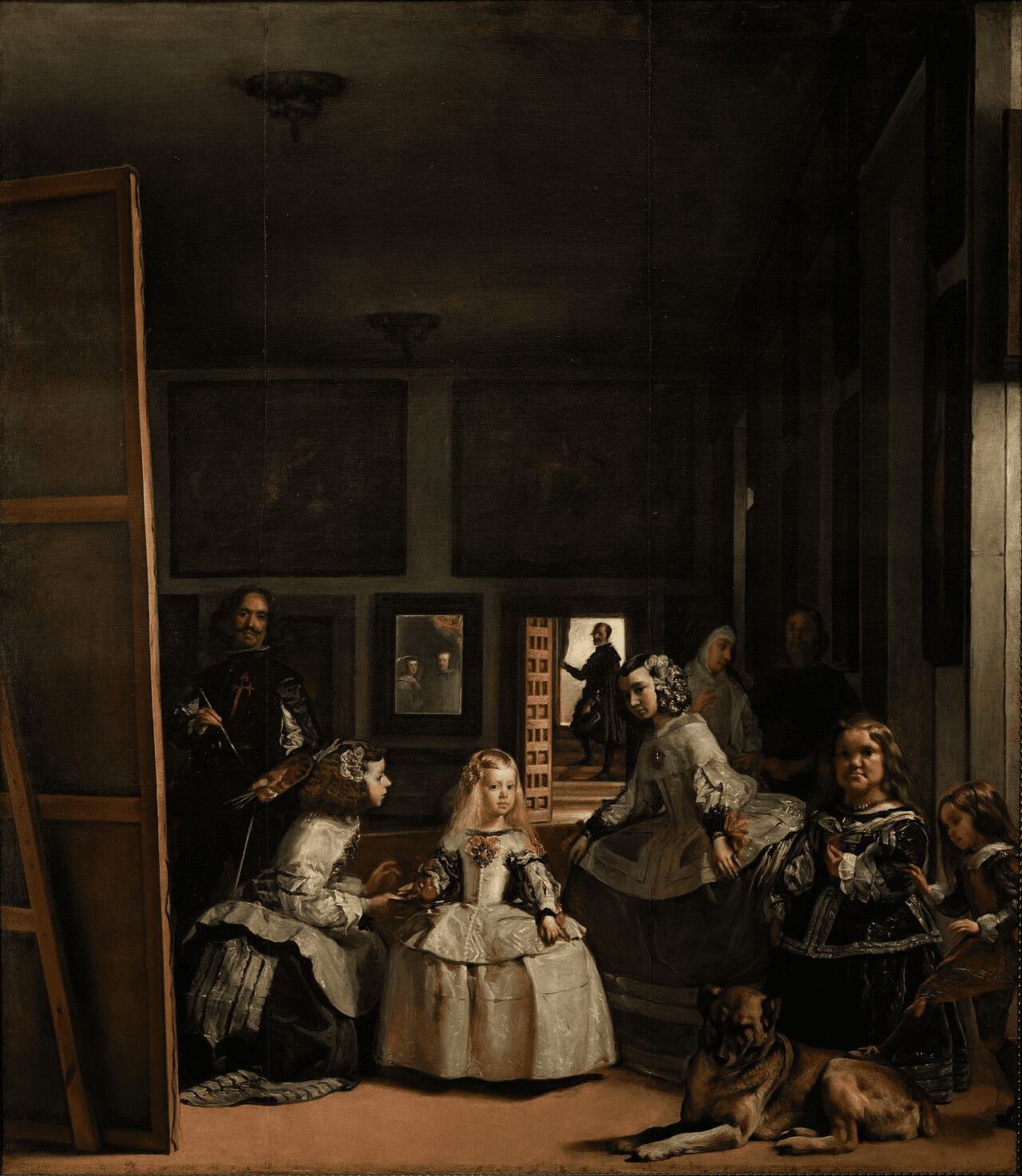
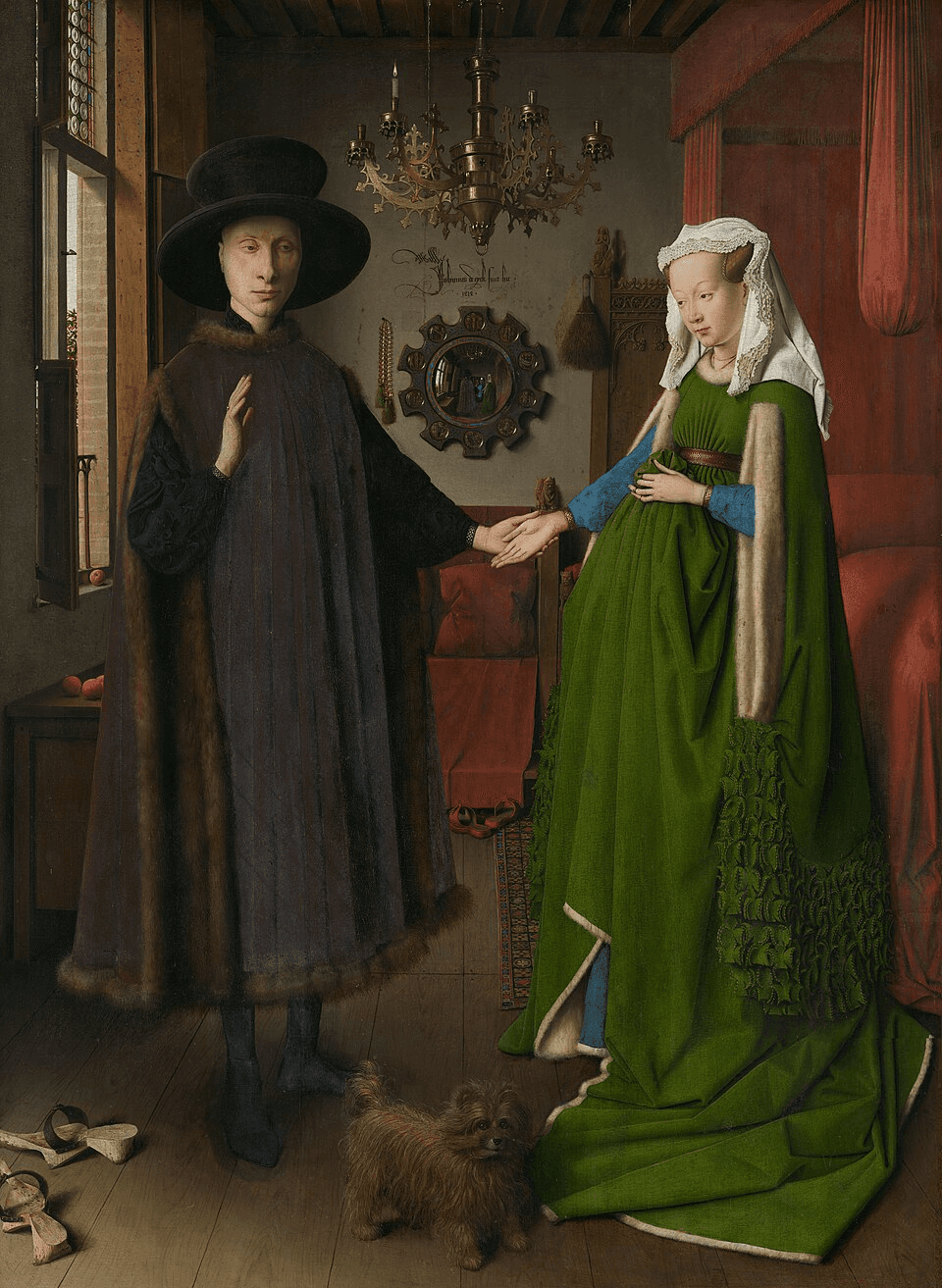
Lichtenstein's is the anti-Arnolfini, the anti–Las Meninas: the convention with the reflection deleted. No room. No monarchs. No you. Just the diagonal lines that mean "mirror," the dots that mean "smooth," the jumps that mean "beveled edge" — the signifiers with the signified removed. And compare Pistoletto, working at the same moment: the Quadri specchianti, from 1962 — polished steel that literally reflects the viewer, tissue-paper figures silkscreened on mirror. Pistoletto is participation; Lichtenstein is evacuation. One gives you yourself. The other gives you the cartoonist's notation for yourself, and keeps yourself.

The process is the usual Lichtenstein paradox: projection of a sketch, Magna backgrounds, dots rubbed through perforated metal stencils — Sotheby's: "he would rub paint through a perforated stencil with a toothbrush, a painstaking labor meant to make a picture look as though no one had labored over it at all." Bader: "consistently handpainted canvases that increasingly feign the look of industrial production." The nothing was handmade. The convention was labored over.

(Naming trap, for the record: a different Mirror #2 exists — a 1972 linocut/screenprint from the Gemini Mirror Series, editioned, twenty-eight inches square. The SFMOMA painting is 1970, unique, six panels, catalogue raisonné RLCR 1846. Keep them separate.)
The double-feature
Mirror #2 came to SFMOMA with the 1992 Anderson gift — the thirty-work Pop tranche from Harry W. and Mary Margaret Anderson that built the museum's Pop core. Accession 92.267.A–F. And its Floor 2 neighbor, Rouen Cathedral, Set 5 (1969, Part 26), is 92.266 — one accession number earlier, one year earlier, also oil and Magna, also a multi-panel polyptych. The pairing is a gift to the writer: the Cathedral looks backward — art history rebuilt through a dot-grid, appropriation, Monet mechanized. The Mirror looks at painting itself — the sign for glass, self-reflexivity, the viewer evacuated. Art-about-art from opposite directions, one year apart, one donor's eye. The Cathedral asks what a painting of a painting looks like. The Mirror asks what a painting of nothing looks like — and answers: diagonal lines. Dots. Jumps. The convention we unconsciously accept.
So here's the thesis: Mirror #2 is Lichtenstein's purest philosophical object — six panels of cartoon notation for a mirror, with the mirror removed. Van Eyck put the viewer in the glass. Velázquez put the monarchs there. Pistoletto gives you your actual face. Lichtenstein gives you the dashed lines that mean face, mean room, mean you — and keeps the rest. "There's no simple way to draw a mirror, so cartoonists invented dashed or diagonal lines to signify 'mirror.'" Five hundred years of metaphysics, reduced to a convention, painted by hand to look machine-made, eight by nine feet of nothing that means everything. Stand in front of it. You're not there. That's the point. 🌁
Timeline — Roy Lichtenstein (the Mirrors)
1969 — begins the Mirror paintings; Rouen Cathedral sets
1970 — paints Mirror #2 (Six Panels), oil and Magna
1972 — Gemini Mirror Series prints (separate editioned works)
1988–90 — the Reflections paintings revisit the theme
1992 — Anderson gift brings Mirror #2 to SFMOMA
1997 — dies September 29, New York, age 73
2010 — Bader's Hall of Mirrors (MIT Press) theorizes the series