
SFMOMA, Part 27: Floor 2, 1900 to Now. Love (Robert Indiana, 1973).
You know it before you read the label. Two-by-two stack of blocky Roman serif capitals — LO over VE — the O tilted rightward, flat hard-edge red letters on blue and green fields. Forty-eight and a quarter inches square. The most reproduced image in American art, and this is a 1973 painting of it — not the sculpture, not the print, the painting, in the canonical red-blue-green scheme, executed with flat print-mimicking precision. The date is the story: 1973 is the stamp year. The eight-cent LOVE stamp was unveiled at the Philadelphia Museum of Art before Valentine's Day; some 425 million were printed over two years, the best-selling commemorative in American history. This canvas is the stamp-year LOVE — the motif at maximum cultural detonation, painted while the country was licking it and sticking it to envelopes.
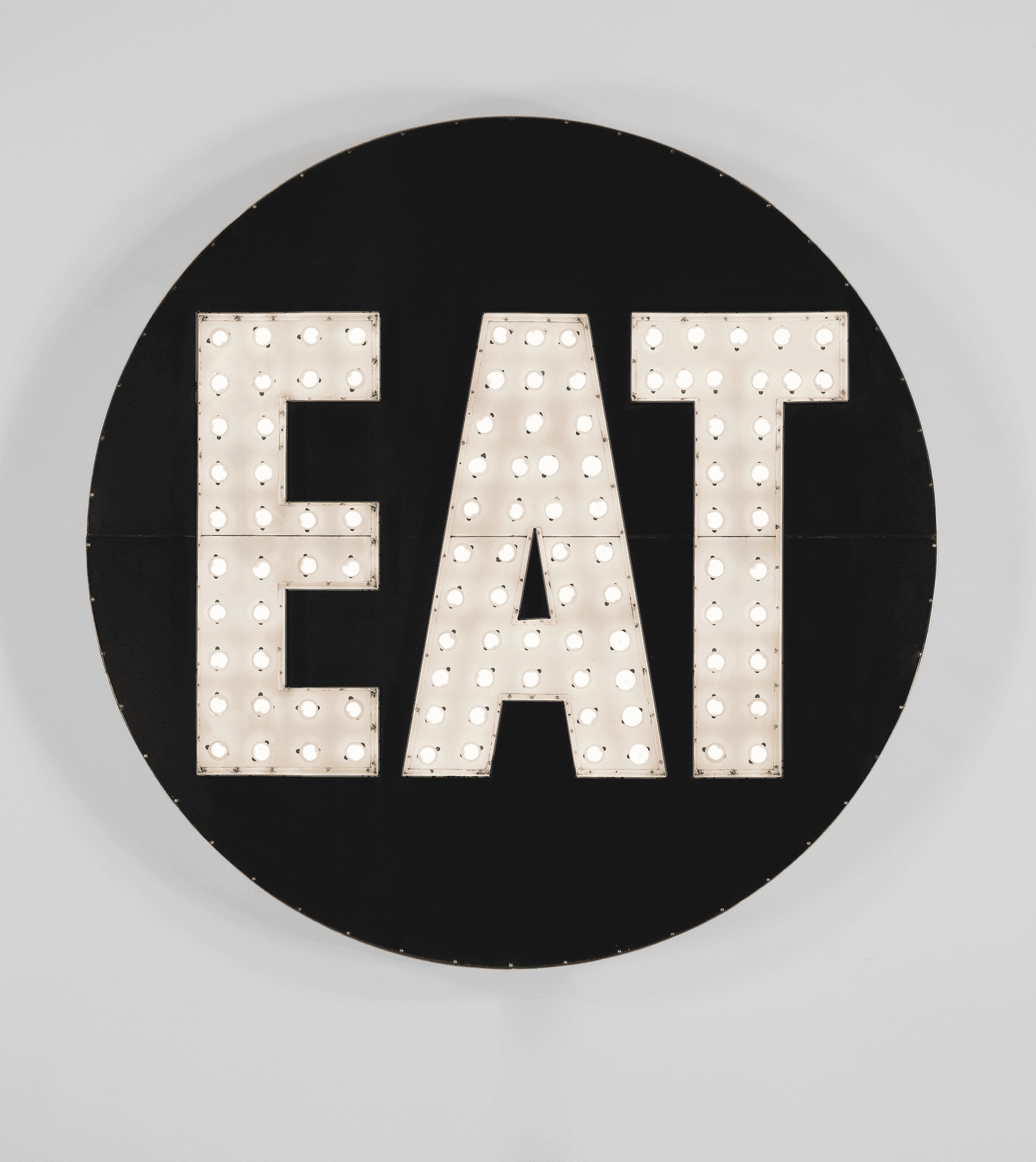
Robert Indiana was born Robert Clark, September 13, 1928, in New Castle, Indiana — and took his state's name: "thousands and thousands of people named Clark." Air Force, 1946. The School of the Art Institute of Chicago on the G.I. Bill. Skowhegan. Edinburgh. New York, 1954; 31 Coenties Slip, via Ellsworth Kelly — they were lovers for a time; "Ellsworth Kelly introduced me to Hard-Edge." The hard-edge stencil letterforms came from brass stencils he found in the loft. First solo, 1962. EAT lit the 1964 World's Fair. And LOVE: designed 1964-65, commissioned by MoMA as a Christmas card in 1965 — "the most profitable Christmas card the museum ever published" — first painting 1966, first Cor-Ten steel sculpture 1970 in Indianapolis. Then the world took it. Then the world wouldn't give it back.

"LOVE bit me. It was a marvelous idea, but it was also a terrible mistake. It became too popular... It's much better to be exclusive and remote. That's why I'm on an island off the coast of Maine, you see." (NPR, 2014.) In 1973 — the year of this painting — he bought the Odd Fellows' Star of Hope hall on Vinalhaven, Maine, for ten thousand dollars; moved there full-time in 1978. Self-imposed exile, while the image colonized everything: sculptures in fifty-plus editions worldwide, Amor in Washington, Ahava ("love" in Hebrew) in Jerusalem in 1977, a Google doodle in 2011, and the knockoffs — he kept a collection of them, calling LOVE the twentieth century's "most plagiarized work of art." The Whitney's 2013-14 retrospective was titled Robert Indiana: Beyond LOVE — the institution treating the icon as something to get past. Dan Mills at Bates: "the proverbial one-hit wonder... overshadowed some of his other contributions." Thomas Crow's double edge: "formally brilliant, commercially devoured."
The seed and the sign
Raised a Christian Scientist, Indiana grew up under a plaque over the reader's platform in the church: "God Is Love." To the collector Larry Aldrich: "The LOVE paintings sprang like a crop from that seed planted at your museum, Larry." And then the inversion — Love Is God, 1964 — the decade's secular sacrament, grown from the church wall. NPR's gloss: he flipped it.

The colors came from the road. "The red and the green came from the Phillips 66 gas sign... His father worked for Phillips 66... when he began making the LOVE paintings in 1965, his father died. So the red and green of the LOVE painting, silhouetted against the blue Indiana sky, is in memoriam of his father." (Martin Krause of the Indianapolis Museum of Art, via NPR.) Indiana: "I would be in the car and I'd see that red-and-green sign against the blue Indiana sky." A gas station sign, a dead father, a church plaque, the Indiana sky — the most famous four letters in art are a memorial collage. His color theory, on the red-blue-green scheme: "With the red, blue, and green paintings, the interaction in the eyes is of such a nature that with the slightest change of light, the fields automatically interchange, the positive becomes negative and vice versa, with almost a violent effect in the eye." Stand in front of the 1973 canvas and watch it happen — the fields won't sit still.
And the tilted O — the most famous letter-tilt in art history, Thomas Crow reading "the abnormally thin bar of the L with the aperture of the V below, yielding the downward-pointing blue arrow... his inspired tilting of the O that launches its green counter along a priapic diagonal" — was, by the artist's account, a light touch: "The tilted O was not my invention... It was a typographic play, and I simply thought it made the word a little more dynamic."
The fiasco
Pre-1978, American copyright wasn't automatic — you had to register. Indiana didn't register the design; one account says he disliked how the © symbol looked on his art. When the piracy came, the post-hoc registration attempt was rejected: a single word cannot be protected. Hence the public-domain decades, the knockoff collection, the legal wars. The day before he died — May 19, 2018, respiratory failure, age eighty-nine, on Vinalhaven — his rights agent, the Morgan Art Foundation, sued his caretaker and publisher over unauthorized reproductions. In April 2026, a Manhattan federal jury awarded Morgan $102.2 million. The afterlife of the afterlife: in 2008 he'd made HOPE for Obama, raising over a million — LOVE's afterlife as political currency.
"I was the least Pop of all the Pop artists," he said. "Sculptural poems." "There are more signs than trees in America... I think of myself as a painter of American landscape." SFMOMA's Love came with the 1992 Anderson gift — thirty Pop works, the tranche that built the museum's Pop core, the reason this canvas hangs on Floor 2 in the donor-authored Pop room with Warhol, Lichtenstein, Oldenburg, Rosenquist. The collectors banked Pop as history while it was news. This is the richest-storied LOVE in the collection: the stamp year, the memorial colors, the tilted O, the $102 million verdict still drying.
So here's the thesis: Love (1973) is American art's most successful failure — a church plaque inverted, a gas sign memorialized, a typographic pun that ate its maker. Indiana wanted to be exclusive and remote; the image wanted to be everywhere. The 1973 canvas catches it mid-detonation: red and green for the father and the Phillips 66 sign, blue for the Indiana sky, the O tilted "a little more dynamic," the fields interchanging with "almost a violent effect in the eye." "LOVE bit me." It bit everyone. The stamp stuck. The lawsuits outlived him. The painting — four feet square, flat as a print, violent as an eye-test — just keeps looking back, positive becoming negative, negative becoming positive, with the slightest change of light. 🌁
Timeline — Robert Indiana
1928 — born Robert Clark, September 13, New Castle, Indiana
1954 — moves to New York; 31 Coenties Slip
1964–65 — designs LOVE; Love Is God
1965 — MoMA Christmas card commission
1970 — first LOVE sculpture, Indianapolis
1973 — paints Love (SFMOMA canvas); the LOVE stamp; buys Star of Hope, Vinalhaven
1992 — Anderson gift brings it to SFMOMA
2018 — dies May 19, Vinalhaven, age 89
2026 — Manhattan jury awards Morgan Art Foundation $102.2M