新教
Preface: How Did Protestantism Come About?
1) Luther, England, and the Map of Christianity
In 1517, Martin Luther circulated his Ninety-five Theses, publicly challenging the authority of the Catholic Church, and the Reformation began. The Protestant movement that followed rested on two principles: justification by faith (sola fide) and scripture alone (sola scriptura). It denied that the church stood between the believer and salvation and held that the final authority in matters of faith lay only in the Bible and in personal conscience.
England followed quickly, but its Reformation was, from the start, political first and religious only halfway. In 1534, Henry VIII broke with Rome and, through the Act of Supremacy, made himself head of the Church of England. The new church absorbed some Protestant doctrine, but in structure, ritual, and government by bishops it kept much of the Catholic framework.
Before turning to the Puritans, it helps to be clear about how Christianity, Catholicism, Orthodoxy, and Protestantism relate. "Christianity" is the umbrella term for every tradition that recognizes Jesus as the Christ, affirms his crucifixion and resurrection, and takes the Bible as the core of faith. It is not one church but a family of faiths centered on Jesus. Over time, different institutions and structures of authority formed around the same figure, producing the major branches: Catholicism, Orthodoxy, and Protestantism. What divided them was never whether to believe in Jesus. It was who had the right to interpret the faith and govern the church.
Catholicism and Orthodoxy both claim to carry on the original tradition of early Christianity, and both emphasize sacraments, tradition, and an ordained clergy. They split over authority. Catholicism is centered in Rome. It holds that the pope has supreme jurisdiction over the universal church, and that the church itself, through its historical tradition and its councils, forms part of the authority of faith. Orthodoxy rejects papal supremacy and holds that self-governing regional churches guard the tradition together. In doctrine the two are very close. On the question of who has the final say, they cannot be reconciled.
Protestantism rejected the premise the two shared: that the church itself is the authority. Luther and the reformers who followed him held that salvation does not depend on church rituals or clerical mediation but on the individual's relationship of faith with God. That principle, one step after another, denied the pope's authority, reduced the sacraments' role as channels of grace, and freed the interpretation of scripture from church control. Protestantism is therefore not one church but a family of denominations that share these principles.
The basic difference between Catholicism and Protestantism is not style of worship but the source of authority. Catholicism holds that scripture, church tradition, and the church's teaching authority together make up the system of truth, and that the church is the means through which salvation is given. Protestantism holds that scripture alone has final authority, and that the church is a gathering of believers. The first emphasizes hierarchy, ritual, and continuity with the past. The second emphasizes conscience, preaching, and flattening the hierarchy. The difference shaped how each understood politics, social order, and individual responsibility.
This is why the Church of England is called semi-Protestant: it conceded Protestant theology on paper but kept the Catholic skeleton in its institutions and worship. England's break with Rome was driven mainly by politics. It rejected papal authority, brought in an English Bible under Henry and English-language worship under his son Edward VI, and absorbed some Protestant doctrine. But it kept bishops, the parish system, state control over church appointments, and much of the traditional liturgy and prayer. The compromise served the state well. To the Puritans it looked like a betrayal of principle: authority had only passed from the pope to the crown, instead of being returned to scripture and faith.
2) "If Both Church and State Call You a Heretic, How Do You Prove You Are Not?"
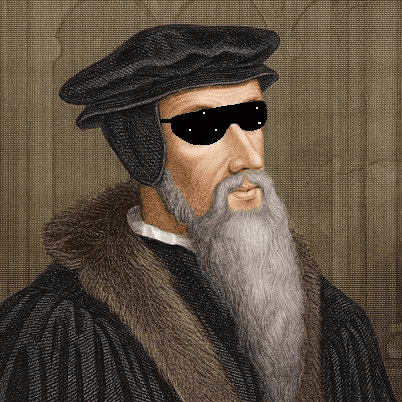
The Puritans' real intellectual source was John Calvin, not Luther.
Calvin was born in 1509 in Noyon, a small cathedral town in northern France, in a thoroughly Catholic world. His family was comfortable. His father, Gérard Cauvin, worked as a notary and administrator for the bishop and cathedral chapter of Noyon, so the church Calvin knew as a child was not a mysterious community of faith but an institution tied up with power and advancement. His father first intended him for a career in the church, then changed course and sent him into law, the standard route for a bright young man to become part of the establishment.
His education was conventional and elite. In Paris he studied Latin, rhetoric, and classical literature in the humanist manner. Then he went to Orléans and Bourges to study Roman law, receiving the most rigorous legal training available in Europe: close reading of texts, logical deduction, questions of where authority comes from and what makes an institution legitimate. That training shaped how he thought for the rest of his life: cool, structured, and acutely sensitive to ambiguity and to abuses of authority. At this point he was headed for a career as a lawyer or a learned official inside the system, not as a religious reformer.
The turn came in Paris in the early 1530s. Reformist ideas were spreading quietly among French intellectuals, but the French crown was bound tightly to the Catholic Church and had no tolerance for them. The guardian of orthodoxy was the Sorbonne, as the University of Paris's Faculty of Theology was known. Robert de Sorbon had founded the college in the thirteenth century to house poor theology students, but it grew into the body that ruled on orthodoxy. By the Reformation, "the opinion of the Sorbonne" meant, for practical purposes, the Catholic position. It censored books, judged preaching, and advised the crown on religious questions. The king needed its theological endorsement, and it needed the king to enforce its rulings against heretics. It was a central node in the alliance of church and state.
On November 1, 1533, All Saints' Day, Nicolas Cop, newly elected rector of the University of Paris and a friend of Calvin's, gave the customary inaugural address at the church of the Mathurins. He argued that what makes a person a true Christian is not how many rituals they observe or good works they perform, but whether they truly receive the Gospel. The language was mild. The substance went straight to the core claim of the Reformation, justification by faith. In Catholic teaching, faith is completed through the church, the sacraments, and good works. Here, faith itself was sufficient. Just as provocative was what the speech left out. It said little about church tradition, papal authority, or the clergy, and instead quoted scripture again and again, as if scripture alone were enough to guide believers to the truth. It was delivered in Latin, from a university platform, but its logic was very close to sola scriptura. It also carried the humanists' mockery of scholastic theologians, obsessed with formal disputation and blind to the spirit of Christ. That kind of criticism was common in Renaissance humanism, but in France in 1533 it sounded exactly like Lutheranism. When academic criticism turns on the authority of the church itself, it stops being academic.
Coming from the head of the university, in the institution that stood for Catholic orthodoxy, the address was taken as a public declaration of position. It provoked a political response, not a theological debate. Within two days charges of heresy were filed against Cop, and he fled, eventually reaching Basel. Those around him, Calvin among them, became targets. Calvin was no anonymous student. He was elite-educated, a close friend of Cop's, and seen as an intellectual asset of the reform party. Whether he helped write the speech has long been debated, and a surviving copy is partly in his handwriting. Suspicion was enough. Calvin left Paris in a hurry. A year later, after the Affair of the Placards in October 1534, when anti-Catholic posters appeared overnight in Paris and even on the door of the king's bedchamber, King Francis I turned to open persecution, and Protestants were burned in Paris. Early in 1535 Calvin left France for Basel.
Calvin was never formally tried or convicted in France. He chose exile before the purge reached him. In sixteenth-century France, once an accusation of heresy entered the courts, the likely outcome was prison, confiscation, or death. For a young lawyer, staying meant the end of both career and life. So, pushed out of the system, Calvin was forced into theology. He had to answer, for himself and for France's Protestants, an urgent question: if both the church and the state declare you a heretic, how do you prove you are not? It was not a spiritual question but a question of legitimacy. His answer was the Institutes of the Christian Religion, published in Basel in March 1536. The first edition was prefaced with an open letter to Francis I defending French Protestants against the charge of sedition. It was not written for ordinary believers. It was a rigorously reasoned, systematic defense of the faith, almost a Protestant constitution, giving the new faith a logical structure, a source of authority, and a workable social form, built the way a lawyer would build a case.
Calvinism became the foundation of Puritanism not because it comforted people but for the opposite reason: it was severe, and it was stable. It offered not emotional consolation but a worldview that could run for generations, closing the loop between faith, morality, and social order. Calvin could turn abstract doctrines like predestination and the sovereignty of God into a system that could be practiced, governed, and sustained because he did theology the way a lawyer works. He did not abandon law. He carried its method into theology.
First, his starting point was not personal experience or religious fervor but the question of authority. As a trained lawyer, Calvin knew that any system must first answer where final authority lies. His answer was that it belongs to God alone. From that he built a clear chain: God's will is the ultimate source, scripture is the authoritative record of God's revelation, and the church and tradition can only interpret and carry out that will. They can never become sources of authority themselves. The position recurs throughout the Institutes, and its direct consequence is the denial that the pope or the church can legislate matters of faith.
Second, on predestination, Calvin drew a sharply rational distinction between cause and effect. Whether a person is saved can be explained only by God's decision in eternity, not by human action, choice, or religious practice. The cause of salvation lies only in God's will; human conduct can only be its effect in time. This cut off, logically and completely, the possibility that conduct leads to salvation, and it made the idea of obtaining salvation through rituals, good works, or moral performance theoretically untenable.
Third, his critique of the church was not a moral denunciation but an analysis of structural consequences. If any share of the power to save is handed to human action or church procedure, he argued, salvation will inevitably be institutionalized and monopolized and will turn into a resource to be managed and distributed. Under that structure, morality stops being a response to God and turns into performance and exchange, not because individuals are necessarily corrupt, but because the institution rewards that outcome. In this sense his critique reads less like an anticlerical manifesto than a risk analysis of a system.
Fourth, Calvin did not deny the importance of moral conduct, but he changed its status completely. Good works are not the condition of salvation but the effect of faith and grace at work. Conduct cannot prove that a person is chosen, but a steady, ordered, moral life was seen as the outward evidence that faith was real. Later Puritans developed this into a strict system of moral supervision. They watched conduct not to accumulate merit but to confirm that faith and life were consistent.
Finally, the form of the Institutes itself shows the lawyer at work. It is not a book of sermons or a devotional. It is a systematic argument that starts from first principles, builds its case step by step, answers objections, and was revised again and again to make it more coherent. It grew from six chapters in 1536 to four books and eighty chapters in the final Latin edition of 1559. That is why it could be cited and used in the Reformation's long disputes and became the founding text of the Reformed tradition. It is not written like a legal code, but it has a legal kind of stability.
The radical point of predestination is not that God knows everything in advance. It is that a person's salvation or damnation was decided by God before time began and has no causal connection to that person's conduct, choices, or even their expressions of faith. The church could not dispense salvation through rituals, and individuals could not earn credit through good works. Salvation was removed entirely from the logic of human exchange.
At first glance this looks inhuman. If everything is already decided, why be moral, why be disciplined, why live like one of the chosen? This is where Calvinism is ingenious. It did not abandon conduct. It changed its meaning. Conduct is no longer the means of salvation but the outward sign that salvation may already be there. You do good not in order to be saved, but because you may already have been chosen.
The result was a psychology under constant tension. Believers could never be certain they were among the elect, yet they were expected to live with the order, discipline, and moral intensity of the elect. The effect was not relaxation but endless self-examination, self-management, and self-restraint. The sociologist Max Weber made this the center of The Protestant Ethic and the Spirit of Capitalism (1905), arguing that this anxiety drove Puritans toward methodical work and discipline. Historians still debate how far his thesis holds, and Calvin himself warned believers against searching their lives for proof of election. But it helps explain the almost obsessive moral discipline of Puritan society: not a belief that conduct could buy salvation, but a fear that one's way of life might reveal that one was not chosen.
Here Calvinism broke completely with Catholicism. Catholicism offered a working mechanism of salvation: through the church, the sacraments, confession, and good works, a person could keep repairing their relationship with God within the institution. Calvinism abolished that mechanism. Once salvation cannot be administered, the institution loses its religious authority. This is the theological root of the Puritans' hostility to church hierarchy. In Calvinist logic, concentrating spiritual authority in a human hierarchy is itself a usurpation of God's power. The rule of bishops was not just a question of organization but of theology, because it implied that some people were closer to God than others. For Calvin, the distance between God and humanity is absolute, and no office, ordination, or bloodline can shorten it. Puritans therefore disliked bishops and spiritual aristocracy and preferred more equal, decentralized church government: some favored rule by elected elders (Presbyterianism), others the self-governing congregation (Congregationalism), which became the model in New England. For the same reason, Puritans were English Calvinists in theology, not Lutherans, whose emphasis on personal religious experience did less to reshape institutions.
The framework was powerful in practice precisely because it offered no certainty. You could not know whether you were saved. You could only live out the possibility through constant discipline, work, and moral effort. Puritans therefore took time management, vocation, family order, and public morality with great seriousness, and were willing to build their theology into the structure of society. Faith was no longer only an inner state. It became an ethic of action that reached into every part of life.
In the late sixteenth century, the Puritans first appeared as a reform party within the Church of England. They did not set out to leave it. They soon split into two tendencies. Moderates stayed in the church, hoping to "purify" it by reforming doctrine, simplifying ritual, and reducing the power of bishops. Others moved toward separation, concluding that the Church of England's structure was beyond repair and that they had to cut ties with it entirely. The divide was not over theological details but over a basic judgment: could one still be faithful to God inside the existing establishment? The crown distrusted both, because in the Church of England, church order was a pillar of royal legitimacy, and any challenge to the church's structure was a challenge to political authority.
Under Elizabeth I and then James I, from the late sixteenth into the early seventeenth century, this tension hardened into systematic repression. Puritan preaching was censored, nonconforming gatherings were banned, and ministers who refused the official rituals were punished. Some Puritans gave up hope of reforming the church in England and chose to leave. The group that sailed to North America on the Mayflower in 1620 is the most famous, but it represented the Separatists, not Puritanism as a whole, and even on the Mayflower they were only about a third of the passengers.
In North America, New England was not merely a refuge. It was a testing ground where Puritans could put their social ideals into practice. In 1630, before landing in Massachusetts, John Winthrop told his fellow colonists in a lay sermon that they would be "as a city upon a hill," with the eyes of all people upon them. Centered on the Massachusetts Bay Colony, they tried to build a society bound by religious covenant. The church was the core of society, religious norms formed the basis of law and public morality, and individual conduct was placed under the community's moral watch. The system was coherent, and it was exclusive. The Puritans had little tolerance for heresy or dissent, including from other Protestants. They had fled religious persecution, and in North America they recreated it. That should not be romanticized.
By the second and third generations, the religious intensity faded. As fewer children of church members could testify to a conversion experience, the churches adopted the Half-Way Covenant in 1662, a sign of how far the original fervor had cooled. Puritanism gradually secularized. What remained was not a complete theological system but an ethic stripped of its religious shell: diligence, self-discipline, and temperance; a respect for contracts and public duty; and the belief that the order of the community comes before individual desire. That secularized Puritan ethic deeply shaped New England's political culture, influenced early American republican thought, and supplied the moral backdrop for what later came to be called American exceptionalism.
3) Reading the Institutes of the Christian Religion
When I went looking for the Institutes of the Christian Religion, I found it is not one book. The edition I found comes in three volumes, but the work itself is divided into four "books." Book One concerns the knowledge of God the Creator: God as the creator, preserver, and governor of the universe and everything in it, the premise of every argument that follows. It does not ask whether God exists. It starts from the premise that he is creator, preserver, and ruler of all things, and asks how, on that basis, we should understand humanity and God, and what place the church and the pope have in that relationship.
Book One lays out the nature and purpose of knowing the Creator. This knowledge is not learned in school; it is innate. But humanity's fall was so severe, through ignorance on one side and wickedness on the other, that the knowledge has been corrupted and nearly destroyed. It can no longer lead people to glorify God or bring them happiness. And although this inner knowledge is aided by the whole of creation, which reflects God's perfection like a mirror, people do not benefit from it.
I agree with this. I often feel that the "divinity" of the world was present from the very beginning of all things, that it is with us in our breathing, our actions, our self-awareness. Even from the standpoint of physics, the existence of this universe is extraordinarily improbable. But there is a bias in how we see this, what physicists call the anthropic principle. It is not that we exist because we are special. It is that because we exist, we are able to observe and reflect and ask, "Why do we exist?" The question can only be asked because we are already here. And we are surrounded by this divinity; everything in the world is an answer to our questions. I often say, "The answer is within me," because I believe that the answers to everything I want to ask are already in my heart. If I don't overthink, they surface on their own. Our problem is not that there are no answers but that there are too many, and we can't tell which ones matter.
To give people direction, God gave his written word to those he chose to make himself known to, which is why, Calvin says, we must attend to scripture. In scripture God reveals himself not only as Father but as the creator of heaven and earth, one God in three persons, Father, Son, and Holy Spirit. Because of the fall, neither the knowledge built into our nature nor the beautiful mirror of creation can teach us to glorify him. So Calvin turns to God's revelation in scripture and to the doctrine of the Trinity. Then, so that no one can blame God for faults that are their own, freely and blindly chosen, he describes humanity's original condition at creation: made in the image of God, with free will and an unfallen nature. Having dealt with creation, he turns to God's preservation and government of all things, and closes Book One with the doctrine of providence.
Chapter one asks how we come to know God and ourselves. It opens with the question of what true wisdom is. True wisdom, Calvin says, consists of two parts: knowledge of God and knowledge of ourselves. The two are so closely bound together that it is hard to say which comes first. As soon as anyone looks at themselves, they are led to think of God, in whom "we live, and move, and have our being" (Acts 17:28). The gifts we have are not from ourselves; even our existence depends entirely on God. These blessings, falling on us drop by drop from heaven, are like streams that lead us back to their source.
I don't know how others read this passage, but I often think about the difference between cleverness, wisdom, and deep wisdom. Cleverness seems tied to learning and comprehension. Wisdom seems innate. Deep wisdom, to me, is using wisdom to look inward, measured over time, and extending the understanding of oneself to the understanding of others and of everything in the world. This may be close to Buddhist thinking; I'm not sure, because I haven't studied Buddhism closely. But I am drawn to Tibetan Buddhism and may need to learn more about it later. There are too many subjects I want to study right now.
Second, Calvin says, our own poverty reveals God's infinite riches more clearly. Through our first parents' rebellion we fell into wretched corruption, and that forces us to look up to heaven, not only as the starving look for food, but in fear that teaches humility. Because humanity is beset by every kind of misery and stripped of its original divine adornment, its deformity and incompleteness are laid bare, and in feeling their own misery, everyone gains at least some knowledge of God.
This is classic biblical storytelling. I understand it, and I often feel my own sinfulness so strongly that I want to run to the nearest church, confess, and cry in front of a priest. But finding someone to confess to shouldn't be my reason for believing in Christianity. Recently I watched the latest Knives Out film, Wake Up Dead Man: A Knives Out Mystery. I have never studied the Bible, and it was the first time I heard the story of the road to Damascus.
For anyone who doesn't know it, the road to Damascus is the story in the Acts of the Apostles of the conversion of Saul, later the apostle Paul. Saul, a Pharisee, was traveling to Damascus to persecute Christians. On the way, a light from heaven struck him to the ground, and he heard a voice calling his name and asking why he was persecuting him. He was blind for three days. In Damascus, a disciple named Ananias restored his sight and baptized him, and the persecutor became a preacher, his identity and mission completely overturned. What matters in the story is not that he saw a vision. It is the collapse of certainty that comes from being called by name and stopped in one's tracks: a man who believed he stood on the side of truth suddenly discovers that he has been using God as a tool, and his entire view of the world is rebuilt, irreversibly.
Watching the film, I suddenly understood something I never had before, the sentence "God is within me." I could feel it. I could feel that this divinity is higher than I am. I'm not sure I believe the story of Jesus, but whether the story is literally true doesn't matter. When we feel our own ignorance, emptiness, poverty, weakness, wickedness, and corruption, we recognize, as Calvin writes, that true wisdom, firm strength, perfect goodness, and pure righteousness are found only in the Lord. Our own incompleteness turns our thoughts to God's perfection. Only when we stop being satisfied with ourselves can we sincerely look up to God. For who would not rather rely on themselves? As long as a person does not know their true condition and is content with their own gifts, unaware of or forgetting their misery, who would not be complacent? So knowledge of ourselves not only prompts us to seek God; it also helps us find him.
Chapter two concerns what it means to know God and what that knowledge is for. For Calvin, truly knowing God is not merely admitting intellectually that a god exists. It includes reverence and love: sensing his greatness and so revering him, and sensing his kindness and so loving him. Calvin criticizes those who speculate about what God is in his essence but do not care what he is toward us. Knowledge of God must be practical: knowing how his attributes bear on our lives. He defines piety as "that reverence joined with love of God which the knowledge of his benefits induces." Unless people first recognize God as the source of every good, and so respond with gratitude and obedience, they will never worship him sincerely. A person who truly knows God as Creator will show willing obedience and complete trust. In hardship, they trust in his protection. In success, they give him the glory.
Here I want to return to Wake Up Dead Man. When the young priest, Father Jud (played by Josh O'Connor), is accused of murder, he at first wants to clear himself. But in the end he doesn't want to pour his energy into solving the case, because every minute spent suspecting people of the worst takes him further from what he should be doing. While he is chasing evidence, a clerk on the other end of a phone call begs him, as a priest, to pray for the clerk's gravely ill mother. In that moment he understands that his duty is not to catch the killer but to keep helping lost people find their way.
Chapter three is titled "The Knowledge of God Has Been Naturally Implanted in the Human Mind." Its core argument is that no one can plead ignorance of God. Calvin holds that God has planted in every human heart a "sense of divinity" (sensus divinitatis). This knowledge is not acquired but innate, which fits what I said earlier. However primitive a culture may be, even among people who live almost like animals, there remains deep down a "seed of religion." This sense cannot be erased. People may suppress it or deny God aloud, but when crisis or death approaches, the dread of God returns.
Religion, then, is not a human invention. Calvin rejects the view, already current in his day, that religion was a trick devised by a few clever men to control the masses. If there were not already a seed of awareness of God in the human heart, no politician or schemer, however persuasive, could have planted religion there. People would rather worship wood or stone than have no god at all. That preference, to worship the wrong thing rather than nothing, shows how deep and ineradicable the longing for God is. This inner knowledge also produces a basic sense of moral responsibility, an awareness that one must answer to God.
Calvin's conclusion to the chapter is that humanity has no excuse. Since God has left a witness in every heart, two things follow. First, atheism is false: those who say they do not believe in God are fighting a fierce battle within themselves, trying to escape him. Second, judgment is just: in the end, before God, no one can defend themselves by saying they did not know there was a God. 🕍
前言:新教是如何产生的?
1)路德、英格兰与基督教版图
1517年,马丁·路德发表了《九十五条论纲》,公开挑战天主教会的权威,宗教改革就此开始。随后的新教运动建立在两条原则之上:因信称义(sola fide)与唯独圣经(sola scriptura)。它否认教会横亘在信徒与救赎之间,主张信仰事务的最终权威只在于《圣经》与个人良心。
英格兰很快跟进,但它的宗教改革从一开始就是政治先行、宗教只走了一半。1534年,亨利八世与罗马决裂,通过《至尊法案》自任英格兰教会最高首领。新教会吸收了一些新教教义,但在结构、仪式和主教制上保留了天主教的大部分框架。
在谈清教徒之前,有必要先厘清基督教、天主教、东正教与新教之间的关系。"基督教"是总称,指一切承认耶稣为基督、肯定其受难与复活、以《圣经》为信仰核心的传统。它不是一个教会,而是以耶稣为中心的信仰家族。围绕同一人物,历史上形成了不同的制度与权威结构,产生了天主教、东正教、新教这几个主要分支。划分它们的从来不是信不信耶稣,而是谁有权解释信仰、谁来治理教会。
天主教与东正教都自称承继了早期基督教的正统传统,都强调圣礼、传统与按立的神职人员。两者的分裂在于权威问题。天主教以罗马为中心,主张教宗对普世教会拥有最高管辖权,教会本身通过历史传统与大公会议构成信仰权威的一部分。东正教拒绝教宗至上,主张各自治的地方教会共同守护传统。两派在教义上非常接近,但在"谁说了算"的问题上无法调和。
新教否定了两者共享的前提:教会本身就是权威。路德及其追随的改革者主张,救赎不取决于教会仪式或神职人员的中介,而取决于个人与上帝的信心关系。这一原则一步步推开:否认教宗权威,削弱圣礼作为恩典管道的作用,把解释《圣经》的权力从教会手中解放出来。因此新教不是一个教会,而是共享这些原则的教派家族。
天主教与新教的根本区别不在崇拜形式,而在权威来源。天主教认为《圣经》、教会传统与教会训导权共同构成真理体系,教会是救赎得以施予的管道。新教认为唯独《圣经》拥有最终权威,教会是信徒的聚集。前者强调层级、仪式与历史延续;后者强调良心、讲道与层级的扁平化。这一区别塑造了双方对政治、社会秩序与个人责任的不同理解。
这就是为什么英格兰教会被称为"半新教":它在纸面上让步于新教神学,却在制度与崇拜中保留了天主教的骨架。英格兰与罗马的决裂主要由政治驱动。它否认教宗权威,在亨利统治下推出英文《圣经》,在他儿子爱德华六世时期推行英文礼拜,吸收了一些新教教义。但它保留了主教、教区体制、国家对教会任命的控制,以及大量传统礼仪与祷文。这套妥协对国家很有用,在清教徒看来却是原则的背叛:权威只是从教宗转到了王冠手里,而不是回归《圣经》与信仰。
2)"如果教会和国家都说你是异端,你如何证明自己不是?"
清教徒真正的思想源头是约翰·加尔文,不是路德。
加尔文1509年出生于法国北部小城努瓦永,一个彻底天主教的世界。家境宽裕。父亲热拉尔·科万是努瓦永主教与座堂教士团的公证人与行政人员,所以加尔文童年所认识的教会不是神秘的信仰共同体,而是与权力、晋升纠缠在一起的机构。父亲最初想让他走教会仕途,后来改了主意,送他去学法律——那是聪明年轻人进入体制的标准路径。
他的教育是常规而精英的。在巴黎,他按人文主义方式学习拉丁文、修辞学与古典文学。然后去奥尔良和布尔日攻读罗马法,接受了当时欧洲最严格的法律训练:细读文本、逻辑推演,追问权威从何而来、什么使一个制度合法。这种训练塑造了他一生的思维方式:冷静、结构化,对含混与权力滥用极其敏感。这时的他正走向体制内的律师或博学官员生涯,而不是宗教改革者。
转折发生在1530年代初的巴黎。改革思想在法国知识分子中悄然传播,但法国王室与天主教会捆绑紧密,对此毫无容忍。正统的守护者是索邦,也就是巴黎大学神学院。罗贝尔·德·索邦在十三世纪创办这所学院,原为收容贫寒神学生,后来成长为裁定正统的机构。到宗教改革时期,"索邦的意见"实际就等于天主教立场。它审查书籍、评判讲道、就宗教问题向王室建言。国王需要它的神学背书,它需要国王动用权力镇压异端。它是政教联盟的核心节点。
1533年11月1日,万圣节,新当选的巴黎大学校长、加尔文的朋友尼古拉·科普在马蒂兰教堂发表例行的就职演说。他主张,一个人之所以为真基督徒,不在于遵守多少仪式、行多少善功,而在于是否真正领受了福音。措辞温和,实质直指宗教改革的核心主张——因信称义。按天主教教义,信心要通过教会、圣礼与善功才得以完全;在这里,信心本身就足够了。同样挑衅的是演说省略的东西:它几乎不提教会传统、教宗权威或神职人员,而是一再引用《圣经》,仿佛唯独《圣经》就足以引导信徒抵达真理。演说用拉丁文发表,站在大学讲台上,逻辑却非常接近唯独圣经。它还带着人文主义者对经院神学家的嘲讽——沉迷形式辩论、对基督精神视而不见。这类批评在文艺复兴人文主义中很常见,但在1533年的法国听起来就是路德主义。当学术批评转向教会权威本身,它就不再是学术了。
出自大学首脑之口,在代表天主教正统的机构里发表,这篇演说被当作公开的立场宣言。它招来的不是神学辩论,而是政治回应。两天之内,科普就被控异端,他逃走了,最终抵达巴塞尔。他身边的人,加尔文在内,都成了目标。加尔文不是无名学生:他受过精英教育,是科普的密友,被视为改革派的知识资产。演说是否为他参与起草,学界争论已久,现存的一份抄本部分出自他的笔迹。嫌疑就够了。加尔文匆忙离开巴黎。一年后,1534年10月"标语事件"爆发——一夜之间巴黎街头出现反天主教标语,甚至贴到了国王卧室门上——弗朗索瓦一世转向公开迫害,新教徒在巴黎被烧死。1535年初,加尔文离开法国前往巴塞尔。
加尔文在法国从未正式受审或定罪。他在清洗到来之前选择了流亡。在十六世纪的法国,一旦异端指控进入法庭,可能的结局就是监禁、没收财产或死刑。对一个年轻律师来说,留下意味着职业与生命的终结。于是,被体制推出来的加尔文被迫转向神学。他必须为自己,也为法国的新教徒,回答一个紧迫的问题:如果教会和国家都宣布你是异端,你如何证明自己不是?这不是灵性问题,而是合法性问题。他的回答就是1536年3月在巴塞尔出版的《基督教要义》。第一版以致弗朗索瓦一世的公开信作序,为法国新教徒辩护,反驳叛国指控。它不是写给普通信徒的,而是一部论证严密、体系完整的信仰辩护书,近乎一部新教宪法:为新信仰提供逻辑结构、权威来源与可行的社会形态,写法就像律师在立论。
加尔文主义成为清教主义的基础,不是因为它安慰人,恰恰相反:因为它严厉,而且稳定。它提供的不是情感慰藉,而是一套能运行几代人的世界观,把信仰、道德与社会秩序闭环。加尔文能把预定论、上帝主权这类抽象教义变成可以实践、可以治理、可以持续的体系,是因为他做神学像律师办案。他没有抛弃法律,而是把法律的方法带进了神学。
第一,他的起点不是个人体验或宗教热忱,而是权威问题。受过法律训练的加尔文知道,任何体系首先要回答最终权威在哪里。他的答案是:只属于上帝。由此建立一条清晰的链条:上帝的旨意是终极来源,《圣经》是上帝启示的权威记录,教会与传统只能解释、执行这个旨意,永远不能成为权威本身。这一立场贯穿《要义》全书,直接后果就是否认教宗或教会在信仰事务上的立法权。
第二,在预定论上,加尔文对原因与结果做了极其理性的区分:一个人得救与否,只能用上帝在永恒中的决断来解释,与人的行为、选择或宗教操练无关。救赎的原因只在上帝的旨意,人的行为至多是它在时间中的结果。这在逻辑上彻底切断了行为通向救赎的可能,使通过仪式、善功或道德表现获取救赎在理论上站不住脚。
第三,他对教会的批判不是道德谴责,而是结构后果分析。他论证,如果把任何一部分拯救的权力交给人的行为或教会程序,救赎必然被制度化、垄断化,变成可以管理、分配的资源。在这种结构下,道德不再是对上帝的回应,而变成表演与交换——不是因为个人必然腐败,而是因为制度奖励这种结果。从这个意义上,他的批判与其说是反教权的檄文,不如说是对一个系统的风险分析。
第四,加尔文并不否认道德行为的重要,但他彻底改变了它的地位:善功不是救赎的条件,而是信心与恩典运行的结果。行为不能证明一个人蒙拣选,但持续、有序、有道德的生活被视为信心真实的外在证据。后来的清教徒把这一点发展成严格的道德监督体系:他们观察行为不是为了积累功德,而是为了确认信心与生活一致。
最后,《要义》本身的形式就透着律师作风。它不是讲道集,也不是灵修书,而是一部从第一原理出发、一步步立论、回应反驳、为求更融贯而反复修订的系统论证。从1536年的六章,扩展到1559年拉丁文定本的四卷八十章。正因如此,它能在宗教改革的长期论战中被引用、被使用,成为改革宗传统的奠基文本。它写得不像法典,却有法律般的稳定性。
预定论最激进之处不在于上帝无所预知,而在于一个人的得救或沉沦在时间开始之前就由上帝决定,与这个人的行为、选择乃至信仰表达都没有因果关系。教会不能通过仪式分发救赎,个人也不能通过善功赚取功德。救赎被彻底移出了人类交换的逻辑。
乍看这不近人情。如果一切早已注定,为什么还要道德、为什么还要自律、为什么要活得像蒙拣选的人?加尔文主义的精妙正在这里:它没有抛弃行为,而是改变了行为的含义。行为不再是得救的手段,而是救赎可能已经临在的外在标记。你行善不是为了得救,而是因为你可能已经被拣选。
结果是一种持续紧绷的心理:信徒永远无法确知自己是否在选民之列,却被要求以选民的秩序、纪律与道德强度来生活。效果不是放松,而是无休止的自我省察、自我管理与自我克制。社会学家马克斯·韦伯在《新教伦理与资本主义精神》(1905)中以此为中心,论证这种焦虑把清教徒推向有条理的工作与纪律。他的论点成立到什么程度,史学界至今争论,加尔文本人也告诫信徒不要在生活中搜寻蒙拣选的证据。但它有助于解释清教社会的近乎偏执的道德纪律:不是相信行为能买到救赎,而是害怕自己的生活方式暴露出自己并未蒙选。
在这里,加尔文主义与天主教彻底决裂。天主教提供了一套可运行的救赎机制:通过教会、圣礼、告解与善功,人可以在制度内不断修复与上帝的关系。加尔文主义废除了这套机制。一旦救赎无法被管理,制度就失去了宗教权威。这就是清教徒敌视教会层级的神学根源。在加尔文的逻辑里,把属灵权威集中在人的层级中,本身就是僭越上帝的权柄。主教统治不只是组织问题,更是神学问题,因为它暗示有些人比另一些人更接近上帝。对加尔文而言,上帝与人之间的距离是绝对的,任何职位、按立或血统都不能缩短它。清教徒因此厌恶主教与属灵贵族,更喜欢平等、分散的教会治理:有人主张由选举产生的长老治理(长老制),有人主张会众自治(公理制),后者成为新英格兰的模式。出于同样的原因,清教徒在神学上是英格兰的加尔文主义者,而不是路德宗——路德宗对个人宗教体验的强调,对制度重塑的作用要小得多。
这套框架在实践中之所以有力,恰恰因为它不提供确据。你无法知道自己是否得救,只能通过持续的纪律、工作与道德努力,把这种可能性活出来。清教徒因此极其认真地对待时间管理、职业、家庭秩序与公共道德,愿意把神学建成社会结构。信仰不再只是内在状态,而成为渗入生活每个角落的行动伦理。
十六世纪晚期,清教徒最初作为英格兰教会内部的改革派出现。他们本不想离开。但很快分化为两派:温和派留在教会里,希望通过改革教义、简化仪式、削弱主教权力来"净化"它;另一派走向分离,认定英格兰教会的结构已无可救药,必须彻底切割。分歧不在神学细节,而在一个基本判断:在现有建制里,还能不能对上帝忠诚?王室两派都不信任,因为在英格兰教会里,教会秩序是王权合法性的支柱,挑战教会结构就是挑战政治权威。
从伊丽莎白一世到詹姆斯一世,十六世纪末到十七世纪初,这种张力硬化为系统性镇压。清教讲道被审查,不从国教的聚会被禁止,拒绝官方仪式的牧师受惩罚。一些清教徒放弃了在英格兰改革教会的希望,选择离开。1620年乘五月花号驶往北美的那群人最出名,但他们代表的是分离派,不是清教主义整体——即便在五月花号上,他们也只占乘客的约三分之一。
在北美,新英格兰不只是避难所,更是清教徒实践社会理想的试验场。1630年,在马萨诸塞登陆前,约翰·温斯罗普在一篇布道中告诉同行的殖民者,他们将成为"山巅之城",万众瞩目。以马萨诸塞湾殖民地为中心,他们试图建立一个以宗教圣约为纽带的社会:教会是社会核心,宗教规范构成法律与公共道德的基础,个人行为置于共同体的道德注视之下。这套体系是自洽的,也是排他的。清教徒对异端和异议几乎没有容忍,哪怕来自其他新教徒。他们逃离了宗教迫害,又在北美重建了它。这不值得浪漫化。
到第二代、第三代,宗教热度消退。随着能见证归信体验的教会成员子女越来越少,教会于1662年采用《半途圣约》,这本身就是原初热情冷却的标志。清教主义逐渐世俗化。留下来的不是完整的神学体系,而是一套剥离了宗教外壳的伦理:勤勉、自律、节制;尊重契约与公共责任;相信共同体的秩序先于个人欲望。这种世俗化的清教伦理深刻塑造了新英格兰的政治文化,影响了早期美国的共和思想,也为后来所谓的"美国例外论"提供了道德底色。
3)读《基督教要义》
当我去找《基督教要义》时,发现它不是一本书。我找到的版本是三卷本,但这部著作本身分为四"卷"。第一卷讲对创造主上帝的认识:上帝是宇宙万物的创造者、维系者与治理者,这是后面一切论证的前提。它不问上帝是否存在,而是从他是万物的创造、维系与统治者这一前提出发,追问:在此基础上,人与上帝该如何理解,教会与教宗在这关系中又处什么位置。
第一卷先阐明认识创造主的性质与目的。这种知识不是在学校里学来的,而是天生的。但人的堕落太严重——一面是无知,一面是邪恶——这知识已被败坏、近乎毁灭,再也不能引导人荣耀上帝、带给人幸福。虽然内在的知识有整个受造界相助,如镜子般映照上帝的完美,人却从中得不到益处。
我同意这一点。我常常觉得,世界的"神性"从万物之初就存在,它在我们的呼吸、行动、自我意识中与我们同在。即便从物理学的角度看,这个宇宙的存在也极不可能。但我们看待它的方式有偏差,物理学家称之为人择原理:不是因为我们特殊我们才存在,而是因为我们存在,我们才能观察、反思并发问"我们为什么存在"。这个问题之所以能被问出来,恰恰因为我们已经在这里。我们被这种神性包围,世界上的万物都是对我们问题的回答。我常说"答案在我里面",因为我相信我想问的一切,答案都已在我心里。只要不想太多,它们自己会浮现。我们的问题不是没有答案,而是答案太多,分不清哪个重要。
为了给人指引,上帝把他的书面话语赐给他所拣选、要向之显明自己的人,这就是加尔文说我们必须留意《圣经》的原因。在《圣经》里,上帝启示自己不仅是父,更是天地万物的创造者,是三位一体的独一上帝:圣父、圣子、圣灵。因为堕落,植于本性的知识和受造界这面美丽的镜子都不能教我们荣耀他。于是加尔文转向《圣经》中的上帝启示与三位一体教义。然后,为使无人能把自己自由盲目选择的过错归咎于上帝,他描述了人受造时的原初状态:按上帝的形象所造,有自由意志,本性未堕。讲完创造,他转向神对万物的维系与治理,以护理(天意)教义收束第一卷。
第一章问我们如何认识上帝、认识自己。开篇问什么是真智慧。加尔文说,真智慧由两部分组成:认识上帝与认识自己。两者紧密相连,难分先后。人一看自己,就被引向思想上帝——"我们生活、动作、存留,都在乎他"(《使徒行传》17:28)。我们所有的恩赐都不是出于自己,连存在都完全依赖上帝。这些恩惠如天上点点滴滴落在我们身上,像溪流把我们引回源头。
不知道别人怎么读这一段,但我常想聪明、智慧与大智慧的区别。聪明似乎关乎学习与理解;智慧似乎是天生的;大智慧在我看是用智慧向内看,以时间为尺度,把对自己的理解延伸到对他人、对世间万物的理解。这可能接近佛教思想,不确定,因为我没系统学过佛。但我被藏传佛教吸引,以后可能要多学一些。现在想学的科目实在太多了。
第二,加尔文说,我们自己的贫乏更清楚地显明上帝的无限丰富。因我们始祖的悖逆,我们堕入可悲的败坏,这迫使我们仰望上天,不只像饥饿的人寻找食物,更带着教人谦卑的敬畏。因为人类被各样苦难围困,剥去了原初的神圣装饰,畸形与不完全暴露无遗,人在感受自己的悲惨时,至少对上帝有了一些认识。
这是典型的圣经叙事。我懂,也常常强烈地感到自己的罪,以至于想跑到最近的教堂,跪在神父面前认罪痛哭。但找个人认罪不该是我信基督教的理由。最近我看了最新的一部《利刃出鞘》电影《Wake Up Dead Man:亡者苏醒》。我从没读过《圣经》,那是我第一次听到大马士革之路的故事。
不了解的人可以这样理解:大马士革之路是《使徒行传》中扫罗(后来的使徒保罗)归信的故事。法利赛人扫罗正前往大马士革迫害基督徒,途中天上之光把他击倒在地,他听见有声音呼唤他的名字,问他为什么逼迫他。他瞎了三天。在大马士革,门徒亚拿尼亚恢复了他的视力并为他施洗,迫害者变成了传道者,身份与使命彻底翻转。故事的关键不是他看见了异象,而是被点名、被拦下所带来的确定性的崩塌:一个自以为站在真理一边的人,突然发现自己一直在把上帝当工具,整个世界观被不可逆地重建。
看这部电影时,我突然明白了以前从没明白的一句话:"上帝在我里面。"我能感觉到,我能感到这神性比我更高。我不确定信不信耶稣的故事,但故事字面真不真不重要。当我们感到自己的无知、空虚、贫乏、软弱、邪恶与败坏,我们就认识到,如加尔文所写,真智慧、坚固的力量、完全的良善、纯粹的公义只在主里面。我们自身的不完全把思想引向上帝的完全。只有不再自我满足,才能真诚地仰望上帝。谁不宁愿靠自己呢?只要人不知道自己的真实光景,对自己的恩赐心满意足,忘记或无视自己的悲惨,谁会不自满?所以认识自己不仅催促我们寻求上帝,也帮助我们找到他。
第二章讲认识上帝是什么意思、有什么用。对加尔文而言,真正认识上帝不只是理智上承认有神,还包括敬畏与爱:感到他的伟大而敬畏他,感到他的慈爱而爱他。加尔文批评那些揣测上帝本质是什么、却不关心他对我们是什么的人。认识上帝必须是实践性的:知道他的属性如何落在我们的生命上。他把敬虔定义为"因认识他的恩惠而生的、与爱相连的敬畏"。人若不先认上帝为一切美善的源头,以感恩与顺服回应,就永远不能真诚地敬拜他。真正认识上帝为创造主的人,会甘心顺服、完全信靠:患难中信靠他的保守,顺利时把荣耀归给他。
这里我想回到《亡者苏醒》。年轻神父贾德(乔什·奥康纳饰)被控谋杀时,起初想为自己洗清。但最后他不想把精力花在破案上,因为每花一分钟用最坏的心思揣测人,就离他该做的事更远一分。当他追查证据时,电话那头一个职员求他以神父的身份为病重的母亲祷告。那一刻他明白,他的职责不是抓住凶手,而是继续帮助迷失的人找到路。
第三章题为"认识上帝的知识天然植于人心"。核心论点是:无人能以无知为借口。加尔文认为,上帝在每个人心里种下了"神性感"(sensus divinitatis)。这种知识不是后天习得,而是天生的,这正合我前面所说。无论文化多么原始,哪怕人活得近乎禽兽,心底深处仍有一粒"宗教的种子"。这种感觉抹不掉。人可以压制它、口头否认上帝,但危机或死亡临近时,对上帝的敬畏会回来。
那么宗教不是人的发明。加尔文拒绝当时已有的观点——宗教是几个聪明人编出来控制大众的把戏。如果人心里没有预先种下对上帝的觉知,再有说服力的政客或阴谋家也种不下宗教。人宁愿拜木头石头也不愿没有神,这种"拜错也不愿不拜"的倾向,恰恰说明对上帝的渴慕有多深、多难磨灭。这种内在知识也带来基本的道德责任感——知道要向上帝交账。
加尔文这一章的结论是:人类没有借口。既然上帝在每颗心里都留了见证,两件事随之成立:第一,无神论是假的:说不信上帝的人,内心正打着一场激烈的仗,想逃离他;第二,审判是公义的:末日站在上帝面前,无人能以"我不知道有上帝"自辩。🕍
序文:プロテスタンティズムはいかにして生まれたのか。
1) ルター、イングランド、そしてキリスト教の地図
1517年、マルティン・ルターが『95箇条の提題』を公表し、カトリック教会の権威に公然と挑戦したことで、宗教改革が始まった。それに続くプロテスタント運動は二つの原理の上に立っていた。信仰による義認(sola fide、信仰のみ)と、聖書のみ(sola scriptura)である。プロテスタンティズムは、教会が信者と救済のあいだに立つことを否定し、信仰に関する事柄の最終的な権威は聖書と個人の良心にのみあると主張した。
イングランドもすぐ後に続いたが、その宗教改革ははじめから政治が先行し、宗教的には中途半端なものであった。1534年、ヘンリー8世はローマと断絶し、国王至上法によって自らをイングランド国教会の首長とした。新しい教会はプロテスタントの教義をいくらか取り入れたものの、組織構造、儀礼、司教による統治においてはカトリックの枠組みを多く残した。
清教徒に話を進める前に、キリスト教、カトリック、正教会、プロテスタンティズムがどのように関係しているのかを明確にしておくとよい。「キリスト教」は、イエスをキリストと認め、その十字架と復活を肯定し、聖書を信仰の核心とするあらゆる伝統を指す包括的な用語である。それは一つの教会ではなく、イエスを中心とする信仰の家族である。時を経るなかで、同じ人物をめぐって異なる制度と権威の構造が形成され、主要な分派、すなわちカトリック、正教会、プロテスタンティズムが生まれた。それらを分けたのは、イエスを信じるかどうかでは決してなかった。信仰を解釈し教会を統治する権利が誰にあるのか、という点であった。
カトリックと正教会はともに、初期キリスト教の本来の伝統を受け継いでいると主張し、秘跡、伝統、叙階された聖職者を重んじる。両者は権威をめぐって分裂した。カトリックはローマを中心とする。教皇が全世界の教会に対する最高の管轄権を持つとし、教会自体が、その歴史的伝統と公会議を通じて信仰の権威の一部をなすとする。正教会は教皇の至上性を拒否し、自治的な地方教会が共同で伝統を守るとする。教義において両者はきわめて近い。しかし、最終的な発言権が誰にあるのかという問いにおいては、両者は和解しえない。
プロテスタンティズムは、両者が共有していた前提、すなわち教会自体が権威であるという前提を拒否した。ルターとそれに続く改革者たちは、救済は教会の儀礼や聖職者の仲介に依存するのではなく、神に対する個人の信仰の関係にかかっているとした。その原理は、一歩また一歩と、教皇の権威を否定し、恩寵の通路としての秘跡の役割を縮小し、聖書解釈を教会の統制から解放していった。したがってプロテスタンティズムは一つの教会ではなく、これらの原理を共有する諸教派の家族である。
カトリックとプロテスタンティズムの基本的な違いは、礼拝の様式ではなく、権威の源泉にある。カトリックは、聖書、教会の伝統、教会の教導権がともに真理の体系をなすとし、教会は救済が与えられる手段であるとする。プロテスタンティズムは、最終的な権威を持つのは聖書のみであり、教会は信者の集まりであるとする。前者は階層、儀礼、過去との連続性を重んじる。後者は良心、説教、階層の平準化を重んじる。この違いは、それぞれが政治、社会秩序、個人の責任をどのように理解するかを形づくった。
イングランド国教会が「半プロテスタント」と呼ばれるのはこのためである。紙の上ではプロテスタントの神学を認めながら、制度と礼拝においてはカトリックの骨格を残したのである。イングランドのローマからの離脱は、主として政治によって動かされた。教皇の権威を拒否し、ヘンリーのもとで英語の聖書を、その息子エドワード6世のもとで英語の礼拝を導入し、プロテスタントの教義をいくらか取り入れた。しかし、司教、教区制度、教会人事に対する国家の統制、伝統的な典礼と祈祷書の多くを残した。その妥協は国家にとっては都合がよかった。清教徒にとっては、それは原理の裏切りに見えた。権威は教皇から王冠へと移っただけで、聖書と信仰へと返されなかったのである。
2) 「教会と国家の両方から異端と呼ばれたら、自分は異端ではないとどう証明するのか」
清教徒の真の知的源泉は、ルターではなくジャン・カルヴァンであった。
カルヴァンは1509年、フランス北部の小さな司教座都市ノワイヨンで生まれた。周囲は徹底したカトリックの世界であった。家は裕福であった。父ジェラール・コーヴァンは、ノワイヨンの司教と聖堂参事会に仕える公証人兼事務官として働いていた。したがって幼いカルヴァンが知っていた教会は、神秘的な信仰の共同体ではなく、権力と出世に結びついた制度であった。父ははじめ彼を聖職者の道に進ませようとしたが、方針を変えて法律の道に送った。法律は、聡明な青年が体制の一員になるための定番の道であった。
彼の教育は正統的でエリート的なものであった。パリでは人文主義の流儀でラテン語、修辞学、古典文学を学んだ。その後オルレアンとブールジュに移り、ローマ法を学んだ。当時のヨーロッパで得られる最も厳格な法学教育であった。テクストの精読、論理的演繹、権威はどこから来るのか、何が制度を正統なものにするのかという問いかけである。その訓練は、その後の彼の思考様式を形づくった。冷静で、構造的で、曖昧さと権威の濫用に鋭敏な思考である。この時点では、彼は宗教改革者ではなく、体制内の弁護士あるいは学識ある官僚への道を歩んでいた。
転機は1530年代初頭のパリに訪れた。改革派の思想がフランスの知識人のあいだで静かに広がりつつあったが、フランス王権はカトリック教会と固く結びついており、それらに寛容ではなかった。正統の守護者はソルボンヌ、すなわちパリ大学神学部であった。ロベール・ド・ソルボンが13世紀に貧しい神学生のための寄宿舎として創設した学院は、正統を裁定する機関へと成長した。宗教改革の時代までには、「ソルボンヌの意見」は実質的にカトリックの立場を意味した。書物を検閲し、説教を審査し、宗教問題について王権に助言した。王はその神学的お墨付きを必要とし、ソルボンヌは異端に対する裁定を執行してくれる王を必要とした。それは教会と国家の同盟の中心的な結節点であった。
1533年11月1日、諸聖人の祝日に、パリ大学の新学長に選ばれたばかりのニコラ・コプは、マチュラン教会で慣例の就任演説を行った。コプはカルヴァンの友人であった。彼は、真のキリスト者であるかどうかを決めるのは、どれだけ多くの儀礼を守り善行を積むかではなく、福音を真に受け入れているかどうかである、と論じた。言葉遣いは穏やかであった。内容は宗教改革の核心的主張、すなわち信仰による義認にまっすぐに向かっていた。カトリックの教えでは、信仰は教会、秘跡、善行を通じて完成される。ここでは、信仰それ自体で十分とされた。同じくらい挑発的だったのは、演説が省いたものである。教会の伝統、教皇の権威、聖職者についてはほとんど語られず、その代わりに聖書が繰り返し引用された。まるで聖書だけで信者を真理へ導くのに十分であるかのように。ラテン語で、大学の演壇から語られたが、その論理はsola scriptura(聖書のみ)にきわめて近かった。また、形式的な論争に執着しキリストの精神に盲目なスコラ神学者たちへの人文主義者の嘲笑も含まれていた。その種の批判はルネサンス人文主義ではありふれたものだったが、1533年のフランスではそれはまさしくルター主義に聞こえた。学問的批判が教会の権威そのものに向かうとき、それはもはや学問ではなくなる。
大学の長の口から、カトリック正統を体現する機関において語られたことで、その演説は公的な立場表明と受け取られた。それは神学的論争ではなく政治的対応を引き起こした。二日以内にコプに対する異端の告発がなされ、彼は逃亡し、最終的にバーゼルにたどり着いた。周囲の人々、なかでもカルヴァンは標的となった。カルヴァンは無名の学生ではなかった。エリート教育を受け、コプの親しい友人であり、改革派の知的資産と見なされていた。彼が演説の執筆を手伝ったかどうかは長く議論されてきたが、現存する写しの一部は彼の筆跡である。疑いだけで十分であった。カルヴァンは急いでパリを去った。一年後、1534年10月の檄文事件の後、反カトリックの檄文が一夜にしてパリ中に、王の寝室の扉にまで貼られ、フランソワ1世は公然たる迫害に転じ、パリでプロテスタントが火刑に処された。1535年初頭、カルヴァンはフランスを離れてバーゼルに向かった。
カルヴァンはフランスで正式に裁判にかけられたり有罪とされたりしたことは一度もない。粛清が自分に及ぶ前に亡命を選んだのである。16世紀のフランスでは、一度異端の告発が法廷に入れば、ありうる結末は投獄、財産没収、死刑であった。若い法律家にとって、留まることは経歴と人生の終わりを意味した。こうして体制から押し出され、カルヴァンは神学へと追いやられた。彼自身のため、そしてフランスのプロテスタントのために、切迫した問いに答えなければならなかった。教会と国家の両方があなたを異端と宣告したら、自分は異端ではないとどう証明するのか。それは霊的な問いではなく、正統性の問いであった。彼の答えが、1536年3月にバーゼルで出版された『キリスト教綱要』である。初版には、フランソワ1世に宛てた公開書簡が序文として付けられ、フランスのプロテスタントを反逆の嫌疑から弁護していた。それは普通の信者のために書かれたものではなかった。厳密に論証され、体系化された信仰の弁明であり、ほとんどプロテスタントの憲法のようなもので、新しい信仰に論理的構造、権威の源泉、実行可能な社会形態を与えた。弁護士が訴訟を組み立てるようにして築かれたのである。
カルヴァン主義が清教徒の基礎となったのは、それが人々を慰めたからではなく、むしろその逆の理由による。厳格であり、安定していたからである。それが与えたのは感情的な慰めではなく、何世代にもわたって機能しうる世界観であり、信仰、道徳、社会秩序のあいだの循環を閉じるものであった。カルヴァンが予定説や神の主権といった抽象的な教義を、実践され、統治され、持続可能な体系に変えることができたのは、彼が法律家のように神学を行ったからである。彼は法律を捨てなかった。その方法を神学に持ち込んだのである。
第一に、彼の出発点は個人的経験や宗教的熱情ではなく、権威の問題であった。訓練を受けた法律家として、カルヴァンは、いかなる体系もまず最終的な権威がどこにあるのかに答えなければならないことを知っていた。彼の答えは、それは神のみに属するというものであった。そこから明確な連鎖が築かれる。神の意志が究極の源泉であり、聖書は神の啓示の権威ある記録であり、教会と伝統はその意志を解釈し実行することしかできず、決して自らが権威の源泉になることはできない。この立場は『綱要』全体を通じて繰り返され、その直接の帰結は、教皇や教会が信仰の問題について立法することはできないという否定である。
第二に、予定説について、カルヴァンは原因と結果を鋭く合理的に区別した。ある人が救われるかどうかは、永遠における神の決定によってのみ説明でき、人間の行為、選択、宗教的実践によるものではない。救済の原因は神の意志にのみあり、人間の行いは時間のなかでのその結果でしかありえない。これは、行いが救済につながる可能性を論理的に完全に断ち切り、儀礼や善行や道徳的実践によって救済を得るという考えを理論的に成り立たなくした。
第三に、彼の教会批判は道徳的糾弾ではなく、構造的帰結の分析であった。救済する力のいかなる一部でも人間の行為や教会の手続きに委ねられれば、救済は必然的に制度化され独占され、管理され分配される資源へと変わる、と彼は論じた。その構造のもとでは、道徳は神への応答であることをやめ、遂行と交換へと変わる。個人が必ずしも腐敗しているからではなく、制度がその結果に報いるからである。この意味で、彼の批判は反聖職者主義の檄文というより、体系のリスク分析のように読める。
第四に、カルヴァンは道徳的行いの重要性を否定しなかったが、その地位を完全に変えた。善行は救済の条件ではなく、信仰と恩寵が働いていることの結果である。行いはその人が選ばれた者であることを証明できないが、堅実で秩序立った道徳的な生活は、信仰が本物であることの外的な証拠と見なされた。後の清教徒たちはこれを厳格な道徳監督の体系へと発展させた。彼らが行いを監視したのは功績を積むためではなく、信仰と生活が一致していることを確認するためであった。
最後に、『綱要』の形式そのものが法律家の仕事を示している。それは説教集でも信心書でもない。第一原理から出発し、一歩ずつ論証を積み上げ、反論に答え、一貫性を高めるために何度も改訂された体系的論証である。1536年の6章から、1559年の最終ラテン語版では4巻80章へと成長した。だからこそ宗教改革の長い論争のなかで引用され用いられ、改革派伝統の基礎テクストとなったのである。法典のように書かれてはいないが、法的な安定性を持っている。
予定説のラディカルな点は、神がすべてをあらかじめ知っているということではない。ある人の救済あるいは断罪が、時間の始まる前に神によって決定されており、その人の行い、選択、さらには信仰の表明とも因果関係がない、という点である。教会は儀礼によって救済を授けることはできず、個人は善行によって功績を稼ぐことはできなかった。救済は人間の交換の論理から完全に取り除かれた。
一見するとこれは非人間的に見える。すべてがすでに決まっているなら、なぜ道徳的である必要があるのか、なぜ規律正しくある必要があるのか、なぜ選ばれた者のように生きる必要があるのか。ここにカルヴァン主義の独創がある。行いを捨てなかったのである。その意味を変えたのである。行いはもはや救済の手段ではなく、救済がすでにあるかもしれないことの外的なしるしである。救われるために善を行うのではなく、すでに選ばれているかもしれないから善を行うのである。
その結果、信者は絶えざる緊張のもとに置かれる心理が生まれた。自分が選ばれた者のうちに入っているかどうかを確信することは決してできないのに、選ばれた者の秩序、規律、道徳的強度をもって生きることが期待された。その効果は弛緩ではなく、終わりのない自己吟味、自己管理、自己抑制であった。社会学者マックス・ヴェーバーは『プロテスタンティズムの倫理と資本主義の精神』(1905年)においてこの不安を中心に据え、それが清教徒を方法的労働と規律へと駆り立てたと論じた。彼のテーゼがどこまで成り立つかは歴史家のあいだで今も議論されているし、カルヴァン自身も、選ばれていることの証拠を自分の生活のなかに探すなと信者に警告していた。しかしそれは、清教徒社会のほとんど強迫的な道徳的規律を理解する助けになる。行いが救済を買えると信じたからではなく、自分の生き方が自分は選ばれていないことを露呈するのではないかという恐れからである。
ここでカルヴァン主義はカトリックと完全に袂を分かった。カトリックは機能する救済の仕組みを提供した。教会、秘跡、告解、善行を通じて、人は制度のなかで神との関係を修復し続けることができた。カルヴァン主義はその仕組みを廃止した。救済が管理できなくなれば、制度は宗教的権威を失う。これが、清教徒の教会階層への敵意の神学的根源である。カルヴァン主義の論理では、人間の階層に霊的権威を集中させること自体が神の力の簒奪である。司教の支配は単なる組織の問題ではなく神学の問題であった。なぜなら、それはある人々が他の人々より神に近いことを含意するからである。カルヴァンにとって、神と人間のあいだの距離は絶対であり、いかなる職位、叙階、血統もそれを縮めることはできない。したがって清教徒は司教や霊的貴族制を嫌い、より平等で分権的な教会統治を好んだ。選挙された長老による統治(長老制)を支持する者もいれば、自律的な会衆(会衆制)を支持する者もいた。会衆制はニューイングランドのモデルとなった。同じ理由で、清教徒は神学においてはイングランドのカルヴァン主義者であって、ルター主義者ではなかった。ルター主義は個人的宗教経験を重んじたが、制度を作り替える力はそれほど持たなかったのである。
その枠組みが実践において強力であったのは、まさしく確実性を何も与えなかったからである。自分が救われているかどうかを知ることはできなかった。絶えざる規律、労働、道徳的努力を通じて、その可能性を生きることしかできなかった。したがって清教徒は時間管理、召命、家庭の秩序、公衆道徳をきわめて真剣に受け止め、神学を社会の構造に組み込もうとした。信仰はもはや内面的状態だけではなかった。生活のあらゆる部分に及ぶ行為の倫理となった。
16世紀後半、清教徒ははじめイングランド国教会内の改革派として現れた。彼らは教会を離れるつもりはなかった。やがて二つの傾向に分裂した。穏健派は教会に留まり、教義を改革し、儀礼を簡素化し、司教の権力を縮小することで教会を「浄化」しようと望んだ。他の者たちは分離へと向かい、イングランド国教会の構造は修復不可能であり、完全に手を切らなければならないと結論した。分裂は神学的細部の問題ではなく、基本的な判断の問題であった。既存の体制のなかにいてなお神に忠実でありうるのか、という問いである。王権は両方を疑った。イングランド国教会において教会秩序は王権の正統性の柱であり、教会の構造へのいかなる挑戦も政治的権威への挑戦であったからである。
エリザベス1世のもとで、そしてジェームズ1世のもとで、16世紀後半から17世紀初頭にかけて、この緊張は体系的弾圧へと硬化した。清教徒の説教は検閲され、国定の儀礼に従わない集会は禁じられ、公式の儀礼を拒んだ牧師は処罰された。一部の清教徒はイングランドで教会を改革する希望を捨て、去ることを選んだ。1620年にメイフラワー号で北アメリカに渡った集団が最も有名だが、それは分離派であって清教徒全体ではなく、メイフラワー号の乗客のなかでも彼らは3分の1ほどにすぎなかった。
北アメリカにおいて、ニューイングランドは単なる避難所ではなかった。それは清教徒が社会的理想を実践できる実験場であった。1630年、マサチューセッツに上陸する前、ジョン・ウィンスロップは平信徒説教のなかで同僚の植民者たちに語った。彼らは「丘の上の町」となるだろう、すべての人々の目が彼らに注がれるだろう、と。マサチューセッツ湾植民地を中心に、彼らは宗教的契約によって結ばれた社会を築こうとした。教会は社会の核心であり、宗教的規範は法律と公衆道徳の基礎をなし、個人の行いは共同体の道徳的監視のもとに置かれた。その体系は一貫していた。そして排他的であった。清教徒は異端や異論にほとんど寛容ではなく、他のプロテスタントに対してもそうであった。彼らは宗教的迫害から逃れてきたのに、北アメリカでそれを再現した。そのことは美化されるべきではない。
第二世代、第三世代になると、宗教的強度は薄れた。回心の経験を証言できる教会員の子どもの数が減るなかで、教会は1662年にハーフウェイ盟約を採用した。それは本来の熱情がどれほど冷めたかを示すしるしである。清教徒主義は次第に世俗化した。残ったのは完全な神学体系ではなく、宗教的外殻を脱いだ倫理であった。勤勉、自己規律、節制。契約と公的義務の尊重。共同体の秩序は個人の欲望に優先するという信念である。その世俗化された清教徒倫理はニューイングランドの政治文化を深く形づくり、初期アメリカの共和主義思想に影響を与え、後にアメリカ的例外主義と呼ばれるものの道徳的背景を提供した。
3) 『キリスト教綱要』を読む
『キリスト教綱要』を探してみると、それは一冊の本ではないことがわかった。私が見つけた版は全3巻だが、著作自体は4つの「巻」に分かれている。第一巻は創造主なる神の知識についてである。宇宙とそのなかのすべてのものの創造主、保存者、統治者としての神。それは後に続くあらゆる論証の前提である。神が存在するかどうかを問わない。彼が万物の創造主、保存者、支配者であるという前提から出発し、そのうえで人間と神をどのように理解すべきか、教会と教皇はその関係のなかでどのような位置を占めるのかを問う。
第一巻は、創造主を知ることの性質と目的を展開する。この知識は学校で学ぶものではない。生まれながらに備わっている。しかし、人類の堕落は、無知の側からも邪悪の側からもあまりに深刻で、その知識は腐敗し、ほとんど滅びかけている。もはや人々を神に栄光を帰させることも、幸福をもたらすこともできない。そして、この内面的知識は、神の完全性を鏡のように映す被造物全体によって助けられているにもかかわらず、人々はそこから益を得ない。
私はこれに同意する。私はしばしば、世界の「神聖さ」は万物の初めから存在し、私たちの呼吸、行為、自己意識のなかにともにあると感じる。物理学の立場から見ても、この宇宙の存在は驚くほどありそうもないことである。しかし、私たちの見方には偏りがある。物理学者が人間原理と呼ぶものである。私たちが特別だから存在するのではない。存在するからこそ、観察し、省察し、「なぜ私たちは存在するのか」と問うことができるのである。その問いは、私たちがすでにここにいるからこそ問うことができる。そして私たちはこの神聖さに囲まれている。世界のすべてのものは、私たちの問いへの答えである。私はしばしば「答えは私の内にある」と言う。問いかけたいことの答えは、すべてすでに私の心のなかにあると信じているからである。考えすぎなければ、それらはひとりでに浮かび上がる。私たちの問題は、答えがないことではなく、答えが多すぎて、どれが重要なのかわからないことである。
人々に方向を与えるために、神は、ご自身を知らしめるために選んだ者たちに、書かれた御言葉を与えた。だからこそ、とカルヴァンは言う、聖書に耳を傾けなければならない。聖書において神は、父としてだけでなく、天と地の創造主として、父、子、聖霊の三位一体の一なる神としてご自身を啓示する。堕落のゆえに、私たちの本性に組み込まれた知識も、創造の美しい鏡も、神に栄光を帰すことを教えることはできない。そこでカルヴァンは聖書における神の啓示と三位一体の教義に向かう。次に、自分の自由で盲目的な選択による過ちを神のせいにできないように、創造における人間の本来の状態を描く。神のかたちに造られ、自由意志と堕落していない本性を持つものとして。創造を扱った後、万物の保存と統治に向かい、摂理の教義をもって第一巻を閉じる。
第一章は、私たちがどのように神と自分自身を知るに至るかを問う。真の知恵とは何かという問いから始まる。真の知恵は、とカルヴァンは言う、二つの部分からなる。神の知識と自分自身の知識である。両者はあまりに固く結びついているので、どちらが先かは言いがたい。自分自身を見るやいなや、人は神のことを思わざるをえない。「私たちは、神のうちに生き、動き、存在しているのである」(使徒言行録17章28節)。私たちが持つ賜物は自分自身から来たものではない。私たちの存在そのものが完全に神に依存している。天から一滴ずつ降り注ぐこれらの祝福は、私たちをその源へと導く流れのようなものである。
他の人々がこの一節をどう読むかは知らないが、私はしばしば、賢さ、知恵、深い知恵の違いについて考える。賢さは学びや理解力と結びついているように思える。知恵は生まれつきのもののように思える。深い知恵とは、私にとっては、知恵を使って内面を見つめ、時間をかけて測り、自分自身の理解を他者や世界のすべてのものの理解へと広げることである。これは仏教の考えに近いのかもしれない。仏教を詳しく学んだことがないのでわからない。しかし、私はチベット仏教に惹かれており、後でもっと学ぶ必要があるかもしれない。今学びたいことは多すぎる。
第二に、とカルヴァンは言う、私たち自身の貧しさが神の無限の豊かさをいっそう明らかにする。最初の親たちの反逆によって私たちは惨めな腐敗に陥り、それが私たちを天を見上げさせずにはおかない。飢えた者が食物を求めるようにというだけではなく、謙遜を教える恐れにおいてである。人類はあらゆる種類の惨めさに取り囲まれ、本来の神聖な装いを剥ぎ取られているので、その醜さと不完全さはあらわになり、自分の惨めさを感じるなかで、誰もが少なくともいくらかの神の知識を得る。
これは典型的な聖書の物語である。私はそれを理解するし、自分の罪深さをあまりに強く感じて、最寄りの教会に駆け込み、告白し、司祭の前で泣きたくなることもしばしばである。しかし、告白する相手を見つけることが、私がキリスト教を信じる理由であってはならない。最近、最新の『ナイブズ・アウト』映画『ナイブズ・アウト:ウェイク・アップ・デッドマン』を観た。聖書を学んだことは一度もなく、ダマスコ途上の物語を初めて聞いた。
知らない人のために説明すると、ダマスコ途上とは、使徒言行録にある、サウロ、後の使徒パウロの回心の物語である。パリサイ人であったサウロは、キリスト教徒を迫害するためにダマスコへ向かっていた。途中で天からの光が彼を地に倒し、自分の名を呼んでなぜ自分を迫害するのかと問う声を聞いた。彼は三日間盲目であった。ダマスコでアナニアという弟子が彼の視力を回復させ、洗礼を授け、迫害者は説教者となり、そのアイデンティティと使命は完全にひっくり返った。この物語で重要なのは、彼が幻を見たことではない。名を呼ばれて足を止められることから来る確信の崩壊である。真理の側に立っていると信じていた男が、突然、自分が神を道具として使っていたことに気づき、世界観全体が不可逆的に作り替えられる。
映画を観ながら、私はこれまで理解したことのなかったこと、「神は私の内にある」という一文を突然理解した。それを感じることができた。この神聖さが私より高いものであることを感じることができた。イエスの物語を信じているかどうかはわからないが、物語が文字どおり真実かどうかは重要ではない。自分の無知、空虚、貧しさ、弱さ、邪悪さ、腐敗を感じるとき、私たちは、カルヴァンが書くように、真の知恵、堅固な力、完全な善、純粋な義は主のうちにのみ見いだされることを認識する。私たち自身の不完全さが、私たちの思いを神の完全へと向けさせる。自分自身に満足することをやめたときにだけ、私たちは心から神を見上げることができる。自分自身に頼らないことを誰が望まないだろうか。人が自分の真の状態を知らず、自分の賜物に満足し、自分の惨めさに気づかないか忘れているかぎり、誰が自己満足しないだろうか。だから自分自身の知識は、私たちを神を求めるよう促すだけでなく、神を見いだす助けにもなる。
第二章は、神を知るとはどういうことか、その知識は何のためかを扱う。カルヴァンにとって、神を真に知るとは、知的に神が存在することを認めるだけではない。畏敬と愛を含む。神の偉大さを感じて畏れ、神の慈しみを感じて愛する。カルヴァンは、神が本質において何であるかを思索しながら、神が私たちに対して何であるかを気にかけない者たちを批判する。神の知識は実践的でなければならない。神の属性が私たちの生活にどう関わるかを知ることである。彼は敬虔を「神の恵みの知識が引き起こす、神への愛と結びついた畏敬」と定義する。人々がまず神をあらゆる善の源として認識し、感謝と従順をもって応答しなければ、決して心から神を礼拝することはない。神を創造主として真に知る者は、喜んで従い、完全な信頼を示す。困難のなかでは神の守りを信頼し、成功のなかでは神に栄光を帰する。
ここで『ウェイク・アップ・デッドマン』に戻りたい。若い司祭ジュド神父(ジョシュ・オコナーが演じる)が殺人の嫌疑をかけられるとき、彼ははじめは身の潔白を晴らしたいと思う。しかし最後には、事件の解決に力を注ぎたくなくなる。なぜなら、人々を最悪の方向に疑うことに費やす一分一秒が、彼がすべきことから彼を遠ざけるからである。彼が証拠を追いかけているあいだ、電話の向こうの事務員が、司祭として、重病の母のために祈ってくれと懇願する。その瞬間、彼は理解する。自分の務めは犯人を捕まえることではなく、迷える人々が道を見いだすのを助け続けることである、と。
第三章の題は「神の知識は人間の心に自然に植えつけられている」である。その核心的主張は、誰も神を知らなかったと言い訳できないということである。カルヴァンは、神がすべての人間の心に「神の感覚」(sensus divinitatis)を植えつけたとする。この知識は獲得されるものではなく、生まれながらのものであり、それは私が先に述べたことと合致する。どれほど未開な文化であっても、ほとんど動物のように生きる人々のあいだでさえ、深いところには「宗教の種」が残っている。この感覚は消し去ることができない。人々はそれを抑圧したり、口では神を否定したりするかもしれないが、危機や死が近づくとき、神への畏れは戻ってくる。
したがって宗教は人間の発明ではない。カルヴァンは、宗教は大衆を支配するために少数の賢い者たちが仕組んだ策略であるという、当時すでにあった見方を退ける。人間の心に神への気づきの種があらかじめなければ、いかに説得力のある政治家や策士も、そこに宗教を植えつけることはできなかっただろう。人々は、神を持たないよりは木や石を拝むことを選ぶだろう。その、間違ったものを拝んででも何も拝まないよりましとする選好は、神への憧れがいかに深く消しがたいかを示している。この内面的知識はまた、基本的な道徳的責任の感覚、すなわち神に答えなければならないという自覚を生む。
この章の結論としてカルヴァンは、人類には言い訳が立たないとする。神がすべての心に証しを残した以上、二つのことが帰結する。第一に、無神論は誤りである。神を信じないと言う者たちは、神から逃れようとして自分の内で激しい戦いを戦っている。第二に、裁きは正しい。最後には、神の前で、神がいることを知らなかったと言って自分を弁護できる者はいない。🕍