The Institution
SFMOMA, Part 0: The Museum That Owns Half Its Walls
The San Francisco Museum of Modern Art is a museum of modern and contemporary art at 151 Third Street, in San Francisco's South of Market district, across from Yerba Buena Gardens. It was founded in 1935, and by its own description it was the first museum on the West Coast devoted to twentieth-century art. "Modern" here means art from roughly 1900 to the present. This sets it apart from the city's other major museums: the Fine Arts Museums of San Francisco (the de Young and the Legion of Honor), whose collections span many centuries, and the Asian Art Museum.
SFMOMA collects across four fields: painting and sculpture, photography, architecture and design, media arts. Its own collection numbers more than 33,000 works. Its galleries cover about 170,000 square feet over seven floors, in two connected buildings. The first is the 1995 building by Mario Botta, recognizable by its striped cylindrical skylight. The second is the 2016 expansion by Snøhetta, whose white east façade rises behind it. The photography center is the largest space devoted to photography in any American art museum. The ground-floor galleries are free to the public, and admission is free for anyone eighteen or younger. In 2017, the first full year after the expansion, the museum drew just over 1.1 million visitors.
That is the museum as a visitor meets it. The standard account of the San Francisco Museum of Modern Art runs through its buildings. Mario Botta's striped oculus on Third Street in 1995, then Snøhetta's rippled white tower behind it in 2016, then a collection deep enough to fill seven floors. On this version, SFMOMA became a major museum when it got a major building and a major collector, Doris and Donald Fisher, the couple who founded Gap.
That account leaves out where the museum actually came from, and it skips over what the Fisher arrangement is. SFMOMA was built twice, on two different models. The first was a director with no collection and no money who staged first museum shows for artists nobody else would show. The second is a contract under which a large share of the museum's most visible galleries holds art the museum does not own. This series goes through the collection one work at a time. Every post after this one will say which of the two layers a work belongs to.
1935: The Fourth Floor

On January 18, 1935, the San Francisco Museum of Art opened on the fourth floor of the War Memorial Veterans Building on Van Ness Avenue. It had no building of its own and almost no collection. Its director, Grace McCann Morley, had been hired only weeks before opening day.
Morley was a Californian. She studied French literature at UC Berkeley, took a doctorate at the Sorbonne, taught French at Goucher College in Baltimore, and worked as a curator at the Cincinnati Art Museum before she returned to the Bay Area in 1933. She had no inherited holdings to manage, so she built a program instead. The museum stayed open until 10 p.m. In its early years it mounted more than seventy exhibitions a year. She ran programs for labor unions, church groups and Girl Scouts. In 1937 a Carnegie Corporation grant paid for an extension program that took exhibitions into rural Northern California and reached more than 100,000 people in its first year.
The collection came from a donor rather than a purchase budget. Albert M. Bender, an Irish-born San Francisco insurance broker, gave the museum more than 1,100 objects. Among them was a 1931 double portrait that Frida Kahlo painted in San Francisco while Diego Rivera worked on murals in the city, Frieda and Diego Rivera. Kahlo made it as a gift for Bender. It entered the museum's collection in 1936 and is the subject of a later post in this series.

1940: Guernica on Van Ness
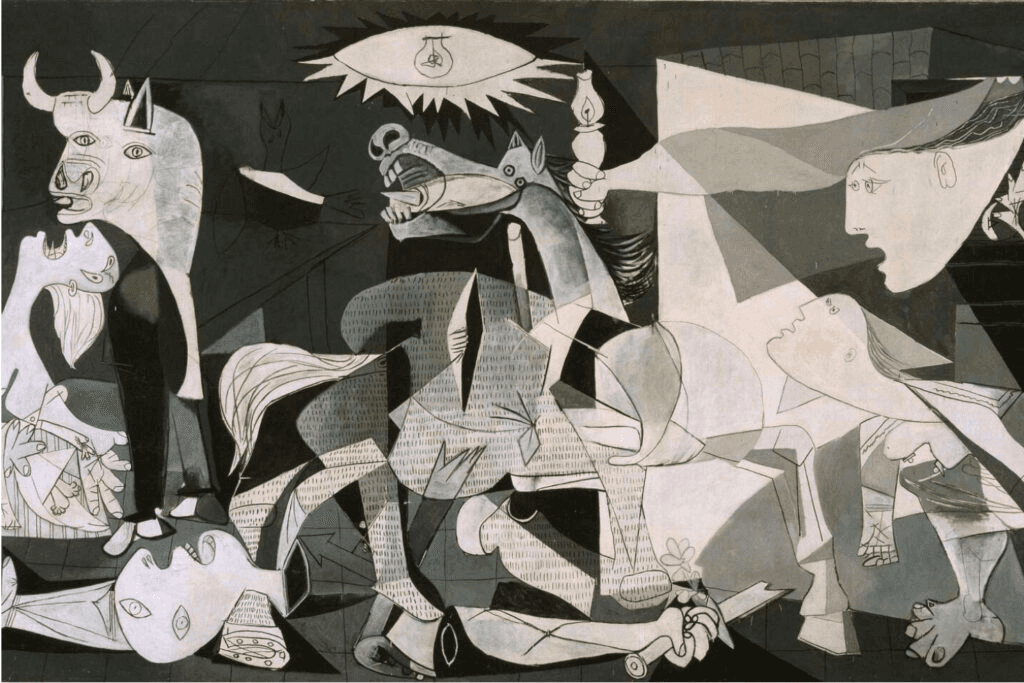
In 1940 the museum hosted a Picasso retrospective that included Guernica. On closing night, by the museum's own account, 1,300 visitors refused to leave.
Bigger shows came through a small institution like this one because Morley treated the museum as a public utility, not a treasure house. She had four years earlier given Henri Matisse his first West Coast exhibition, built largely from the collection of Michael and Sarah Stein. The Steins had lived in Paris and known Matisse early, then settled in the Bay Area. The Steins moved from San Francisco to Paris in 1903 and returned to the Bay Area in 1935. Femme au chapeau was shown in the 1936 exhibition, but it was not bequeathed to SFMOMA by the Haas family until 1990.

1941–1946: First Solo Shows
The record that gives the early museum its reputation is a run of first solo museum exhibitions for artists who were not yet established. By SFMOMA's own count, these were Arshile Gorky in 1941, Clyfford Still in 1943, Jackson Pollock in 1945, and Robert Motherwell and Mark Rothko in 1946. Out of the Pollock show the museum bought Guardians of the Secret (1943).

These "first" claims come mainly from the institution's own histories. They are widely repeated and broadly accepted, but each one depends on how a "museum solo exhibition" is defined.
What the list shows is the order of things. In the 1940s, a museum on the fourth floor of a veterans' building in San Francisco was taking risks that New York institutions had not yet taken. Abstract Expressionism had a West Coast stage before it had a canon.
1958: Morley Leaves
Morley retired from the museum in 1958. From 1946 to 1949 she took leave to work for UNESCO, where she headed its Museums Division, helped build the International Council of Museums (ICOM), and founded ICOM's regional agency for Asia. In 1960 she became the founding director of the National Museum of India in New Delhi, which she ran until 1966. She remained in India and died in New Delhi in 1985.
The museum she left behind had a reputation, but its collection was modest. The gap between what the museum was known for and what it owned would shape every major decision that followed.
1975: "Modern"
In 1975, under director Henry T. Hopkins, the institution added "Modern" to its name. The same year, Clyfford Still gave it twenty-eight large paintings. Thirty-two years after his first museum show, it was the same museum. Still was famously hostile to dealers, critics, and the art world, entrusting his paintings only to institutions that accepted his conditions. That he chose to give this one a body of work is a measure of what Morley's early bet had bought.
1995: Third Street
On January 18, 1995, the museum's sixtieth anniversary, SFMOMA opened its own building at 151 Third Street in South of Market. Mario Botta, the Swiss architect, designed it in association with Hellmuth, Obata and Kassabaum, and it cost about $60 million. Its signature was the black-and-white striped cylinder cut on a slant, an oculus over a central atrium that made the building recognizable from the street.

The site lay in the Yerba Buena redevelopment district. That district was cleared from the 1960s onward, displacing the residential hotels and the largely elderly, working-class population of South of Market. The museum did not cause that clearance, but it arrived as one of its anchor institutions.
2007–2009: The Presidio
The Fishers began collecting in the 1970s, buying prints for Gap's offices; their rule was that both of them had to want a work in order to buy it. The collection eventually grew to about 1,100 works by 185 artists. In 2007 Donald Fisher announced his own museum. The Contemporary Art Museum at the Presidio would be a 100,000-square-foot, roughly $150 million building on the Main Post of the former army base, now part of a national park.
Preservationists opposed it. The National Park Service wrote that the building would "dominate the head of the Main Parade and will negatively impact the setting, feeling, association and historic character of the property." In mid-2009, after two years of dispute, Fisher withdrew.
On September 25, 2009, SFMOMA announced a partnership instead. About 1,100 works from the Fisher collection would come to the museum under a trust administered jointly by the family and SFMOMA, initially for at least twenty-five years. The collection remained Fisher property. Donald Fisher died two days later.
2016: Snøhetta
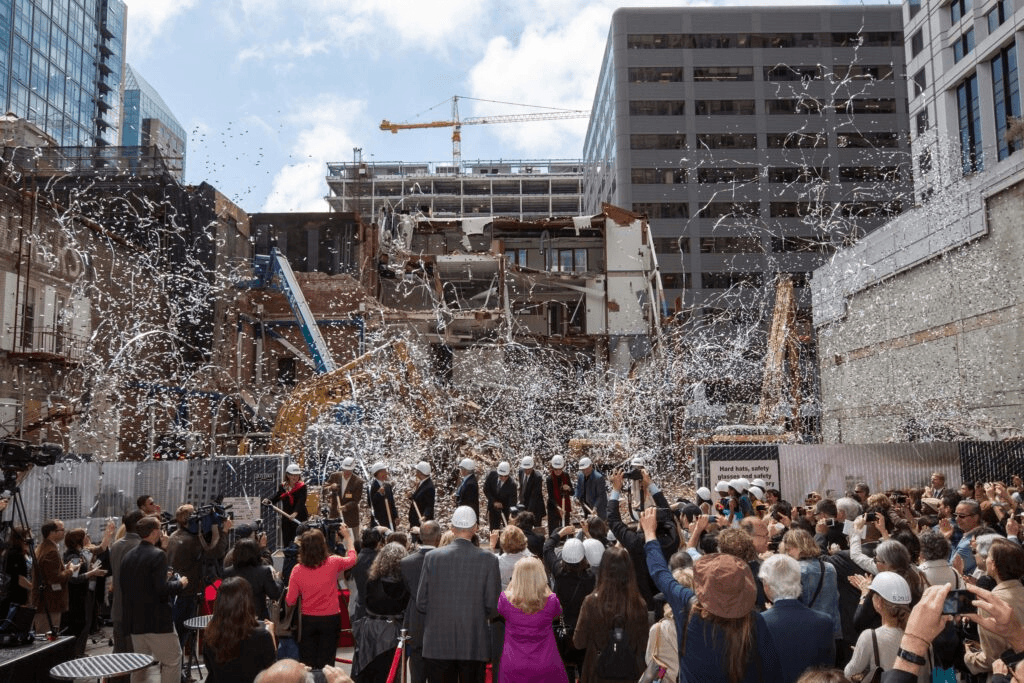
The expanded museum opened on May 14, 2016. The Norwegian firm Snøhetta added a ten-story wing behind the Botta building, clad in more than 700 individually shaped fiberglass-reinforced panels. Gallery space nearly tripled. The campaign raised more than $610 million: $305 million for the building, $245 million for the endowment and $60 million for programs and operations. A parallel Campaign for Art brought in more than 600 promised gifts from 230 donors. Admission became permanently free for visitors eighteen and under.
The Fisher terms are the part of the story that is least visible from the galleries. The loan was extended to 100 years, renewable in twenty-five-year increments. As reported at the time, three-quarters of the works in the designated Fisher galleries had to come from the Fisher collection at all times, and the museum was required to mount a Fisher-only presentation once every decade. The opening hang showed about 260 Fisher works across three floors. Most of the detailed terms have never been made public.
The expansion changed the museum's finances as well as its size. Annual operating costs rose from about $35 million to about $65 million. The share of the budget covered by endowment and fundraising rose to about two-thirds.
2026: The Reinstallation
On April 18, 2026, SFMOMA opened the first full reinstallation of the Fisher galleries since 2016. Nearly 250 works by 35 artists now fill about 60,000 square feet across four floors. Floor 6 is organized around memory and history, Floor 5 around the fundamentals of form, and Floor 4 holds fourteen single-artist galleries. Floor 3 is given to Claes Oldenburg and Coosje van Bruggen. Calder, Kelly and LeWitt each get a floor-scale survey.
The museum's own 2026 description puts the loan at "over 720 works by 100 artists." That is substantially fewer than the roughly 1,100 announced in 2009. The public record does not explain the difference.
The museum's owned collection now numbers more than 33,000 works across painting, sculpture, photography, architecture and design, and media arts. The Fisher works are not counted among them. They are, however, the works a first-time visitor is most likely to see. Doris Fisher died on May 2, 2026, at the age of 94, two weeks after the reinstallation opened. 🌁
Timeline — SFMOMA
1935 — San Francisco Museum of Art opens January 18 on the fourth floor of the War Memorial Veterans Building; Grace McCann Morley director
1936 — First West Coast Matisse exhibition; Kahlo's Frieda and Diego Rivera enters the collection via Albert M. Bender
1937 — Carnegie grant funds the extension program across rural Northern California 1940 — Picasso retrospective with Guernica
1941 — Arshile Gorky's first museum solo show
1943 — Clyfford Still's first museum solo show 1945 — Jackson Pollock's first museum solo show; Guardians of the Secret acquired
1946 — First museum solo shows for Mark Rothko and Robert Motherwell
1958 — Morley retires; goes on to UNESCO and ICOM 1975 — "Modern" added to the name; Clyfford Still gives twenty-eight paintings
1995 — Mario Botta building opens on Third Street, January 18 2007 — Donald Fisher proposes a contemporary art museum at the Presidio
2009 — Presidio plan withdrawn; Fisher partnership announced September 25; Donald Fisher dies two days later
2016 — Snøhetta expansion opens May 14; Fisher loan set at 100 years 2026 — Full reinstallation of the Fisher galleries opens April 18