Capitalist Realism

SFMOMA, Floor 4 · Ways of Seeing: Fourteen Artists
The largest work in the room Sigmar Polke shares with Roy Lichtenstein is about ten feet high and thirteen wide, and you can see through it. The fabric is soaked in resin and tinted golden yellow, so the wooden stretcher bars behind it show through: one horizontal bar across the middle, two vertical bars meeting it. Drawn over this in black lines and pale washes is a room with a steep perspective. A heavy white curtain is pulled back at the left. At the right stands a bearded old man in a patterned robe and a fur cap, raising a thin wand in one hand and swinging a censer in the other, smoke looping out of it. Facing him is a hooded figure drawn only in pale blue lines, arms raised, as transparent as the fabric. On the floor, inside two concentric rings, are two lit candles, a skull, and a book.

SFMOMA’s audio guide gives this Untitled (2003) to a working magician, Christian Cagigal. He reads it as the conjuring of a spirit, calls it a “sacred magic trick,” and ends by saying Polke “fooled a magician.”
Polke is usually introduced as the German answer to American Pop. In 1963 he and Gerhard Richter coined the label Capitalist Realism, and like Lichtenstein next door he painted the dots of commercial printing by hand. That account describes four or five years of a career that lasted almost fifty. What runs through all of it, from the dot paintings of the 1960s to this conjurer in 2003, is a concern with images that deceive, and with the people who make them.
1941–1953 — Two Germanys
Sigmar Polke was born on February 13, 1941, in Oels, in Lower Silesia, the seventh of eight children. Oels is now Oleśnica, in Poland. In 1945, as the Soviet army advanced and Germans were expelled from Silesia, the family fled west to Thuringia, which became part of the Soviet occupation zone and then of East Germany.
Polke spent his childhood under the new socialist state. Its official art was Socialist Realism: heroic workers, smiling farmers, and party leaders painted in a polished, legible style, as a tool of state persuasion. In 1953, when he was twelve, the family left East Germany, first for West Berlin and then for the Rhineland. They settled in Willich, near Krefeld.
By the time he reached the West, Polke had lived under two political systems and known each through its images. In the East, painting told citizens what to believe. In the West, as the economic recovery took hold, advertising told consumers what to want.
1959–1967 — Glass and the Academy
From 1959 to 1960 Polke apprenticed at a stained-glass workshop in Düsseldorf. He learned to paint on glass, a craft in which the image is meant to be seen with light passing through it. Nearly fifty years later he would return to it, and his late paintings on transparent fabric draw on the same training.
In 1961 he entered the Kunstakademie Düsseldorf, the most important art school in West Germany. He studied with the abstract painters Karl Otto Götz and Gerhard Hoehme. Joseph Beuys, who joined the faculty that year, became the dominant presence at the school, with his felt, fat, and lectures on art as social sculpture. Polke studied there until 1967. Among his fellow students was Gerhard Richter, nine years older, who had come over from East Germany in 1961.
1963 — Kaiserstraße 31a
In May 1963 Polke, Richter, Konrad Lueg, and Manfred Kuttner rented an empty shop at Kaiserstraße 31a in Düsseldorf and hung their own exhibition. The press release announced that Pop Art “recognizes the modern mass media as a genuine cultural phenomenon” and claimed an aesthetic revolution. The four used the term Capitalist Realism.
Capitalist Realism was the ironic name Polke, Richter, and their friends gave to their imagery taken from West German advertising and mass media, mocking both American Pop and the Socialist Realism of East Germany. The term was a joke aimed in two directions. It borrowed the name of the East’s official style and attached it to the West’s. Polke and Richter had both grown up under Socialist Realism. Now they painted the West’s version of propaganda, the ads and magazine photographs of the economic miracle.
That autumn Richter and Lueg staged a performance in a Düsseldorf furniture store, sitting in the showroom as living exhibits. Polke did not take part.
In 1963 and 1964 Polke painted consumer goods: socks, white shirts, chocolates, biscuits. They are laid out flat and repeated, painted in a deadpan style that is careful and empty at once, as if West German prosperity amounted to a stack of identical cookies.
1963–1966 — The Raster
At the same time Polke began the paintings that made his reputation. A Rasterbild, “raster picture” or “screen picture,” is a painting in which Polke enlarged the halftone dots of a printed newspaper or magazine photograph and painted them by hand. Raster is the German word for the screen used in printing to break a photograph into dots. Polke painted each dot himself, often with the rubber end of a pencil dipped in paint.
The result looks mechanical from a distance and handmade up close. The dots are irregular. Some smear, some are missing, some are doubled. Polke called the raster “the structure of our time, the structure of a social order, of a culture.” A photograph in a newspaper claims to show the world. Enlarged, its dots show that it is a pattern of ink that the eye assembles into a picture.
Lichtenstein’s Ben-Day dots in the same room are evenly spaced and precise. Polke’s are uneven, and the unevenness is deliberate. Where Lichtenstein made a printed image look clean and designed, Polke made it look like what it physically was: a coarse screen that barely holds an image together.
In 1966 Polke had his first solo exhibition, at Galerie René Block in West Berlin.
1966 — Springbrunnen (Fountain)
Springbrunnen is a raster painting from 1966. It is paint on linen, 41 by 27½ inches, about the size of a wall poster, in a thin black frame. Black dots lie over a cream and warm yellow ground, with patches of saturated dark green. At the left, a seated figure emerges from the dots, cropped and in partial profile, wearing a low-brimmed cap. The face is a dark eye socket and the bridge of a nose. The jaw and neck dissolve into near-black. The figure seems to sit in a lawn chair. Above it is a small house with wide horizontal windows, a gabled roof, and a chimney. The right half and middle ground are filled with a large tiered fountain, a thin column of water rising from the top and falling into a round pool. Dark green patches suggest trees. Small red and orange bursts at the upper right suggest a sunset.

The scene is suburban leisure: a man resting in a garden with a house and an ornamental fountain. It is the kind of image a West German magazine of the 1960s would run to show the comfortable life the recovery had brought. In Polke’s version the man has almost no face. The dots that should build his features break up into dark patches. The fountain, the symbol of the good life, is a mottled shape barely held together by the screen.
1966 — Ohne Titel (Watercolor)
Polke drew and painted on paper constantly. The smaller of two watercolors in the room, Ohne Titel (Untitled), is dated “Polke 66” at the lower right. It is 11¾ by 8½ inches. At the left is a crudely drawn man in cartoon style, with a large potato-shaped head, gray contour lines on the cheek and jaw, a dark crescent for an eyelid, and a small dark mark for a mouth. His hair is a blotchy patch of gray-black. His clothing is sketched in crossed gray lines like plaid. Beside his face a bright yellow shape bulges out, dotted with small ochre spots and ringed in a thick gray outline. Long dark lines arc across the upper right. The paper is stained with watery beige and gray blooms.

The yellow dotted shape beside the man’s face is open to reading. It may be a speech or thought balloon emptied of words, or a raster dot enlarged until it becomes a thing in its own right. Polke did not say. The sheet shares the raster paintings’ vocabulary of dots and cheap cartoon drawing, made fast and loose in watercolor.
1966–1969 — Patterns and Higher Beings
From 1966 to 1968 Polke photographed small arrangements of household objects in his home and studio with a Rollei camera, and in 1968 he published a portfolio of fourteen of these photographs. He began painting on commercially printed fabrics instead of plain canvas: bedsheets, curtain material, and upholstery printed with stripes, polka dots, and floral patterns. He painted over the patterns or let them show through.
His imagery in these years drew on the decorative motifs of middle-class taste: palm trees, beaches, flamingos, herons. SFMOMA owns two of his palm-tree paintings of 1966 and 1968, not on view. The critic Hal Foster has described these images as middle-class kitsch and Polke’s treatment of them as a sometimes cruel anthropological expedition.

In 1969 he painted Higher Beings Commanded: Paint the Upper-Right Corner Black! The canvas is white except for its upper right corner, which is black. The title mocks two kinds of authority at once: the mystical claims of early abstract art, and the order from above that a painter follows without question.
1968 — Ohne Titel (Watercolor)
The second watercolor, also Ohne Titel, is signed “S. Polke 68” at the lower right. It is 11⅞ by 8 5/16 inches. Soft blues, warm oranges, and vivid reds surround a dark blue-gray heron with a rounded body, two thin legs, a long neck, and its small head angled up. A thick red ribbon curves down from the upper right, brushes the bird’s neck, and continues as a wavy vertical line toward the bottom. Broad orange and ochre strokes in the lower third suggest reflections rippling on water, with pale blue ovals among them. The upper half holds circular motifs: blue disks ringed in yellow and orange, the largest with dark crossed lines inside it. At the left edge stands a tall pale column with a red-orange edge, a gray spiral near the top, and two pinkish crosshatched panels below. Thin blue lines loop over the whole sheet.
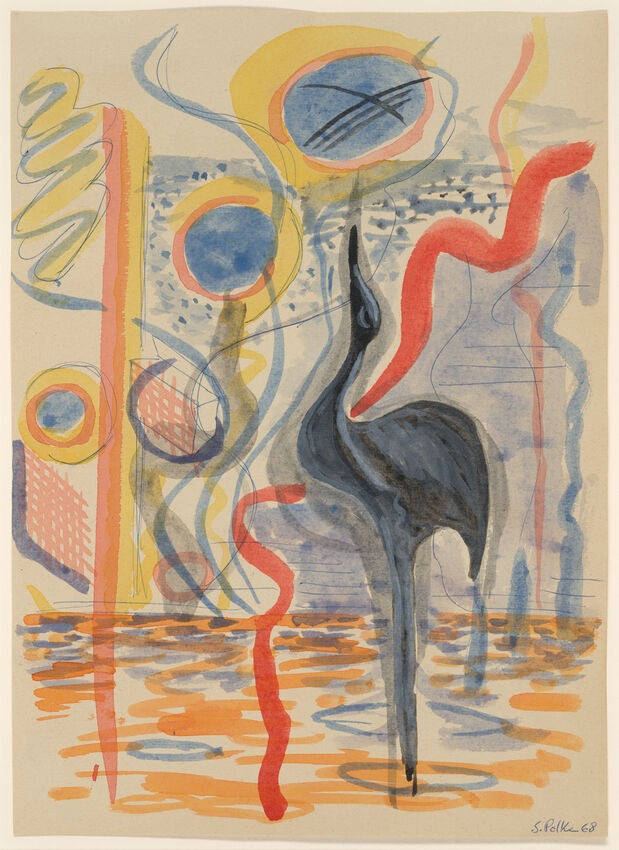
The heron is one of the kitsch motifs Polke used in his fabric paintings of these years, the sort of bird printed on a souvenir tray or a living-room curtain. Here it stands among targets, spirals, and a red line that cuts across it, in a field that does not resolve into a landscape. The decorative bird is placed inside a composition that refuses to be decorative.
The 1970s — Drift
In 1970 Polke began showing with the dealer Michael Werner. In the early 1970s he lived at the Gaspelshof, a farmhouse commune near Willich, where artists and friends came and went. He experimented with drugs. In 1971, in Paris, he made photographs he developed with chemical staining, reportedly under the influence of LSD.
He traveled widely. In 1973 he went to the United States with the artist James Lee Byars and photographed homeless men on New York’s Bowery, manipulating the prints in the darkroom. In 1974 he traveled to Afghanistan and Pakistan, and in 1975 he made a photographic series in São Paulo and won a painting prize at the São Paulo Biennial. In 1977 he became a professor at the Hochschule für bildende Künste in Hamburg, where he taught until 1991. In 1978 he settled in Cologne.
The 1980s — Chemistry: Untitled (1983)
In the 1980s Polke’s materials became part of his subject. He used resins, lacquers, and pigments that changed color with heat, light, or humidity, and toxic historical pigments such as orpiment, made from arsenic, which painters had abandoned for centuries. Some of his paintings changed over time as their chemistry reacted. He had his first New York solo show at the Holly Solomon Gallery in 1982. In 1986 he won the Golden Lion at the Venice Biennale, shared with Frank Auerbach.

The Untitled of 1983 in the room is acrylic on paper, 39 by 27½ inches, in a light wood frame. It combines splashed abstraction with bold black line drawing. A tall, cartoon-like woman strides diagonally across the lower half on long pale legs, in pointed shoes, with a cinched waist, exaggerated red lips, closed eyes with thick lashes, and a closed book balanced on her head. Her hair falls in a heavy mass above her shoulders. Behind her, a warm yellow wash fills much of the upper half, broken by purple blotches, black smears, and drips. Teal and green pool at the lower left, where a dark figure crouches or sits. Wavy white lines suggest water, and a small pale blue figure runs left beneath the woman’s legs. At the right a large vase floats, holding thin black lines like reeds, surrounded by splatters. At the lower right, angular blue shapes like letters or signage lie over a grid of red and gray strokes.
A woman walking with a book on her head is the exercise of a finishing school, training posture and poise. Polke draws her in the style of a fashion illustration and drops her into a field of stains and drips. The clean graphic line of commercial drawing and the uncontrolled spill of paint occupy the same sheet without merging.
2003 — Untitled: The Phantasmagoria
From the 1980s on, Polke painted on fabric made transparent with resin, so the stretcher bars and the wall behind showed through. He returned repeatedly to images from old printed sources: woodcuts, engravings, and illustrations from books and broadsheets.
The 2003 Untitled is oil and resin on fabric, 119¼ by 158½ inches. Hannah Klemm, a curatorial fellow at SFMOMA, traced its source in a 2016 essay. The scene comes from a show bill printed in London in October 1802, advertising the phantasmagoria of a showman named Paul de Philipsthal.
A phantasmagoria was a theatrical show, popular around 1800, in which a modified magic lantern projected images of ghosts, demons, and spirits onto smoke or a translucent screen, so that they seemed to float in the air. The show bill’s image is thought to depict Johann Georg Schröpfer, an eighteenth-century coffee-house owner in Leipzig who staged fake séances to summon the dead. Philipsthal’s bill said his act “professes to expose the Practices of artful Impostors and pretended Exorcists.” The phantasmagoria presented itself as a demonstration of how such tricks were done, while giving the audience the thrill of the ghosts.
Polke projected a transparency of the found image onto the resin-treated fabric. The skewed perspective of the room suggests the projector was set at an angle. He painted the sorcerer and the curtain on both the front and the back of the fabric. Klemm compares this to Hinterglasmalerei, the German folk craft of painting on the back of glass, which connects the painting to Polke’s apprenticeship as a glass painter. The panels on the back wall are each washed in a different color, black, red, green, and brown. The frame of the original show bill is visible at the top and bottom of the canvas.
The transparency of the fabric does the painting’s main work. The stretcher bars cross through the figures. They show behind the opaque magician and straight through the ghost, so the viewer cannot tell which figure is in front. The ghost is painted as thin as the support. The magician is solid. The painting reproduces the phantasmagoria’s own method: an image projected onto a translucent screen, offered as an illusion and an exposure of illusion at the same time.
In 2003 and 2004 Tate Modern in London gave Polke a solo exhibition. From 2006 to 2009 he designed stained-glass windows for the Grossmünster in Zürich, returning to the craft of his apprenticeship. He died in Cologne on June 10, 2010, after a long illness with cancer. He was sixty-nine.
The Room
Polke’s five works hang beside Lichtenstein’s, and the comparison is the point of the pairing. Both men painted the dots of commercial printing by hand. Lichtenstein’s dots built images that could be read in a glance. Polke’s made images come apart.
Read in date order, Polke’s works on Floor 4 move from a suburban fountain dissolving into a screen, through cartoon heads and souvenir herons, to a fashion figure stranded in stains, and finally to a two-hundred-year-old advertisement for a ghost show. Across that span, his subjects are images that ask to be believed: the newspaper photograph, the decorative motif, the illustration, the summoned spirit. Philipsthal’s show bill promised to expose the impostors while selling tickets to their ghosts. Polke’s painting does the same. 🌁
Timeline — Sigmar Polke
February 13, 1941 — Born in Oels, Lower Silesia, now Oleśnica, Poland.
1945 — Family flees to Thuringia, later East Germany.
1953 — Family leaves East Germany for West Berlin, then Willich in the Rhineland.
1959–1960 — Apprentices at a stained-glass workshop in Düsseldorf.
1961 — Enters the Kunstakademie Düsseldorf; studies with Karl Otto Götz and Gerhard Hoehme.
May 1963 — Exhibition at Kaiserstraße 31a with Richter, Lueg, and Kuttner; the term Capitalist Realism.
1963–1964 — Paintings of socks, shirts, chocolates, and biscuits; begins the raster paintings.
1966 — First solo show, Galerie René Block, West Berlin; paints Springbrunnen and the smaller Ohne Titel watercolor.
1966–1968 — Rollei photographs of object arrangements; paintings on patterned fabric.
1967 — Leaves the Academy.
1968 — Paints the heron Ohne Titel watercolor.
1969 — Higher Beings Commanded: Paint the Upper-Right Corner Black!
1970 — Begins showing with Michael Werner.
Early 1970s — Lives at the Gaspelshof commune.
1973 — Travels to the United States with James Lee Byars.
1974 — Travels to Afghanistan and Pakistan.
1975 — Prize at the São Paulo Biennial.
1977–1991 — Professor at the Hochschule für bildende Künste, Hamburg.
1978 — Settles in Cologne.
1982 — First New York solo show, Holly Solomon Gallery.
1983 — Paints the acrylic-on-paper Untitled.
1986 — Golden Lion, Venice Biennale.
2003 — Paints the phantasmagoria Untitled.
2003–2004 — Solo exhibition at Tate Modern.
2006–2009 — Stained-glass windows for the Grossmünster, Zürich.
June 10, 2010 — Dies in Cologne.
April 18, 2026 — Five works in Ways of Seeing: Fourteen Artists.