Created on
Updated on
Filmmaking in the Age of AI(13): Save the Cat! by Blake Snyder (2005)
Helpful to Read to Get Started, Bad If You Treated It As A Bible
Preface: Re-teaching myself the new filmmaking pipeline, now with AI (netflix please notice me). co-written with Claude. NOW WITH AUDIO.
Let's take a look at the book that everyone in the industry has read or at least heard of, Save the Cat! by Blake Snyder (2005). As good as Save the Cat! is at writing screenplays that sell, it does not teach you how to make it good. Here is the thing about Save the Cat! that nobody who hates it wants to admit, and nobody who loves it wants to examine: it probably is the most useful screenwriting book ever written, but also possibly the most dangerous. Both things are true at the same time.It is genuinely, practically, immediately useful. And something about the way it conquered Hollywood has made movies measurably worse. Understanding how both of those things can be true simultaneously is, I'd argue, the most important thing a working writer can understand about craft books in general — because Save the Cat! is where the tension between "here's a tool" and "here's the truth" becomes impossible to ignore.
Blake Snyder was, by his own description, Hollywood's most successful spec screenwriter. That's not a boast — it was literally how the Hollywood Reporter described him. In a 1989 bidding war, he sold his first spec script, Stop! Or My Mom Will Shoot, for $500,000. He went on to sell thirteen original screenplays. His million-dollar sales included Blank Check for Disney and Nuclear Family for Amblin Entertainment (Spielberg's production company). Here is where the biography gets interesting: Stop! Or My Mom Will Shoot won the Golden Raspberry Award for Worst Screenplay in 1993. Blank Check was a modest Disney hit that no one over twelve remembers with particular affection. Nuclear Family was never produced. This is not a trivial detail. Snyder was not a writer who had made great films. He was a writer who had sold a lot of scripts — which is a different and very specific skill. And Save the Cat! is, at its core, a book about how to sell scripts. The commercial instinct is embedded in every page. His measure of a good story is always, fundamentally: will this work on an audience? That's a legitimate measure. But it's not the only one.
Snyder died suddenly in August 2009, at 51, from cardiac arrest — just four years after the book was published and before he could fully reckon with its cultural footprint. His book kept selling. By 2020, it was still Amazon's number-one bestseller in both Screenplay and Screenwriting categories. It's been in continuous print for twenty years. The Save the Cat! brand has since expanded to novels, TV, horror, young adult — the method now has its own franchise, which is either deeply fitting or deeply ironic depending on your view of it. Save the Cat! has three major contributions: the logline methodology, the ten genres, and the beat sheet.
Snyder is obsessed with the logline — the one or two sentence summary of a film. And he's right to be. His four requirements for a strong logline are worth memorising:
Irony — the logline must be emotionally involving, with a built-in tension or contradiction. Not "a man hunts a killer" but "a claustrophobic police chief who hates water must hunt a great white shark terrorising his beach town."
A compelling mental picture — you should be able to see the movie from the sentence.
An audience and a cost — who is this for, and what will it demand of them emotionally?
A killer title — the title should communicate the movie's substance and tone.
What Snyder understood, and what most screenwriting books ignore, is that a logline is not a summary — it's a test. If you can't compress your story into a logline that satisfies these four requirements, the story probably doesn't have a clear enough concept to sustain a feature film. The logline forces you to identify what your story is about at the most fundamental level, before you've written a word of the script. This is some of the most practical, immediately applicable advice in any craft book. The exercise of pitching your logline to strangers — not friends, not writing partners, but people with no vested interest in your success — and reading their reactions is, as Snyder puts it, the fastest way to find out if your concept is gold or dust.
Snyder's second big contribution is his genre system — and it's more interesting than it first appears, because he's not talking about genre in the traditional sense. He's not talking about comedy versus thriller versus romance. He's talking about the fundamental shape of the problem at the centre of a story.
Monster in the House — a killer in a confined setting (Alien, Jaws, Fatal Attraction)
Golden Fleece — a quest for a defined prize (Star Wars, Raiders of the Lost Ark, Stand By Me)
Out of the Bottle — a wish fulfilled with unintended consequences (Liar Liar, Freaky Friday)
Dude with a Problem — an innocent person thrust into a life-or-death battle (Die Hard, Schindler's List, The Martian)
Rites of Passage — a change-of-life crisis and the pain of transition (Ordinary People, 10, Days of Wine and Roses)
Buddy Love — two people who need each other to become whole (Rain Man, every romantic comedy ever made)
Whydunit — not just who did it, but why (Chinatown, JFK)
Fool Triumphant — the underestimated underdog defeats the establishment (Being There, Forrest Gump)
Institutionalized — an individual's battle with a system or group (MASH, One Flew Over the Cuckoo's Nest)
Superhero — an extraordinary person in an ordinary world (Superman, A Beautiful Mind)
These categories cut across traditional genre in a useful way — a Monster in the House story can be a horror film or a thriller or even a drama, but the fundamental dramatic question and structural requirements are the same. Knowing which type of story you're writing tells you what promises you're implicitly making to the audience, and what you need to deliver. if you're stuck in development, asking "what genre am I actually in, by Snyder's taxonomy?" often clarifies why a particular story element isn't working. A Dude with a Problem story requires an innocent hero — if your protagonist has been complicit in creating the problem, you're drifting out of the genre and the story will feel off. These categories are not flawless — they're built around Hollywood commercial films and don't accommodate slower, more internal stories particularly well. But as a diagnostic tool for writers in development, they're genuinely useful.
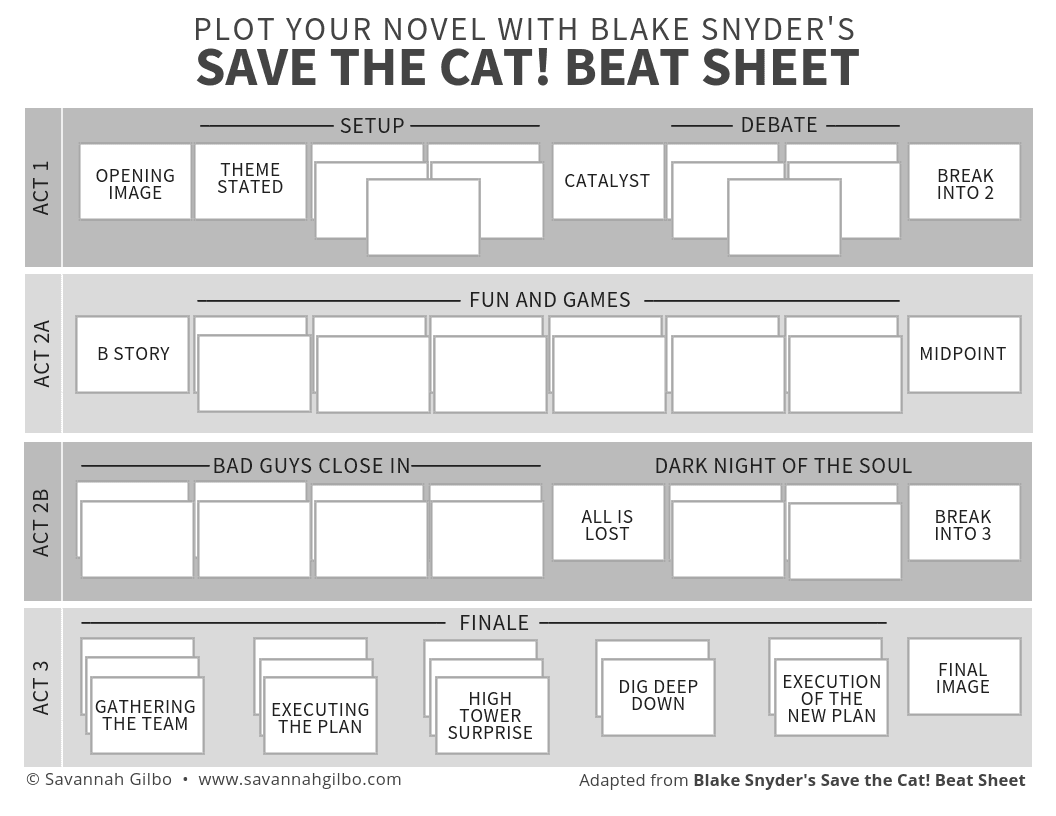
And now we get to the thing that everything else gets overshadowed by. The Blake Snyder Beat Sheet — which Snyder himself called the BS2, a name that, depending on your view, either stands for "Blake Snyder 2" or says something more general about the enterprise — is a set of 15 story beats, each assigned a specific page number in a standard 110-page screenplay. Where McKee and Field gave you principles, Snyder gives you a timetable.
The beats, with their target pages:
Opening Image (p.1) — A snapshot of the hero's world before the story begins. Establishes tone, mood, type.
Theme Stated (p.5) — A secondary character says something to the hero that names what the story is about. The hero doesn't understand it yet.
Set-Up (p.1–10) — The hero's flawed world in all its detail. Introduce the "Six Things That Need Fixing" — the missing elements in the hero's life.
Catalyst (p.12) — The inciting incident. Something happens that changes everything.
Debate (p.12–25) — The hero resists the change. Should I go? What if I don't? The last chance to turn back.
Break into Two (p.25) — The hero makes the choice. The story begins in earnest. Act Two starts.
B Story (p.30) — A new character or relationship introduced who will carry the film's thematic argument.
Fun and Games (p.30–55) — The promise of the premise. This is why people bought a ticket. The hero in their new world, before it gets hard.
Midpoint (p.55) — A false victory or a false defeat. Stakes are raised. The story pivots.
Bad Guys Close In (p.55–75) — Everything starts to fall apart. External pressure mounts. Internal doubts deepen.
All Is Lost (p.75) — The hero hits rock bottom. The worst moment.
Dark Night of the Soul (p.75–85) — The hero wallows. What does it all mean? (Snyder: "This is the whiff of death.")
Break into Three (p.85) — The solution appears, usually thanks to the B story.
Finale (p.85–110) — The hero applies the lesson learned. The world is changed.
Final Image (p.110) — A mirror of the Opening Image, showing how far the hero has come.
You have to sit with this for a moment to appreciate what Snyder actually did here. He took Aristotle, Syd Field, Joseph Campbell, and every successful Hollywood film he'd ever seen, and reverse-engineered them into a minute-by-minute assembly guide. The theme stated on page five. The break into two on page twenty-five. The all is lost on page seventy-five. Each page of a screenplay equals approximately one minute of film — so Snyder is essentially handing you a 110-minute schedule. And the immediate, honest response is: this is remarkably useful. Snyder's own explanation for why he built the beat sheet: "Like a swimmer in a vast ocean, there was a lot of open water between those two Act Breaks. And a lot of empty script space in which to get lost, panic, and drown. I needed more islands, shorter swims." That's a genuine insight about why writers get stuck. Act Two is where most screenplays die — it's fifty pages of "confront, struggle, fail, try again" with no clear map. The beat sheet gives you islands. Things to aim for. Concrete moments to build toward. For a writer staring at a blank page on page thirty-three with no idea where to go next, the beat sheet is a lifeline.
In 2013, Peter Suderman wrote a piece in Slate that became one of the most widely read articles ever published about screenwriting. Its thesis: Save the Cat! had taken over Hollywood, and movies had gotten measurably worse as a result. Suderman's case was careful. He didn't claim Snyder was a fraud or that the beat sheet was wrong. He made a more specific and disturbing argument: that the absolute specificity of Snyder's formula, combined with its widespread adoption by the film industry, had turned a structural tool into a structural prison. The distinction that matters here is between Jurassic Park and The Amazing Spider-Man. Both are three-act Hollywood blockbusters. Both hit something like Snyder's beats. But Jurassic Park hits them out of order and out of proportion — the story breathes, it surprises, it moves at its own pace. The Amazing Spider-Man, made nearly two decades later in a Hollywood that had thoroughly absorbed the beat sheet, follows Snyder's structure beat by beat, nearly to the page. The film feels — and this is the key word — assembled.
Snyder himself insisted the beat sheet was a structure, not a formula. And he's technically right. But the distinction evaporated in practice. Development executives, story consultants, script readers — an entire layer of the industry that processes, evaluates, and notes scripts — absorbed the beat sheet as a checklist. If the theme isn't stated by page five, that's a note. If the all is lost isn't landing by page seventy-five, that's a problem. The beat sheet stopped being something writers used to build stories and became something the industry used to judge them. The result, if you've watched Hollywood blockbusters with any critical attention over the past fifteen years, is obvious. The villain who gets caught on purpose (appearing in The Dark Knight, The Avengers, Skyfall, and Star Trek Into Darkness in the same summer). The hero who hits rock bottom at the seventy-five minute mark in every single film. The final image that deliberately echoes the opening image, just in case you missed the growth. Stories that are structurally correct in the way that an IKEA bookshelf is structurally correct — every part is present and in the right place, and the result has no soul.
The beat sheet doesn't just organize story. It organizes story around a very specific type of protagonist and a very specific type of change. The hero in a Save the Cat story has "Six Things That Need Fixing." They are flawed in quantifiable ways. They resist the call. They go on a journey. They hit rock bottom. They learn something. They change. The final image shows the change. This is the character arc — and Snyder treats it as the only arc worth building a story around. The transformation of a flawed individual, via external pressure, into a better version of themselves. Every beat on the sheet is in service of that arc. What this excludes is significant. Characters who don't change but whose situation changes in ways that illuminate something true. Characters who are destroyed by circumstances rather than redeemed by them. Stories where the point is not the protagonist's growth but the revelation of how the world works — the kind of story that ends not with a character transformed but with an audience understanding something they didn't before. The great tragedies. The great social critiques. The films that trouble rather than resolve.
Snyder's genres — for all their utility — have the same issue. They are almost exclusively built around victory, transformation, or earned defeat. The categories themselves assume that stories exist to answer questions, resolve conflicts, and deliver emotional satisfaction. Which many stories do. But not all. And the ones that don't — that leave you unsettled, uncertain, still turning things over days later — don't fit neatly into Monster in the House or Rites of Passage. Snyder's actual examples in the book reveal the bias clearly. His canonical texts are Miss Congeniality, Legally Blonde, Die Hard. These are not bad films. But they are a very specific kind of film — high-concept, commercially optimised, emotionally tidy. The beat sheet was built from them and works best for stories that share their DNA.
Despite all of this, I keep the book on my shelf. And here's why. The beat sheet is the fastest diagnostic tool in existence. If you have a draft that isn't working and you can't figure out why, map it onto the BS2. Within twenty minutes you'll know: is there a midpoint? Is the all is lost actually at all is lost, or is it the midpoint, which means the second half of your film has no escalation? Is the break into three genuinely new information, or is it just the hero deciding to try harder, which doesn't count? This is not the beat sheet working as a formula. This is the beat sheet working as an X-ray. You're not building to the template; you're using the template to find what's broken. The difference matters enormously.
The logline discipline remains invaluable. If you can't write a logline that satisfies Snyder's four requirements, there's almost certainly a concept problem — and better to find that out on a Post-it note than on page eighty of a draft. And the genres, used loosely, are genuinely clarifying. Knowing you're writing a Rites of Passage story — a story fundamentally about a character confronting a life transition they can't avoid — tells you something real about what needs to be at the emotional centre. Not what page it needs to appear on. Just what it is.
There's one more thing worth saying about Save the Cat! that doesn't get said enough, and it's about the title concept itself — the moment where the hero does something to earn the audience's sympathy. Snyder's example: early in your film, show your protagonist saving a cat. A small, kind act. An easy way to establish that they're worth rooting for. The underlying instinct is correct: audiences need to be given a reason to care before they'll invest in a character's journey. But Snyder's version of this — the explicit, early, unambiguous act of likability — has calcified into one of the most exhausting clichés in mainstream cinema. The hero doing something generous within the first ten pages, not because it's true to who they are, but because the book says they need to save a cat.
What Snyder wanted was for protagonists to be worth rooting for. What the industry did with it was add a scene where the protagonist is visibly nice to someone or something, check the box, and move on. Likability as a performance rather than an emergence. The best characters in cinema are not likable in the first ten minutes. They are interesting. They are alive in a way that makes you want to keep watching, not because you think they're a good person but because you need to know what they're going to do next. The "save the cat" moment, taken literally and applied mechanically, is exactly the kind of shortcut that Snyder's deeper instincts would have condemned.
Save the Cat! is the most practically useful entry-level screenwriting book ever written. If you are new to script structure, if you are stuck mid-draft, if you need to quickly diagnose why a story isn't working — nothing else does what the beat sheet does at the speed it does it. It is also a book written specifically for one kind of story — the high-concept commercial Hollywood film — by someone who was brilliant at selling scripts to studios. Its framework assumes that stories are fundamentally about individual transformation through adversity, that audiences need clearly likable protagonists, that every emotional experience needs to be resolved, and that box office is the most reliable measure of whether a story worked.
Those assumptions aren't wrong. They're just not universal. And the damage comes not from the book itself but from what happened when the industry adopted it wholesale — when "structure" became synonymous with "the BS2," when development notes started citing page numbers, when writers stopped asking "what does my story need?" and started asking "what does the beat sheet require?" Snyder would have hated that. He was genuinely passionate about good storytelling. He believed that originality and structure weren't enemies — that you could follow the beats and still make something that had never existed before. He's right. But the machine he built made it very hard to tell the difference. Read it. Use the logline test. Use the genre taxonomy. Use the beat sheet as a diagnostic tool when you're stuck. And then put it away, and write the story that only you can write — whether or not it has a midpoint on page fifty-five. ☀️