Created on
Updated on
Filmmaking in the Age of AI(18): VFX: Georges Méliès
singled-handedly pioneering techniques with a thousand PAs
Preface: Co-written with Claude. Following the last post.
Practical effects: smoke, fire, and on-set transformation(2)
Continued from the last section. There were practical effects he used other than smoke. Explosions were practical charges on set, scaled to read correctly for the camera position. The word "explosion" overstates what Méliès was actually producing on set. He wasn't detonating charges large enough to destroy anything. He was producing controlled bursts of light, heat, and smoke — the specific visual signature of an explosion — at a scale calculated to read correctly within the frame of a fixed, wide-angle camera shooting a full theatrical stage.
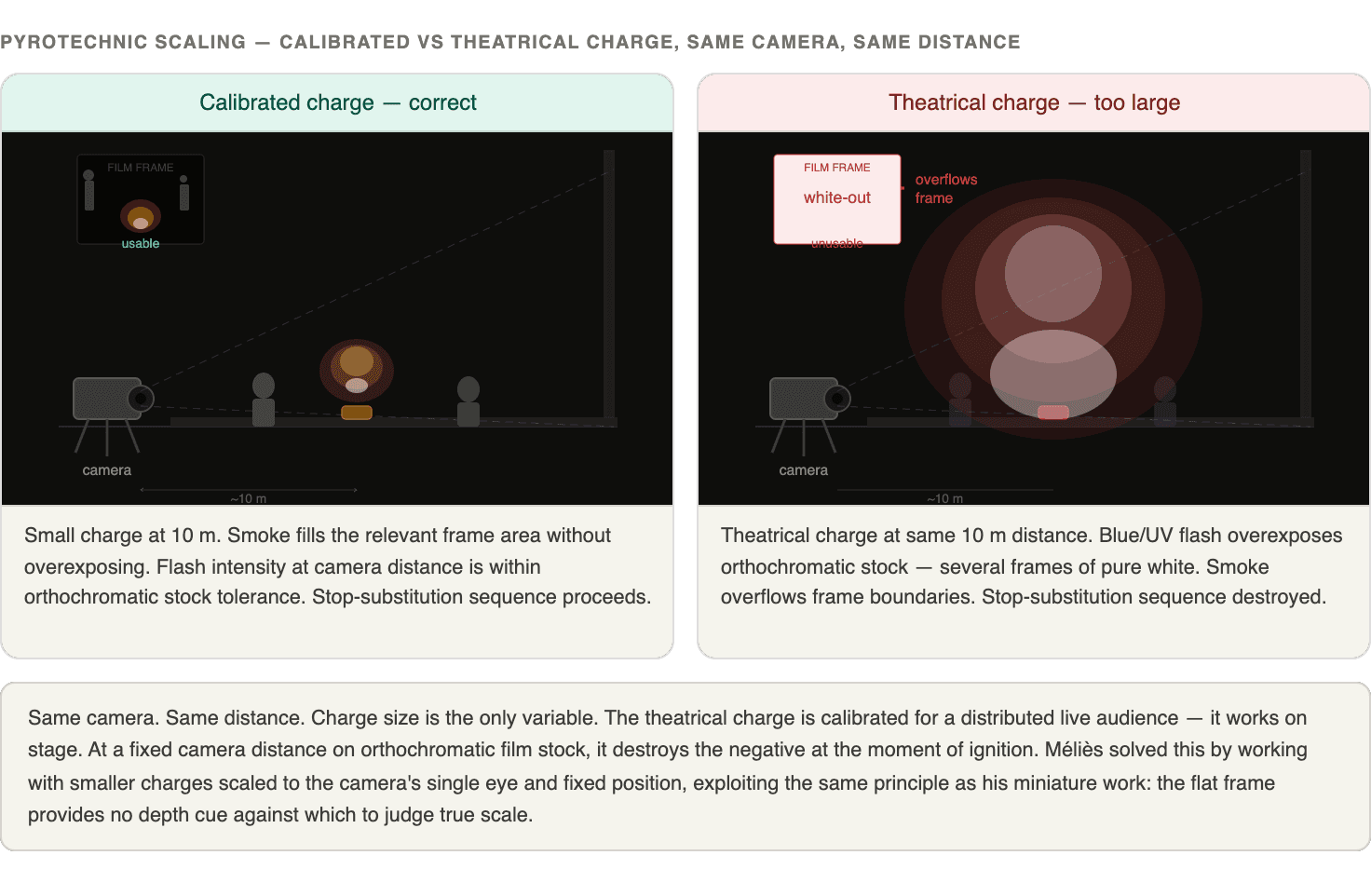
The material he used was flash powder: a pyrotechnic mixture typically composed of magnesium or aluminum powder combined with an oxidizer — potassium nitrate or potassium perchlorate in most theatrical formulations of the period. Flash powder is not a single substance — it's a class of pyrotechnic mixture sharing one defining characteristic: an oxidizer and a metallic fuel combined at fine particle size, in proportions that allow near-instantaneous combustion when ignited. The reaction is not an explosion in the conventional sense. It's a deflagration — a very rapid burn that propagates through the mixture at subsonic speed, releasing its energy in a fraction of a second. The products are intense white light, a sharp pressure wave that reads as a loud report, dense white smoke, and significant heat. Flash powder can self-confine and deflagrate violently in relatively small quantities — it is sensitive to heat, friction, static electricity, and impact, and can cause severe hearing damage and amputation injury even sitting in the open. This wasn't a theoretical concern. Smith-Victor, now a standard photographic lighting manufacturer, built its first dedicated flash powder plant in Griffith, Indiana in 1909 — a deliberate siting decision to keep volatile manufacturing away from its Chicago offices. The Griffith plant was destroyed in an explosion shortly after, killing an employee. Working with flash powder in the late 19th and early 20th century was genuinely hazardous work. Méliès was working with this material inside an enclosed glass-walled studio. The glass ceiling that gave him control over natural light for his compositing work also meant there was nowhere for a misfired charge to safely disperse. His ability to use flash powder at all in the Montreuil studio without incident across hundreds of productions reflects real operational discipline — the kind that came from years of working with pyrotechnics on a live theater stage, where a misfired flash pot in front of a paying audience had consequences that focused the mind (On set safety PSA).
Creature transformations used physical costume changes executed within the window of a stop-substitution cut. The stop-substitution cut gives you a working window of a few seconds — from the moment the camera stops to the moment it restarts. The camera stopping doesn't create a visible gap in the film. From the audience's perspective the image is continuous.Why not just stop the camera, take as long as you need to change the costume or swap the actor, and restart? The answer is light. Méliès shot in a glass-walled studio using natural sunlight as his primary light source. Sunlight changes continuously — clouds move across the sky, the sun's angle shifts, the quality and intensity of the light on the set changes from minute to minute. The two sides of the cut will have different exposure values, different shadow positions, different tonal qualities. The practical window wasn't determined by how long the camera could be stopped. It was determined by how long the light held consistent and how long a performer could hold a position without drifting. Everything that needs to change in the frame has to change within that window. For a figure to transform from one creature into another, or from a human into a monster, or from a fully dressed person into a skeleton, the physical change has to be completed before the camera restarts and the new exposure begins.
A full creature costume of the kind Méliès used could not be removed and replaced within a stop-substitution window. It was designed to be worn, not to be rapidly exchanged. What the window allowed instead was a category of change that could be executed in under three seconds: a prop substitution, a partial costume addition or removal, a position change, or a complete actor swap. Rather than changing one actor's costume, Méliès would stop the camera with actor A on his mark, clear actor A from the frame entirely, place actor B — already in a different costume — on the same mark, and restart.
What Méliès formalized across hundreds of films was a repeatable production methodology for in-camera compositing: pre-plan the spatial division of the frame, build the matte geometry in advance, shoot in a defined pass sequence, rewind with mechanical consistency, verify alignment against developed test footage. The separation of elements, the sequential exposure, the hold-out matte logic — that workflow is the direct conceptual precursor to every compositing pipeline that followed. He's made a great amount of contribution to the development of VFX, but there's more. I'm going to go on and introduce a few techniques he genuinely developed or was first to systematize in cinema that are worth mentioning.
The dissolve as a narrative transition
The dissolve — one image fading out while another fades in, the two overlapping briefly in the middle — existed as a photographic darkroom technique before Méliès. What he did was bring it into cinema as a deliberate transitional device between scenes, using it to signal the passage of time or a shift in place. The dissolve requires two things happening simultaneously: one image fading out while another fades in, with both present in the frame at the same time during the middle of the transition. He was working with a hand-cranked camera. The the aperture inside the lens could be manually adjusted while the camera was rolling. So to fade out, he would gradually close the iris while continuing to crank, reducing the amount of light reaching the film until the image went completely dark.
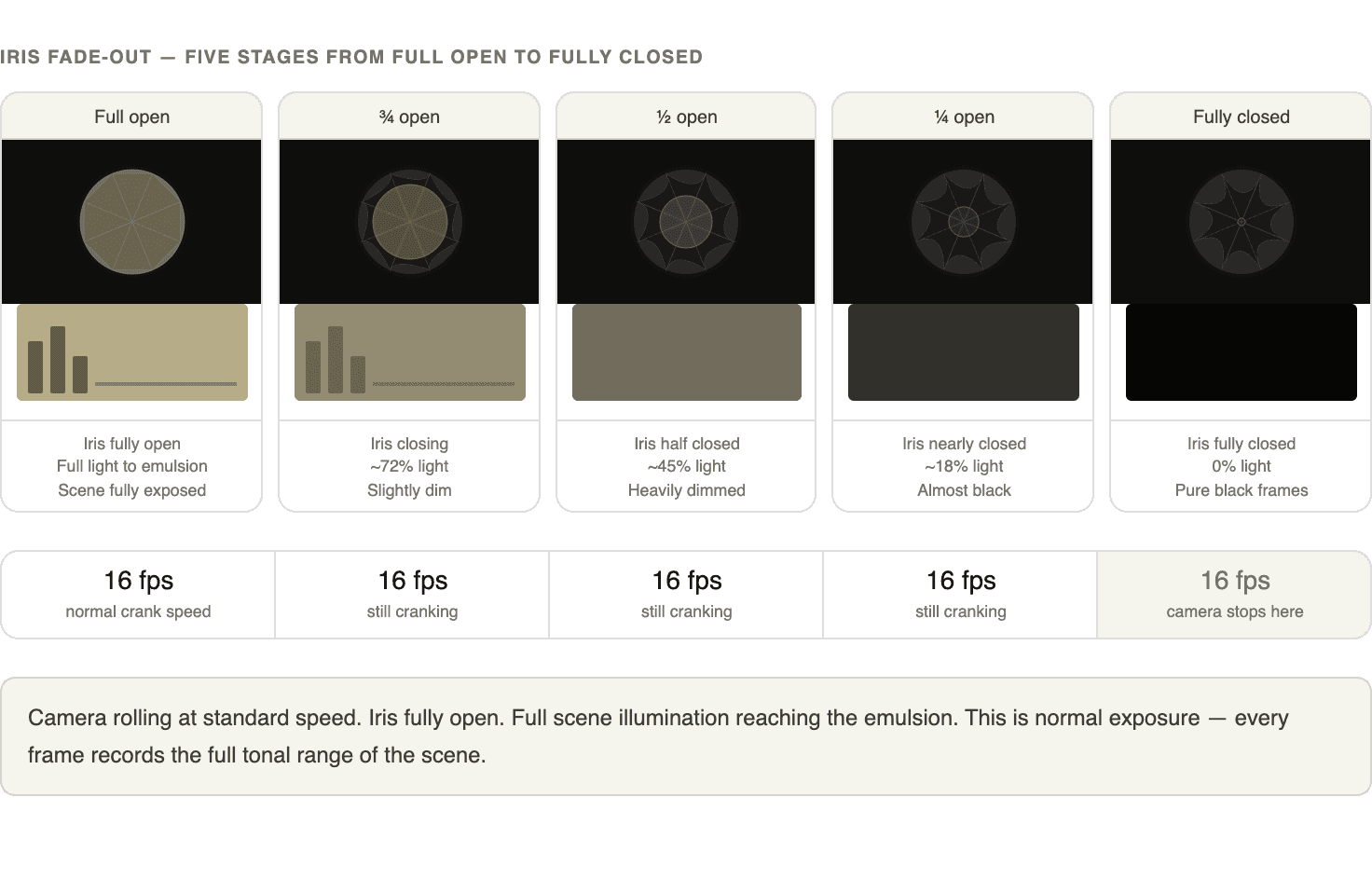
This is the direct ancestor of every dissolve used in film editing from 1900 to the present. He discovered and exploited the basic camera tricks including the dissolve, fade-out, superimposition, and double exposure. The distinction matters: he didn't invent the optical phenomenon, but he was the first to use it as a cinematic grammar. Just like dissolve, the fade-out and fade-in are achieved by gradually closing the camera's aperture while rolling, the fade-out let Méliès end a scene by having the image slowly go to black — signaling conclusion, passage of time, or the end of a sequence. Combined with a fade-in from black at the start of the next scene, it created the fade-to-black structure that remained standard in film editing for decades. Méliès also developed the split screen by covering half the frame, shooting his footage, rewinding the film, covering the other half of the frame, and shooting new footage. The hold-out matte logic underlying it is identical to the multi-pass compositing in The One-Man Band; the split screen is simply that technique applied to a two-zone division rather than seven.
The simulated moving camera via moving subject
L'homme à la tête de caoutchouc (The Man with the Rubber Head, 1901) contains one of his most technically interesting effects: a disembodied head appears to grow larger and larger, inflated by bellows. The effect was not achieved by zooming — Méliès' camera had no zoom. It was achieved by placing the head on a rolling cart on a track and physically moving it toward the fixed lens while the camera rolled.
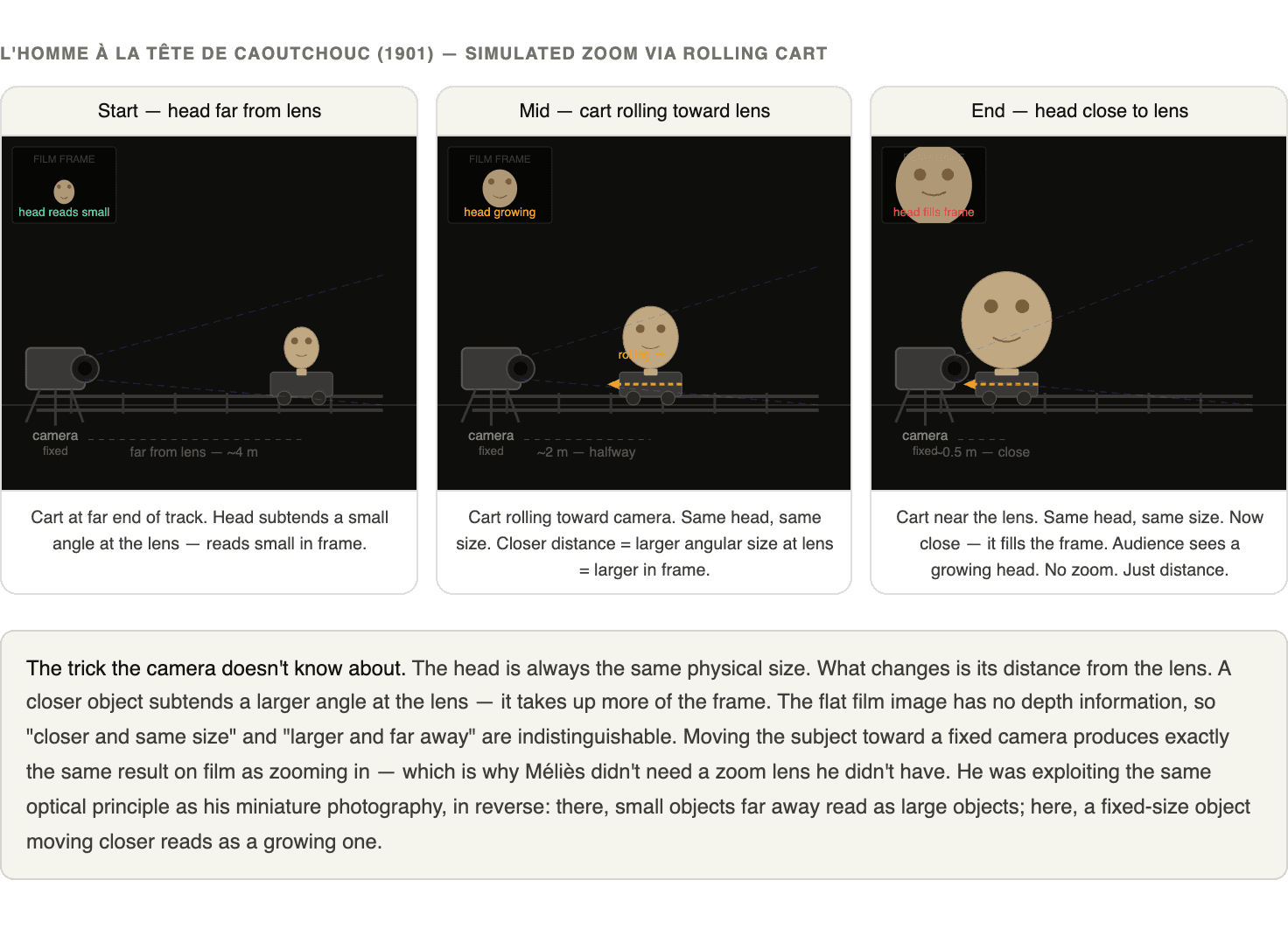
The fixed camera recorded the head approaching — which reads on a flat image as the head growing. Twin versions of Méliès appear in the film, suggesting the multiple exposure technique was combined with the tracking subject to produce the composite. This is the first instance in cinema of a moving subject used to simulate camera movement — a technique that would become fundamental to visual effects cinematography when moving cameras were eventually combined with compositing.
The storyboard as pre-production tool
Méliès was one of the first filmmakers to use written screenplays and storyboards, believing the art form to be one of narrative importance. He drew his shots on small cards before production began. For effects sequences — where timing, spatial arrangement, and the relationship between practical elements and camera position had to be worked out before a single frame was shot — pre-visualization was not optional. You could not improvise a seven-pass multiple exposure composite on the day. Méliès' insistence on designing the shot before shooting it is the origin of pre-visualization as a production discipline, now standard across all VFX-heavy film production.
References
Smith-Victor Corporation, "History." Smith-Victor. https://smithvictor.com/history/ — for the Griffith, Indiana plant, the Henry Plough fatality, and the company's evolution from flash powder to lighting.
"Jas. H. Smith & Company History." Historic Camera Collectors Club. http://historiccamera.com/cgi-bin/librarium2/pm.cgi?action=app_display&app=datasheet&app_id=2679 — for the 1901 fires, the naming of "Victor" flash powder, and the company's manufacturing history.
"Georges Méliès." Wikipedia. https://en.wikipedia.org/wiki/Georges_Méliès — for the attribution of substitution splices, multiple exposures, dissolves, and hand-painted color, and for Méliès as one of the first filmmakers to use storyboards.
"The Man with the Rubber Head." Wikipedia. https://en.wikipedia.org/wiki/The_Man_with_the_Rubber_Head — for the 1901 production details, the pulley-controlled chair on a ramp, the real-time focus pulling, and the multiple-exposure composite of Méliès appearing as both apothecary and disembodied head.
"The secret of The Man with the Rubber Head." Cinémathèque française, via Google Arts & Culture. https://artsandculture.google.com/story/CQXRJW0P8DelIg — for the cart-on-rails mechanism and the perspective trick.
"Storyboard." Wikipedia. https://en.wikipedia.org/wiki/Storyboard — for Méliès' role as an early adopter of pre-production art to visualize planned effects, and the later formalization of storyboarding at Disney in the 1930s.
Museum of Modern Art, "Georges Méliès." https://www.moma.org/artists/3918 — for surviving production drawings from Le Voyage dans la lune (1902), direct evidence of Méliès' pre-visualization practice.
Justin Alvarez, "The 5 Best Films By Georges Méliès." Guernica, 2017. https://www.guernicamag.com/justin_alvarez_the_5_best_film/ — for the attribution of the stop trick, production sketches, split screen, and dissolve, and for the D.W. Griffith quote ("I owe him everything").