Created on
Updated on
Filmmaking in the Age of AI(21): French Impressionism
Renior, Monet, Sisley, Bazille
Preface: Co-written with Claude.
Renoir moved to Paris in 1844 when he was roughly three years old. His family relocated from Limoges when he was a toddler. In 1854, at 13, Renoir dropped out of school and started working at a porcelain factory in Paris. His father was a tailor, I looked it up, he didn't own a tailor shop or anything, he was a tailor by trade, likely working independently or for clients, not a large shop owner. His mother was a seamstress, hand-sewing, garment work, that sort of thing. They were part of the artisan working class in Limoges, in the Haute-Vienne region. Unlike many academic painters of the time, he did not come from elite artistic circles. In the context of 19th-century Paris (especially during the rise of Impressionism), “academic painters” refers to the artists tied to the official system of the École des Beaux-Arts and the Salon (the state-run exhibition system). These painters represented the dominant establishment taste that artists like Renoir, Monet, and Van Gogh were reacting against. The École des Beaux-Arts (officially École nationale supérieure des Beaux-Arts, or ENSBA) is France’s premier school of fine arts. It was the most important official art school in France in the 18th–19th century — basically the center of “academic art” training in Paris.
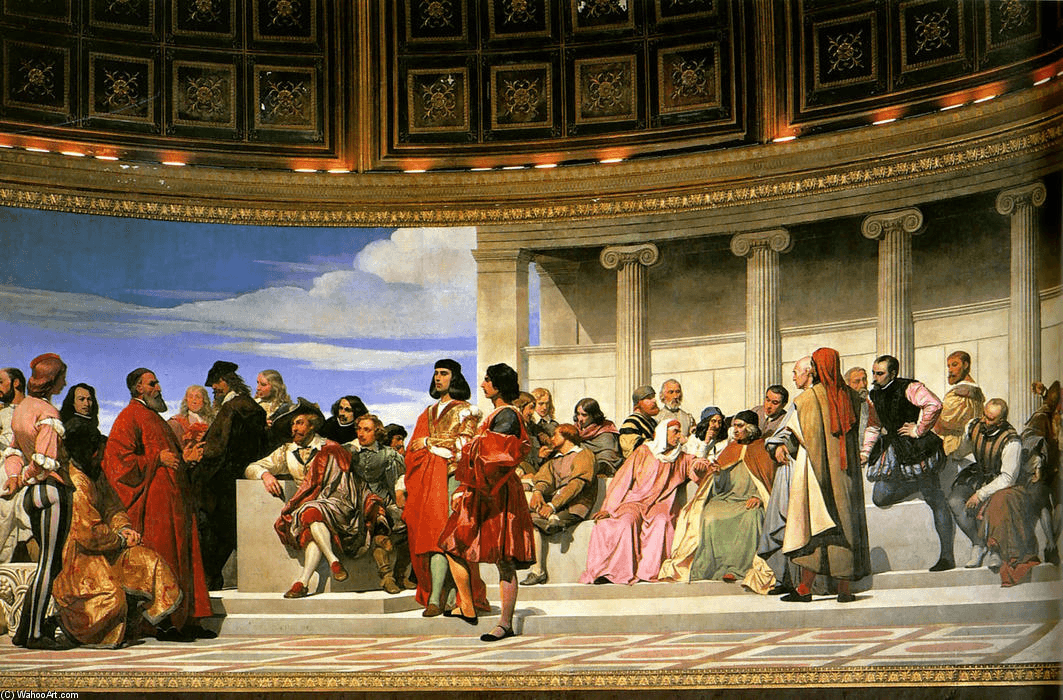
The “Salon” in 19th-century France refers to the official, state-run art exhibition system controlled by the French government and tied to the École des Beaux-Arts in Paris. It was the main gatekeeper of artistic success in France. The Salon de Paris was a huge public exhibition held every 1–2 years, this is where artists submitted works for approval, and it was run by an official jury. If your work was accepted, you became “legitimate” in the art world. If rejected, your career was severely limited. In 19th-century France, the Salon controlled the reputation, sales, commissions, and museum recognition. It was an economic and cultural filter for art careers.
The Salon preferred academic painting, meaning historical scenes (highest prestige), mythology and religion, polished realism, smooth brushwork (no visible strokes) and idealized human bodies, which aligned with artists trained at the École des Beaux-Arts. Artists like Renoir, Monet, Degas, and others were often rejected by the Salon or shown only in small, unfavorable placements. Their work showed modern life, such as cafés, streets, leisure, used visible brushstrokes and focused on light and perception rather than narrative. They created their own exhibitions, starting in 1874: the Impressionist exhibitions. It was the birthplace of Impressionism as a public movement. The first one was in 1874, organized by a group of artists who had been repeatedly rejected by the official Salon, and it included Claude Monet, Pierre-Auguste Renoir, Edgar Degas, Camille Pissarro, Berthe Morisot and Paul Cézanne.
The Impressionist exhibitions were a series of independent art shows in Paris where artists rejected the official Salon system and created their own platform to show modern art. The official Salon rejected their work as “unfinished” or “ugly”, and favored academic painting (mythology, polished realism). Instead of waiting for approval, they just rented a space and exhibited independently. At the first exhibition (1874), Monet showed Impression, Sunrise. A critic mockingly called the group “Impressionists” based on this painting, the name stuck, even though it was originally as an insult. Instead of history, mythology, they showed cafés, streets, rivers, dancers and just everyday modern life. They broke academic rules, they used visible brushstrokes, loose composition, unfinished appearance and focus on light over detail. I guess you could call it "vibe painting". They often painted outdoors (en plein air), quickly, to capture light changes, focused on moments instead of narratives. In total, there were 8 major Impressionist exhibitions: 1874 was the first (Monet, Renoir, etc.), during 1876 to 1886, they continued irregularly. Each one expanded the movement and gradually gained recognition. They changed everything: they broke the monopoly of the Salon, introduced modern art to the public, shifted art toward personal perception and opened the path to Post-Impressionism and modernism.
By the way, Vincent van Gogh never participated in the first exhibitions, since arrived in Paris in 1886 (last phase of Impressionist shows). He was influenced by them, especially color and brushwork, but was never formally part of the core group. I guess you could say, he is Impressionism-adjacent, but not an official member.
Anyways, so Renoir wasn't rich. After moving to Paris, the family needed the money. He was painting pastoral pieces that evoked Rococo decoration of the Ancien Régime, as well as likenesses of Marie Antoinette — a motif he quickly mastered. So his day job as a teenager was essentially hand-painting fine china: flowers, pastoral scenes, portraits of a dead queen on cups and plates. He was immediately exceptional at it. He had a prodigious natural talent and was able to paint far quicker than his fellow artisans. Because he was paid by the piece and worked faster than everyone else, he earned good money and was able to help his parents buy a little cottage.
He was eventually allowed to copy nudes from a book his mother had given him called The Gods of Olympus by the Great Masters — which is a funny detail. His mother handed her thirteen-year-old son a book of classical nudes to copy at work, and his bosses let him. The nude, the portrait, the pastoral scene — those three subjects he practiced obsessively as a teenager on porcelain are more or less the same three subjects that define his entire career as a painter. Then the industrial revolution ended it. A machine was invented to print pictures onto china and he and his colleagues were made redundant. He was around 17 or 18. After that he painted fans, café murals, cloth panels for missionaries — whatever he could get — and spent his evenings saving up until he had enough to enroll in serious art school at 21.
When Renoir enrolled that year, he did both: the official École des Beaux-Arts for evening courses in drawing and anatomy, and Gleyre's private studio for actual painting instruction. These existed side by side in Paris — the École was the state institution, Gleyre's was one of many independent ateliers where working artists took on students. Renoir needed the formal credential of the École, but the real education happened at Gleyre's. Gleyre advocated a return to classical subjects painted in the traditional 18th-century manner — the style beloved of the Salon. So on paper, Gleyre was an academic. But in practice, Renoir later confided that Gleyre could be of no technical help to them, their visions diverged so completely — but that he had the immense merit of leaving them alone. While both schools advocate for the same thing, Gleyre allows Renior to experiment even when he didn't want to follow their teachings anymore. The studio was also cheap. It was not official, access was easy, and above all it was much less expensive than other Parisian ateliers — a significant factor for young artists who were often broke.
Renoir worked quietly and intensely in his corner, astonished by the aristocratic flair of the bourgeois Monet. Monet was already a known personality in the room — elegant, confident, nicknamed "the dandy" by jealous classmates. Renoir, the tailor's son who had spent his teens painting china, was the opposite in background. But they clicked immediately. Sisley and Bazille completed the group. What they shared was not Gleyre's taste but their rejection of it. All four students dreamed of an art that was closer to life and free from past traditions. They were using the studio as a meeting place, not as a source of artistic direction. The rebellious Monet later claimed, with a bit of bravado: "After a month, I said to myself, 'What they do here is stupid.' Renoir and Sisley were my studio mates, and I took them with me. I said, 'Let's go paint outdoors.'" In reality he stayed longer than that, but the direction of travel was clear. When Gleyre's studio closed in 1864 due to financial difficulties, Renoir, Sisley, Bazille, and Monet relocated to the Forest of Fontainebleau to pursue en plein air sessions — painting outdoors, focused on capturing the transient effects of light.
The friendships outlasted the studio entirely. Renoir's immersion in the emerging Impressionist circle deepened through regular gatherings at the Café Guerbois in Montmartre starting around 1866, where he engaged in discussions with Monet, Pissarro, Degas, and the influential Manet — whose bold compositions and modern subjects challenged conventional Salon standards and encouraged Renoir to explore contemporary urban life rather than historical or mythological themes. They were also literally living together through much of the 1860s, sharing studios and surviving on very little. After leaving Gleyre's studio the starving painters lived together and survived mainly on potatoes they had grown themselves. Renoir recalled Monet occasionally pulling off a lavish dinner somehow — turkey with truffles — but those were the exceptions. By 1874, twelve years after they all met in Gleyre's studio, they mounted the first Impressionist exhibition — independently, outside the Salon system entirely. The group that had formed in an academic studio ended up being the force that broke academic painting's monopoly on French art.
Bal du moulin de la Galette (1876) by Renoir
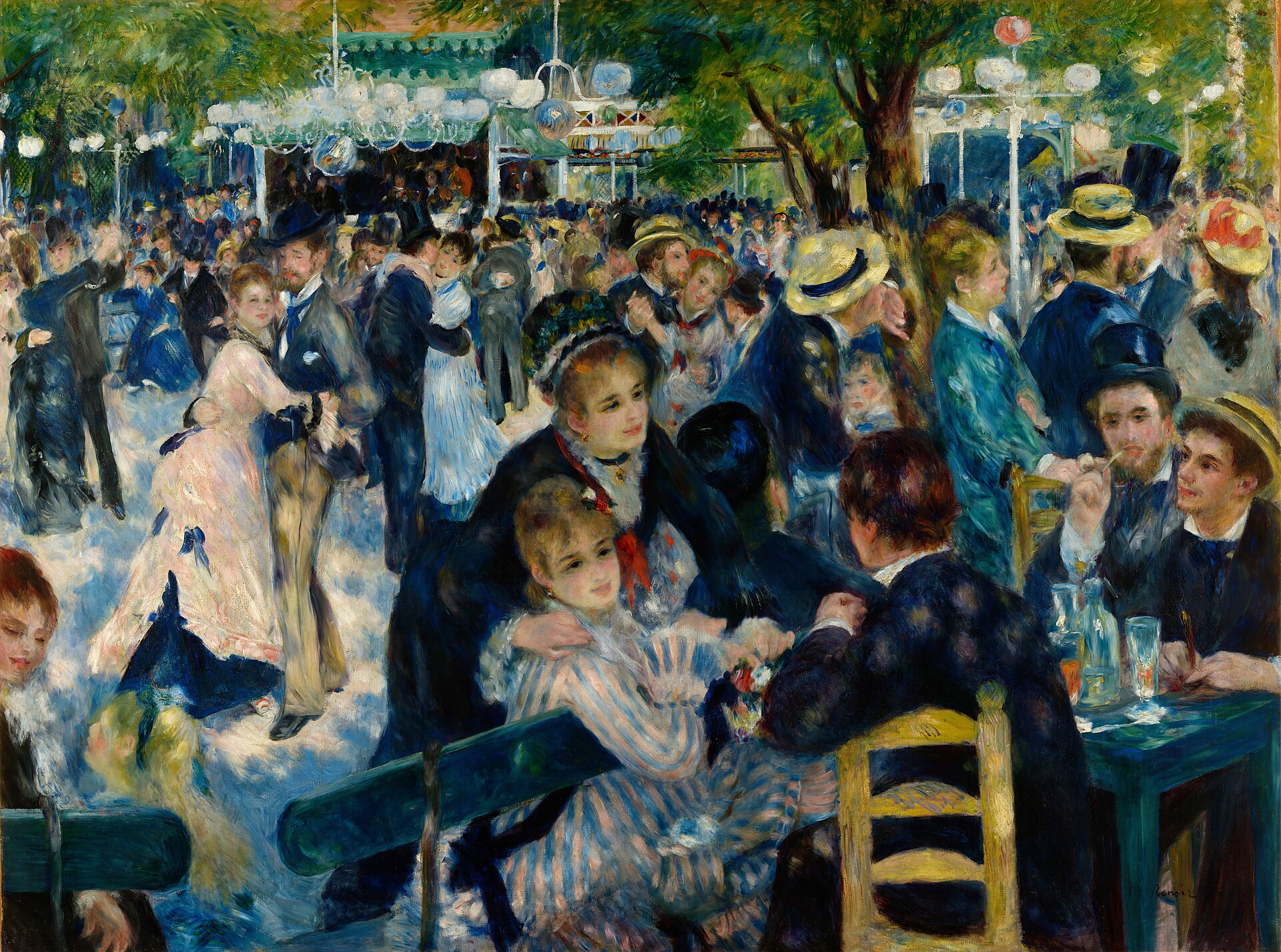
This painting was painted at Bal du moulin de la Galette, year 1876. The Moulin de la Galette is a historic windmill and former dance hall located in the Montmartre district of Paris, France. Built in the early 17th century, it became a celebrated social and artistic landmark during the 19th century, immortalized in numerous paintings by Impressionist artists. This specific painting is done at the actual outdoor dance garden of Moulin de la Galette. Pierre-Auguste Renoir was 35 years old.
This is early-to-mid career, but crucially, he was already part of the Impressionist circle, even though still financially unstable, and not yet “accepted” by the official art establishment, he was in the phase of artistic rebellion, but not security. At the time of Bal du moulin de la Galette, he is finally gaining confidence, painting outdoors regularly, surrounded by friends and models and experimenting with light and social scenes. However, he was still not financially stable, still outside official prestige systems. He was living in Montmartre, painting scenes of local life and friends, trying to sell work privately and participating in early Impressionist exhibitions (starting 1874). This painting reflects his life situation socially embedded in Paris nightlife, but artistically still outside establishment approval, while trying to capture joy without institutional validation. As much as I'd love to expand on impressionist, we must move onto another master that emerged during that time. Picasso. ☀️