Created on
Updated on
Filmmaking in the Age of AI(24): Pissarro
A man from the Caribbean, of mixed European and Creole heritage
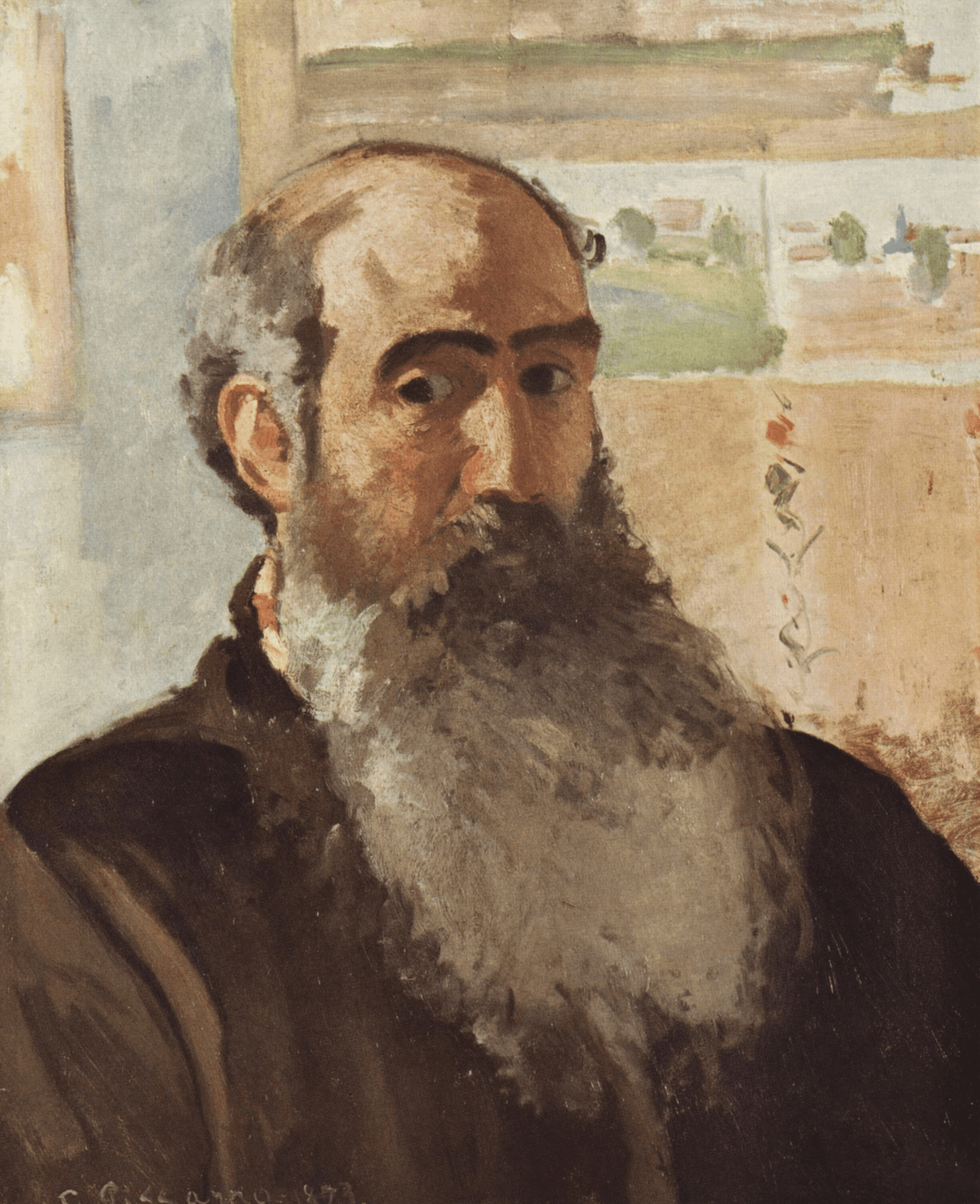
Preface: Co-written with Claude.
When Pissarro arrived in Paris in 1855, the French had a set of ready-made categories for people who looked like him and came from where he came from, and none of those categories were flattering. France's relationship with its Caribbean colonies — Martinique, Guadeloupe, French Guiana — was built on slavery, which had been abolished only in 1848, seven years before Pissarro arrived. The racial hierarchies those colonies had produced did not vanish with abolition. A man from the Caribbean, of mixed European and Creole heritage, with darker coloring than the average Parisian, was immediately placed within a racial taxonomy that had nothing to do with his actual background, his education, his culture, or his capabilities.He also carried his Jewishness in a France where Jewish emancipation — Jews had been granted full citizenship rights during the Revolution — was still contested, where antisemitism was not a fringe position but a mainstream one, and where the memory of periodic legal restrictions on Jewish life was recent enough that people his parents' age had lived under them.The combination — colonial origin, Jewish identity, foreign birth — put him outside French society in multiple simultaneous ways. He couldn't walk into a room in Paris and be anonymous. His origins were readable, or partially readable, and what was read was not neutral.
Before Paris, there was Venezuela. This is the part of Pissarro's biography that most people skip over because it doesn't fit the standard Impressionist narrative, but it's formative. In 1852, twenty-two years old and miserable working in his father's hardware shop in St. Thomas, Pissarro met a Danish painter named Fritz Melbye who was passing through on a journey through South America. Melbye was six years older, trained, serious, and apparently immediately recognizable to Pissarro as someone living the life he wanted. Pissarro essentially ran away with him — left his family, left the shop, left the respectable future his father had mapped out, and spent two years in Venezuela painting. They lived in Caracas and in La Guaira, the port city below it. Pissarro drew constantly — market scenes, street life, the landscape, people of every background going about their lives. These early drawings already show what would define his mature work: interest in ordinary people doing ordinary things, attention to labor and commerce and the texture of daily life, no hierarchy of worthy and unworthy subjects. He was twenty-two and twenty-three, living by his own choices for the first time, in a country that was not his and not anyone else's claim on him. It was a genuinely formative freedom. When he finally went to Paris, he was not a young man leaving home for the first time. He was a man who had already chosen himself once and was choosing himself again.
Monet was Norman. His family was in the grocery trade in Le Havre — working class by the standards of Parisian culture, but French, Catholic, European, part of the unremarkable fabric of provincial French life. When he struggled, when his family disapproved of painting, when the Salon rejected him, he was a Frenchman being rejected by French institutions. The rejection was painful but it didn't question his fundamental right to exist in the country. Renoir was from Limoges, the son of a tailor and a seamstress. Working class, genuinely poor in childhood, grew up in Paris. Again: French, Catholic, embedded in the social world he was painting. His outsider status was economic, not racial or national.Sisley was British-born and in some ways the closest to Pissarro's situation — also never quite belonging, also dying without recognition. But Sisley was Anglo-Saxon, Protestant, part of a culture that occupied a position of prestige in 19th-century Europe. His foreignness was eccentric rather than threatening. Degas came from banking money and Italian family connections and a classical education. His difficulty with institutions was temperamental — he didn't want their approval, or told himself he didn't. That's a luxury of a man who could have had it. Pissarro had none of these default memberships. He arrived in Paris in 1855 with his talent and his Caribbean Jewish background and the memory of two years painting in Venezuela, and he built everything from that position, with no institutional safety net and no cultural default setting that the city recognized as legitimate.
So basically, Pissarro was sent to sent to boarding school in Passy, outside Paris, at age twelve in 1842. This is his first encounter with France, and he starts drawing seriously. Returns to St. Thomas five years later to work in his father's business. He ran away in 1852, at twenty-two he leaves St. Thomas with a Danish painter named Fritz Melbye and goes to Venezuela for two years, drawing and painting. And in 1855, he arrived permanently in Paris. The World's Fair is on, and crucially the exhibition includes a major showing of Corot's work. Pissarro is struck by it deeply and eventually manages to study briefly with Corot, who becomes his first real mentor. In the next following years, he got work accepted at the Salon for the first time, listed as a student of Corot. Meets Monet around this period at the Académie Suisse, a free studio where artists could work from live models without formal instruction. Cézanne was also there. All the way through the 1860s was te decade of grinding poverty and formation. He's painting consistently, developing his landscape practice, getting rejected by the Salon repeatedly. He meets Julie Vellay, a maid working in his mother's household, and they begin a relationship. His mother disapproves — she was bourgeois and Jewish, Julie was Catholic and working class — and withholds support for years. They didn't marry until 1871. They eventually had eight children.
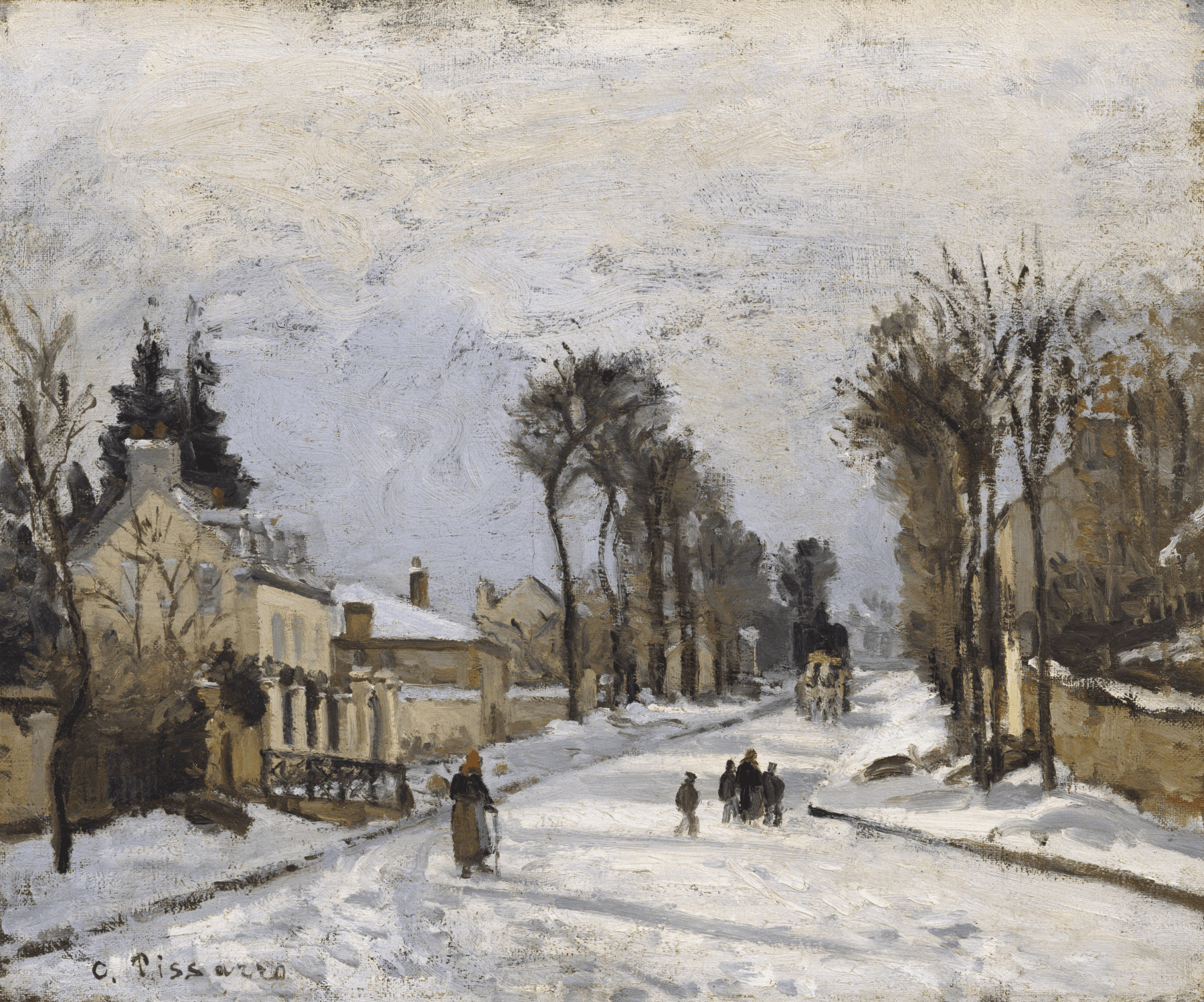
His paintings from the late 1860s and early 1870s, made in and around Louveciennes and Pontoise, are where you first see him fully himself. The Road to Versailles at Louveciennes (1870) depicts road in winter, bare trees on either side, a few figures in the distance, grey sky above. It sounds like nothing. What it is, when you stand in front of it, is an almost physical sensation of cold air and wet ground and the specific silence of a winter road in northern France. He has painted the road not as a flat brown surface but as a complex of greys and ochres and muted purples that track exactly how winter light falls on packed earth. The sky is not background — it is the source of everything, pressing down on the trees, determining the color of every surface below it. The paint handling in these early works is firmer and more structured than Monet's. Where Monet's brushwork was becoming increasingly dissolved and atmospheric, Pissarro used directional strokes that followed the forms — different marks for foliage, for ground, for sky, for the surface of a road. You can read the physical texture of what he's painting in the texture of the paint itself. This structural quality is what Cézanne absorbed when he came to paint beside him in Pontoise — the understanding that Impressionist looseness didn't have to mean the dissolution of form, that you could be atmospheric and architecturally coherent simultaneously.
In 1870, the Franco-Prussian War forces him to flee to London with Julie. German troops occupy his house in Louveciennes and destroy most of the work he'd left behind — an estimated 1,500 paintings, gone. In London he reconnects with Monet, and they both study Turner and Constable. He also meets the dealer Paul Durand-Ruel, who becomes the Impressionists' primary commercial lifeline. In 1874, he had his first Impressionist exhibition. Pissarro is the only artist to show in all eight Impressionist exhibitions, from 1874 to 1886. He's the elder statesman of the group, the one everyone trusts, politically radical and personally generous in a way that makes him the social glue.
From roughly 1872 to 1882, Pissarro and Cézanne worked side by side in and around Pontoise. They painted the same views, the same quarries and hillsides and river bends, and the dialogue between their canvases is one of the most instructive things in 19th-century art. Cézanne in this period was learning from Pissarro how to look — how to build a painting from direct observation rather than from the Romantic dramatic imagination that had dominated his early work. Pissarro was learning from Cézanne something about structural density, about how a painting could have the freshness of direct observation and still feel architecturally resolved. You can place a Pissarro and a Cézanne from this period side by side — same motif, same hillside, same cluster of buildings — and watch two completely different intelligences at work. Pissarro's version breathes, moves, feels like a specific afternoon. Cézanne's version feels like the afternoon distilled into something more permanent, the underlying geometry of the place beginning to emerge through the surface of appearances.
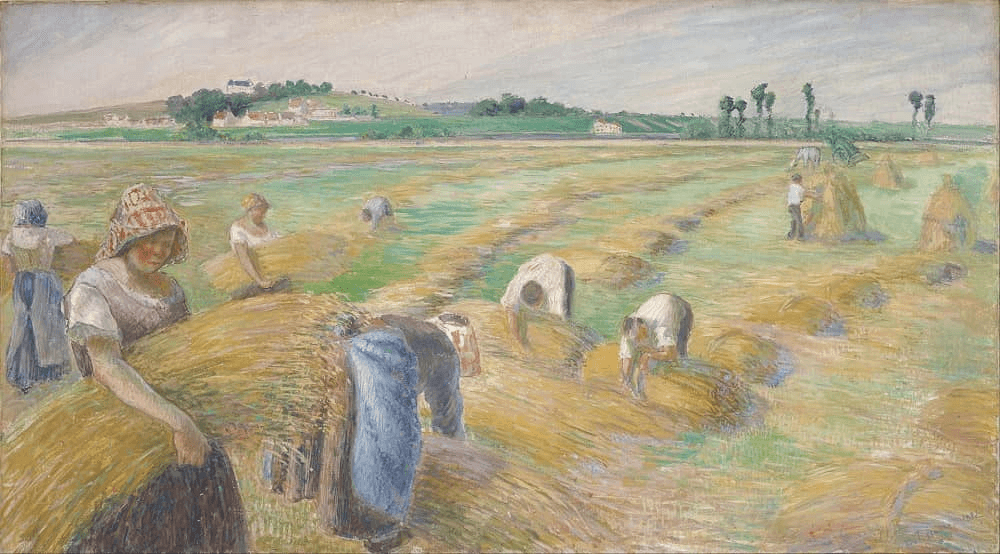
The Harvest (1882) was one of the thirty-six works that Pissarro chose to exhibit at the Seventh Impressionist Exhibition in which all the mainstream Impressionists were represented, with the exception of Edgar Degas. By carefully positioning his figures on and around the receding lines of piles of hay, Pissarro has created a peaceful and rhythmical composition. Eight figures, four men and four women, are preparing the harvest. The concentration of figures on the lefthand side causes an imbalance in the composition, thus making our eye fix immediately on the standing woman wearing a red headscarf. The bushel of hay that she is holding is placed at an angle, leading from the corner of the picture and pointing towards the wide, open landscape on the righthand side. In all of these the human body is shown as an instrument of labor, bent toward the earth or carrying weight or engaged in the concentrated physical work of farming, selling, tending. The figures have mass and purpose. They are not decorating the landscape. They are in it, using it, dependent on it. The academic tradition had a way of painting rural figures that was essentially pastoral — soft light, gentle poses, picturesque poverty that didn't smell. Pissarro's insistence on painting market women and field workers with the same sustained attention that academic painters gave to mythological goddesses was not decorative. It was a statement.This was political in a concrete sense. Anarchist politics held that the labor of ordinary people was the foundation of everything valuable in society, and that this labor was systematically rendered invisible by the culture's preference for celebrating the people who owned rather than the people who worked.
In 1880s, he started living in Éragny-sur-Epte with his large family, painting the countryside and peasant life. Financially it's still a struggle. He begins to have serious eye problems — an infection that would eventually prevent him from painting outdoors at all, forcing him to work from windows and indoors. I found this beautiful painting I particularly like. La Récolte des Foins, Éragny, 1887 by Camille Pissarro.
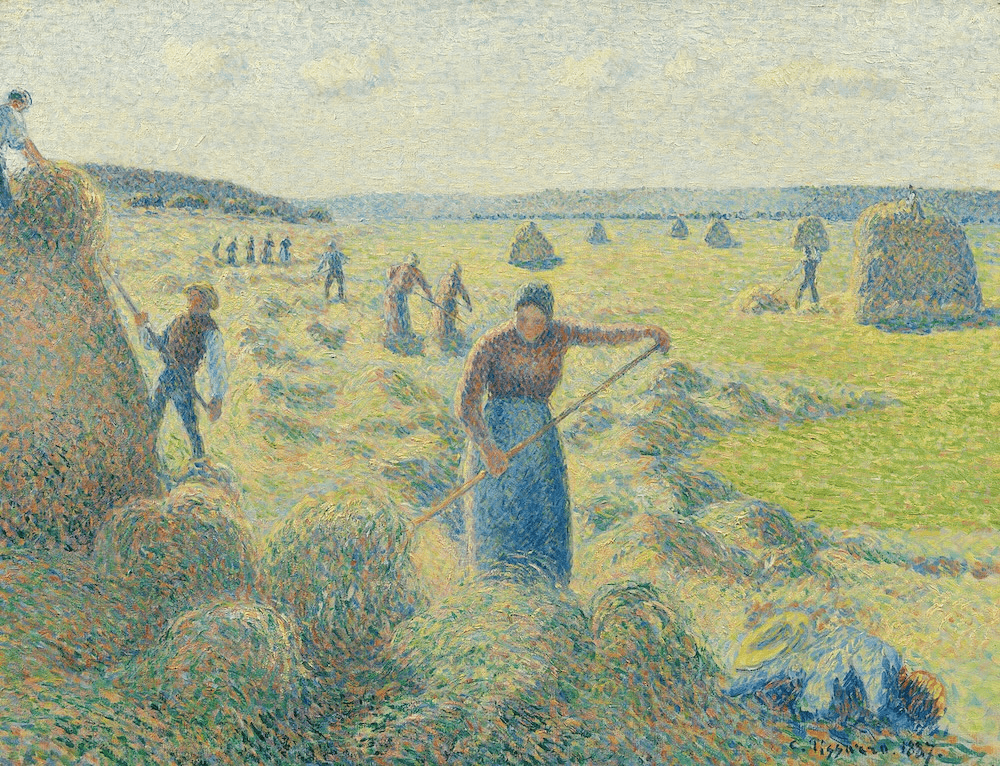
The first thing to establish is where this painting sits in the arc of his career. 1887 is year two of his Pointillist experiment, you can see the style is changing: they are now points. He had encountered Seurat and Signac in 1885, committed to their method entirely by 1886, and was now deep inside the attempt to rebuild his entire practice around systematic dots of pure color. This is not a transitional work — it is him fully committed to a new approach, testing it on a subject he knew more intimately than almost any other. The painting is held at the Van Gogh Museum in Amsterdam, which is appropriate for reasons that will become clear.
At the center of the canvas, a woman uses a hayfork while behind her others do similar work in a brightly lit field punctuated by haystacks(WikiArt). That description is accurate and completely inadequate — the way a plot summary is accurate and completely inadequate. What matters is not what is depicted but what the depiction does. The scene is Éragny in high summer, the hay harvest that organized rural life around a specific window of good weather, collective labor, physical urgency. Pissarro had watched this from his garden every year since moving there in 1884. He knew these fields and these figures not as picturesque subjects but as the actual texture of the place he lived. The woman with the hayfork is not a peasant type. She is a specific woman doing a specific job on a specific afternoon in a place he walked past every day.
The paint was applied in tiny dots and dashes of contrasting colour. Van Gogh Museum But what this means technically is worth unpacking fully because the technique here is not Seurat's and not quite anyone else's either. Seurat's Pointillism was systematic to the point of being almost mechanical — uniform dots of carefully calculated complementary colors, applied with a consistency that gave his paintings their particular humming, slightly static quality. A Sunday on La Grande Jatte feels constructed, deliberate, a painting that knows it is making an argument. Pissarro's dots are not uniform. Look at the surface of this painting carefully and you see dots and dashes and short strokes of varying sizes and pressures — the system is present but filtered through a hand that had been painting outdoors from direct observation for twenty-five years. His marks carry the residue of that experience. They are more alive, more varied, more responsive to what he was actually looking at than Seurat's controlled surfaces.
The field in the foreground shimmers with yellows and golds and warm greens, the colors of cut hay in full summer sun. The sky above holds blues and whites and the faintest warmth, modified by the heat rising from the field below. The figures are built from the same dot structure as everything around them — they are not painted differently from the landscape, which means they emerge from it and belong to it rather than being placed in front of it. This is the optical principle at work: from a distance, Pissarro's color palette, applied in systematic dots and dabs, forms a unity and increases the painting's light and color intensity. Google Arts & Culture Up close it's a field of separate colored marks. Step back and it resolves into the most convincing summer heat you've ever seen in paint.
By 1888 the doubts were already accumulating. He wrote to Lucien — and the letters from this period are some of the most honest documents in Impressionist history — that the method was strangling him. The problem was not the theory. The theory was sound. The problem was that he was a painter who needed to respond to what was actually in front of him, and Pointillism required pre-meditation at every mark. You could not be surprised by the light. You could not chase something you hadn't planned for. The system was smarter than the moment. There was also a practical crisis. His eyes, which had been giving him trouble intermittently since the 1870s, were worsening. Painting outdoors in wind — the condition of his entire career up to this point — was becoming painful, then dangerous to his already compromised vision. The lacrimal duct infection that would eventually force him indoors entirely was establishing itself as a permanent condition rather than a recurring problem. By 1890 he had formally abandoned Pointillism. But he did not return to 1885. What he came back to was a looser handling that carried everything the experiment had taught him about color relationships — the complementary shadows, the optical mixing, the understanding that adjacent colors modify each other — without the mechanical constraint of the dot. His post-Pointillist paintings from the early 1890s are richer in color than anything he made before 1885. The detour had been necessary even though the destination wasn't where Seurat intended.
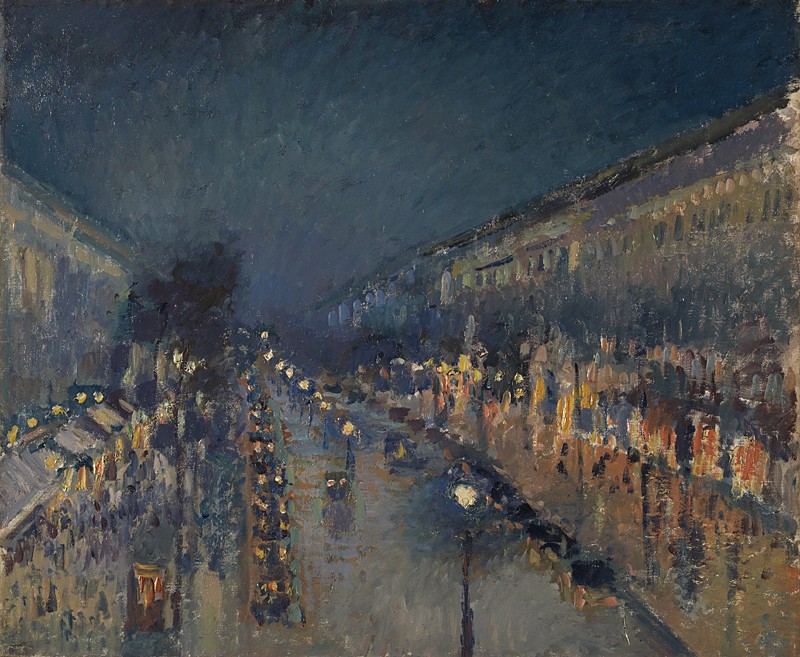
The paintings Pissarro made from hotel windows in the 1890s and early 1900s are his final achievement and arguably his most radical. The eye disease that made outdoor painting painful forced him indoors, and indoors meant Paris — hotel rooms overlooking the Boulevard Montmartre, the Boulevard des Italiens, the Avenue de l'Opéra, the Place du Théâtre Français. He painted each view repeatedly across different seasons, different times of day, different weather — applying to the city the serial logic Monet was applying to haystacks and cathedrals simultaneously, though neither man was directly imitating the other. The Boulevard Montmartre at Night (1897) is one of the most astonishing things he ever made — the wet boulevard below reflecting the gas and electric lights, the crowd reduced to flickers of color and movement, the whole thing pulsing with a kind of urban energy that is completely different from anything else in Impressionist painting. He was sixty-seven when he painted it, nearly blind, working from above. What the elevated viewpoint gave him — what he perhaps couldn't have found any other way — was a particular relationship to the city. He was of it and above it simultaneously. The crowds below were his world and not quite his world. The beautiful indifferent streets went about their business while he watched, while France argued about whether men like him belonged there, while the Belle Époque performed its optimism.
There was a political event that happened during that time that had influenced all the impressionists quite a bit. It's about this dude called Alfred Dreyfus, who was arrested in October 1894, accused of passing military secrets to Germany. The evidence was fabricated. The trial was a scandal of institutional antisemitism dressed up as military justice. He was convicted, publicly degraded, sent to Devil's Island. For Pissarro the Affair was not a political abstraction. Everything we discussed earlier — the Caribbean Jewish background, the outsider status that was never metaphorical — meant that the public argument France was now having about whether Jewish people were authentically French was an argument about him and his children. He was sixty-four years old and France was asking, again, whether men like him belonged there. The friendships that ended in this period were not casual losses. Degas — a man Pissarro had known for thirty years, a painter whose work he genuinely admired, who had been part of the same circle, the same exhibitions, the same arguments about what painting should do — became someone he could no longer be in a room with. Renoir's antisemitism, which had been present but subterranean for years, surfaced fully. The social world of Impressionism, already fragmenting as the painters aged and dispersed, broke along lines that were uglier than aesthetic disagreement. He kept painting. This is the fact that matters most about Pissarro in the 1890s. Whatever was happening in France, whatever was being said in the press and the cafés and the studios, he kept painting.
This is one of 14 views of the Boulevard Montmartre in Paris that Camille Pissarro painted in 1897. These include the boulevard seen in snow, rain, fog, mist and sunlight, and in the morning, afternoon, at sunset and at night. The picture is the only example of a night painting by Pissarro. Pissarro was especially fascinated by the different types of artificial light, which are reflected on the wet pavements. The cool white of the newly installed electric street lamps along the centre of picture contrasts with the warm yellow gaslight of the shop windows and the oil-burning lamps of the cabs that line the street. The brushstrokes have an almost abstract gestural quality, as Pissarro applied the paint as a patchwork of dashes and daubs to suggest the passing crowds and traffic, and the city’s shimmering lights.
The full shape of Pissarro's career is only visible from a distance — and the distance reveals something that wasn't obvious to his contemporaries. He did what almost no major artist manages: he kept developing. From the structured landscapes of the 1860s through the figure paintings of the 1870s and 1880s through the Pointillist experiment through the late boulevard series, he was always moving, always testing, always willing to find himself not yet finished. The career has no plateau, no period of coasting on an achieved style. Cézanne built his mature vision from Pissarro's foundation. Gauguin's early work is unthinkable without him. Seurat's Pointillism found its most serious convert in a man thirty years his senior who gave it five years of genuine commitment before concluding honestly that it wasn't quite right for him. He influenced everyone and was contained by no one. He died in 1903 still looking, still painting, still paying attention to the world with the completeness of a man who had spent fifty years learning how to see it clearly. ☀️