Created on
Updated on
Filmmaking in the Age of AI(26): Degas
one of the most quietly horrifying social systems of the Belle Époque
Preface: Co-written with Google Search.
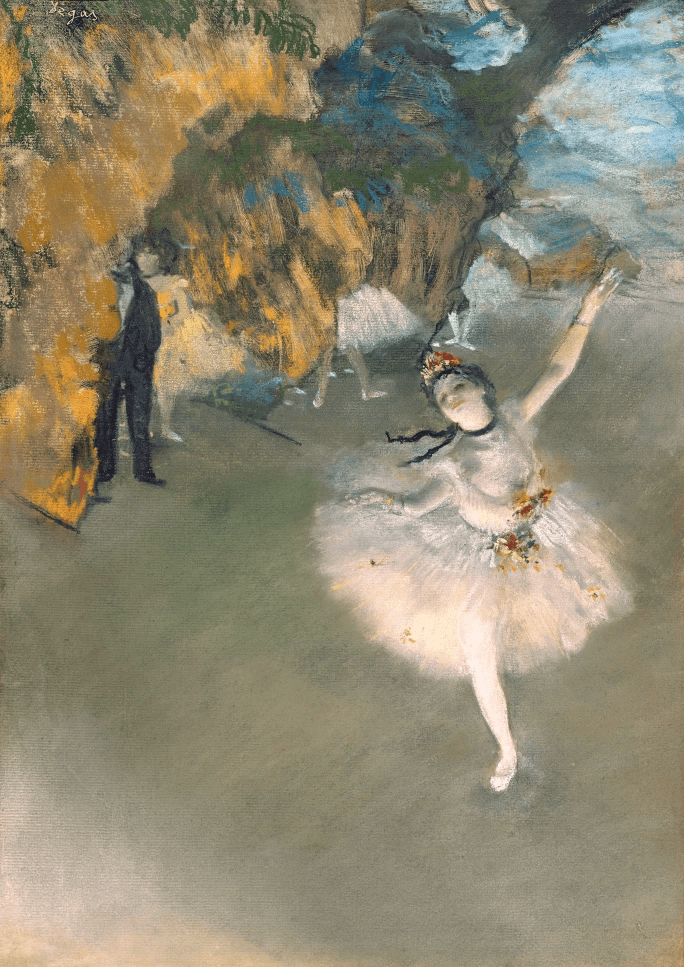
Edgar Degas (1834–1917) was a founding member of the Impressionist movement, yet he famously hated the label, preferring to be called a Realist. Unlike his peers who painted outdoors to capture natural light, Degas worked exclusively in his studio, meticulously planning his compositions from memory, photographs, and sketches. He is best known for his obsession with ballet dancers, producing approximately 1,500 works that captured the unglamorous, gritty reality of their lives backstage.
During his life, Degas only ever exhibited one sculpture: the controversial Little Dancer Aged Fourteen. When Degas exhibited it at the 1881 Impressionist show, it was the only sculpture he ever publicly displayed. And he showed it not in marble or bronze — the respectable media of "serious" sculpture — but in wax, with real human hair, a real linen bodice, a real tutu, and real ballet slippers. Critics and audiences were genuinely disturbed. This wasn't a statue. It occupied some uncanny middle ground between art object and effigy, doll and corpse. Degas rendered Marie van Goethem — the real girl who modeled for it — with what critics read as the facial features of a criminal type. Physiognomy, the pseudoscience of reading moral character from bone structure, was mainstream in 1881. Several reviewers explicitly said her face showed "the promise of vice," "bestial," "dangerous." They weren't just being cruel — they were applying a widely accepted framework that literally saw low-class girls with certain features as pre-criminal.
Marie van Goethem was a petit rat — the bottom rung of the Paris Opéra Ballet. These girls, almost all from working-class or destitute families, were known to be kept as mistresses by wealthy male opera subscribers who had backstage access as a class privilege. Everyone in Paris knew this. I can't believe this, but it's true. Back in the day, dudes just had to go see Ballet and they can turn any girl there into their mistress. Often underage in today's sense. The ballet was a legalized transaction. Degas knew it. His backstage paintings make that world explicit. So showing this particular girl, at this particular age, mid-career — before the "fall" that everyone understood was coming — was a statement that made bourgeois audiences profoundly uncomfortable precisely because they recognized what they were looking at. This is very intense, I'm starting to wonder if this is the reason why Degas was obsessed with Ballet. Not the art, but this opera system as a morbid reflection of the sick society at the time. It is still sick today. The critics who called her face degenerate and her future inevitable were the same class of men whose money made that future inevitable. Degas put that contradiction in a glass case and made people stand in front of it.
This is one of the most quietly horrifying social systems of the Belle Époque, and it operated almost entirely in plain sight. The Paris Opéra had a class of wealthy male subscribers called abonnés. Their subscription didn't just buy them a seat in the house — it bought them physical access to the backstage, specifically the foyer de la danse, the warm-up and waiting room where the dancers gathered before and after performances. This was a formal, institutionalized arrangement. The Opéra management permitted it. It was built into the financial architecture of the institution. These men were not sneaking backstage. They walked through a door they had paid to walk through, and they mingled with girls as young as twelve or thirteen while they stretched, waited, and changed. The foyer de la danse was, functionally, a showroom.
Here's where it becomes even harder to look away: the mothers were often present too, and they were not there to protect their daughters. They were there to facilitate introductions. A working-class family with a daughter in the Opéra corps understood — not as a dark secret but as practical reality — that the real economic value of a ballet career wasn't the dancer's wage, which was poverty-level, but the patronage she might attract from an abonné. The mother's job was to manage that relationship toward the best possible outcome for the family. This wasn't individual moral failure. It was a rational response to a system designed to make it the only option.Degas painted the mothers constantly — sitting in the wings, watching rehearsals, waiting. They're a recurring presence in his ballet work, and their presence is never incidental.
Marie's family was exactly this profile. Her mother, Antoinette van Goethem, was a laundress — a common occupation for women on the economic margin in that part of Paris. All three van Goethem daughters were enrolled in the Opéra ballet school. Not one. All three. That's not a coincidence or a passion for dance — that's a family strategy. Marie was eventually expelled from the Opéra for missing too many classes. The likely reason: she had already been taken up by a patron and the classes had become beside the point. The ballet training was always partly a pretext — a structure that gave the whole arrangement a veneer of respectability, a reason for the girl to be there, a reason for the men to be watching.
Degas was himself an abonné. He had that backstage access. His ballet paintings — which the public adored as charming images of grace and beauty — are painted from the perspective of a man standing in that foyer, watching girls who didn't really have the option to ask him to leave. The paintings are beautiful and they are also documents of surveillance.The Little Dancer makes this legible in a way the paintings can let you avoid. The sculpture doesn't let you aestheticize her into a symbol of elegance. She stands there — specific age announced in the title, specific class announced by her face and posture, specific future announced by everything Paris already knew about girls like her — and she looks out at you with an expression that critics found insolent but which reads, with modern eyes, as exhaustion. She is fourteen. The title is not incidental. Degas chose to tell you exactly how old she is.
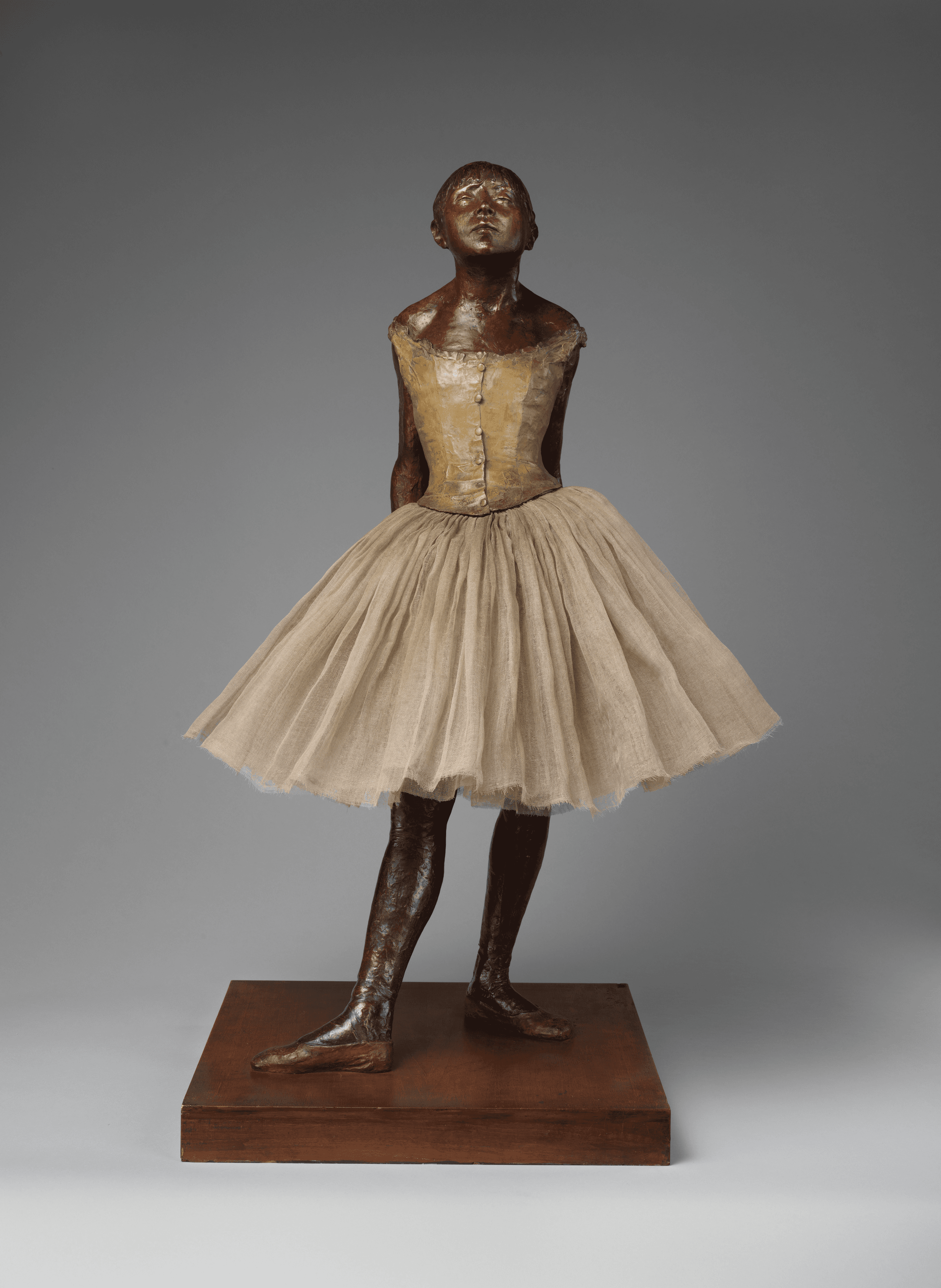
However, when he died, friends discovered over 150 wax and clay sculptures in his studio that he had used as private studies for movement. That's a lot without ever having a place to exhibit them. I guess he didn't care. He was obsessed, and for sure, depressed as well, judging by what he made. The sadness is hitting me so intensely. ☀️