Created on
Updated on
Filmmaking in the Age of AI(27): King Kong (1933)
The Dunning Process
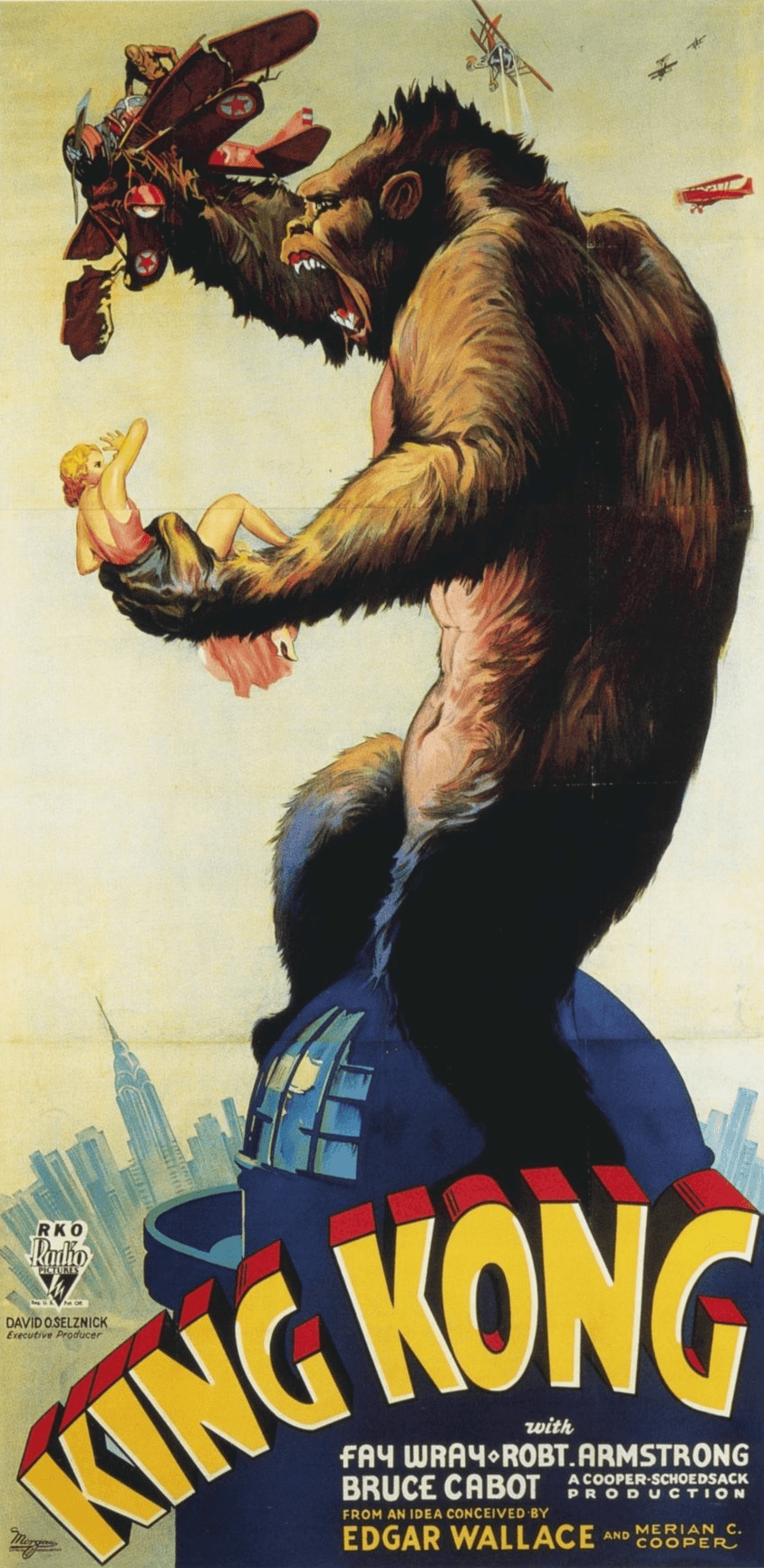
On March 2, 1933, King Kong opened simultaneously at the 6,200-seat Radio City Music Hall and the 3,700-seat RKO Roxy across the street(King Kong Wiki). It attracted over 50,000 people on its first day, and after its first four days set an all-time attendance record for an indoor event(AFI|Catalog). Every one of its ten shows per day sold out. Over those four days it grossed $89,931. The production cost was $672,254.75 — which included costs carried over from the canceled. Roosevelt declared a four-day national bank holiday on March 6, 1933 — four days after Kong opened — as an emergency measure to stop bank runs during the Depression. Every bank in the country closed. People couldn't access cash. Ticket sales dropped sharply in week two, right in the middle of what should have been the film's peak momentum. Despite that, during its first run the film made a profit of $650,000. Before its 1952 re-release it had accumulated worldwide rentals of $2,847,000. Wikipedia That 1952 re-release added another $1.6 million in the US alone.
The movie invented the monster movie as a genre. Universal had already established that horror could sell with Dracula and Frankenstein in 1931-32, but those were rooted in European Gothic tradition — castles, aristocrats, literary source material. Kong was something different. It was American in its setting, its energy, its spectacle logic. It established that you could build a film around a creature that didn't exist in any prior literary or cultural tradition and have audiences accept it completely. The beauty-and-the-beast emotional structure is the other major cultural contribution. The idea that the monster's downfall comes from tenderness rather than just violence gave the film a tragic register that pure horror movies didn't have. That template — the sympathetic monster — runs directly through Godzilla, through every creature feature that asks you to feel something when the creature dies. Tomoyuki Tanaka stated explicitly that he was influenced by King Kong when developing Godzilla .
the film is built on imagery that maps onto racial fears that were very much alive in 1930s America. The specific anxiety it's tapping into is the fear of Black male sexuality threatening white womanhood which was one of the most charged and violent social preoccupations of that era. Lynchings were still happening regularly. The Scottsboro Boys trial was 1931, two years before Kong. Nine black teenagers falsely accused of raping two white women on a train in Alabama in 1931. The case became one of the most significant legal and civil rights events of the decade. The accused ranged in age from thirteen to nineteen. They were arrested, tried, and most were sentenced to death within weeks . Trials that lasted less than a day each, with all-white juries, in a deeply hostile environment. The convictions were eventually appealed to the Supreme Court twice. The first case, Powell v. Alabama in 1932, established that defendants in capital cases had a right to effective counsel — a landmark ruling. The second, Norris v. Alabama in 1935, ruled that systematically excluding Black people from juries was unconstitutional. Most of the Scottsboro Boys spent years in prison despite the convictions being legally undermined. The last surviving member, Clarence Norris, wasn't officially pardoned by Alabama until 1976.
The cultural atmosphere around race and sexual threat was explicit and paranoid in ways that are hard to overstate. Kong isn't literally a Black man. But the visual and narrative coding is hard to read as accidental — a dark, powerful, "primitive" creature from Africa, brought in chains to civilization, who becomes obsessed with and possessive of a blonde white woman, and is ultimately killed for it. That's a recognizable story shape to a 1933 American audience, and it lands in a very specific cultural place. The island natives reinforce this — they're depicted as savage, rhythmic, sexually charged, worshipping the creature. The film draws heavily on colonial imagery of Africa as a place of primal darkness. None of this was unique to King Kong. Hollywood in this era routinely encoded these anxieties. What makes Kong worth examining specifically is that the film also asks you to sympathize with the creature which creates a genuine tension. You're being asked to mourn something the film has simultaneously coded as a racial threat. That contradiction is part of why scholars keep returning to it.
It doesn't invalidate the film's technical achievement but it's part of what the film was culturally doing and why it resonated the way it did with that specific audience at that specific moment. It was re-released four times before 1960. It became one of the first major films to have a significant television afterlife in the 1950s. Peter Jackson made a three-hour remake in 2005 because he'd been obsessed with the original since childhood. The image of Kong on the Empire State Building is one of a handful of cinema images that has fully crossed into general cultural iconography, recognizable to people who have never seen the film.
RKO Radio Pictures, the studio that made the movie, was one of the five major Hollywood studios during the studio system era, alongside MGM, Warner Bros., Paramount, and Fox. They never had the stability of the other majors. They went through constant ownership changes, financial crises, and leadership turnover throughout the 30s and 40s. Howard Hughes eventually bought controlling interest in 1948 and basically ran it into the ground by the mid-50s. The studio ceased original production in 1957. But during their peak years they produced genuinely important work — King Kong, the Astaire-Rogers musicals, Orson Welles's Citizen Kane, Notorious. A lot of it happened despite the instability, not because of conditions were favorable. In the context of King Kong, the Depression-era financial pressure is relevant because it meant Cooper had to justify the budget by reusing what Creation had already built — the sets, the models, O'Brien's team. The film was ambitious but it was also, from the studio's perspective, a way to salvage a failed investment by redirecting it toward something with a stronger commercial hook.
The origin is Merian C. Cooper. He was the driving force, and the story of how it became a project is genuinely interesting. Cooper was the producer at the studio at the time. He was an adventurer before he was a filmmaker. He'd been a WWI pilot, a POW who escaped on foot through Germany, and had led expeditions to Africa and Persia that he filmed as documentary features. He had a fixation on gorillas that bordered on obsessive — he'd been reading about them, thinking about them, sketching ideas involving a giant gorilla battling Komodo dragons for years before he ever set foot in Hollywood. The idea came from Cooper's desire to make a film about a giant gorilla struggling against modern civilization. The beauty-and-the-beast dimension came later, after he joined RKO in 1931. The project crystallized when Cooper saw O'Brien's work on Creation — the prehistoric adventure RKO had been developing. Cooper recommended the cancellation of O'Brien's project because he thought the story was boring, but he was impressed by the effects work and saw how it could be used to facilitate his own pet project about a giant gorilla battling Komodo dragons.
Willis O'Brien was the effects supervisor on Kong, and the person most responsible for why the film actually works technically. He was a self-taught animator who had been experimenting with stop-motion since around 1914. Before he ever worked on a feature film he was showing miniature stop-motion dinosaur figures at the 1915 San Francisco World's Fair — just as a personal project, to see if he could make them convincing. That caught the attention of a producer who hired him to make a short film, and his career in creature effects began from there. By the time Kong came along he was the undisputed authority on stop-motion animation in Hollywood. His work on The Lost World in 1925 had already demonstrated that you could put fabricated prehistoric creatures on screen and have audiences accept them as real. But Kong was a different scale of problem — not just making creatures move convincingly, but making a single creature the emotional center of a feature film, and integrating it with live actors in ways that had never been attempted so extensively. His personal life during this period was quietly tragic. His wife had been diagnosed with cancer and tuberculosis while Kong was in production. His two sons both contracted tuberculosis. He was carrying all of that while building one of the most technically ambitious films ever made. He never got the recognition his work deserved during his lifetime. The industry repeatedly passed him over. He died in 1962, largely forgotten by the mainstream.
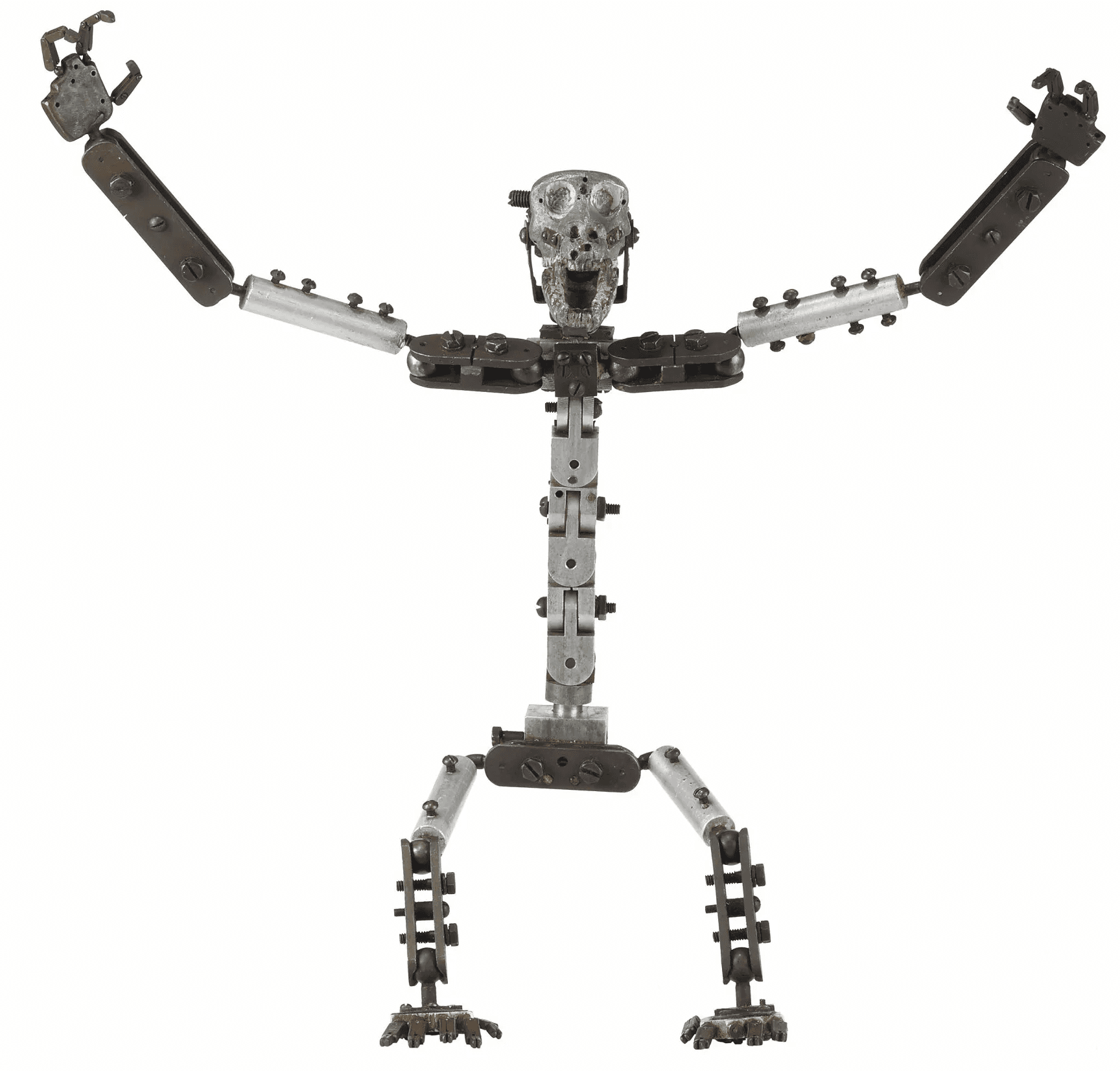
The Kong puppets were built by Marcel Delgado, O'Brien's longtime collaborator. The internal skeleton was machined aluminum — ball-and-socket joints at every anatomical point where a real primate would have articulation. Shoulders, elbows, wrists, individual fingers, hips, knees, ankles. Each joint had enough friction to hold its position when released but could be moved with finger pressure. That friction balance was critical — too loose and the puppet would drift between frames from its own weight, too tight and the animator couldn't make fine adjustments. Over the aluminum skeleton went layers of foam rubber shaped to suggest musculature — not just padding, but sculpted to follow the contours of where a real gorilla's muscle groups would be. This is what gave Kong his physical credibility. When he moves, mass shifts. His shoulder rotates and you can see the suggestion of a deltoid engaging. That's the foam rubber doing its job.
Over the foam went latex skin, and over that the rabbit fur. The fur choice was specific — rabbit fur has a fine, dense texture that reads well at the scale these puppets were being photographed. Coarser fur would have looked like a carpet at close range. The problem with rabbit fur is that it's directional — it has a natural grain — and every time the animator's fingers touched the puppet to reposition a limb, they disturbed the fur. Frame to frame, the fur would shift slightly, creating a subtle rippling effect in the finished film. You can see it if you look closely. It became an accepted artifact of the medium rather than a solved problem.
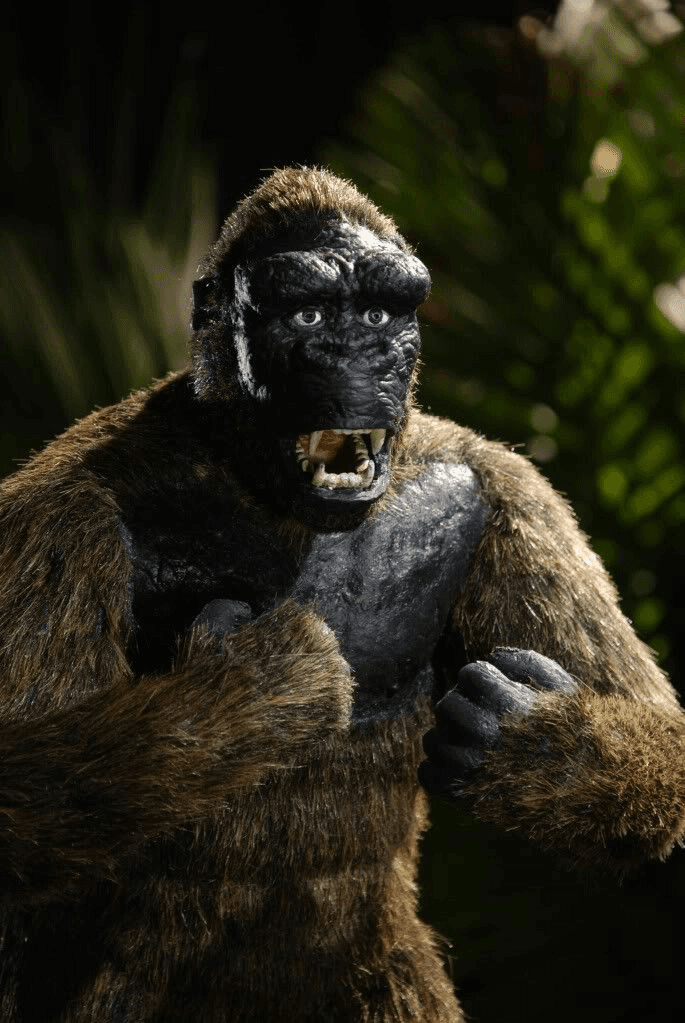
The animator — primarily O'Brien, sometimes his assistant Buzz Gibson — would make an adjustment to the puppet, move a limb a fraction of an inch, reposition a finger, shift the weight distribution slightly, and then step back and shoot a single frame. Then do it again. At twenty-four frames per second, one second of finished film required twenty-four individual adjustments and twenty-four individual exposures. A three-minute sequence required over four thousand. The surface gauge was the tool that made this possible at any level of precision. It was essentially a pointed needle on an articulated arm mounted on a heavy base — stable enough that it wouldn't move between setups. Before shooting a frame, the animator would position the gauge needle so it just touched a reference point on the puppet — the tip of a finger, the end of the nose, a specific point on the shoulder. After shooting the frame and making the next adjustment, the gauge told him exactly where that reference point had been. Without it, there was no reliable way to maintain spatial continuity across thousands of frames.
The lighting created another layer of discipline. The puppet was being shot on a miniature set under controlled artificial light. If anyone walked into the soundstage and then walked out, the air movement and the brief change in ambient light could create a visible inconsistency in the next frame. So once a shot began, the crew effectively couldn't leave. They worked in long unbroken sessions — sometimes twenty hours straight(!!!!) — to maintain the integrity of a single sequence. Great art requires great work…I see. What the animator was actually trying to do in each adjustment was think ahead several frames simultaneously. Stop-motion that moves in perfectly equal increments between frames looks mechanical — robotic. Real movement accelerates and decelerates. A creature reaching for something starts slow, accelerates through the middle of the motion, and decelerates as it arrives. To achieve that the animator had to vary the size of each adjustment — small increments at the start, larger through the middle, small again at the end. All of this calculated mentally, in real time, while crouching over an eighteen-inch puppet under hot lights.
The Kong/T-Rex fight is where this discipline is most visible. Seven weeks for three minutes of screen time. Two puppets moving simultaneously, interacting physically — biting, wrestling, throwing weight against each other. Every frame required repositioning both puppets in relation to each other while maintaining the logic of a genuine physical struggle. The spatial relationship between the two creatures had to be consistent across thousands of frames, the contact points between them had to feel like real force was being exchanged, and the whole thing had to read as spontaneous rather than calculated.
You have an eighteen-inch puppet on a miniature set. You have a full-sized human actress on a full-sized set. You need them to appear to be in the same physical space, at a scale that makes the puppet look fifty feet tall. How do you put those two images together onto a single strip of film without the seam being visible? In 1933 there was no digital compositing. There was no optical printer sophisticated enough to cleanly combine multiple image sources in post. Everything had to be solved either in-camera or through photochemical processes that were imprecise and expensive. O'Brien used three different methods depending on what each specific shot required.
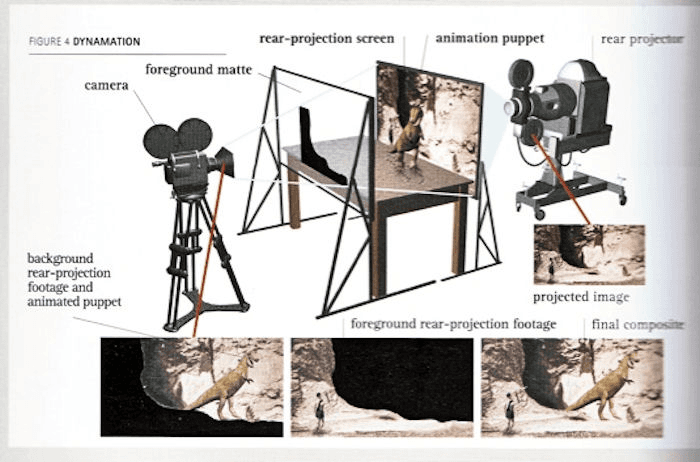
Rear projection was the most straightforward. You take your completed stop-motion footage of Kong and project it onto a large translucent screen from behind. Your live actor performs in front of that screen. The camera films both simultaneously — the actor in the foreground, the projected Kong image behind. From the camera's perspective they appear to share the same space. This is what we talked about previously in The Hobbit, this is called forced perspective. The practical advantage was that the actors could actually see what they were reacting to. Fay Wray wasn't imagining a giant gorilla — she was looking at one, projected at scale behind her. That's why the performances in Kong feel grounded in a way that a lot of greenscreen work doesn't. The actors had something real to respond to physically and emotionally. The limitation was scale and brightness. The projected image had to be bright enough to read on film, which meant the projection equipment was running hot, and the image degraded over long takes. It also meant the lighting on the actor had to be carefully matched to the lighting in the stop-motion footage — if Kong was lit from the left, the actress had to be lit from the left, or the composite would feel wrong even if the audience couldn't articulate why.Dodge Dunning, who worked as the technician operating the Dunning process on Kong alongside his father used a process invented by his mom, Carroll Dunning to solve this problem in King Kong. Instead of projecting Kong behind the actors, it needed to composite actors into the stop-motion footage, so they appeared to be in the same miniature environment as the puppet.
He has two things that exist in completely separate physical spaces. A real woman on a real stage. An eighteen-inch puppet on a miniature set in another part of the building. He needs them to appear in the same photograph together. The only thing that exists is light hitting chemical film emulsion and creating a permanent image. Once light hits the film and exposes it, that area of the film is committed. You can't erase it. You can't layer things on top of it later in any precise way. So the question becomes: how do you get two separately photographed things onto one strip of film without one obliterating the other?
So the key insight is: certain pairs of colors cancel each other out on film emulsion. They're called complementary colors. Yellow-orange and blue are a complementary pair. When yellow-orange light hits an area of film that's already been treated with blue, the two neutralize each other — that area of the film behaves as if it was never exposed at all. It stays blank. Open. Available for another image to fill it.
First, they filmed Kong's stop-motion sequence completely. Finished animation, done. Now they have a strip of film with Kong in it. Second, they took that strip and made a special print of it where everywhere Kong and the environment appear, they print normally — but everywhere they want the actress to appear, they print that area in blue instead. When you have a strip of exposed film, you can make copies of it — called prints — by running light through the original negative onto fresh film stock. The brightness and color of that light controls how the copy comes out. This is standard photochemical printing, the same process used to make every film print sent to every cinema.The Dunnings modified that printing process. Instead of printing the entire frame uniformly, they masked specific areas during the printing exposure. The areas containing Kong and the jungle they printed normally — full light through, image transfers as-is. The areas where Wray needed to appear they printed through a blue filter instead of white light. So those zones transferred onto the print stock as blue rather than as whatever Kong image was originally there.
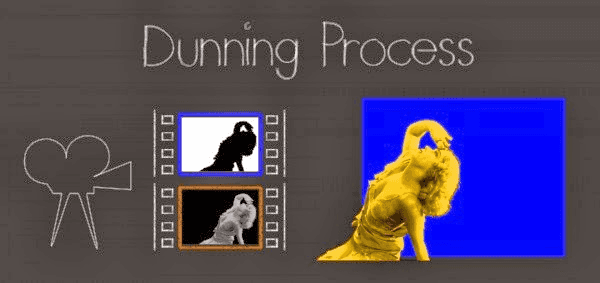
Third, they loaded that strip into the camera alongside a fresh unexposed strip — two strips of film running through the camera simultaneously. That's the bi-packing. If you just ran both strips through the camera with normal white light, the light from Wray's stage would hit every part of the frame equally — including the parts already containing Kong. Kong's image would get washed out. Wray's image would appear everywhere, not just where she's supposed to stand. You'd get a mess — two images blurred on top of each other with no separation.
Fourth, they brought Fay Wray onto a white-backed stage and lit her with yellow-orange light specifically. When the camera ran, her yellow-orange image hit the fresh film. But it also hit the Kong strip running alongside it. Wherever it hit the blue zones in the Kong strip — the holes — the yellow-orange and blue cancelled each other out, and Wray's image burned through onto the fresh film in exactly those spots. Everywhere else, the Kong footage printed normally because there was no blue to interact with.The blue zones in the Kong strip are the film saying "I am reserved. I will only accept the opposite of blue." When yellow-orange light from Wray hits those blue zones, the two cancel — and Wray's image is accepted there. Everywhere else on the Kong strip there is no blue, so yellow-orange light has nothing to cancel against — it simply can't burn through. Kong's image holds.
To summarize the whole Dunning process in one sequence now that all the pieces are clear:
Film Kong's stop-motion completely
Print a modified copy where Wray's zones are blue instead of Kong image
Load that modified strip and a blank strip into the camera together
Bring Wray onto a white-backed stage and light her with yellow-orange specifically
Run the camera — yellow-orange light hits the blue zones and cancels, Wray burns through in exactly those spots. Kong holds everywhere else.
One composite strip comes out.
Ok, now let's move onto the Williams Process.
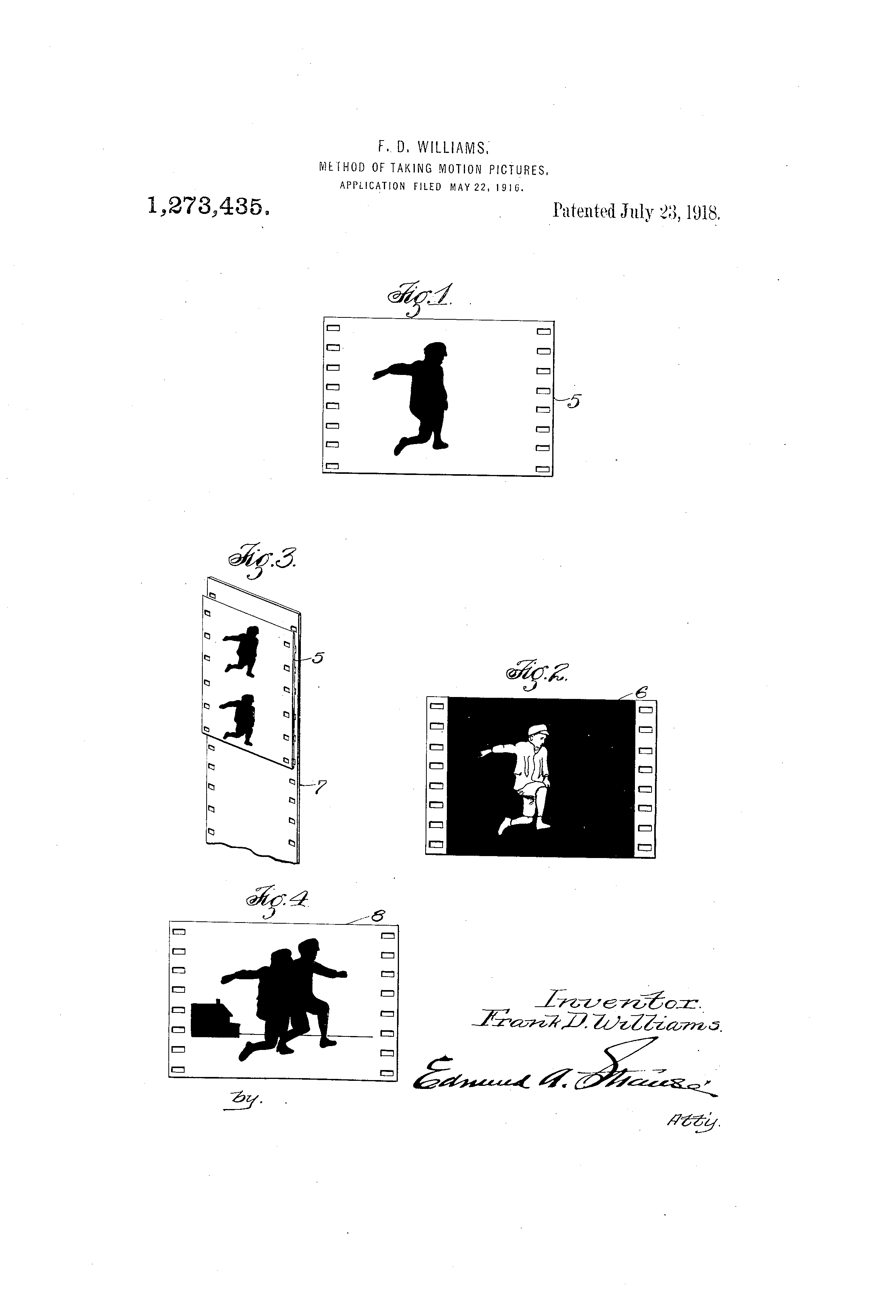
The Williams process or Williams double matting process is a matte creation technique patented by the American cinematographer Frank D. Williams in 1918 (Wikipedia). The core difference from the Dunning process is this: the Dunning process happened inside the camera, in a single pass, while filming. The Williams process happened after filming, in a separate machine called an optical printer. An optical printer is essentially two projectors aimed at each other with a camera in the middle. One projector plays footage. The camera photographs it. You can combine multiple strips of footage this way by running them through in sequence — projecting one, then another, building up a composite image on a single output strip.
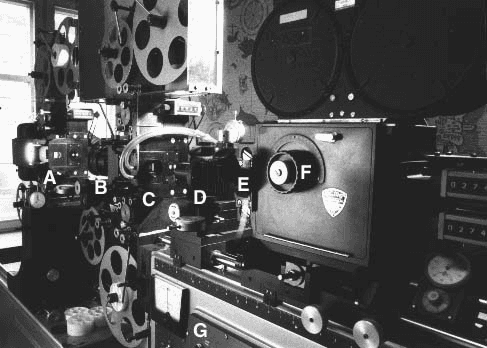
The Williams process was used for the wider, more chaotic shots where precise edge quality between actor and creature wasn't critical. For the long shaky sequence, where Kong finds the sailors on a log bridge over a ravine and shakes them off one by one. The sailors are falling, scrambling, dropping into the pit. Because the camera is pulled back wide and the action is frantic, the matte edge between the live actors and the miniature log set didn't need to be frame-perfect. The chaos of the movement masked any softness in the composite. Wherever O'Brien chose the Williams process, it was because the shot had one or more of these qualities: wide framing, fast movement, or the actor and creature weren't in close physical proximity within the frame. Those conditions all make a slightly soft matte edge invisible to the audience. Contrast that with the Dunning process shots — the T-Rex fight, the Empire State Building sequence — where the spatial relationship between creature and actor was tight and the framing was closer. Those needed the Dunning's in-camera precision because the matte edge was right in the audience's eyeline. O'Brien was essentially making a cost-benefit calculation on every shot. Williams process was faster and more reliable but produced a softer edge. Dunning was harder to execute but tighter. He matched the tool to what each shot could get away with. The William process can replace the dunning effect, but just for shots that are less precise. Combined together, between William Process, Dunning Process, and Rear Projection, Stop Motion, thousands and hundreds of work, many people fought for this vision, and created and invented, and trusted process, you have one of greatest films in early cinema. ☀️