Created on
Updated on
Filmmaking in the Age of AI(28): 2001: A Space Odyssey (1968)
Stanley Kubrick!!!!
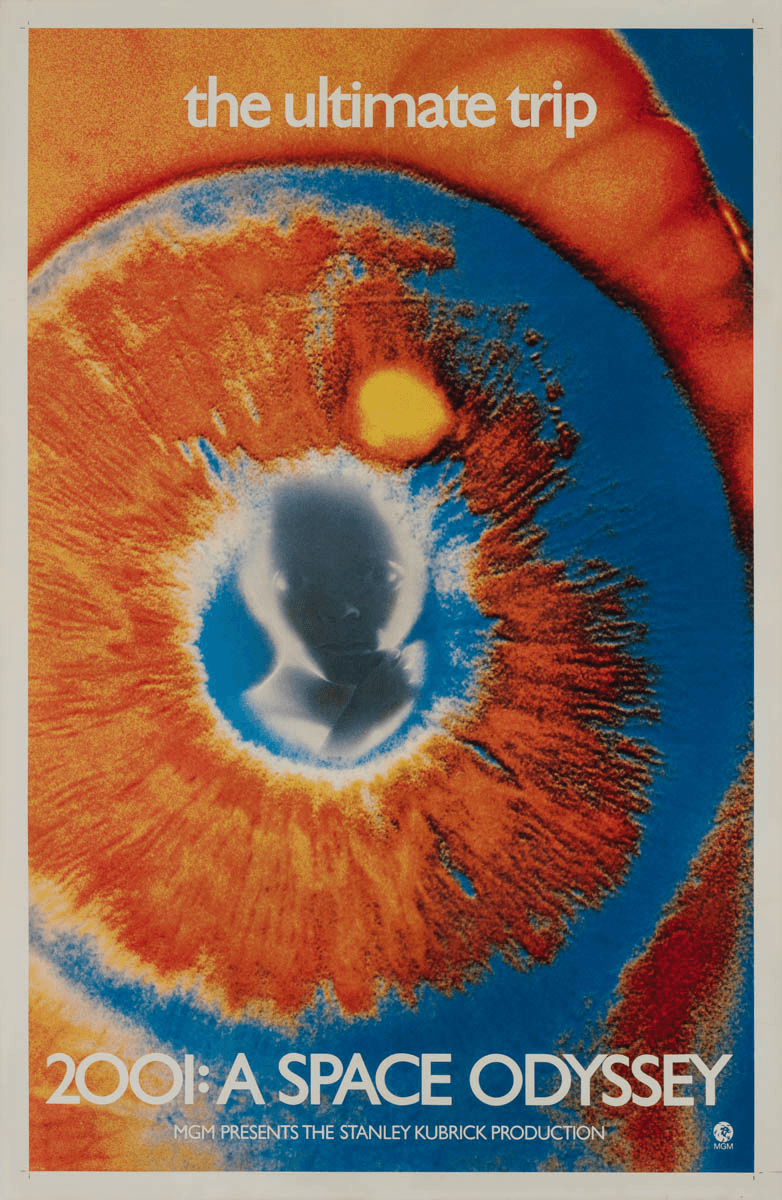
Preface: Co-written with Claude.
The success of King Kong (1933) cannot be overstated. They utilized what they had at the time to make the movie possible: the leftover set from another canceled movie, the dunning process during principle photography, the Williams process used in post, rear projections, miniatures, forced perspectives, stop motion, working 20 hours at a time in the studio, everything. I'd imagine AC didn't work that well back then either, as seen in Babylon(2023) by Damien Chazelle. At this point we are probably all getting used to how crazy filmmakers can be, the extreme length they'd go to make something possible on picture, and the results were astounding. Whatever was recorded will last forever and embraced by and inspire generations of filmmakers. The technology changes, yet storytelling as an art, an visual/sound/performance art, will live forever. So don't argue with me about AI, it's a tool. I can have a whole ass debate with you, but the bottom line is this: this is my page. Open to friendly suggestions, closed to insults and meaningless complains. Anyways, moving on.
What O'Brien proved on King Kong was a principle that would quietly govern the next four decades of effects filmmaking: audiences will accept a fabricated reality completely, if the craft behind it is disciplined enough to earn their trust frame by frame. Thirty-five years later, Stanley Kubrick and his effects team would take that same principle and aim it at the hardest possible subject — the cosmos, rendered with a scientific fidelity so precise that NASA engineers called it accurate. King Kong looked inward — at fear, at spectacle, at the most primal thing an audience could feel in a dark room. The next film on this list looked in the opposite direction entirely. Where Kong gave you a creature you could mourn, 2001: A Space Odyssey gave you a universe that didn't care whether you mourned at all. The ambition got larger.
Stanley Kubrick!
He was born in the Bronx in 1928. His father was a doctor who gave him a camera when he was thirteen, and he became obsessed with photography almost immediately. By sixteen he was selling photographs to Look magazine professionally. That's the first thing to understand about Kubrick: he had an unusually precise, technical visual mind from very early, and he developed it through a craft that was about capturing reality exactly as it was, not inventing it.
![[Image from LOOK - Job 50-W99 titled Jazz story]](https://framerusercontent.com/images/j62mKcdXYklaNSmUlao3YwLZWoE.png)
[Image from LOOK - Job 50-W99 titled Jazz story]
He was largely self-educated. He didn't go to film school — he learned by watching films obsessively at the Museum of Modern Art in New York, and by making them. His first feature, Fear and Desire, was made in 1953 when he was twenty-four, financed by his family. It cost about $10,000 in its initial budget — which ballooned to around $53,000 once post-production sound and music were added — not a small sum given the time and his age. He later disowned it(lol). What's striking about his early career is how quickly he moved through genres. Killer's Kiss (1955) was noir. The Killing (1956) was a heist film. Paths of Glory (1957) was an anti-war film. Spartacus (1960) was a big studio epic he was hired onto and famously had difficult relations with because he couldn't control it. Lolita (1962) was literary adaptation. Dr. Strangelove (1964) was political satire. He wasn't finding his genre. He was learning cinema from the inside out, genre by genre, each film a different set of problems to solve. By the time he arrived at 2001 he had complete technical mastery and complete creative control — he had negotiated that with MGM specifically. And he was interested in a question that no film had seriously attempted: what does humanity look like from the outside, across the full span of its existence, against the scale of the universe? Bro, that's a big question.
Kubrick became obsessed with one question sometime in the early 1960s: are we alone in the universe? Not in a casual way. He started reading everything he could find on the subject — scientific papers, philosophy, astronomy. He contacted experts. He interviewed scientists. He was trying to establish, as rigorously as he could, what the actual state of human knowledge was on the question of extraterrestrial intelligence. One of the books he encountered was Arthur C. Clarke's collection of essays Profiles of the Future (1962), which dealt seriously with the long-term trajectory of human civilization and technology. Kubrick reached out to Clarke directly in 1964. The letter he sent Clarke is remarkably straightforward — he told Clarke he wanted to make the proverbial good science fiction film, and that he thought Clarke was the right person to work with on it. Clarke was based in Ceylon — now Sri Lanka — at the time. They agreed to meet in New York. Clarke later wrote that within hours of their first meeting he was convinced Kubrick was unlike anyone he had worked with — systematically brilliant and utterly focused on the problem.
They decided to work from a short story Clarke had written in 1948 called The Sentinel — a brief tale about an astronaut discovering an alien artifact on the moon that had been left there as a kind of alarm system, waiting to signal its makers when humanity had developed enough to find it. The story itself is only a few pages. It was essentially a seed — a single idea that Kubrick and Clarke then spent two years expanding into something enormous. The working process was unusual. They developed the story and the screenplay simultaneously, with Clarke also writing a novel version in parallel (oh hoho). Neither the film nor the novel was strictly an adaptation of the other — they were two versions of the same expanding idea, developed side by side. What they kept returning to was the same problem: every previous science fiction film had depicted alien intelligence in terms humans could immediately understand — creatures with faces, motivations, language. Kubrick and Clarke thought this was intellectually dishonest. If genuinely advanced extraterrestrial intelligence existed, it would be so far beyond human comprehension that depicting it in recognizable terms would be a lie. That decision — to depict the alien as genuinely unknowable — is what made the film's VFX requirements unlike anything that had been attempted before.
The Production.
The production of 2001 is one of the most extraordinary in cinema history, not just for what was achieved but for how Kubrick organized the effort. He based the core of the production at MGM's Borehamwood studios outside London. Principal photography began December 29, 1965 at Shepperton Studios, then moved to Borehamwood in January 1966. The shoot ran for over a year — 241 days of principal photography, to put this in perspective, most movies have a month or two for principal photography. But the effects work ran considerably longer than that. The total production from start to finish was roughly four years(..bro's got money).
The first thing Kubrick did before shooting a single frame was hire a team of scientific consultants. Not as advisors to be occasionally consulted — as active participants in the design process. He brought in people from NASA, from aerospace companies, from astronomical institutions. He wanted every detail of the space environment to be physically accurate. The way spacecraft moved in vacuum. The absence of sound. The behavior of zero gravity. The geometry of orbital mechanics. This is completely unprecedented for a Hollywood film of the era (bruh). The instinct in science fiction was always to make space more dramatic — ships banking through turns, explosions with sound, gravity that conveniently kept actors on the floor. Kubrick explicitly rejected all of that.
The production designer was Tony Masters. The special effects supervisor was Douglas Trumbull, who was twenty-three years old when he joined the production and had never worked on a feature film before. Kubrick hired him partly because of that — he wanted people who didn't have established habits about how things were supposed to be done. The practical consequence of the scientific accuracy mandate was that almost nothing could be borrowed from existing film technology. Every major effect in the film required a purpose-built solution.
The Centrifuge…
The centrifuge is the rotating interior of the Discovery spacecraft — the hamster wheel environment where the astronauts jog and eat and go about their daily routines while the ship travels to Jupiter. In the film it appears completely matter-of-fact. An astronaut jogs around the full circumference of the wheel. Another sits at a console at the bottom while a third stands at the top, upside down relative to him, eating.
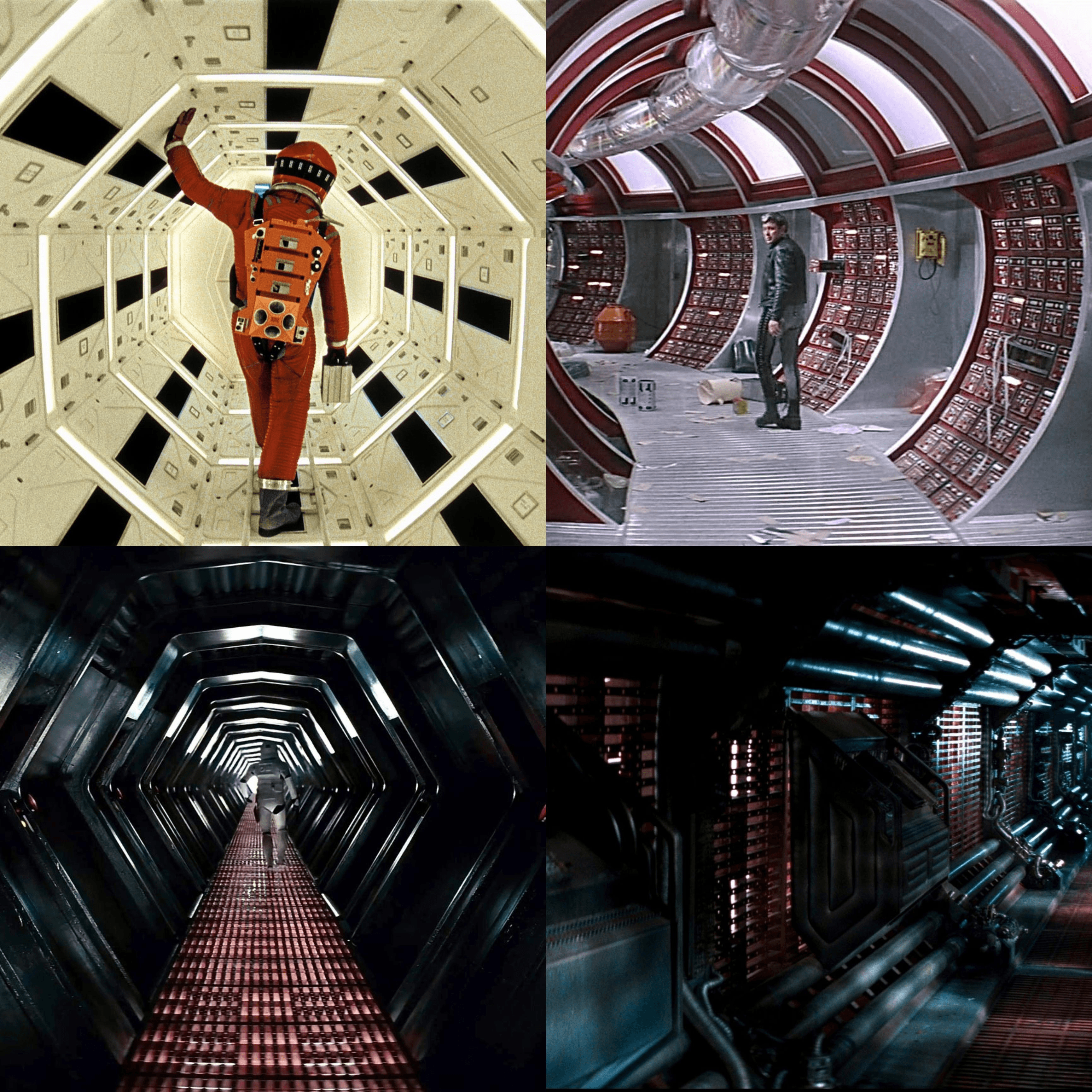
To achieve this Kubrick had a full-scale centrifuge built(bro). Not a partial set, not a forced perspective trick — an actual rotating wheel, 38 feet in diameter, built by Vickers-Armstrongs, one of Britain's leading aircraft manufacturers. It cost $750,000, which was a substantial fraction of the entire film's budget. It weighed 30 tons. It could rotate at a maximum speed of 3 miles per hour. The camera was bolted to the interior of the wheel and rotated with it. The actor jogged in place — or appeared to jog — while the entire set rotated around him. From the camera's perspective, the actor was always at the bottom of the wheel. From the actor's perspective, he was on a treadmill inside a rotating room. The eating scene — where one astronaut sits at the bottom of the wheel eating while another stands at the top — required both actors to be in the set simultaneously at opposite points of the wheel's circumference. The one at the top was essentially standing on the ceiling. Kubrick had to choreograph their positions precisely so that when the wheel stopped rotating, both were in the correct spatial relationship to each other and to the camera.
The practical discipline required was extreme. Every object in the centrifuge set had to be physically secured so it wouldn't move when the wheel rotated. Food on the console trays was pinned. Equipment was bolted. The actors had to move with complete awareness of the rotation speed and their position in the wheel at all times. There were no digital tricks. No wires. No post-production manipulation. What you see in the film is a 30-ton rotating room with a camera bolted inside it, operated by actors who had rehearsed their movements to a precise mechanical schedule (bro).
Front Projection.
Front projection is the technique used for the Dawn of Man sequence — the opening section of the film where the apes appear on the African prehistoric landscape.
The landscape is not real. The apes are actors in costumes on a stage at Borehamwood outside London. The African environment — the vast plains, the sky, the distant rock formations — is a still photograph projected onto the set. But the way it's projected is what makes it extraordinary, and what makes it look completely different from any rear projection that had been done before.
Standard rear projection — which we talked about in the Kong context — projects the background image onto a screen from behind. The actors perform in front of it. The problem is that the projected image has to be bright enough to read on film, which means the projector is running hot and the image degrades. More critically, if any of the projected light spills onto the actors in the foreground, they pick up a ghost of the background image on their costumes and skin. The join between actor and background looks soft and unconvincing. You can always tell. Kubrick and his effects team — specifically Tom Howard — developed a different approach.
They placed the projector in front of the set, in line with the camera, projecting forward onto a massive screen behind the actors rather than through it from behind. A half-silvered mirror was positioned at 45 degrees in front of the camera lens. The projector was aimed at the mirror, which reflected the projected image forward onto the background screen. The camera shot through the mirror at the same angle, so the camera and projector shared exactly the same optical axis — they were looking at the scene from precisely the same point in space. This is a bit hard to understand without a visual aid, so here's an video.
The result was a background image of extraordinary sharpness and brightness, with no light spill onto the foreground actors, and no visible shadows. The join between the ape actors and the African landscape looks seamless in a way that rear projection simply couldn't achieve. The technique was so effective that front projection largely replaced rear projection in film production through the 1970s and into the era of digital compositing. It's also the technique — refined and scaled up enormously — that became the foundation for the LED volume work in The Mandalorian decades later. The underlying concept is a direct ancestor: put the background environment in the same physical space as the actor rather than compositing them separately — the foundational logic that LED volume stages like The Volume on The Mandalorian eventually inherited, though through very different technology.
Slit-scan
Slit-scan is the technique used for the Star Gate sequence — the psychedelic tunnel of light and color that Bowman travels through in the final act of the film. It's about four minutes long and it's unlike anything that had appeared in cinema before it.
The basic problem Kubrick gave Douglas Trumbull was this: create the visual experience of traveling through infinite space at impossible speed, with no reference points, no creatures, no recognizable objects — pure abstract light and motion. Something that felt genuinely alien and overwhelming. And it had to feel like forward movement — like you were being pulled through something — not like patterns floating past a stationary camera.
Imagine a piece of artwork — a photograph, a painted pattern, anything with visual information on it — lying flat on a table. Now imagine a camera pointing straight down at it, but with a piece of cardboard covering the artwork except for a single narrow slit — a gap maybe an inch wide. The camera can only see that one thin strip of the artwork at a time. Now move the artwork slowly away from the camera while simultaneously moving the camera closer to the artwork — zooming in — at exactly the same rate.
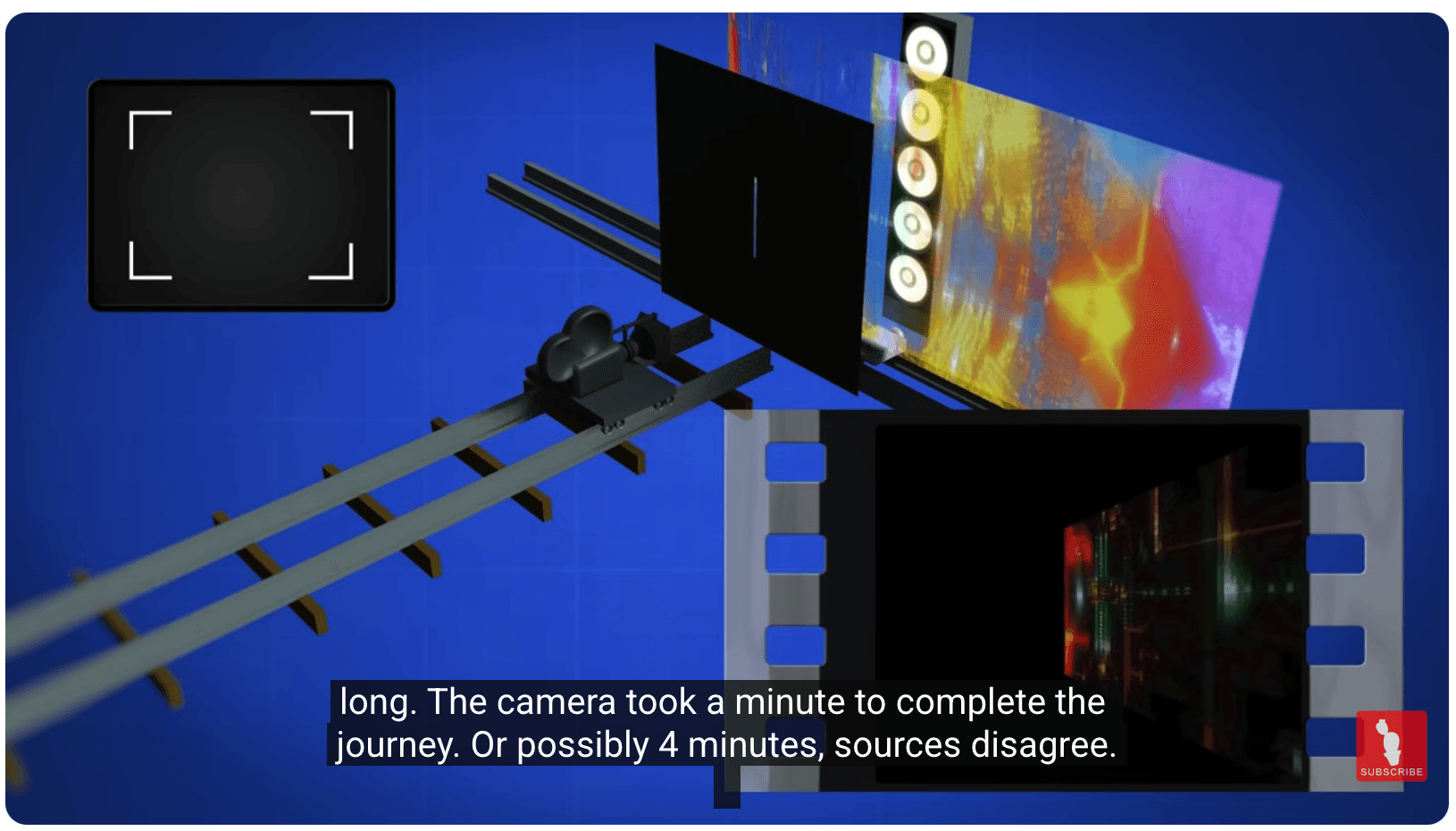
What happens is this: the slit stays in the same position in the frame, but the artwork behind it appears to stretch and smear outward from the center, because the camera is getting closer while the artwork is moving away. The visual information in that narrow slit gets pulled and elongated across the frame. If you do this with a long exposure — leaving the camera shutter open for several seconds per frame rather than the normal fraction of a second — the smearing effect becomes a streak of light that extends from the center of the frame outward to the edges.
Slit-scan had a surprisingly short life as a mainstream technique — it was labor intensive, slow, and expensive, and CGI made it obsolete within about fifteen years. But a handful of films used it meaningfully in that window. Trumbull himself used it again on Brainstorm (1983) for sequences depicting the experience of death recorded on tape — the same idea of representing a consciousness traveling through something beyond normal perception. John Whitney Sr. — who was one of the pioneers of computer animation and had actually been experimenting with slit-scan-adjacent techniques before Trumbull — continued developing it as an art form independently through the 1970s. His work was more abstract art than cinema but it fed back into film visual language.
Star Trek: The Motion Picture (1979), Trumbull was the effects supervisor and used an evolved version of slit-scan for the wormhole sequence and the V'ger cloud interior. You can see the direct lineage from the Star Gate. The TV title sequence world picked it up heavily through the 1970s — it became a signature look for science and technology programming because it suggested speed and data and the future. 2001 is the only film where slit-scan is doing genuine philosophical work rather than just looking impressive. Every other use is essentially decorative — borrowing the aesthetic without the meaning behind it. More on this in the next post. ☀️
REFERENCE LIST
Wikipedia, Stanley Kubrick — en.wikipedia.org/wiki/Stanley_Kubrick
Wikipedia, Fear and Desire — en.wikipedia.org/wiki/Fear_and_Desire
Wikipedia, 2001: A Space Odyssey — en.wikipedia.org/wiki/2001:_A_Space_Odyssey
Wikipedia, 2001: A Space Odyssey (novel) — en.wikipedia.org/wiki/2001:A_Space_Odyssey(novel)
Wikipedia, The Sentinel (short story) — en.wikipedia.org/wiki/The_Sentinel_(short_story)
Wikipedia, Douglas Trumbull — en.wikipedia.org/wiki/Douglas_Trumbull
Wikipedia, Technologies in 2001: A Space Odyssey — en.wikipedia.org/wiki/Technologies_in_2001:_A_Space_Odyssey
Britannica, Stanley Kubrick — britannica.com/biography/Stanley-Kubrick
National Air and Space Museum, "The Making of 2001's Star Gate Sequence" — airandspace.si.edu
American Cinematographer (ASC), "Filming 2001: A Space Odyssey" — theasc.com
Museum of the Moving Image, "Kubrick's Space Odyssey" — movingimage.org
2001 Archive, "The Special Effects of 2001: A Space Odyssey" — 2001archive.org
The Prop Gallery, "2001: A Space Odyssey — The Dawn of Front Projection" — thepropgallery.com
Fred Ordway firsthand account — visual-memory.co.uk/amk/doc/0075.html
Douglas Trumbull, "Creating Special Effects for 2001: A Space Odyssey" — visual-memory.co.uk/sk/2001a/page3.html
Metrograph, "Enemy Territory: Fear and Desire" — metrograph.com
Cinephilia Beyond, "Arthur C. Clarke's 2001 Diary" (excerpts from Lost Worlds of 2001) — cinephiliabeyond.org
Photogpedia, "Stanley Kubrick: From 17-Year-Old Photography Prodigy to Master Film Director" — photogpedia.com