Created on
Updated on
Maxwell's Demon: Information is Physical
You probably have heard of Schrödinger's Cat, but have you heard of Maxwell's Demon?
Preface: Co-written with Gemini.
Maxwell's Demon is a famous thought experiment created by the physicist James Clerk Maxwell in 1867. Its purpose was to challenge the Second Law of Thermodynamics, which states that entropy (disorder) in an isolated system always increases over time. If the history of physics were a mountain range, James Clerk Maxwell (1831–1879) would be one of the tallest peaks, sitting right alongside Newton and Einstein. While he might not have the "household name" status of Einstein, most physicists consider him the bridge between the classical physics of the 1600s and the modern physics of the 1900s. Albert Einstein himself famously kept a framed photo of Maxwell on his wall, saying he stood on Maxwell’s shoulders.
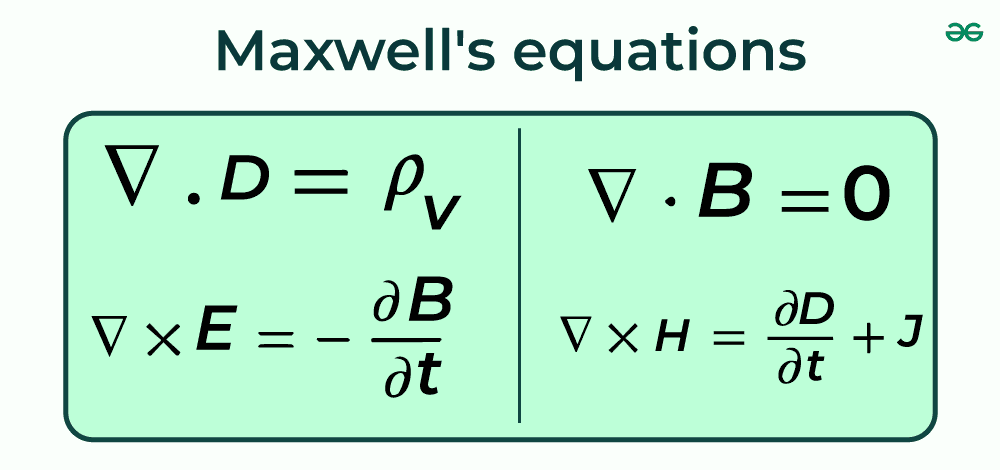
Maxwell was a polymath who touched almost every area of physics, but these are his most enduring legacies. Before Maxwell, electricity, magnetism, and light were thought to be three separate things. Maxwell wrote a set of equations—now famously known as Maxwell's Equations—that proved they are all manifestations of the same thing: the electromagnetic field. He mathematically predicted that these fields travel through space as waves at a specific speed. When he calculated that speed, it matched the measured speed of light perfectly. He concluded: "Light is an electromagnetic disturbance propagated through the field according to electromagnetic laws."
He helped figure out what heat actually is. He developed the Maxwell-Boltzmann distribution, a statistical way to describe how molecules in a gas move at different speeds. This shifted physics from looking at individual particles to using statistics and probability to describe large systems. Before Maxwell, scientists tried to track the movement of gas by imagining billions of tiny billiard balls bouncing around. The problem? It’s mathematically impossible to track every single collision. Maxwell realized you don't need to know what one molecule is doing; you just need to know what the crowd is doing. This shift—from individual tracking to "Statistical Mechanics"—changed the DNA of physics forever.
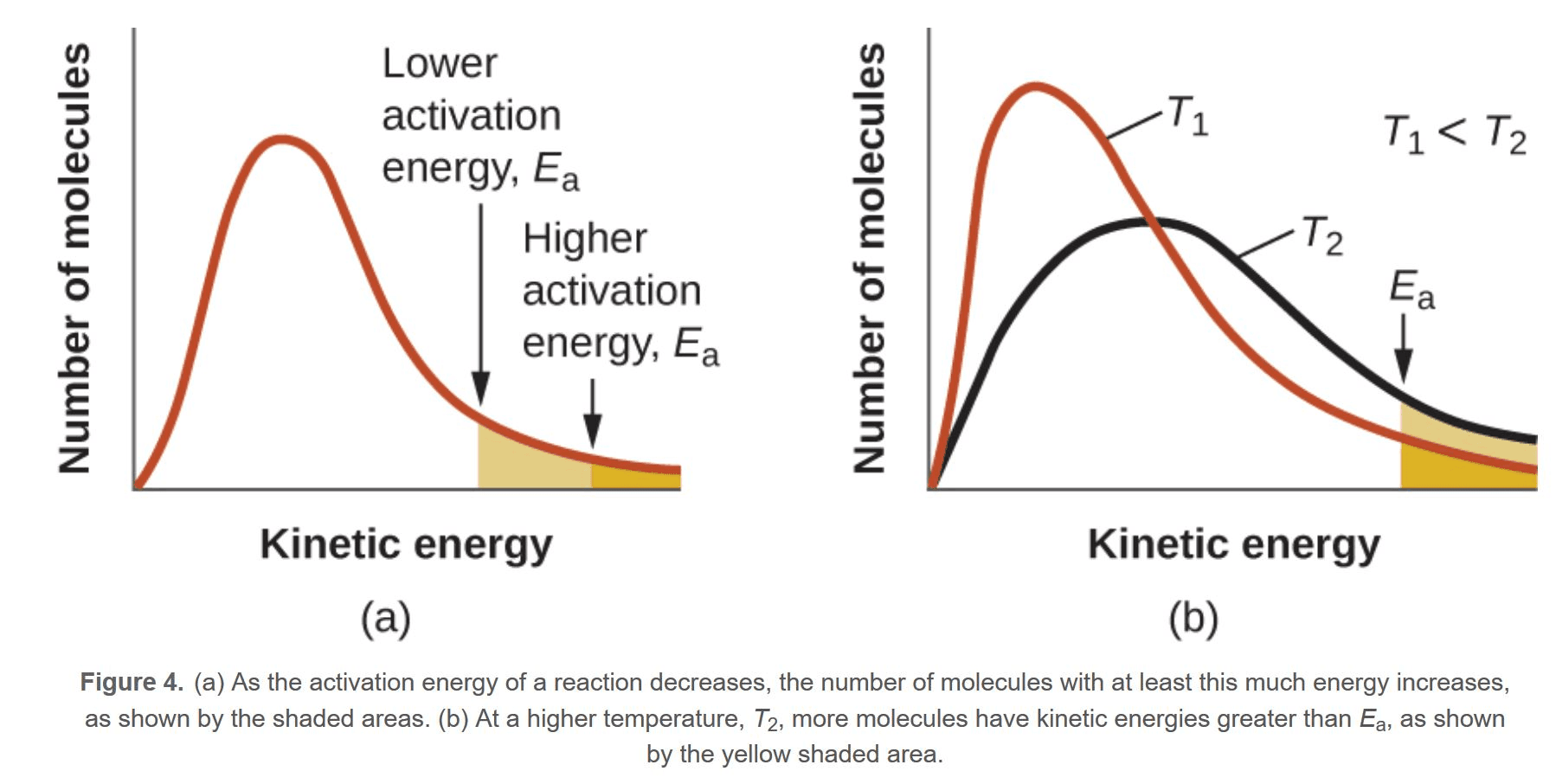
Imagine a room full of air. Some molecules are zipping around at supersonic speeds, while others are barely crawling. Maxwell (and later Ludwig Boltzmann) realized that if you plot these speeds on a graph, they form a specific, lopsided bell curve. The peak is the most probable speed, most molecules cluster around a "medium" speed. This is where the curve is highest. The tail is a small number of molecules that move incredibly fast. These are the ones responsible for things like chemical reactions or evaporation. Lastly, there is the Absolute Zero, no molecules move at zero speed, unless it’s at absolute zero, hence this is where the curve starts and is its origin.
The most brilliant part of this discovery is how it explains Heat. For Cold Gas, the curve is tall and narrow. Most molecules stay close to a slow average speed. For Hot Gas, however, the curve flattens out and shifts to the right. The "average" speed is higher, but there is also a much wider variety of speeds. This wasn't just a clever math trick; it was a philosophical pivot. Maxwell introduced Probability into the laws of nature. Instead of saying "This particle will be here," Maxwell said "There is a 95% probability that a particle has this much energy." He proved that things we feel—like Pressure and Temperature—are just "emergent" properties. Temperature isn't a "thing" a single molecule has; it’s just the average kinetic energy of the whole group. By showing that the universe is governed by statistics at a tiny scale, he laid the groundwork for 20th-century physicists (like Heisenberg and Schrödinger) to describe atoms using wave functions and probabilities. Maxwell turned physics from a game of "Track the Ball" into a game of "Predict the Casino." Ever wonder why your coffee cools down even if the room isn't freezing? According to the Maxwell-Boltzmann distribution, there are always a few "hot" molecules in the "tail" of the curve moving fast enough to break free from the liquid (evaporation). As these fast ones leave, the average speed of the remaining molecules drops—and your coffee gets colder.
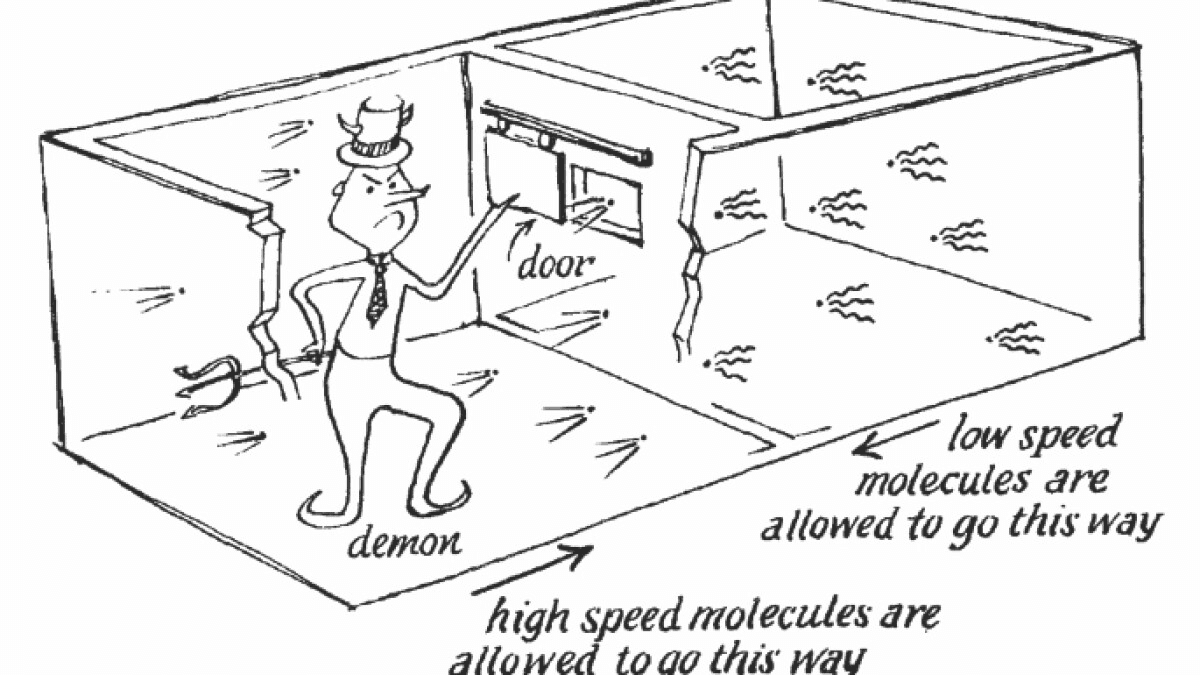
Maxwell created the "Demon" in 1867 because he was bothered by how "absolute" the Second Law of Thermodynamics seemed. At the time, the law was treated like a divine, unbreakable rule: Entropy (disorder) must always increase. Maxwell, however, had just spent years proving that gases are actually made of billions of tiny, individual molecules moving at different speeds. He realized that the Second Law isn't a "mathematical certainty"—it's a statistical one. Maxwell wanted to show that the Second Law only works because we are "big." We see gas as one big, uniform cloud. But if we were tiny enough to see individual molecules, the "law" starts to look more like a suggestion. To a Giant, air is just a lukewarm gas. To a Demon, air is a collection of some very fast particles and some very slow ones. And a Demon is this microscopic creature that could identify fast particles and slow ones, and push a “weightless door” to separate the two kinds of particles into different sections. Imagine a sealed box filled with gas at a uniform temperature. Inside the box, the gas molecules are moving at various speeds—some are fast (hot) and some are slow (cold). A wall divides the box into two sides (A and B), with a tiny door controlled by a "demon." The demon watches the molecules. When a fast molecule from side A heads toward the door, the demon opens it to let it into side B. When a slow molecule from side B heads toward the door, the demon lets it into side A. The Result is that over time, side B becomes filled with fast molecules (gets hot) and side A becomes filled with slow molecules (gets cold). You now have a temperature difference. You could use that difference to run an engine, like a steam turbine. You just created useful energy out of nothing, because the door is weightless, so it takes no energy to push it, yet it created a temperature difference, this is directly against the second law of thermodynamics. The Paradox is that though the demon has created a temperature difference from a state of equilibrium without doing any "work" in the traditional mechanical sense. This would decrease the entropy of the system, seemingly breaking the Second Law.
Maxwell’s argument was: "Okay, sure, a heavy door takes energy to move. But what if I make the door infinitesimally small and perfectly balanced? As the door gets smaller and smaller, the energy needed to move it approaches zero." If the door was weightless, it’d take zero energy to move it. And since it takes zero energy to move the door, the demon will expense no energy while sorting the two kinds of particles. If the Second Law of Thermodynamics were an absolute, fundamental law of the universe (like the speed of light), it shouldn't break down when the door approaches weightless. By making the door weightless, Maxwell forced other physicists to look for the "cost" of the experiment somewhere else. If the cost isn't in pushing the door, where is it?
For 60 years, scientists were stumped. They eventually realized the cost isn't in the arm of the demon; it’s in the eyes and the brain. To sort the molecules, the Demon has to know which ones are fast and which are slow. To know that, he has to "see" them. In our world, seeing requires light. To see a tiny molecule, the Demon would have to bounce at least one photon (a particle of light) off it. That photon carries energy. When it hits the molecule, it kicks it, changing its speed and direction. The energy used to "light up" the room to see the molecules ends up adding more chaos (entropy) to the gas than the Demon saves by sorting them. Even if the Demon has "magic eyes" that don't need light, he still has a brain (or a computer). Step A: The Demon sees a fast molecule. He records this in his memory: Fast molecule approaching. Step B: He opens the door. Step C: Now he needs to wait for the next molecule. But his memory is still holding the information from the last one. Eventually, the Demon’s memory will get full. To keep the experiment going forever, he must erase the old information to make room for the new.
In 1961, a physicist named Rolf Landauer proved that erasing 1 bit of information (changing a 1 to a 0) physically requires a minimum amount of energy that must be released as heat. Before Landauer, everyone thought "information" was just an abstract idea—like a thought in your head or a number on a page. Rolf Landauer changed everything by proving that information is physical. He realized that if you want to perform a logical operation that is "irreversible" (like erasing data), you have to pay a tax to the universe in the form of heat. Imagine a simple computer memory cell that can hold one "bit" of information: either a 0 or a 1. If the bit is a 1, it’s in one state. If the bit is a 0, it’s in another. Now, imagine you want to erase that bit—meaning, no matter what it was before, you want to force it to become a 0. This is an "irreversible" act because once you’ve done it, you can’t look at the result and know what the starting state was. The history is gone. Why does "Forgetting" create heat? In physics, information is tied to Entropy (S). When the Demon (or a computer) has two possible states (0 or 1), there is a certain amount of "disorder" or "possibility" in the system. When you force those two possibilities into just one (the erased state), you are reducing the entropy of that memory cell. But the Second Law of Thermodynamics says you can't just make entropy disappear! It has to go somewhere. That entropy is "dumped" into the environment. It is dumped in the form of Heat.
Landauer even calculated the exact minimum amount of energy you must release to erase a single bit of information.
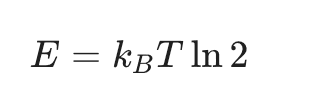
Where k_B is the Boltzmann constant. T is the absolute temperature of the surroundings. ln 2 is the natural log of 2 (representing the two states, 0 and 1). At room temperature (around 20°C), this "cost" is incredibly tiny—about
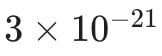
Joules. To put that in perspective, a single grain of sugar falling a few millimeters releases way more energy. This solved Maxwell's Paradox. To sort the molecules, the demon must observe them and store information about their speed. Erasing information generates heat. Because the demon has a finite memory, it must eventually "erase" the data it has collected to make room for more. This process of erasing information increases the entropy of the surroundings by an amount that more than offsets the entropy decrease caused by the sorting. Essentially, the "demon" is part of the system. When you account for the energy required for the demon to process and erase information, the Second Law of Thermodynamics remains undefeated.
When we say "Information is Physical," we are saying that information is not some ghostly, abstract concept that exists only in our minds. Instead, information is as "real" and subject to the laws of physics as a rock, a battery, or a bolt of lightning. This phrase was the battle cry of Rolf Landauer, and it fundamentally changed how we view the universe. Here is the breakdown of what it actually means. You cannot have information without a physical "carrier." To store even a single bit (a 1 or a 0), you must manipulate something physical. A switch: Is it up or down? An atom: Is its spin up or down? A voltage: Is it high or low? A DNA strand: Which base pair is at this position? If you want to move information, you have to move matter or energy (like an electrical pulse or a photon). If you want to change information, you have to exert force. There is no such thing as "intangible" data.
In the 19th century, Entropy was about heat and steam engines. In the 20th century, thanks to Claude Shannon and then Landauer, we realized that Entropy is actually a measure of Information. High Entropy = Low Information: if a gas is totally mixed up (equilibrium), you have no information about where the fast molecules are. It's just a "blur." Low Entropy = High Information: if the gas is sorted (like the Demon does), you have high information. You know exactly where the "hot" ones are. Because the Second Law of Thermodynamics says entropy must increase, it is essentially saying that information tends to degrade or "blur" over time unless you spend energy to keep it organized.
If information were just abstract math, you should be able to calculate things forever without the room getting hot. But because information is physical. To flip a bit from 0 to 1, you have to move electrons. As we discussed with the Landauer Limit, the act of "resetting" a physical system to a blank state requires dumping entropy into the environment as heat. Some modern physicists, like John Wheeler, took this even further with the idea of "It from Bit." This theory suggests that at the most fundamental level, the universe isn't made of particles or fields, but of binary information. Every atom, every electron, and every "thing" (the It) is actually just the result of a series of yes/no questions (the Bit) about its properties. Earth, and the entire universe, is a giant simulator / processor, we are all creating energy / heat, by processing random information. That doesn’t sound like a farfetched idea anymore. ☀️