DATE
2/11/26
TIME
8:37 PM
Strategic Management(ii): Utility and Application
Preface: This is my study clip notes from reading Strategic Management by P. Subba Rao.
An integrative course in Business Management was first introduced by Harvard Business School in 1911 to create general management skills and abilities. However, the course of Business Policy and Strategic Management took a clear shape after the Ford Foundation and the Carnegie Corporation sponsored research was incorporated into the curriculum at business schools in the USA in the 1950s. The Gordon-Howell report recommended a capstone course in an area called business policy.
The objective of Gordon-Howell report in recommending a course in business policy was to integrate other areas of study, to apply analytical applied techniques learned previously in other courses like human resources, marketing, production/operations, finance, organisational behaviour and operations research, to the issues or problems that would confront a business firm as a whole. Thus, a course on Business Policy and Strategic Management, " ... will give students an opportunity to pull together what they have learned in the separate business fields and utilise this knowledge in the analysis of complex business problems."
The research results during the 1980s supplemented the growing literature on competitive strategy. The research efforts introduced new techniques such as industry analysis and provided a key place to this course in the curriculum of business schools. These developments prompted the leaders in this field of study, to change the title of the course from Business Policy to Strategic Management. Some business schools in India integrate functional learning from the beginning instead of presenting a capstone course to integrate material learned earlier in functional focused courses.
Business schools in India have included the course on Business Policy as a capstone course in their MBA curriculum However, different nomenclature is used to denote this course. They are: Business Policy, Strategic Management, Business Policy and Strategic Management, Corporate Planning, Corporate Planning and Strategy, Strategic Planning, Management Policy, Management Policy and Strategy and the like.
A strategy is defined as, "a unified, comprehensive, and integrated plan that relates to the strategic advantages of the firm to the challenges of the environment. It is designed to ensure that the basic objectives of the enterprise are achieved through proper execution by the organisation.", which is just a fancy way of saying, we gotta plan.
Below are the criteria for effective strategy:
Clear, decisive objectives: All efforts should be directed towards clearly understood. decisive and attainable overall g~ais. All goals need not be written down or numerically precise but they must be understood and be decisive.
Maintaining the initiative: the strategy preserves freedom of action and enhances commitment. It sets the pace and determines the course of events rather than reacting to them.
Concentration: the strategy concentrates superior power at the place and time likely to be decisive, it must define precisely what will make the enterprise superior in power, best in critical dimensions in relation to its competitors.
Flexibility: the strategy must purposely be built in resources, buffers and dimensions for flexibility and manoeuvre. Reserved capabilities, planned maneuverability and repositioning allow one to use minimum resources while keeping competitors at a relative disadvantage.
Coordinated and committed leadership: the strategy should provide responsible, committed leadership for each of its major goals. Care should be taken in selecting the leaders in such a way that their own interest and values match with the requirements of their roles.
Surprise: the strategy should make use of speed, secrecy and intelligence to attack exposed or unprepared competitors at an unexpected time.
Security: the organization should secure or develop resources required, securely maintain all vital operating points for the enterprise, and an effective intelligence system to prevent the effects of surprises by the competitors.
Below is a list of various kinds of strategies:
Planned Strategy: Precise intentions are formulated and articulated by a central leadership, and backed up by formal controls to ensure their surprise-free implementation in an environment that is benign, controllable, or predictable (to ensure no distortion of intentions); these strategies are highly deliberate.
Entrepreneurial Strategy: Intentions exist as the personal, unarticulated visions of a single leader, and so are adaptable to new opportunities; the organisation is under the personal control of the leader and located in a protected niche in its environment; these strategies are relatively deliberate but can emerge too.
Ideological Strategy: Intentions exist as the collective vision of all the members of the organisation, controlled through strong shared norms; the organisation is often proactive vis-a-vis its environment; these strategies are rather deliberate.
Umbrella Strategy: A leadership in partial control of organisational actions defines strategic targets or boundaries within which others must act (for example, that all new products be high priced and at the technological cutting edge, although what these actual products are to be is left to emerge); as a result, strategies are partly deliberate (the boundaries) and partly emergent (the patterns within them); this strategy can also be called deliberately emergent, in that the leadership purposefully allows others the flexibility to manoeuvre and form patterns within the boundaries.
Process Strategy: The leadership controls the process aspects of strategy (who gets hired and so gets a chance to influence strategy, what structures they work within, etc.), leaving the actual content of strategy to others; strategIes are again partly deliberate (concerning process) and partly emergent (concerning content), and deliberately emergent.
Disconnected Strategy: Members or subunits loosely coupled to the rest of the organisation produce patterns in the streams of their own actions in the absence of, or in direct contradiction to the central or common intentions of the organisation at large; the strategies can be deliberate for those who make them.
Consensus Strategy: Through mutual adjustment, various members converge on patterns that pervade the organisation in the absence of central or common intentions; these strategies are rather emergent in nature.
Imposed Strategy: the external environment dictates patterns in actions, either through direct imposition (say by an outside owner or by a strong customer) or through implicitly preempting or bounding organisational choice (as in a large airline that must fly jumbo 'ets to remain viable); these strategies are organisationally
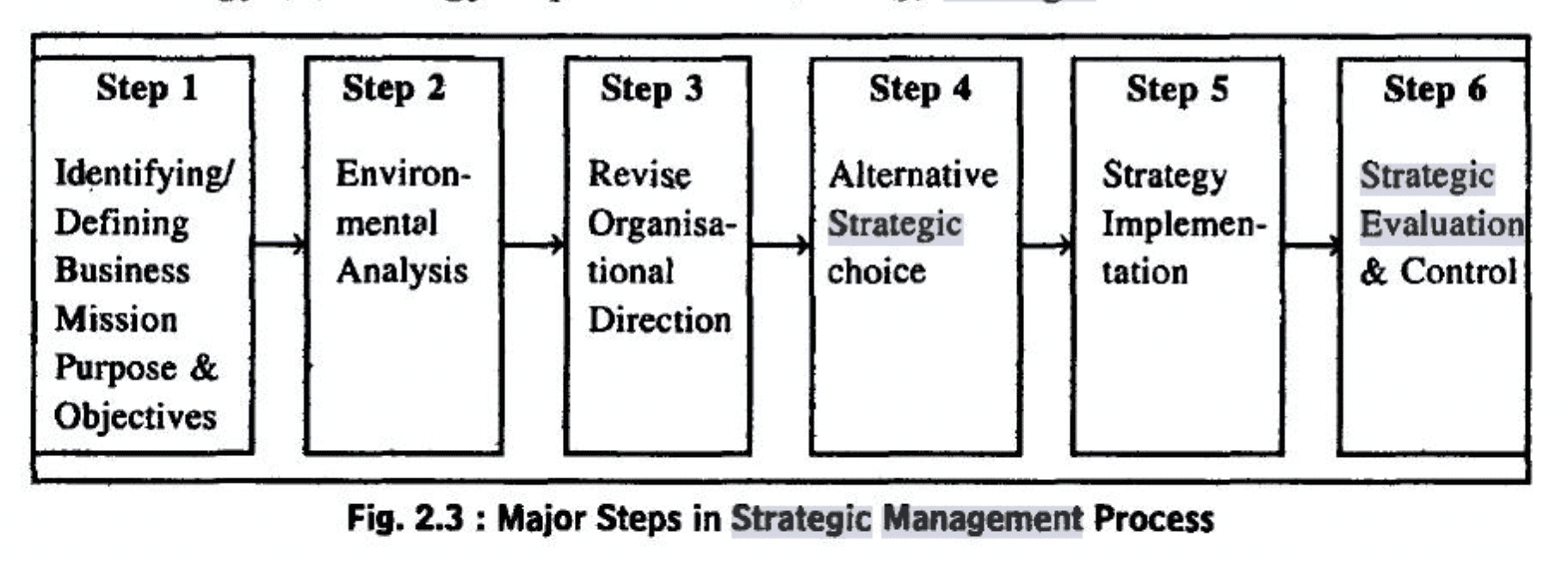
According to Samuel C. Certo and J. Paul Peter, "Strategic management is a continuous, iterative, cross-functional process aimed at keeping an organisation as a whole appropriately matched to its environment." A series of steps that a manager must take are identified by this definition. These steps include performing an environmental analysis, establishing organisational direction, formulating organisational strategy, implementing organisational strategy and exercising strategic control.
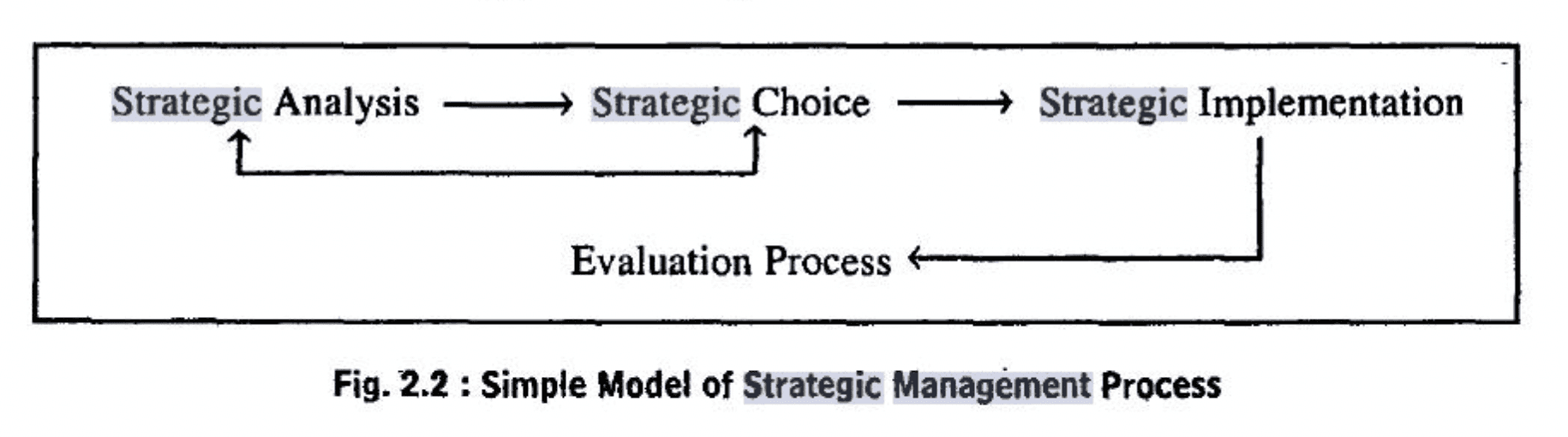
Strategic management is a continuous process and it does mean that the organisation never finishes its strategic work. Managers always will be focusing or reflecting on some aspect of strategic management, though different aspects of strategic management require different emphasis and effort of varying intensity at different times.
Though the process of strategic management starts with the step of performing an environmental analysis, carries on to the step of strategic control and it again begins with the environmental analysis. Thus, strategic management consists of a series of steps repeated cyclically.
Various activities of strategic management draws the inputs from various functional areas of management. Thus, the strategic management process integrates human resources with marketing, production/operations and finance. All these functional areas of management, in a comprehensive effort, contribute simultaneously to create an effective plan or output. Thus, the cross-functional team members work together and the organisation will enjoy the benefits of synergy.
The members can visualise the overall position of where the firm is and what it needs to do in the future in order to achieve a sustainable competitive advantage. This process will encourage commitment of key executives to strategic plans. .
Strategic management identifies its purpose as ensuring that an organisation as a whole appropriately matches its ever changing environment. Organisations must modify their strategies in accordance with the changes in its environment. For example, the announcement of new economic policy by the Government of India in 1991 shook the environment and consequently most of the business firms modified their strategies. ☀️