Created on
Updated on
Animation
2D to 3D
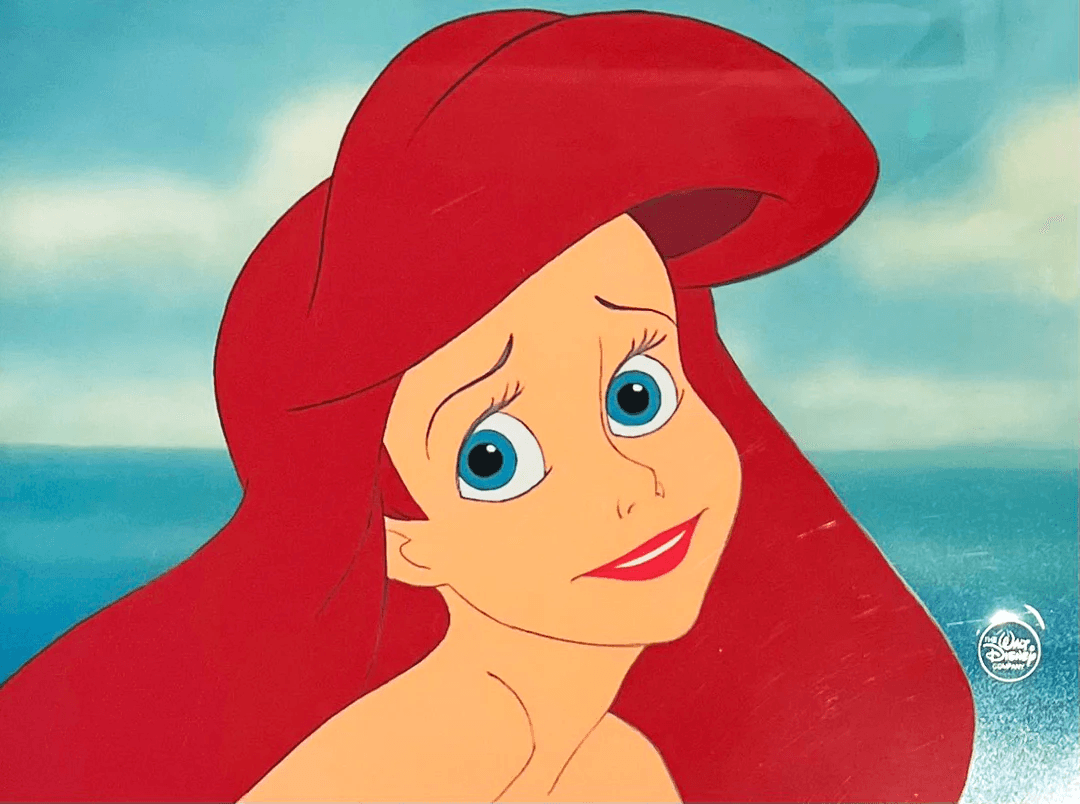
Preface: Welcome to this very long series of filmmaking in the age of AI(2026). The Walt Disney Museum in SF is worth a visit.
A bouncing ball can be animated well or badly, and the difference has nothing to do with whether it bounces at the correct velocity. It has to do with whether it seems alive. That is the problem animation has been working on since the 1930s, and every technical development since — keyframes, curves, digital rigs, motion capture — is in service of solving it.
The Nine Old Men and the principles
Walt Disney hired his first animators in the late 1920s, when animation was a novelty act — characters that moved, that was enough. By the early 1930s, Disney understood that novelty was not a business. He wanted his characters to be believed, not just watched. He began building a studio that treated animation as an art discipline, drawing on contemporary science — studying locomotion films, hiring life drawing instructors, sending his animators to art classes — and accumulating a craft vocabulary through years of experimentation on hundreds of shorts.
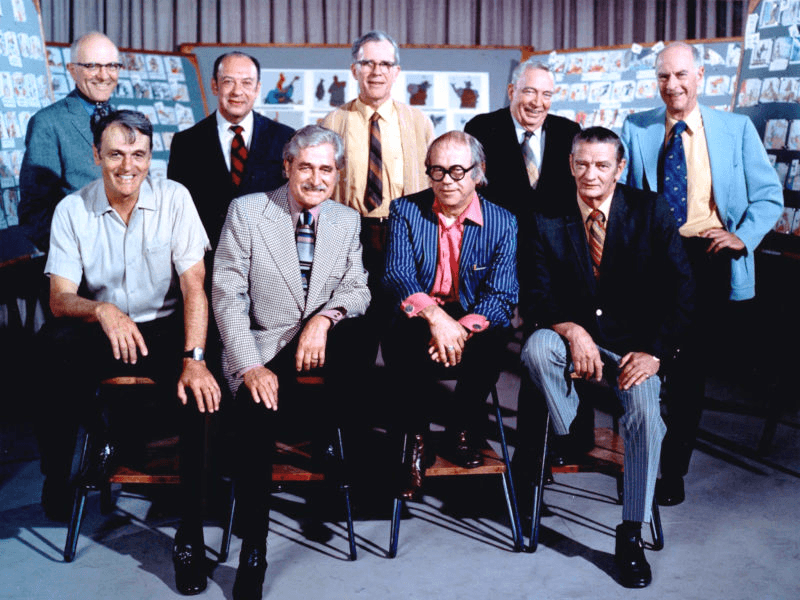
The core of that vocabulary was eventually codified by two of his animators, Frank Thomas and Ollie Johnston. Thomas and Johnston had joined the studio in 1934 and 1935 respectively, and over the following decades animated central characters in nearly every major Disney film — Bambi’s forest creatures, the seven dwarfs, Captain Hook, the Tramp in Lady and the Tramp, Mowgli in The Jungle Book. They were part of Disney’s Nine Old Men — the studio’s core group of animators, so named by Walt Disney himself — who collectively developed the technical and artistic principles on which the studio’s work was built. Thomas and Johnston published those principles in 1981 in The Illusion of Life: Disney Animation, the book that became the definitive reference for everything that followed.
The twelve principles they described were not invented in 1981. They had been in use at Disney since the 1930s. The book formalized what had been accumulated craft knowledge into a communicable system. The principles are: squash and stretch, anticipation, staging, straight ahead and pose to pose, follow through and overlapping action, slow in and slow out, arcs, secondary action, timing, exaggeration, solid drawing, and appeal.
They are not rules about physics, though several of them have physical analogues. They are rules about perception — about how a human eye interprets movement and infers the presence or absence of life behind it. Squash and stretch communicates the material properties of an object: something that squashes on impact reads as soft and elastic; something that doesn’t reads as rigid. Anticipation tells the audience what is about to happen before it happens, which makes the subsequent action feel motivated rather than arbitrary. Follow through and overlapping action describe how different parts of a body keep moving after the primary action has stopped — hair, clothing, secondary limbs — because things in the real world don’t stop all at once. Arcs encode the fact that biological motion follows curved trajectories, not straight lines, because muscles produce rotational movement at joints. Timing — how many frames an action takes — is the animators’ primary tool for communicating weight and effort. A heavy character takes more frames to start moving than a light one. A tired character’s movements have different timing than an energized one.
Appeal is the most important principle and the hardest to teach. A character with appeal is one the audience wants to look at, wants to follow, wants to know. This does not mean a character the audience likes — villains can have enormous appeal. It means a character with a legible inner life, a consistency of design and behavior that makes them feel like a real entity with a perspective on the world. Every other principle serves this one.
The transition to digital
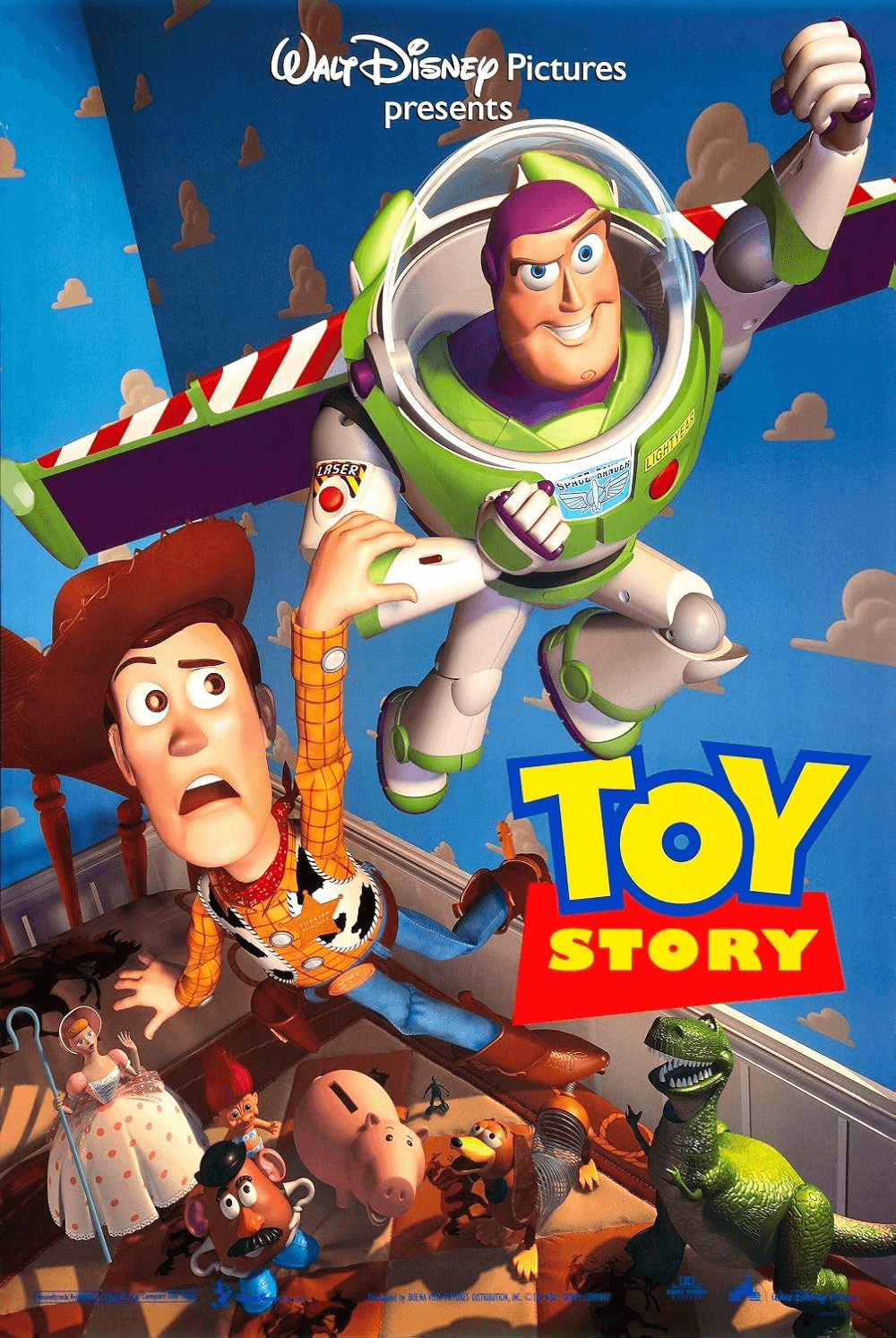
When Pixar produced Toy Story in 1995 — the first fully computer-animated feature film — the pipeline had no hand-drawn frames, no pencil, no paper. Everything was built in software. But the animators working on Woody and Buzz were not writing code. They were working with the same principles Thomas and Johnston had published fourteen years earlier, now implemented inside Maya through a system called keyframing.
A keyframe is an explicitly set pose. The animator moves the rig’s controls to a specific position — arm here, weight shifted there, head tilted this way — and sets a key at a particular frame number. They set another key at a different frame number with a different pose. The software interpolates between the two keys, generating the in-between frames automatically. The animator’s job is to set the right poses at the right times and then shape the interpolation between them.
The interpolation is controlled by animation curves. In Maya’s graph editor, every animated parameter — the rotation of a shoulder joint, the translation of a foot control, the weight of a blend shape — is represented as a curve over time. The shape of the curve determines how the value changes between keys: a flat curve means no change; a steep curve means fast change; a curved ease-in means the motion starts slow and accelerates; a curved ease-out means it decelerates into the next key. An animator working on a shot is not just setting poses — they are shaping dozens of simultaneous curves that together describe a performance. The graph editor is where craft lives in digital animation. An animator who cannot read and sculpt curves cannot work at production level.
The principles mapped directly to digital. Slow in and slow out became ease-in and ease-out on the curve. Follow through became secondary key layers after the primary action. Arcs could be visualized directly on screen using Maya’s ghost tool, which showed the trajectory of a point through space over time. The tools changed. The craft didn’t.
What an animator actually does
A shot arrives in animation with a camera, a cut length, a brief from the director, and a rigged character. The animator has to deliver a performance — every frame of it — that serves the story at that specific moment.The work happens in three phases.
Blocking is the first. The animator works pose to pose, setting key poses at coarse intervals — every ten or twelve frames — to establish the broad shape of the performance. The goal is to figure out what the performance is: how the character moves through the scene, what the key beats are, what the camera sees at each moment. Blocking is sent to the director for review before anything else happens. Getting the blocking approved saves work. Starting from spline before the blocking is locked wastes it.
Spline is the second phase. The interpolation curves are activated, the in-betweens generate, and the animation plays back for the first time as continuous motion. This is usually when it falls apart. The poses that looked right as static frames now read wrong in motion because the curves connecting them are behaving unexpectedly — popping, drifting, losing the arcs, losing the timing. The animator goes back into the graph editor and shapes the curves. This phase is iterative. It can take as long as everything else combined on a complex shot.
Polish is the last phase. The broad performance is working; now the animator refines everything smaller — the secondary actions, the follow through, the weight shifts on the feet, the micro expressions in the face. On a close-up shot, this is where the performance either gains the final level of believability or reveals that something in the blocking was wrong and needs to be revisited.
The whole process — blocking through polish — is driven by judgment calls that no software can make. How long should this emotional beat hold? Which direction does the character’s head tilt when they hear this news? How much does the weight shift when the character stops? These are performance decisions. They require the animator to think like an actor, to ask what the character is thinking at every frame and let that question drive the physical choices. The difference between competent digital animation and great digital animation is whether the animator is solving a technical problem or inhabiting a performance.
The two modes
Creature animation, which dominates the VFX pipeline, is a specialized application. A creature like a dinosaur or a dragon has no human referent — there is no actor whose performance can be studied. The animator has to invent the behavior: how this creature’s weight distributes, how it accelerates, how it holds still, what its default rhythms are. This requires deep study of real animals — their locomotion, their breathing cycles, their idle behaviors — and the ability to extrapolate from the real to the designed. The dinosaurs in Jurassic Park feel real not because they were referenced from living animals (they couldn’t be) but because ILM’s animators studied the locomotion of large birds and reptiles with obsessive specificity and applied that research to anatomically unprecedented creatures.
Effects animation — animating fire, water, smoke, cloth, crowds — was once a hand-drawn specialty and is now largely handled by simulation systems, which is why FX simulation has its own dedicated post in this series. The boundary between animation and simulation is not absolute: a good FX animator knows when to let the simulation drive and when to override it, because simulation produces physically accurate motion, not dramatically useful motion. Those are different things.
The twelve principles are still the foundation. Every CG studio trains its animators from Thomas and Johnston. Every major animation program teaches the principles before it teaches software. The Illusion of Life was voted the best animation book of all time by Animation World Network in 1999, four years after Toy Story had replaced hand-drawn animation as the dominant medium of the field. The fact that a book about pencil and paper was still the definitive text in a field that had moved entirely to computers says something direct: the tools changed, the problem didn’t. The problem is still the same one Thomas and Johnston were working on in the 1930s. How do you make something that isn’t alive look like it is?🫶🏼