Created on
Updated on
Belle Époque / Montmartre
Cinematography Was Invented, So Were Many Other Things

Preface: Welcome to this very long series of filmmaking in the age of AI(2026).
I. The Théâtre Robert-Houdin
The Théâtre Robert-Houdin is where everything started — not just for Méliès personally, but for the entire lineage of techniques that became VFX. To understand it properly you need to know what it was before Méliès bought it, and where it sat when he did.
The theater was founded by the magician Jean-Eugène Robert-Houdin in 1845 at the Palais-Royal, moving in 1852 to a permanent home at 8 Boulevard des Italiens. That address matters more than it looks like it should. This was the most concentrated entertainment district in Europe at the time — the stretch between the Palais-Royal and the Opéra was where Paris's wealthy bourgeoisie spent their evenings, and every institution along it was within a fifteen-minute walk of the others, feeding the same audience: educated, prosperous Parisians who expected spectacle, novelty, and technical sophistication from their entertainment. Robert-Houdin's stage of mechanical automatons and vanishing acts wasn't an eccentric outlier in this district. It was calibrated to the same audience, the same appetite for engineered wonder, as the much larger house half a mile away.
II. The Opéra Garnier
That larger house did more than share the district — in a significant sense, it created the district as Méliès would later know it. In the 1850s and 60s, Haussmann's boulevards carved new axes through Paris and demanded worthy monuments. After an assassination attempt near the old opera house, Napoleon III endorsed a new, safer, fire-resistant theater set as the climax of a straight perspective: the Avenue de l'Opéra, cut as a direct sightline to the building's façade. This explains why the Avenue de l'Opéra is the only street of Haussmann's Grands Boulevards without trees — they were removed so as not to obstruct the view of the Garnier from below. The urban planning decision concentrated Paris's wealthiest and most culturally active population in a specific, walkable district, with the Opéra as its terminus.
The building itself became known as the Palais Garnier, "in acknowledgment of its extraordinary opulence": nearly 2,000 seats, the largest stage in the world at the time, marble, gilt, Chagall ceilings, a grand staircase designed explicitly as a social performance space where audience members could see and be seen during intermissions. The stage machinery was the most sophisticated in Europe — hydraulic lifts capable of raising and lowering entire stage sections, elaborate fly systems for scene changes, gas and early electric lighting rigs. The scale of theatrical illusion the Opéra normalized for Parisian audiences — landscapes that appeared and disappeared, characters who flew, sets that transformed mid-act — became the cultural baseline against which all entertainment in the district was measured. An audience that had seen full-scale romantic opera productions at the Garnier brought high expectations for visual spectacle to any entertainment they attended, Robert-Houdin's included. Méliès's grand illusions, and later his films, were calibrated to that expectation — the standard was set half a mile from his own stage before he ever bought it.
III. Belle Époque
The Palais Garnier was the center of Paris cultural life during the Belle Époque — France's most prestigious entertainment venue in a period that ran from the end of the Franco-Prussian War in 1871 to the outbreak of World War I in 1914. Nobody living through it called it the Belle Époque; the term emerged after 1914, when the catastrophe of the war made the preceding decades look, from the outside, like an age of impossible ease and beauty.
The pace of material change during it was staggering. Running water, gas, electricity, and sanitary plumbing became available to the middle class. Food quality and quantity improved dramatically — spirits consumption rose by 300%, sugar and coffee by 400%. Disposable incomes were plentiful enough to enjoy fashionable clothing and travel, and life expectancy of children rose. For the urban middle class, the city itself became the entertainment: Parisians witnessed the construction of the Eiffel Tower, the rise of Montmartre as an epicenter for art and nightlife, and the transformation of their city under electric light. The Moulin Rouge, built in 1889 with its iconic windmill, was the first building in Paris fully illuminated by electricity.
The Eiffel Tower itself, built for the 1889 World's Fair celebrating the centenary of the French Revolution, was the tallest structure in the world at the time — and Parisians were not happy about it. On February 14, 1887, the "Protest against the Tower of Monsieur Eiffel" ran on the front page of Le Temps, signed by major names in the artistic and literary world: composer Charles Gounod, writers Guy de Maupassant and Alexandre Dumas's son, and architect Charles Garnier himself, who had designed the Opéra. Their complaint was aesthetic and almost territorial — the letter asked whether Paris would continue to associate itself with "the baroque and mercantile fancies of a builder of machines," disfiguring itself irreparably, and called the tower "a gigantic black factory chimney" spreading "a dark ink stain" across the city. The same era that built the most opulent stage machinery in Europe reacted to a genuinely new kind of engineering spectacle as vandalism — worth remembering, later, whenever a new tool provokes the same reflex.
IV. Montmartre
While the rest of Paris was getting wide boulevards, electric lights, and grand exhibitions, there was a hill at the city's northern edge operating on entirely different terms. Montmartre stood apart as the "other Paris" — a village-like district, more rural than urban, with stretches of still-vacant land and makeshift homes packed into a neighborhood known as the maquis. It is a hill, 130 meters above Paris, steep enough that for most of the 19th century horses couldn't reliably get up it. Before it became the center of art, it was known for its wineries, stone quarries, and gypsum mineral mines — the gypsum gave us the phrase "plaster of Paris," meaning the raw material that built much of the city below was literally dug out of the hill above it. The summit was covered in windmills grinding grain; monks had tended the land for centuries; donkeys carried goods up the steep streets. Most of Haussmann's grand ambitions simply hadn't reached the hill yet, and the hilly landscape made much of it unsuitable for his reforms in the first place. It held onto the narrow streets, windmills, and small patchwork houses of its past, so by the 1860s you had this anomaly: a village that looked and felt like the pre-Haussmann Paris that had been erased, sitting directly above the new Paris that had replaced it.
Some of that isolation was engineered elsewhere. Haussmannization was a displacement operation of enormous scale — tens of thousands of working-class Parisians were evicted from the medieval neighborhoods demolished to make those wide boulevards, and many of them moved uphill. There's also a structural, tax-driven reason the nightlife concentrated there that almost nobody mentions: in 1860, the wall built just before the French Revolution to collect duty on goods entering Paris was demolished as part of the plan to bring Montmartre into the 18th arrondissement. That customs wall had run along what is now Boulevard de Clichy and Boulevard de Rochechouart — Montmartre's southern boundary — which meant food and drink on the Montmartre side had effectively been duty-free for decades. Cheaper prices drew people uphill, and the cafés were soon joined by cabarets and dance halls. The bohemian nightlife culture of Montmartre was, in part, built on a tax loophole; cheap wine, cheap absinthe, cheap food, all because the hill sat outside the customs boundary long before it was formally absorbed into the city. By the time the loophole closed, the culture had already taken root, and rents kept dropping the higher one climbed the precarious streets toward the summit — the "butte" — so the population there grew increasingly working class, while lower down, near the established art studios and the supply vendors who served them, artists like Van Gogh who wanted the cheap rent still worked their way up.
Many of the artists who settled there deliberately chose a life as poor Bohemians — even though they often came from wealthy homes — poverty as a kind of self-stylization, a rejection of the bourgeois world below. During the Belle Époque, artists including Modigliani, Monet, Renoir, Degas, Toulouse-Lautrec, Suzanne Valadon, Mondrian, Picasso, Camille Pissarro, and Van Gogh all lived, worked, or had studios in and around Montmartre. A contemporary critic in the 1890s wrote simply that "the quarter resembles a huge studio." With a previously unsuspected realism, they produced paintings that mercilessly revealed the underbelly of the dazzling Belle Époque — the vagabonds, the washerwomen, the dancers, the drinkers — works that remain unique and crucially shaped the history of art in the late nineteenth and early twentieth century.
V. At the Moulin Rouge (1892–93) by Toulouse-Lautrec
The Moulin Rouge opened in 1889 — the same year as the World's Fair, the same year the Eiffel Tower was completed. Same city, different world. When it opened, it seemed to sum up the pleasure-seeking spirit of the era: cheap Montmartre wine and duty-free absinthe, poured under the light of the first fully electrified building in Paris. Most nights, Toulouse-Lautrec was among the customers, busily sketching as cancan girls kicked their legs. He'd been hired to create the cabaret's advertising, and the colorful posters he made of its dancers and singers are now among the most recognizable works hanging in museums anywhere. The dance halls were filled with artists painting free-spirited models; it was universally accepted to live a drunken, ragged lifestyle in the bawdy cabarets. The cancan — scandalous, athletic, deliberately transgressive — became the signature image of everything the era was supposed to be about: pleasure, excess, and the performance of freedom.
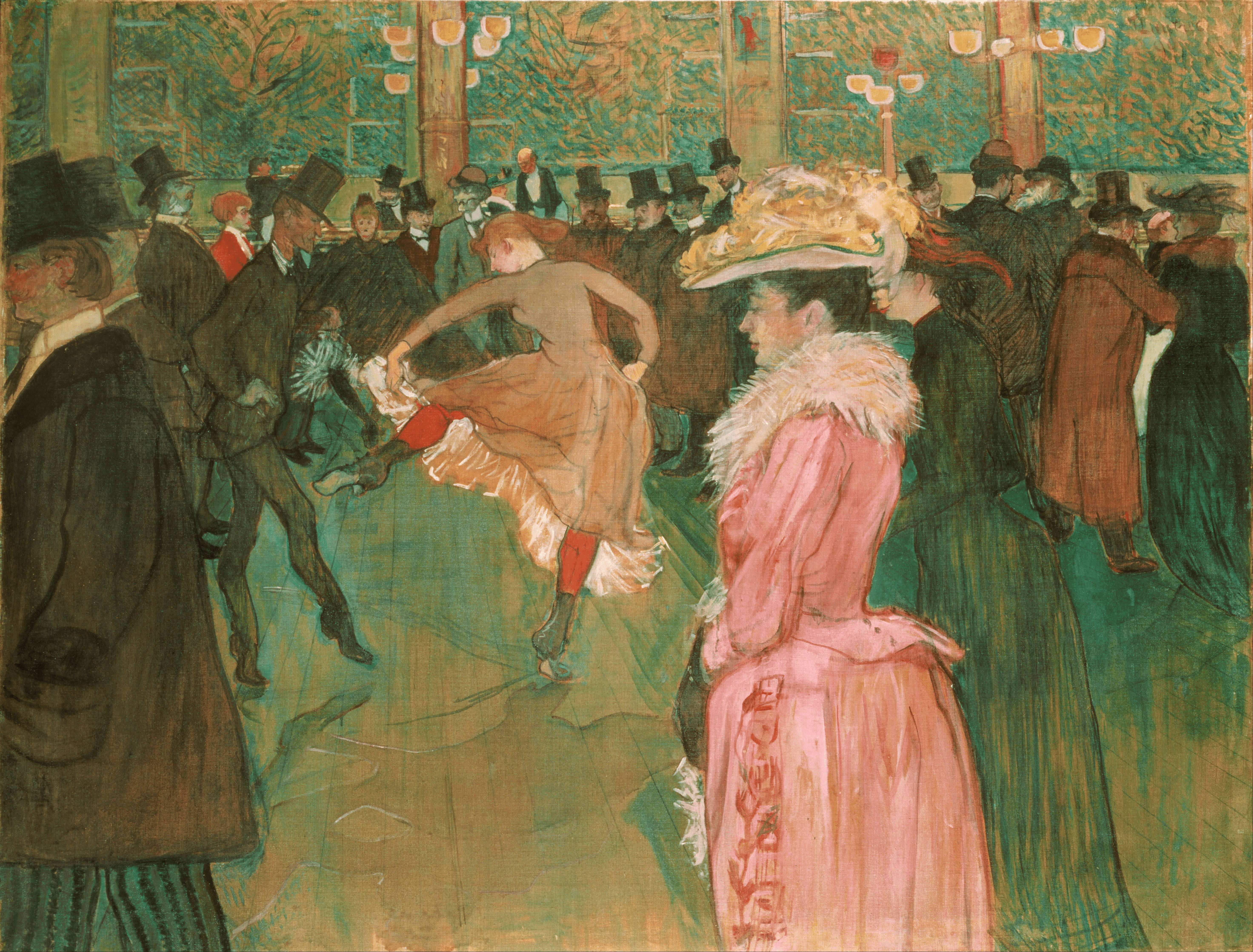
Henri Marie Raymond de Toulouse-Lautrec Monfa was born in Albi in the south of France, the firstborn child of Comte Alphonse and Comtesse Adele de Toulouse-Lautrec — descendants of the Counts of Toulouse, an aristocratic family that had fallen on hard times through generations of inbreeding. His parents were first cousins. Between the ages of 13 and 14, he broke each of his legs in turn; neither fully healed, and the legs stopped growing. He grew into adulthood with the foreshortened legs of a child below a normal-sized torso, standing at 4 feet 8 inches tall, using a cane to walk with difficulty for the rest of his life. The irony is sharp: the last heir of an ancient aristocratic line, exiled by his own body into the brothels and dance halls of Montmartre — and producing there some of the most important paintings of the 19th century.
The painting portrays near its center a group of three men and two women sitting around a table on the floor of the cabaret: from left to right, writer Édouard Dujardin, dancer La Macarona, photographer Paul Secau, photographer Maurice Guibert, and, facing away, Jane Avril, recognizable by her flaming red-orange hair. Toulouse-Lautrec included himself — the diminutive figure in the center background — accompanied by his cousin, physician Gabriel Tapié de Céleyran. He painted himself into the crowd, small, peripheral, watching. That placement is not accidental; it is exactly how he moved through that world, present, embedded, observing from the margins.
Most painters of the era — even the Impressionists — were still painting leisure as pleasure: sunlight, gardens, boats, picnics. Toulouse-Lautrec was painting it as it actually felt at close range. He excelled at capturing people in their working environment, with the color and movement of the gaudy nightlife present, but the glamour stripped away. The composition is deliberately irregular; it's not obvious where the main focus is. A plain wooden counter cuts across the bottom left at a severe 45-degree angle, providing an inner frame and channeling the viewer's perspective inward. You feel like you've walked into the room rather than been posed in front of a painting.
Which is the other half of the Belle Époque story, set against the Opéra half a mile away. The Garnier trained audiences to expect spectacle staged from a comfortable distance — landscapes that appeared and disappeared, watched from a gilded seat. Toulouse-Lautrec, working in the district built on the opposite premise, painted spectacle from inside it, glamour stripped away, the viewer pulled into the room rather than posed in front of it. Two ways of representing the same era's appetite for illusion, half a mile and a world apart — and both, eventually, feeding into what Méliès would build back at 8 Boulevard des Italiens. More on that in the next post. ☀️
Belle Époque — General History
"The Belle Époque: An Era of Sweeping Change." Social Change in Societies. Open Oregon Pressbooks. https://openoregon.pressbooks.pub/socialchange/chapter/1-2-the-belle-epoque-an-era-of-sweeping-change/
"Belle Époque." Wikipedia. https://en.wikipedia.org/wiki/Belle_%C3%89poque
"Belle Époque." New World Encyclopedia. https://www.newworldencyclopedia.org/entry/Belle_%C3%89poque
"Belle Époque Facts for Kids." Kiddle Encyclopedia. https://kids.kiddle.co/Belle_%C3%89poque
"The Belle Époque: Paris' Golden Age of Art, Love and Innovation." M.S. Rau Antiques. https://rauantiques.com/blogs/canvases-carats-and-curiosities/the-belle-epoque-paris-golden-age-of-art-love-and-innovation
"Belle Epoque — Introduction." La-belle-epoque.de. http://www.la-belle-epoque.de/beintroe.html
"Belle Epoque: Guide to the Age of Beauty." Mayfair Gallery. https://www.mayfairgallery.com/blog/belle-epoque-guide-age-beauty/
"By Day & by Night: Paris in the Belle Époque." Norton Simon Museum. https://www.nortonsimon.org/exhibitions/2010-2019/by-day-and-by-night-paris-in-the-belle-epoque/
"The Dark Side of the Belle Époque." Fisun Güner. https://fisunguner.com/dark-side-belle-epoque/
"Insights from the Comparison of the 'Belle Époque' & The Modern Times since the Fall of the Berlin Wall." Cultural Diplomacy Academy. https://www.culturaldiplomacy.org/academy/index.php?insights-from-the-comparison-of-the-belle-%C3%A9poque-the-modern-times-since-the-fall-of-the-berlin-wall-the-cultural-diplomacy-effect=
Having It All in the Belle Epoque — Excerpt. Stanford University Press. https://www.sup.org/books/literary-studies-and-literature/having-it-all-belle-epoque/excerpt/excerpt-introduction
"1899–1914 La Belle Epoque." Silhouettes Costumes. https://silhouettescostumes.com/the-eras-we-build/1899-1914-la-belle-epoque/
The Eiffel Tower
"Eiffel Tower History, Architecture, Design & Construction." Tour Eiffel Official Site. https://www.toureiffel.paris/en/the-monument/history
"When the Eiffel Tower Was a Subject of Controversy." Tour Eiffel Official Site. https://www.toureiffel.paris/en/news/history-and-culture/when-eiffel-tower-was-subject-controversy
"The Artists Who Protested the Eiffel Tower." Tour Eiffel Official Site. https://www.toureiffel.paris/en/news/130-years/artists-who-protested-eiffel-tower
"How the Eiffel Tower Was Saved From Being Demolished." HISTORY. https://www.history.com/articles/eiffel-tower-survival
"The Artists Who Hated the Eiffel Tower." JSTOR Daily. https://daily.jstor.org/the-artists-who-hated-the-eiffel-tower/
"The Controversial Construction of Eiffel's Tower." History Today. https://www.historytoday.com/archive/eiffels-tower
"The Controversial Saga of the Eiffel Tower." Toit de Paris. https://en.toitdeparis.com/post/the-controversial-saga-of-the-eiffel-tower-revisiting-historical-opposition-to-its-construction
"Eiffel Tower: From 1889 Expo to Modern Icon." Machu Picchu.org. https://www.machupicchu.org/eiffel-tower-from-1889-expo-to-modern-icon.htm
Montmartre
"Montmartre." Wikipedia. https://en.wikipedia.org/wiki/Montmartre
"The Lure of Montmartre, 1880–1900." The Metropolitan Museum of Art. https://www.metmuseum.org/essays/the-lure-of-montmartre-1880-1900
"How Montmartre Became an Artist's Haven." Genesis Inspiration Foundation. https://genesisinspirationfoundation.org/how-montmartre-became-artist-haven/
"Montmartre and Impressionism." ImpressionistArts. https://impressionistarts.com/montmartre-and-impressionism
"Montmartre History and Entertainment Culture." Montmartre Footsteps. https://montmartrefootsteps.com/montmartre-historical-cultural-context/
"The Art of Survival: The Transformation of Montmartre." France Today. https://francetoday.com/culture/art_and_design/the-art-of-survival-the-transformation-of-montmartre/
"The Fascinating History of Montmartre." Montmartre Apartments. https://www.montmartreapartments.com/blog/the-fascinating-history-of-montmartre-a-journey-through-time
"Montmartre: Complete Guide to Paris's Legendary Hilltop Village." One Journey. https://onejourney.com/blog/montmartre-complete-guide-paris-legendary-hilltop
"Esprit Montmartre: Bohemian Life in Paris around 1900." Schirn Kunsthalle Frankfurt. https://www.schirn.de/en/schirnmag/esprit-montmartre-bohemian-life-in-paris-around-1900-context-en/
"Esprit Montmartre: Bohemian Life in Paris around 1900." e-flux Announcements. https://www.e-flux.com/announcements/31630/esprit-montmartre-montmartre-spirit-bohemian-life-in-paris-around-1900
Hollein, Max, and Ingrid Pfeiffer, eds. Esprit Montmartre: Bohemian Life in Paris around 1900. Hirmer Publishers, 2014. https://press.uchicago.edu/ucp/books/book/distributed/E/bo18235471.html
"Bohemian Montmartre History, the Artists, Windmills and Streets Scenes." Penn State University. https://sites.psu.edu/ameliecafedes2moulins/2015/04/10/bohemian-montmartre-history-the-artists-windmills-and-streets-scenes/
"The Back Streets of Bohemian Montmartre." Rick Steves. https://www.ricksteves.com/watch-read-listen/read/articles/paris-montmartre-bohemian
"Guide to the Musée de Montmartre." The Geographical Cure. https://www.thegeographicalcure.com/post/guide-to-musee-de-montmartre
"Bateau Lavoir: The 'Laundry Ship' That Sailed the Art World of Montmartre." Francophiles Anonymes. https://www.francophilesanonymes.com/en/paris/montmartre/bateau-lavoir/
Toulouse-Lautrec & At the Moulin Rouge
"At the Moulin Rouge." Wikipedia. https://en.wikipedia.org/wiki/At_the_Moulin_Rouge
"At the Moulin Rouge." Art Institute of Chicago. https://www.artic.edu/artworks/61128/at-the-moulin-rouge
"Henri de Toulouse-Lautrec, At the Moulin Rouge." Smarthistory. https://smarthistory.org/henri-de-toulouse-lautrec-at-the-moulin-rouge/
Jones, Christopher P. "How to Read Paintings: At the Moulin Rouge by Toulouse-Lautrec." Medium / Thinksheet. https://medium.com/thinksheet/how-to-read-paintings-at-the-moulin-rouge-by-toulouse-lautrec-43b8dd72b59f
"Toulouse-Lautrec Paints At the Moulin Rouge." EBSCO Research Starters. https://www.ebsco.com/research-starters/history/toulouse-lautrec-paints-moulin-rouge
"Henri de Toulouse-Lautrec Biography." Toulouse-Lautrec Foundation. https://www.toulouse-lautrec-foundation.org/biography.html
"Henri de Toulouse-Lautrec." Wikipedia. https://en.wikipedia.org/wiki/Henri_de_Toulouse-Lautrec
"Henri de Toulouse-Lautrec." Britannica. https://www.britannica.com/biography/Henri-de-Toulouse-Lautrec
"Tragedy & Brilliance: The Life of Henri de Toulouse-Lautrec." Driehaus Museum. https://driehausmuseum.org/blog/view/tragedy-brilliance-the-life-of-henri-de-toulouse-lautrec
"Henri de Toulouse-Lautrec: Disability and Art in Fin-de-Siècle Paris." Journal of Humanities in Rehabilitation. https://www.jhrehab.org/2017/05/02/henri-de-toulouse-lautrec-disability-and-art-in-fin-de-siecle-paris/
Ike, John David. "Henri de Toulouse-Lautrec's Talent — and Troubles — Were Larger than Life." PMC / National Institutes of Health. https://pmc.ncbi.nlm.nih.gov/articles/PMC5361747/
"Henri de Toulouse-Lautrec." EBSCO Research Starters. https://www.ebsco.com/research-starters/history/henri-de-toulouse-lautrec
"Henri Toulouse-Lautrec." Artelino. https://www.artelino.com/articles/toulouse_lautrec.asp
"Henri Toulouse-Lautrec: Aristocratic and Dispossessed." Barnebys Magazine. https://www.barnebys.com/blog/toulouse-lautrec-aristocratic-and-dispossessed
"At the Moulin Rouge, The Dance, 1890." WikiArt. https://www.wikiart.org/en/henri-de-toulouse-lautrec/at-the-moulin-rouge-the-dance-1890
Renoir & Bal du moulin de la Galette
"Bal du moulin de la Galette." Wikipedia. https://en.wikipedia.org/wiki/Bal_du_moulin_de_la_Galette
"Dance at Moulin de la Galette, 1876." WikiArt. https://www.wikiart.org/en/pierre-auguste-renoir/ball-at-the-moulin-de-la-galette-1876
"The Story Behind Renoir's 'Bal du moulin de la Galette'." My Modern Met. https://mymodernmet.com/renoir-bal-du-moulin-de-la-galette/
"Bal du Moulin de la Galette 1876 — Analysis of Renoir's Masterpiece." Boutiques de Musées. https://www.boutiquesdemusees.fr/en/content/411088-bal-du-moulin-de-la-galette-1876-lign-analysis-of-renoir-masterpiece.html
"Canvassing the Masterpieces: Bal du Moulin de la Galette by Renoir." Rise Art. https://www.riseart.com/article/2627/canvassing-the-masterpieces-the-moulin-de-la-galette-ball-by-renoir
"The Intriguing Story of Renoir's Le Moulin de la Galette." Minima Masters Art. https://www.minimastersart.com/blogs/our-blog/the-intriguing-story-of-renoirs-le-moulin-de-la-galette
"Pierre Auguste Renoir — Moulin de la Galette." UEN Pressbooks. https://uen.pressbooks.pub/arth2720/chapter/renoir-moulin-de-la-galette/
"Pierre-Auguste Renoir." Wikipedia. https://en.wikipedia.org/wiki/Pierre-Auguste_Renoir
"Pierre-Auguste Renoir." Britannica. https://www.britannica.com/biography/Pierre-Auguste-Renoir
"Pierre-Auguste Renoir." World History Encyclopedia. https://www.worldhistory.org/Pierre-Auguste_Renoir/
"Pierre-Auguste Renoir: A Guide to Renoir's Life and Art." MasterClass. https://www.masterclass.com/articles/pierre-auguste-renoir-guide
"Pierre-Auguste Renoir." The Art Story. https://www.theartstory.org/artist/renoir-pierre-auguste/
"Impressionism and Beyond: Pierre-Auguste Renoir." Saatchi Art Canvas. https://canvas.saatchiart.com/art/art-history-101/impressionism-and-beyond-pierre-auguste-renoir
"Renoir." Renoir.net. https://www.renoir.net/
All web sources accessed April 2026.