Created on
Updated on
Liberty of Conscience
1636, Providence | Roger Williams
Preface: Welcome to this quick recap of the history of immigration of US. Celebrating 250 years of USA.
Roger Williams was Initially a Puritan minister, his beliefs evolved and he questioned the authority of the Puritan church in enforcing religious conformity. He was expelled by the Puritan leaders from the Massachusetts Bay Colony, and he established Providence Plantations in 1636 as a refuge offering what he termed "liberty of conscience" making Rhode Island the first government in the Western world to guarantee religious freedom in its founding charter. His ideas on religious tolerance and civil government directly influenced the principles later enshrined in the First Amendment of the U.S. Constitution. He briefly became a Baptist, and in 1638 he founded the First Baptist Church in America in Providence. He then moved beyond organized religion, becoming a "seeker" who did not identify with any specific church. Williams studied the language of the New England Native Americans and published the first book-length study of it in English. Today, Williams's legacy continues to shape debates on religious liberty and the role of government in matters of conscience, with his writings cited in legal arguments and Supreme Court decisions on the separation of church and state.
Where Boston jailed dissenters and, within a generation, hanged Quakers on the Common, Williams's Providence is the settlement that let everyone in — Baptists, Quakers, Jews, seekers of no settled church at all — and asked no one what they believed on the way through the door. He is the tolerant one: the minister banished in 1635 for saying out loud that the civil sword had no jurisdiction over the soul, and who then went and built a colony on precisely that principle, the first in English America founded on liberty of conscience as a matter of principle rather than expedience. He is the friend of the Indians: the Englishman who bothered to learn Narragansett, who published A Key into the Language of America in 1643 as though the people already living here were worth understanding, who bought the ground under Providence from the sachems Canonicus and Miantonomi instead of simply taking it, and who kept up alliance and correspondence with them while his old colony was preparing to burn Pequot towns.
And he is the man who invented the separation of church and state — the image itself, near enough. When Jefferson wrote to the Danbury Baptists in 1802 about a wall of separation between church and state, he was reaching for a figure Williams had already committed to print in 1644 — a hedge or wall of separation between the garden of the church and the wilderness of the world — in the same year, and the same running fight with John Cotton, that produced The Bloudy Tenent of Persecution, his full-dress argument that a compelled belief is no belief at all. A century and a half before Jefferson got the credit, the story goes, a banished Puritan in the Rhode Island woods had already drawn the line the First Amendment would eventually make into law. He is the colonial figure Americans are most certain about. Which is precisely why he is the one worth looking at hardest, because the closer you stand to Roger Williams the less he resembles the man on the pedestal — and the harder the fall when the ground gives way.
1630, Boston
Williams and his wife Mary sailed from Bristol aboard the Lyon around December 1, 1630, a voyage of roughly 65 days, and the Lyon anchored in Nantasket outside of Boston on February 5. They left to get out ahead of William Laud's campaign against Puritan nonconformity — before it caught up with Williams personally.
William Laud in 1630 was the Bishop of London and Charles I's chief instrument for imposing conformity, elevated to Archbishop of Canterbury in 1633. Under Charles and Laud, dissenting clergy and Separatists faced the High Commission and Star Chamber: fines, imprisonment, and corporal punishment. Roger Williams sailed specifically to escape the punitive measures Laud was leveling against Dissenters and Puritan clergy. He was not yet under arrest or formal summons; he read where the pressure was heading and got out ahead of it. In his own later words, he left when Bishop Laud "pursued me out of this land," and he described the departure as bitter as death.
The timing sits at the front edge of the Great Puritan Migration. The Massachusetts Bay Company had secured its charter in 1629, and John Winthrop's fleet had already carried roughly a thousand settlers over the summer of 1630; between 1630 and 1640 about twenty thousand would leave England for New England. Williams did not go with that first wave — he and Mary boarded the Lyon at Bristol on December 1, 1630, months behind it. The ship also carried provisions into a colony suffering a hard winter, which is part of why its arrival was welcomed.
The First Church of Boston had been gathered in 1630, and John Wilson — who had come over with Winthrop's fleet and been installed as its teacher in August 1630 — was its minister. Wilson had a problem that predated the crossing: his wife, Elizabeth Mansfield, had refused to emigrate. Her reluctance was well enough known that Margaret Winthrop was writing letters about it in the spring of 1631. So on April 1, 1631, Wilson set sail from Salem to go back to England and bring his wife (and other prospective emigrants) over, a trip that kept him away for more than a year — he did not return until May 26, 1632, this time with Elizabeth. Before leaving, he arranged for lay members of the congregation — Winthrop, Dudley, and Increase Nowell — to carry the preaching in his absence.
That absence left the Boston pulpit open, and this is where Williams enters. In plain terms, a pulpit is the raised stand at the front of a church that a minister stands behind to preach — like a tall, slanted podium, usually with a ledge to rest an open Bible or notes on. It's elevated so the congregation can see and hear the preacher. But in writing, "pulpit" almost always gets used in a second, figurative way — to mean the preaching position itself, the job of being a church's minister. Newly arrived and highly credentialed — Cambridge-educated, a protégé of Sir Edward Coke — Williams was invited to fill Wilson's place during the vacancy. It was a temporary supply position, not a permanent replacement, and it was a mark of respect for a man the colony had been glad to receive.
English Puritanism was split over what to do about the Church of England, the state church headed by the monarch. The larger camp were non-separating Puritans — they thought the national church was a true church that had been corrupted by unscriptural trappings (bishops, set prayers from the Book of Common Prayer, vestments, ceremonies) and that the right response was to purify it from within while remaining inside it. Crucially, even after crossing the Atlantic, most Massachusetts Bay leaders still considered themselves members of the Church of England — reformers at a distance, not defectors. They remained, in the language of the day, in communion with it.
As mentioned previously, the smaller, more radical camp were the Separatists. They held that the Church of England was not merely corrupted but a false church, beyond saving, and that true Christians were therefore obligated to break off completely and form independent, self-governing congregations with no tie to the national church whatsoever. The Plymouth Pilgrims were Separatists; ordinary Separatism was itself a crime in England, treated as schism. Williams was a hard-line Separatist. When Boston offered him its pulpit, the Boston church still counted itself part of the Church of England — which to Williams meant it was "unseparated," spiritually compromised, still joined to a corrupt body. So Williams turned it down. For him even to lead worship there would be to associate himself with that impurity. That is what he meant by refusing to "officiate to an unseparated people": he would not lend his ministry to a congregation that hadn't made the clean break he believed Scripture demanded.
He coupled that with the deeper objection — that civil magistrates had no business punishing breaches of the first table of the Decalogue. This is the more consequential one, and it needs its terms unpacked. Decalogue just means the Ten Commandments. The Ten Commandments are a set of ten religious and moral rules that, in the Bible, God gives to Moses on Mount Sinai for the Israelites to live by. They appear in the Old Testament, in the books of Exodus (chapter 20) and Deuteronomy (chapter 5). In Christian and Jewish tradition they've long been treated as the bedrock summary of God's law — which is exactly why they mattered so much in a place like Puritan Massachusetts, where the government tried to enforce them. In the numbering the Puritans used (the standard Protestant/Reformed one), they run roughly like this:
Have no other gods before God.
Make no idols or images to worship.
Don't misuse God's name (no blasphemy / swearing false oaths in his name).
Keep the Sabbath day holy (set one day a week apart for God).
Honor your father and mother.
Do not murder.
Do not commit adultery.
Do not steal.
Do not lie about others (bear false witness).
Do not covet — don't crave what belongs to someone else.
The word Decalogue is just a fancier name for this same list (Greek for "ten words").
By long tradition they were split into two "tables" (two tablets): the first table — roughly the first four commandments — covers duties owed to God: worship no other gods, make no idols, don't blaspheme, keep the Sabbath. The second table — the remaining six — covers duties owed to other people: honor your parents, don't murder, steal, commit adultery, lie, or covet. Civil magistrates are the government officials — governor, deputies, the General Court — who made law and punished crime. The Massachusetts orthodoxy held that the magistrate's sword enforced both tables.
The state could and should punish not only murder and theft but also idolatry, heresy, blasphemy, false worship, and Sabbath-breaking. In this model the government was the enforcement arm of true religion, and church and state were fused; they justified it partly by pointing to ancient Israel, where civil rulers punished religious offenses. Williams denied the premise outright: the civil magistrate has no jurisdiction over the first table at all. The state's legitimate authority stops at the second table — offenses that harm other people and disturb the civil peace. Belief, worship, and conscience lie entirely outside government's reach, answerable to God alone.
A civil magistrate is a government official who holds the power to govern, make and apply law, and punish offenders — a secular authority, as opposed to a church authority. The key word is "civil," which here means worldly / governmental, and is meant to contrast with "ecclesiastical," meaning of the church. Seventeenth-century writers constantly paired these two: the civil authority (the state and its officers) versus the ecclesiastical authority (ministers, elders, the church). So "civil magistrate" specifically flags a government official, not a clergyman.
"Magistrate" in that era was also broader than it sounds today. Now the word usually means a minor judge, but in Williams's time it covered anyone vested with governing authority — the functions we'd now split among lawmakers, judges, and executive officials were bundled together in the same men. A magistrate could make law, sit in judgment, and order punishment all at once.
In the concrete setting of my post, the "civil magistrates" were the ruling tier of Massachusetts Bay: the governor (John Winthrop and his successors), the deputy governor (Thomas Dudley), and the assistants — a body of elected leaders who together with the deputies made up the General Court, which served as the colony's legislature and highest court at the same time. These are the exact men who summoned Williams, tried him, and voted his banishment. So when the record says the "civil magistrate" had no right to punish religious offenses, it's naming this specific group of government rulers. Williams argument — that the civil magistrate has no authority over the first table — was a claim that these particular officials, the ones running the colony, had no business reaching into matters of worship and belief. He was drawing a hard line around what a government official may touch (crimes against other people, the civil peace) and declaring everything on the God-facing side of that line off-limits to them. Massachusetts was built on the opposite assumption: that its magistrates were precisely the ones charged with enforcing true religion.
1631, Plymouth
The refusal moved fast into consequences. Within days — he was ordained at Salem on April 12, 1631, barely a week after Wilson sailed — Williams had aligned himself with the more separatist-leaning Salem church, and when the Boston leadership learned Salem meant to give him a teaching post, they protested and the offer was pulled. Williams then moved on to Plymouth. All within a few months of arriving, and all over the same "keep the government out of religion" ideas that would eventually get him kicked out of Massachusetts entirely.
Plymouth was the Separatist settlement — the Pilgrims had already made the complete break from the Church of England that Massachusetts refused to make. For a hard-line Separatist, it was the one place in New England that matched his convictions. He was welcomed. He served as assistant to the Plymouth minister, Ralph Smith, and preached regularly. To support himself he did manual labor and, more importantly for the story, began trading with the Native peoples. This is the period where he threw himself into contact with the Wampanoag and Narragansett — learning their languages, studying their customs, dealing with them directly. He struck up personal friendships with the sachems (a chief or leader of a Native American people) during these Plymouth years, including Massasoit (also called Ousamequin) of the Wampanoag and the Narragansett leaders Canonicus and Miantonomi.
At first, things went well. Governor William Bradford recorded that his teachings "were well approved." He arrived as an asset and was received as one. However, having found Boston and Salem insufficiently pure, he began to find the Pilgrims insufficiently pure too — objecting, for instance, that Plymouth members who sailed back to England still attended Church of England services there.
As time went on, his contact with the Natives hardened into an attack on the colony's land title. His direct dealings with the Wampanoag and Narragansett led him to conclude that the land was theirs, and that the King had no valid right to grant it away by patent. Around December 1632 he wrote a lengthy tract making exactly that argument — which struck at the legal foundation not just of Plymouth but of every English colony holding land under a royal charter.
By 1633 the Plymouth leadership's admiration had curdled into wariness. Bradford's own assessment, written that year, is the definitive line — respect and alarm in the same breath: Williams was "a man godly and zealous, having many precious parts but very unsettled in judgment," who "began to fall into some strange opinions, and from opinion to practice." The ruling elder William Brewster and others grew uneasy enough that the congregation was willing to release him. Same year, Williams left Plymouth and returned to Salem — and this time the move held: he came in as assistant, and became the church's pastor in 1634 after Samuel Skelton died. Notably, a number of Plymouth members who had grown attached to him followed him to Salem, carrying his influence with them.
1633, Salem
Williams came back to Salem as assistant to the aging pastor, Samuel Skelton, and a number of Plymouth members who had grown attached to him followed him north, carrying his influence into the Salem congregation. Back in Salem, Williams wrote the tract attacking the colony's title. The argument: the King had no right to grant land he did not own, the Natives were the true owners, and the colony ought to repent of holding land by royal patent. That personal insult to the Crown, layered on top of the legal challenge, is what made it a threat to the whole colony: if the Bay was seen sheltering a man calling the King a liar, the Crown could revoke the charter.
The attack on the royal patent alarmed the leadership enough to haul Williams before the magistrates in Boston. Governor Winthrop persuaded Williams to drop the charter argument, and some of the clergy convinced the Court of Assistants that his views needn't be punished. The offending tract was suppressed and disappeared — probably burned — and Williams gave assurances. August 1634 , Roger Williams gets the pulpit. Samuel Skelton died on August 2, 1634, and Williams, already serving as assistant, succeeded him as the settled pastor of the Salem church. He now had an official platform and a loyal congregation, and instead of moderating, he used the position to push harder.
From the pulpit he escalated on several fronts at once. He pressed his separatism to its limit, demanding that the Salem church renounce communion with the other Massachusetts churches because they remained unseparated from the Church of England, and forbidding members to pray or worship even with unregenerate family. He revived the land-title argument he'd promised to drop.
Williams's core conviction that belief and worship are a private transaction between a person and God, and that no magistrate — no government — has authority to coerce them. Forcing someone to worship "correctly," punishing them for heresy or false belief, compelling church attendance: all of it, to Williams, was an intrusion into a domain the state has no license to enter. The practical payoff of this position is liberty of conscience — the idea that people of any faith, or none, must be left free to follow their own convictions.
March, 1635, he was ordered before the General Court in March, and again for the July term to answer for his "erroneous and dangerous opinions." The land argument alongside the conscience-and-oath arguments — and the Court ordered him removed from the Salem pulpit. The leverage the Court used is the ugly, revealing part: Salem had a pending petition for land at Marblehead Neck, and the Court refused to grant it unless the Salem church got rid of Williams. The Salem congregation at first protested this as bribery and coercion, sending letters of remonstrance to the other churches — but the pressure worked, the town chose the land, and the church bent.
On October 9, 1635, the General Court of the Massachusetts Bay Colony convicted him of sedition and heresy for spreading "diverse, new, and dangerous opinions" and ordered him banished within six weeks. The execution of the order was delayed because Williams was ill and winter was approaching, so he was allowed to stay temporarily, provided that he ceased publicly teaching his opinions. He kept holding meetings in his own home, and by December reports reached the Court that he had inspired a group of roughly twenty people to plan a settlement of their own at Narragansett Bay.
1636, Providence
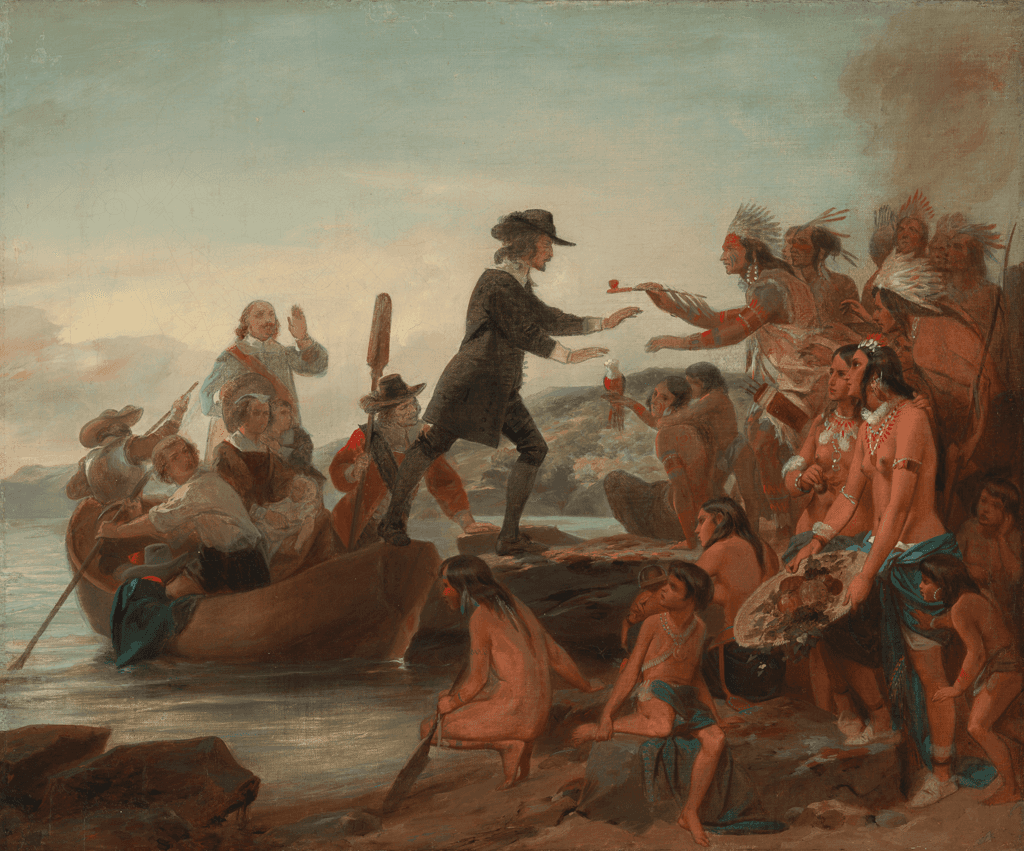
The Court moved to seize him and ship him to England; the officer sent was Captain John Underhill, dispatched to his Salem home. Williams was already gone: the sheriff came in January 1636, only to discover that he had slipped away three days earlier during a blizzard. He fled on foot through deep snow to the head of Narragansett Bay, where Sachem Massasoit hosted Williams there among the Wampanoags until spring. He first settled at Seekonk (Rumford) on land bought from Massasoit, then Plymouth Governor William Bradford sent him a friendly letter which nonetheless warned him that he was still within jurisdiction of Plymouth Colony. So he and his companions crossed Seekonk River to territory beyond any charter and purchased land from Canonicus and Miantonomi, chief sachems of the Narragansetts, were greeted on the west bank and founded Providence.
In 1637, Providence passes a town compact vested power in the householders but limited it to "civil things"; the 1640 agreement, signed by 39 freemen, declared their determination "still to hold forth liberty of conscience."
We whose names are hereunder, desirous to inhabit in the town of Providence, do promise to subject ourselves in active or passive obedience to all such orders or agreements as shall be made for the public good of the body in an orderly way, by the major consent of the present inhabitants, masters of families, incorporated together in a Towne fellowship, and others whom they shall admit unto them only in civil things.
Three things are packed into that sentence, and all three are radical for 1637. First, authority comes from "the major consent of the present inhabitants" — the government's legitimacy rests on the agreement of the governed and operates by majority rule, not on a grant from God, king, or church. Williams was, in the language of the period, a social contractarian, and this is a social contract in miniature. Second, the franchise runs to "masters of families" — heads of household — so power sits with the householders, a civil qualification, not a religious one. Third, and the hinge of the entire document: that consent binds people "only in civil things." In the original manuscript that final phrase was set off on its own line, which historians read as deliberate emphasis. It is the first-table argument from Boston in 1631, now written into law: the community may govern civil conduct and nothing else. Matters of the soul are placed outside the reach of the collective from the first sentence of the colony's existence.
Set it beside the Mayflower Compact of 1620, which the Pilgrims opened "for the Glory of God, and Advancement of the Christian Faith" and framed as a religious undertaking. The Providence compact makes no mention of God, religion, or Christian purpose at all, and requires no oath. There is no established church, no compelled worship, and no religious test for citizenship. The contrast with Massachusetts is exact and worth stating flatly in the post: in 1631 the Bay Colony had restricted the vote to church members, fusing citizenship to religious standing; in Providence, church membership was simply irrelevant to civil participation. A man need not belong to any church, or any faith, to be a full member of the town. That inversion — Massachusetts making religion the qualification for citizenship, Providence making it a non-question — is the whole distance Williams traveled.
The principle got tested almost immediately. In 1638 the town meeting disenfranchised Verin — stripped his voting rights — for restraining his wife's liberty of conscience. His defenders argued it was God's own rule that a wife obey her husband; the town sided with the wife's freedom to worship as she chose. It shows the colony was willing to punish a founding member to defend it — and it shows the concept applied even against the patriarchal authority of the household, which was extraordinary for the period. Verin left Providence rather than submit. Verin himself was never punished for refusing to attend the meetings — that was his own free choice, one that would have been a punishable offense in Massachusetts or Plymouth, where church attendance was mandatory.
The nineteenth-century jurist Joseph Story wrote that in Williams's code one reads, for the first time since Christianity ascended the throne of the Caesars, the declaration that conscience should be free; the scholar David Masson called Providence a community founded on "absolute religious liberty combined with perfect civil democracy"; and modern historians commonly describe it as the first government in the modern world to separate citizenship from religious belief, or the first explicitly secular civil compact. No established church, no compelled worship, no religious test for citizenship, government confined to civil order and decided by majority rule. This made Providence the first place in the modern world to separate citizenship from religious belief — the concrete realization of the wall he'd been arguing for since Boston in 1631. 🇺🇸