Created on
Updated on
1913, Moscow/ Rayonism
Larionov, Goncharova, and Malevich
Preface: welcome to this very brief intro to modern art. Please feel free to use this as a guide for museum visits.
Mikhail Larionov (1881–1964)
Born in Tiraspol to Fiodor Mikhailovich Larionov, a doctor and pharmacist, though he was raised in his grandparents’ home there. In 1898 he entered the Moscow School of Painting, Sculpture and Architecture under Isaac Levitan and Valentin Serov — and was suspended three times for his radical outlook. That’s where, in 1900, he met Natalia Goncharova and formed a lifelong relationship with her.
He’s the organizer-instigator type. In 1908 he staged the Golden Fleece exhibition in Moscow, bringing in international avant-garde work by Matisse, Derain, Braque, Gauguin and Van Gogh, and he promoted group shows for Tatlin, Chagall, and Malevich. He was close to Tatlin early on — close enough that he was especially a mentor to Tatlin, though Tatlin broke off the relationship in 1912 and started openly criticizing him, reportedly to escape Larionov’s “monolithic authority”. That detail is worth keeping — it tells you Larionov’s personality ran toward dominance, not just creative partnership.
He was a founding member of both the Knave of Diamonds (1909–17) and the more radical Donkey’s Tail (1912–14), and he named both groups himself. Camilla Gray, writing his 1961 UK retrospective catalogue, put his centrality bluntly: “Without Larionov, it is impossible to imagine how Malevich and Tatlin could have reached their historical conclusions.” The same source flags an honest caveat worth keeping in your back pocket: he wasn’t actually the earliest abstract artist, despite predating his own work to suggest he was — but he was certainly among the first to produce abstract work. So: brilliant, but also a self-mythologizer who backdated his own canvases. He didn’t drift into leadership — he forced his way into the room and then claimed it. At school he took up all the available wall space at a critique by hanging 150 of his own paintings, leaving no room for anyone else’s work; when the director told him to remove it and he refused, he was expelled. That’s not rebellion against a rule he disagreed with — it’s a direct claim on shared space that left no room for other people’s work to even be seen.
Impressionism (1902–1906) was his earliest documented phase. From 1902 his style was Impressionism. No major surviving “statement” work from this period — it’s apprenticeship, but already restless: this is also when he was submitting 150 paintings to a single monthly critique and getting expelled for refusing to remove any. Even in his most conventional phase, the behavioral pattern is already there. After a 1906 visit to Paris he moved into Post-Impressionism, encountering Gauguin, Cézanne, and the Fauves directly. This is also when he became the organizer before he’d fully become the painter — in 1908 he staged the Golden Fleece exhibition in Moscow, bringing in Matisse, Derain, Braque, Gauguin, and Van Gogh. During his military call-up (1908–09) he produced his “Soldier” series, working with deliberate naïveté that gave folk-tale visual form — similar to contemporary German Expressionists like Nolde, Kirchner, and Mueller, and likely an influence on Chagall, who probably drew from Larionov here.
Soldier on a Horse (c. 1911, now Tate) and The Soldier of the First Division (1909–10), where the figure’s exaggerated, mask-like features and unmodulated colors reject illusionistic depth, evoking both medieval frescoes and the bold simplicity of peasant crafts. This wasn’t pastiche — it was a conscious effort to forge a modern Russian idiom distinct from the Impressionist and Post-Impressionist styles dominating Moscow’s salons.

Spring (1912) is the key transitional work — painted the same year he founded Donkey’s Tail, it came on the heels of his abrupt departure from Jack of Diamonds over their continued allegiance to French and German art, and it synthesized Russian and Eastern traditions as a deliberate provocation to audiences still oriented toward the West. It was shown at the Target exhibition in 1913, and its radical simplification of form directly paved the way into Rayonism the following year.
Glass (1912, Guggenheim) — often cited as his breakthrough into pure abstraction, dissolving an object into intersecting rays of color.
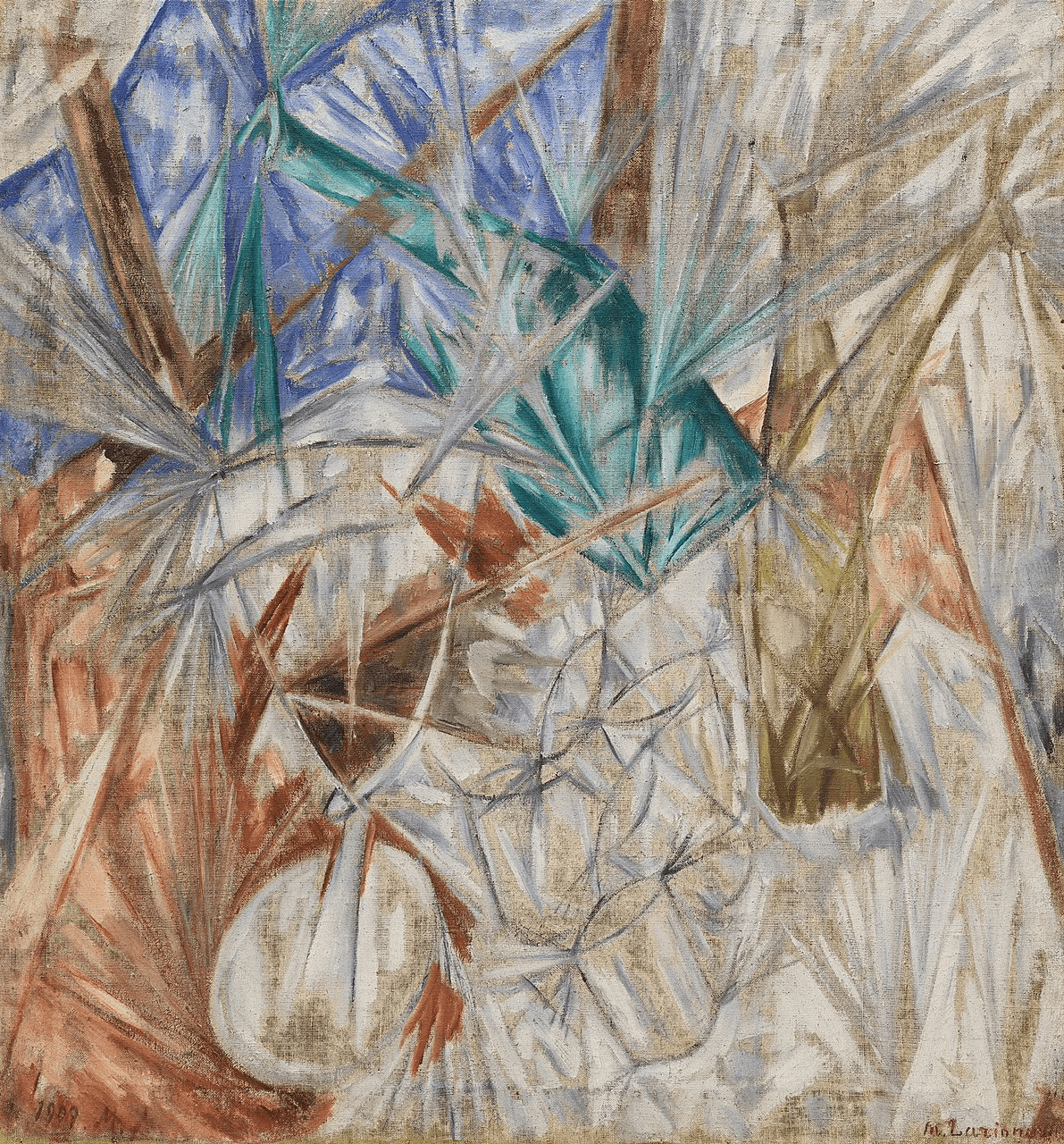
Rayonist Composition: Domination of Red (1912–13, MoMA) — dissolves objects into intersecting rays of light and color, prefiguring the dynamic fragmentation that would follow in Futurism and Cubism more broadly.

Sea Beach and Woman (1913) — a fully non-objective painting using intersecting diagonal slashes of blue, red, and white to create energetic dynamism that bears little resemblance to its own title; the first Rayonist canvases depicted rays reflected from everyday objects shattering the picture space, while subsequent works represent only the rays themselves, intersecting to create dynamic planes of color.

Rayonnist Sausage and Mackerel — his first Rayonist painting given a public showing, at the fourth Union of Youth exhibition in St. Petersburg, December 17, 1912. Note the title — sausage and mackerel are about as anti-monumental a subject as you can pick for a “breakthrough into pure abstraction,” which is very on-brand for the neo-primitivist provocation streak running under all of this.
It is worth-noting that Larionov claimed to have painted his first Rayonist work back in 1909, but he was not always accurate about his paintings’ chronology — he would often omit dates entirely or backdate canvases by more than a decade. As Anthony Parton put it: “Inaccurate memory undoubtedly played its part, but Larionov was a shrewd propagandist of [his and Goncharova’s] historic role as painters.” So even the “main works” list comes with an asterisk: some of what’s catalogued as 1909–1911 Rayonist work may actually be 1912–13 work he later re-dated to look earlier — which is the same self-mythologizing pattern from the founding-and-naming-every-group behavior, just applied to his own canvases instead of institutions.
He was especially close to Tatlin, mentoring him — until Tatlin broke off the relationship in 1912 and started openly criticizing him, reportedly to escape Larionov’s “monolithic authority”. “Monolithic authority” is someone else’s word for him, not his own — and it’s a serious charge: it suggests Tatlin experienced the mentorship as something to escape from, not just outgrow. He was a founding member of both the Jack of Diamonds (1909–1917) and the more radical Donkey’s Tail (1912–1914) — and he named both groups himself. Naming both groups is a small but telling detail: even when founding something collectively, he’s the one who gets to define what it’s called. The actual split from Jack of Diamonds wasn’t really ideological neutrality breaking down — it was Larionov making a unilateral move. In the spring of 1912 Larionov seceded from the Jack of Diamonds group and, with Goncharova, exhibited independently under the name Donkey’s Tail, proclaiming his own art movement, rayonnism. Note the construction: he seceded, he proclaimed his own movement. Goncharova came with him, but the verbs are all singular and his.
What this adds up to, without overreaching is a pattern of claiming the space fully, mentoring people into dependency, founding the institution, naming it himself, and then leave (taking the most loyal people with him) the moment the institution stops being something he fully controls. Camilla Gray’s line from earlier — “Without Larionov, it is impossible to imagine how Malevich and Tatlin could have reached their historical conclusions” — is genuinely true and also slightly damning when set next to Tatlin’s own account of needing to escape him. He was generative and something people needed to get away from to become themselves. Both things, not one or the other. He also backdated his own paintings to claim earlier priority for his abstraction. So the group-founding isn’t an isolated trait — it sits alongside a documented habit of controlling the historical record of his own primacy, not just the social space around him in the present.
In 1915 he left Russia and worked with Diaghilev on the Ballets Russes, theater and costume design became his major outlet through Diaghilev’s Ballets Russes — Le Coq d’Or (1914) and Chout/The Buffoon (1921) merged Constructivist geometry with Russian fairy-tale whimsy. His late paintings, less celebrated, kept revisiting Rayonist motifs in a more lyrical, less confrontational register — the fight basically goes out of the work once he’s in Paris and dependent on Diaghilev rather than running his own institutions. He settled permanently in Paris from 1919, took French citizenship, and died there in 1964.
Natalia Goncharova (1881–1962)
Born into Russian nobility — her family was related to Alexander Pushkin (Russian poet and playwright) and owned numerous estates south of Moscow. Her father was an architect and mathematician; her mother’s side had close links to the priesthood, with her maternal grandfather teaching at the Moscow Theological Academy. That religious lineage matters later — she’s the one who insists on painting icons. She trained initially in sculpture, under Paolo Troubetzkoy, before switching to painting — a switch made at Larionov’s suggestion, per Sotheby’s. Her formal training actually ended in 1909 when the Moscow Institute expelled her for failing to pay tuition — so she was financially precarious even while moving in aristocratic circles. Goncharova studied painting and sculpture at the Moscow School after coming from an aristocratic family, then shifted focus to painting after meeting Larionov — and by 1913 the scale of her output was staggering: her one-person Moscow show that year included 761 works, reduced to 249 when it traveled to St. Petersburg.
Larionov and Goncharova both entered the Moscow School of Painting, Sculpture, and Architecture in 1898, when they were 17 — Larionov on the painting track, Goncharova on the ten-year sculpture curriculum. They didn’t actually meet until 1900, two years in. The Daily Art Magazine version has a nice scene of how it happened: Goncharova was annoyed at Larionov after he told her she was too preoccupied with form and needed to open her eyes to the world — but when he later visited her and found a room full of paintings and drawings, he recognized her talent. Her own account of the moment: “Suddenly, I understood that something I wanted in sculpture was, actually, to be found in painting… and it was painting.” She dropped sculpture for painting because of that conversation — and left school after just three years once Larionov convinced her to switch.
They moved in together unmarried, which upset Natalia’s parents — who initially didn’t accept “poor Mikhail,” but came around once the Tretyakov Gallery bought his first painting. They didn’t formally marry until 1955 — and even then only for estate-planning purposes, so they could inherit each other’s artwork. Sixty years together before paperwork. Where Larionov organizes and theorizes, Goncharova produces at enormous volume and takes the public risk. She was harassed continuously, alongside Larionov, for her artwork and how she presented herself publicly, and she sometimes appeared topless in public with symbols painted on her chest as part of their primitivist street performances.
In 1910, Goncharova held a one-day solo exhibition of twenty paintings at the Society for Free Aesthetics in Moscow. The press characterized the show as “disgusting deprivation,” and police confiscated three paintings — two female nudes and a painting of a fertility goddess. She was charged and tried for pornography in Moscow’s civil court, and was acquitted. The Art UK source is sharper about what was actually on trial here, and it isn’t really obscenity: the basis of the charges was that she had exhibited religious subjects in a secular context, and — as a woman artist — had chosen to depict what were viewed as “masculine” subjects. Combined with her unmarried relationship with Larionov, this was enough to mark her, in the public mind, as a symbol of modernism and avant-gardism; her art was said to “hurt your eyes” and transgress the “boundary of decency”. So it’s gender policing wearing an obscenity statute as a mask — a woman painting nudes and gods was the violation, not the nudity itself. The Souvenir Scribbles source puts the same point even more bluntly: in both the 1910 police case and a 1911 Church confiscation of four more paintings, “Goncharova’s sin was as much her sex as her painting”.
Her deep spiritual affinity drew her to painting religious icons inspired by the Orthodox Church, and in creating them she followed an icon painter’s traditional practices of praying and fasting — even as critics told her she had no right to paint icons at all. Orthodox icons commonly found in homes and churches throughout Russia were genuinely well known and loved by Goncharova. Like many artisans and believers before her, she painted religious scenes as “gifts from above” that materialized intuitively following ongoing devotional dialogue with the Lord. She took that devotional material and run it through a modernist, primitivist visual language the Church didn’t recognize as legitimate — and that’s where the actual conflict comes from. It wasn’t her intent to provoke; it was the form that provoked. Her religious compositions reveal the influence of icons and lubki — popular folk woodcuts — fused with peasant themes, and one art historian’s framing is useful here: her work reflects a desire to elevate rural peasant existence as holy and authentic, in reaction against Western artistic influences and modernization — if there’s a “protest” in it at all, it’s aimed at Westernization, not at Orthodoxy itself. She’s trying to reclaim and dignify Russian peasant and icon traditions against the tide of imported European academic painting, not tear down the Church that produced those traditions.
The Church’s reaction bears this out too — it wasn’t uniformly hostile. There’s a striking case from 1914: when a different solo show of hers in St. Petersburg drew a denunciation as blasphemous and police impounded twenty-two paintings on the order of the Chief Procurator of the Holy Synod, the case eventually went the other way — count Ivan Tolstoy, the Hermitage’s curator, and others spoke up in her support, and the Archimandrite of the Alexander Nevsky monastery himself approved the works, citing their revival of ancient iconographic style. A senior Church official ultimately endorsed her icon paintings as legitimate continuations of the tradition, not blasphemy against it. She wasn’t an anti-Church provocateur. She was a believer who painted sacred subjects in a new visual idiom, and the controversy came from people who couldn’t separate the modernist style from a charge of disrespecting the content — while the topless street performances and the 1910 nude/pagan trial were a completely separate, much more deliberate kind of provocation aimed at Moscow’s sexual and class propriety, not at religion at all.
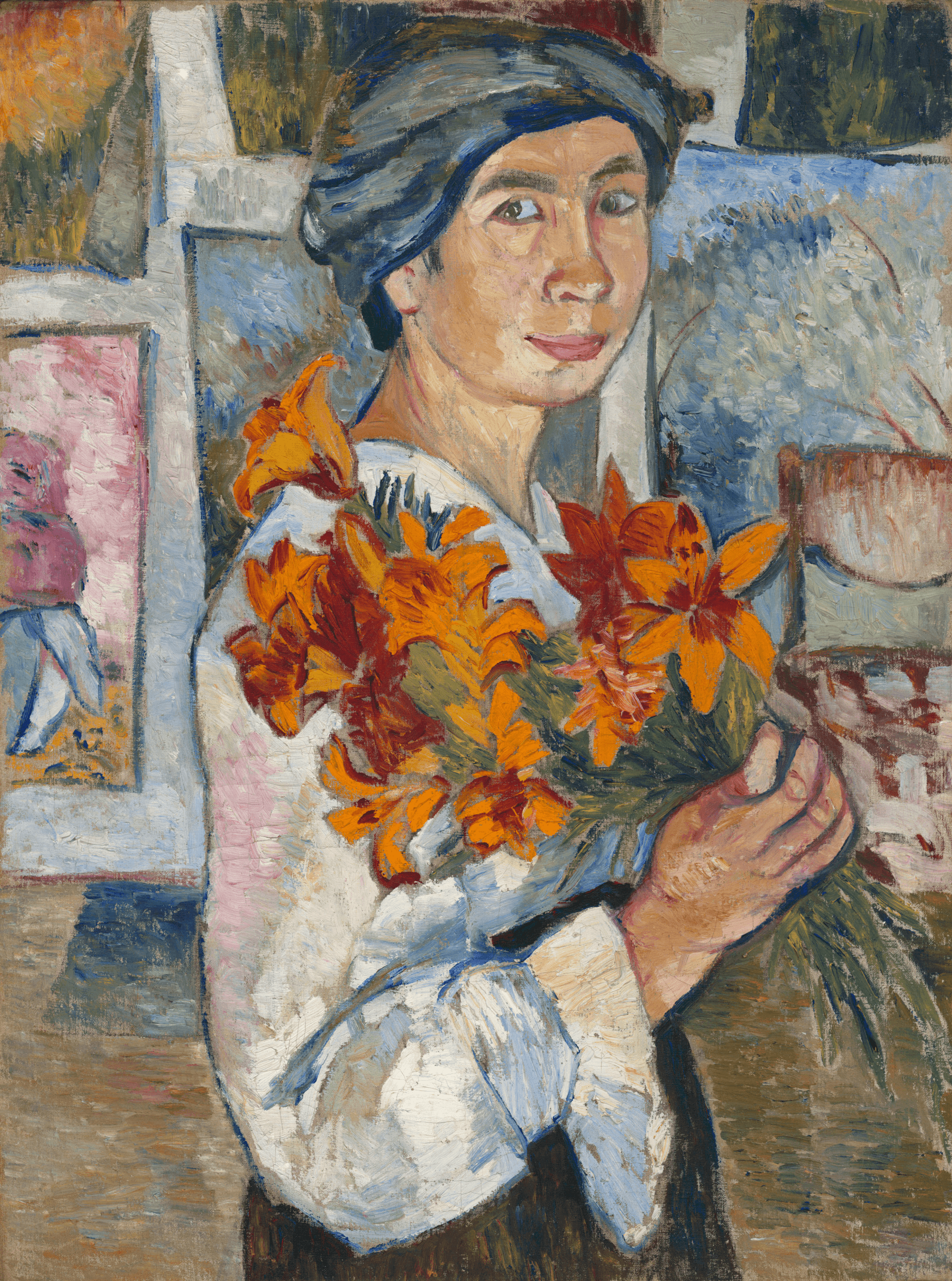
Self-Portrait with Yellow Lilies (1907–08) — her earliest major statement piece, and notably about her own identity as a painter, not as a woman defined by a domestic role. Her early self-portraits deal with identity and reveal her interest in elite masquerades — in one she dresses as a gentlewoman, in another she’s shown in a domestic environment wearing a dress, and others focus specifically on her identity as a painter. Right from the start she’s testing which version of “Natalia Goncharova” the canvas should present.
Peasant / Harvest cycle (1908–1911) was her first deep thematic commitment, it is is the foundational body of work, and it’s explicitly tied to her own biography: between 1908 and 1911 she executed a cycle of rural paintings focused on the harvest as the crystallization of the relationship between people and land — sensitive representations inspired by happy childhood summers in the Moscow countryside.
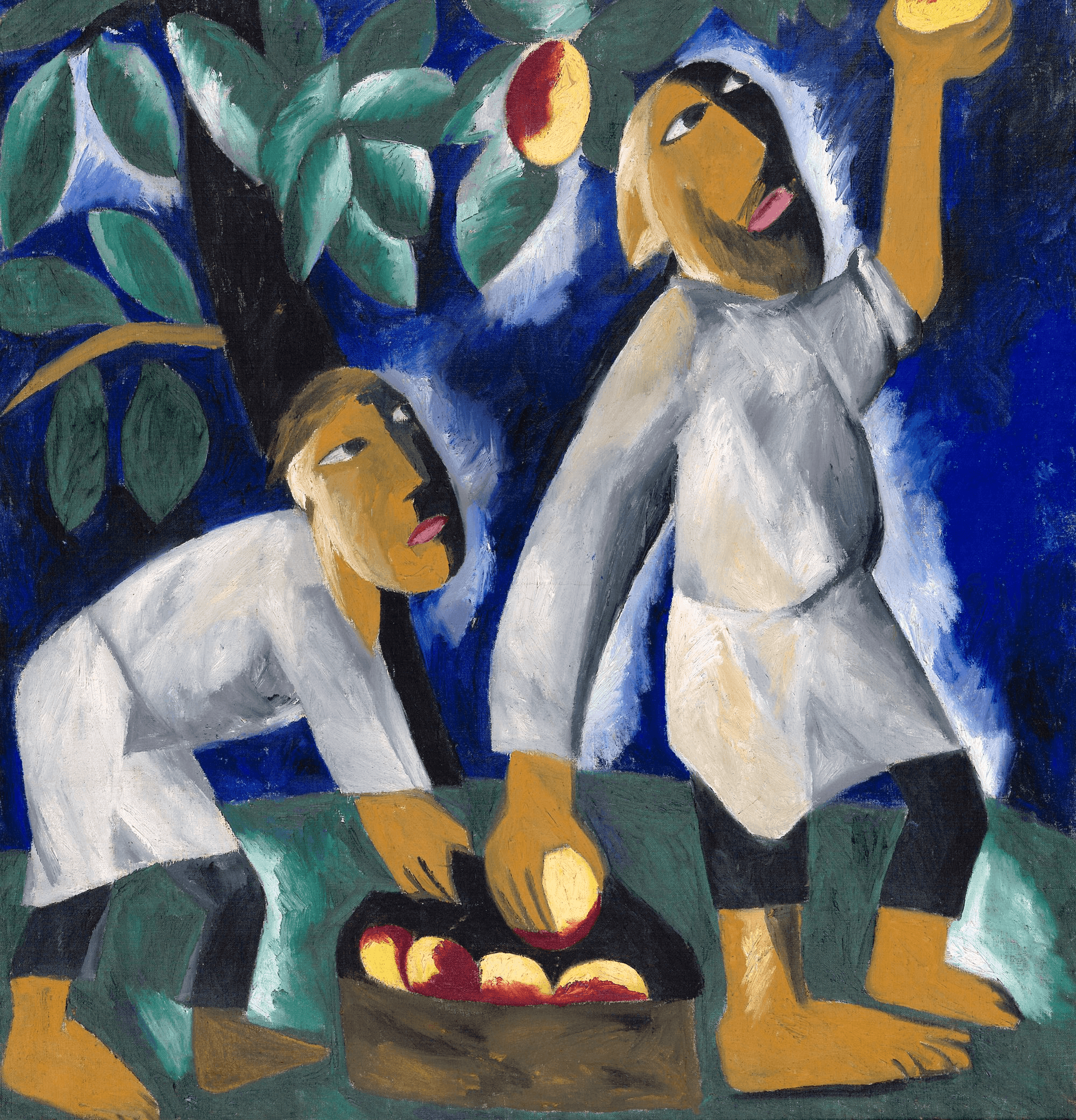
Picking Apples (1909) — a party of peasants gathered around an apple tree, with figures simplified and cubist, reminiscent of carved wooden dolls — formally classical in harmony but striking in its Fauvist blues and pinks. One critic called it “like a scene from Chekhov, reimagined by Matisse.” Sold for $9.8 million in 2007, a record at the time for a female artist.
Peasants Picking Apples (1911) — the mask-like faces of the monumental figures relate to Scythian stone figures she’d seen in southern Russia. Worth flagging the layered meaning here: because the women are picking apples and there’s one male/female couple present, the painting evokes Adam and Eve — the women reaching for the forbidden fruit that led to humanity’s banishment from Eden. She’d painted Pillars of Salt the year before, on Lot’s wife looking back at Sodom against orders. The message in both is rebellion — women who cannot be controlled by patriarchal hierarchy. That’s a genuinely sharp reading — she’s smuggling feminist defiance into ostensibly wholesome peasant-harvest imagery.
The Harvest: Composition in Nine Parts (1911) — nine paintings containing imagery from the Book of Revelation, paired with Peasants Dancing, where the dancing peasants become, in effect, earthly saints. A monumental work, today usually shown with seven of the nine panels surviving.
Deity of Fertility (1909–10) — a cubist female nude in a cool blue palette, confiscated by police in 1910. This is the painting that triggered her pornography trial.
Religious / icon work (1910–1911) :
The Evangelists (1911) — the single most contested painting of her career. It melds the religious style of icons with rebellious Cubo-Futurist elements — bold color and blocked abstraction. Censors removed it from a 1912 group exhibition; the full polyptych delighted audiences in London in 1912 but shocked St. Petersburg when it was pulled from display there in 1914. The censor’s objections were threefold: the title of the exhibition it hung in (“Donkey’s Tail”), the blending of sacred and profane imagery, and the taboo against women painting icons at all. Her own defense of the work, in her own words, is worth keeping as a direct quote candidate: “People say that the looks of my icons is not that of the ancient icons. But which ancient icons? Russian, Byzantine, Ukrainian, Georgian? Icons of the first centuries, or of more recent times after Peter the Great? Every nation, every age, has a different style.” She’s not apologizing for innovation — she’s arguing that “ancient icon style” was never one fixed thing to begin with, so hers is just the next entry in a tradition of variation, not a violation of it. The formal choice that makes the painting genuinely radical, beyond style: she left the apostles’ scrolls blank, as if the gospels have yet to be written for a new era — the evangelists themselves appear confused and lost in thought, rather than serene bearers of settled truth. That’s a striking move for someone the sources describe as a sincere believer — she’s painting apostles who don’t yet know what they’re going to say.

Cyclist (1913) — her best-known Futurist work, explicitly built for comparison with the Italian movement: it’s paired in retrospectives with Boccioni’s Dynamism of a Cyclist to let viewers trace the analogies and differences between Italian and Russian Futurism. This is the piece that put her, rather than Larionov, at the center of Russia’s Futurist conversation.
Co-developed with Larionov, but contemporaries gave her the edge in actual execution — recall the earlier detail that she was hailed as “the artist with the richest paints” and became Rayonism’s most active practitioner even though Larionov is credited as its inventor.
The 1913 retrospective
Worth treating almost as its own “work”: over 800 works shown at the Art Salon on Bolshaya Dmitrovka Street — the first monographic exhibition ever given to a member of the Russian avant-garde. Over 12,000 people visited; 31 works sold. Weeks before it opened, she and fellow artists paraded through Moscow with hieroglyphic face paint, having tipped off journalists in advance so photographers and crowds would be waiting — the body-painting wasn’t separate from the art career, it was the marketing campaign for it.
Mystical Images of War — a series of lithographs, her last Russian work before emigrating, picturing the tragedy and patriotism of war through deliberately simplified, widely distributable compositions.
Paris-era design work (1914–1962)
The long second career: costume and set design for Le Coq d’Or (1914), The Firebird, Liturgy (designed but never staged — Stravinsky was attached to score it), work for the House of Myrbor fashion house, and the monumental triptych Bathers (1922).
Kazimir Malevich (1879–1935)
Completely different social origin from the other two — this is the load-bearing fact about him. Born in 1878 to a Polish Catholic family who were essentially refugees, having fled Poland after the failed 1863 January Uprising against the Tsarist army. His father worked in sugar factories and railway construction, so the family moved constantly around Ukraine, sometimes living in the middle of sugar-beet plantations. Kazimir was the oldest of fourteen children, only nine of whom survived to adulthood, and in his early life he had little or no contact with art — he himself worked in railway construction for a time. No nobility, no priesthood lineage, no Moscow art-school networking from birth — he had to claw his way into the room that Larionov and Goncharova were born adjacent to. The move to Moscow let him study at the Stroganov School and take private lessons, then train at the Moscow School of Painting, Sculpture and Architecture, where he absorbed Impressionist and Post-Impressionist technique before Symbolism and Art Nouveau redirected him. After a 1912 trip to Paris he came under the influence of Picasso and Cubism, and as a member of the Jack of Diamonds group he became a leader of the Russian Cubist movement.
The three met at an exhibition wall, not a classroom: at the Moscow Association of Artists exhibition in 1907, Malevich’s paintings hung alongside the canvases of two other Moscow School students about to become avant-garde leaders — Larionov and Goncharova — together with works by Kandinsky and Vladimir Burliuk. The Malevich Society’s version confirms it from his side: in 1907 he showed at the Moscow Association of Artists exhibition alongside Burliuk, Kandinsky, and Aleksei Morgunov, and also became friends with Goncharova and Larionov, who would go on to become the acknowledged leaders of the Russian avant-garde just before WWI. All of these artists were from the south — Kandinsky grew up in Odessa too — so there’s a shared “provincial outsider in Moscow” identity binding the group initially, even though Malevich’s poverty was on a different level from Larionov’s modest-but-stable medical family or Goncharova’s landed nobility.
Malevich didn’t exhibit widely until Jack of Diamonds, but he absorbed the neoprimitivism of Larionov and Goncharova around him — exploring the same icon and lubok-derived themes, emulating Gauguin’s forms and Matisse’s colors (which he, like them, saw in Shchukin’s collection), and giving his peasants the elongated features borrowed from Picasso’s interest in African and Oceanic masks. So for a stretch, Malevich is genuinely painting in their visual language, not just standing near it. Under the direct influence of Goncharova and Larionov, Malevich developed a Neo-Primitivist style — planar compositions, dark outlines, crudely applied pigment — clearly derived from the lubok woodcut and ancient Russian icons. They all show together repeatedly: Jack of Diamonds (1910–11), then Donkey’s Tail (1912), then Target (1913). Larionov + Goncharova are one unit, bonded by school and romance since 1900; Malevich joins their orbit seven years later through a shared exhibition wall, genuinely absorbs and imitates their visual language for several years — then quietly finds a different French source (Léger, not Boccioni) and starts walking away from the very style he’d been practicing alongside them.🌻